
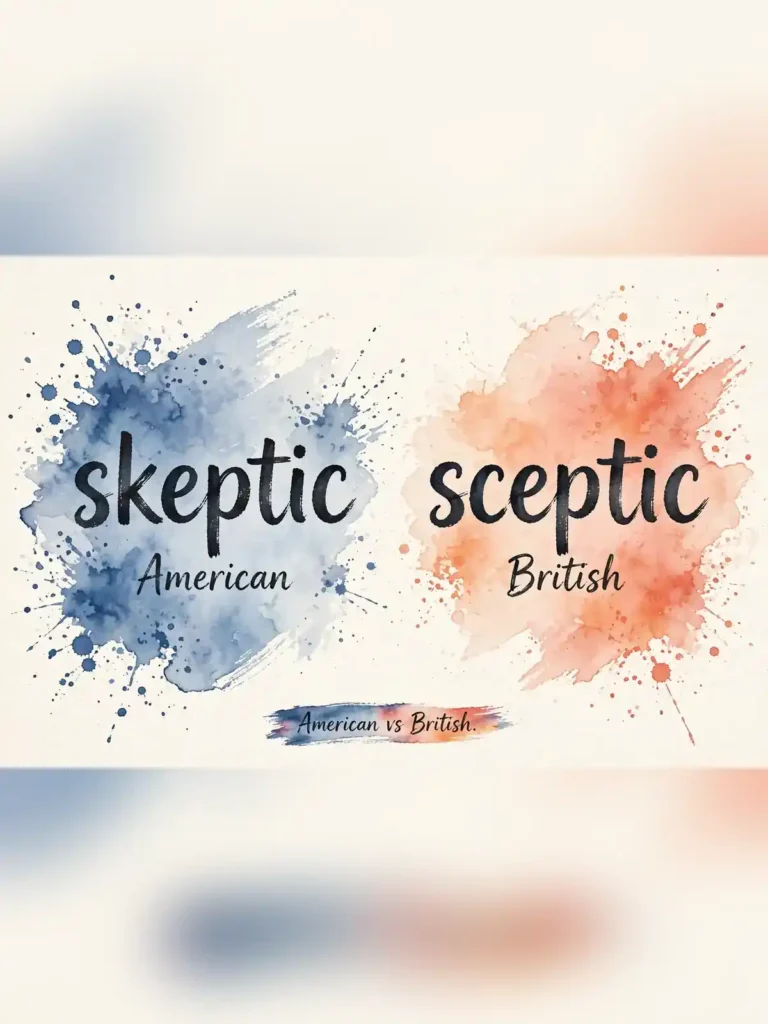
Skeptic or sceptic? The answer depends on which side of the Atlantic your reader sits. This complete guide breaks down the difference between skeptic and sceptic with clear rules, real examples, and simple memory tricks.
This is one of those questions that strikes mid-writing. You are typing an email or finishing homework, and you freeze: which one is it? Guessing is risky, because readers — especially teachers and hiring managers — notice the wrong choice.
Below you will find everything in one place: a quick answer for when you are in a hurry, the origin of both forms, how American and British English handle them, common mistakes with corrections, and plenty of real examples. It is the complete guide to getting this pair right.
Skeptic or Sceptic – Main Difference
‘Skeptic’ is the American English spelling of the noun for a doubter. ‘Sceptic’ is the British English spelling of the same noun, with the identical meaning. Simple rule: Both spellings are correct; match the one your reader expects. Use skeptic for American readers and sceptic for British readers.
Two quick examples: “He is a skeptic.” and “He is a sceptic.”.
Memory trick: Americans are ‘skeptics’ with a ‘k.’ The British are ‘sceptics’ with a ‘c’ — like ‘sceptre.’
One-line definitions:
- Skeptic: the American English spelling of the noun for a doubter.
- Sceptic: the British English spelling of the same noun, with the identical meaning.
The Origin of Skeptic or Sceptic
The Shared Origin
Both spellings share a single history. The word comes from the Greek ‘skeptikos,’ inquiring. British English kept the Greek ‘sc’ spelling.
America simplified it to ‘sk.’ The meaning — one who doubts — is the same. Philosophy and science use it constantly.
For centuries, English spelling was fluid — Shakespeare spelled his own name several ways. Standardization came late, and it came differently in London and New York.
How the Spelling Split Happened
The split came later, and it was about politics as much as language. Science writing crosses borders. ‘Skeptic’ versus ‘sceptic’ is a visible difference in the middle of the word. Each looks misspelled to the other side’s readers.
Noah Webster’s dictionary of 1828 locked in the American forms. British publishers, proud of their own tradition, declined to follow.
How Usage Evolved
As publishing went global, the two spellings began appearing side by side on the same screen. Readers now meet skeptic and sceptic in a single day. The split survives because each region teaches its own form as the only correct one.
Spelling reformers have proposed unifying such pairs for two centuries. None has succeeded. The regional forms are now a stable feature of world English, not a problem to solve.
British English vs American English Spelling
This is the heart of the skeptic versus sceptic question. The meaning is identical on both sides of the Atlantic; only the spelling changes. American English standardized one form, and British English kept the other.
How Each Region Spells It
American style — from newspapers to schools — teaches skeptic as the only correct form. British, Canadian, and Australian style teach sceptic. International organizations usually pick one and note it in their style guide. Once you know the regional rule, the choice becomes automatic.
Examples in Context
An American student writes skeptic; a British student writes sceptic. Both are right at home. The examples below show the same sentence in each region’s spelling. In speech the two forms are indistinguishable; only writing reveals the choice.
For example: “The skeptics doubted.” and “A climate skeptic.”.
| Feature | American English | British English |
|---|---|---|
| Spelling | Skeptic | Sceptic |
| Meaning | Same | Same |
| Example | He is a skeptic. | He is a sceptic. |
Keep the table’s pattern in mind: one meaning, two regional spellings. Match the column to your reader and the choice is made.
Steal or Steel: Meaning, Difference, and Examples
Which Spelling Should You Use?
Here the choice is genuinely regional. Neither spelling is wrong; each is right in its home territory. Match your spelling to your reader, and be consistent within each document.
1. For American English
Use skeptic. American schools, publishers, and style guides all standardize on this form. If your reader is in the United States, skeptic is the expected — and only — choice.
American copyeditors will change sceptic to skeptic on sight.
2. For British and Commonwealth English
Use sceptic. British, Canadian, Australian, and most Commonwealth publishers standardize on this form. If your reader is in London, Toronto, or Sydney, sceptic is correct.
British copyeditors will change skeptic to sceptic on sight.
3. For Formal and Professional Writing
Follow the house style. Universities, journals, and companies usually declare a regional standard — check it and obey it. When no guide exists, match the country of the institution you are writing for.
Academic journals state their regional standard in the author guidelines.
4. For a Global Audience
Pick the region of your largest audience and use it everywhere in the piece. Mixing skeptic and sceptic in one document looks careless even though both are correct. Consistency is the real rule for global readers.
For mixed audiences, add a style note naming your chosen spelling.
Common Mistakes with Skeptic or Sceptic
The same six mix-ups appear in inboxes and essays everywhere. Study each pair — wrong versus right — and the pattern behind it will stick.
Mistake 1: “In American English: a climate sceptic.”
Wrong: In American English: a climate sceptic.
Correct: In American English: a climate skeptic.
American style: skeptic.
Mistake 2: “In British English: a climate skeptic.”
Wrong: In British English: a climate skeptic.
Correct: In British English: a climate sceptic.
British style: sceptic.
Mistake 3: “The US journal’s sceptics.”
Wrong: The US journal’s sceptics.
Correct: The US journal’s skeptics.
American journals use ‘k.’
Mistake 4: “The UK paper’s skeptics.”
Wrong: The UK paper’s skeptics.
Correct: The UK paper’s sceptics.
British papers use ‘c.’
Mistake 5: “Skepticism (US).”
Wrong: Skepticism (US).
Correct: Skepticism is correct in America.
The noun follows the same rule.
Mistake 6: “Scepticism (UK).”
Wrong: Scepticism (UK).
Correct: Scepticism is correct in Britain.
Keep the word family consistent.
Mistake 7: “He is a sceptic.”
Wrong: He is a sceptic.
Correct: He is a skeptic.
In American English the standard spelling is ‘skeptic’. ‘sceptic’ is the British form and looks like an error to American readers.
Mistake 8: “He is a skeptic.”
Wrong: He is a skeptic.
Correct: He is a sceptic.
In British English the standard spelling is ‘sceptic’. ‘skeptic’ is the American form and looks like an error to British readers.
Skeptic or Sceptic in Everyday Examples
Real sentences beat abstract rules. Here is how skeptic and sceptic show up across daily life.
In Emails
- Healthy skepticism.
- The skeptics doubted.
- A climate skeptic.
In News Articles
- He is a sceptic.
- Healthy scepticism.
On Social Media
- The sceptics doubted.
- A climate sceptic.
- In American English: a climate skeptic.
In Formal Writing
- In British English: a climate sceptic.
- The US journal’s skeptics.
In Customer Service Chats
- The UK paper’s sceptics.
- Skepticism is correct in America.
- Scepticism is correct in Britain.
In Job Applications
- He is a skeptic.
- Healthy skepticism.
Skeptic or Sceptic – Google Trends & Usage Data
Search interest in skeptic versus sceptic maps neatly onto the world’s English regions. The pattern is stable and predictable — described here qualitatively, without invented figures.
Which Spelling People Search More
Searches spike around school terms and publishing deadlines. Most queries ask which spelling is “correct” — a question with a regional answer. Learners in each region mostly search their own form, then discover the other exists.
Regional Interest
Skeptic dominates searches from the United States, while sceptic dominates in the United Kingdom, Canada, and Australia. International schools show a mix, reflecting mixed student bodies. The divide follows the classroom, not the dictionary.
How Usage Is Changing
Neither spelling is gaining global ground at the other’s expense. American media keeps skeptic firmly planted; British institutions keep sceptic. The only real trend is awareness: more writers now know both forms exist, which is progress in itself.
Bottom line: the regional pattern is not going anywhere. Searches will keep splitting along the same lines for years to come. Knowing which side your reader is on settles every query before it begins.
Stationary or Stationery: The Difference Made Simple
Skeptic or Sceptic: Side-by-Side Comparison
One last look at skeptic and sceptic, side by side. Find your situation in the left column, then read across.
| Feature | Skeptic | Sceptic |
|---|---|---|
| Meaning | ‘Skeptic’ is the American English spelling of the noun for a doubter | ‘Sceptic’ is the British English spelling of the same noun, with the identical meaning |
| Status | American spelling | British spelling |
| Example | He is a skeptic. | He is a sceptic. |
FAQs About Skeptic or Sceptic
1. What is the difference between skeptic and sceptic?
‘Skeptic’ is the American English spelling of the noun for a doubter. ‘Sceptic’ is the British English spelling of the same noun, with the identical meaning. In short: they are two separate words with two separate jobs. Mixing them changes your meaning, so learn the distinction once and use it forever.
2. Which is correct: skeptic or sceptic?
Both are correct — skeptic in American English and sceptic in British English. Neither is a misspelling. Choose the one your reader expects, and use it consistently through your document. Keep this answer handy for the next time you hesitate.
3. How can I remember the difference between skeptic and sceptic?
Americans are ‘skeptics’ with a ‘k.’ The British are ‘sceptics’ with a ‘c’ — like ‘sceptre.’ Say it to yourself each time you hesitate. After a few uses, the right choice becomes automatic — tricks work because they attach the rule to something vivid.
4. Why do people confuse skeptic and sceptic?
Science writing crosses borders. ‘Skeptic’ versus ‘sceptic’ is a visible difference in the middle of the word. Each looks misspelled to the other side’s readers.
The confusion is so common that it has its own search traffic — you are far from alone. The fix is a single clear rule, which this guide gives you.
5. Can I use skeptic and sceptic interchangeably?
In a loose sense, yes — readers will understand either. But careful writing picks one form per document. Mixing skeptic and sceptic looks inconsistent even when both are technically fine. Keep this answer handy for the next time you hesitate.
6. What is the most common mistake with skeptic and sceptic?
Writing “In American English: a climate sceptic.” when the correct form is “In American English: a climate skeptic..” American style: skeptic. This single error accounts for a large share of all skeptic/sceptic mix-ups.
7. Will spellcheck catch the skeptic/sceptic mistake?
No — and that is exactly why this pair is dangerous. Both skeptic and sceptic are valid words, so no spellchecker will flag the swap. Only your knowledge of the difference catches it.
8. Which is more commonly used: skeptic or sceptic?
In global text, skeptic appears more often — American English dominates the web. But in British publishing, sceptic is the standard. ‘More common’ depends entirely on whose shelf you are reading. File it with the small rules that make writing sharp.
9. Is sceptic correct in American English?
No — American style guides standardize on skeptic. Using sceptic in a US document will be marked as a spelling error. Save sceptic for British and Commonwealth readers.
10. Do I need to change skeptic to sceptic for a British audience?
Yes, for polished writing. A British reader understands skeptic, but sceptic is the expected form. Localizing the spelling is a small touch that signals care.
11. Which spelling should I use in international documents?
Follow the organization’s style guide. If none exists, use the spelling of your primary audience’s region — and use it consistently from title to signature.
12. Will skeptic and sceptic ever merge into one spelling?
Unlikely. Both regional standards are stable, taught in schools, and enforced by publishers. Spelling reformers have proposed unifying such pairs for two centuries without success.
Learn your reader’s form and move on. Once learned, this distinction rarely needs relearning.
Conclusion: Skeptic or Sceptic
The skeptic versus sceptic question looks small, but it sits at the heart of clear writing. ‘Skeptic’ is the American English spelling of the noun for a doubter. ‘Sceptic’ is the British English spelling of the same noun, with the identical meaning. One test — meaning, region, or grammar, depending on the pair — settles it every time.
Keep the memory trick close: Americans are ‘skeptics’ with a ‘k.’ The British are ‘sceptics’ with a ‘c’ — like ‘sceptre.’ Tricks like this survive because they turn a rule into a reflex. Use it deliberately for a week, and the right form will start choosing itself. Writers who master a few such tricks rarely second-guess themselves again.
Final advice: slow down on exactly these two words. They are the kind of pair that spellcheckers ignore and readers notice. A two-second check now saves an embarrassing correction later — and every correct use makes the next one easier.
If you remember nothing else, remember this: Both spellings are correct; match the one your reader expects. That single sentence covers nearly every real-world case. And the next time skeptic and sceptic make you pause mid-sentence, you will know exactly what to do.

Victor Penhall is an English grammar specialist and writing coach, helping learners strengthen their language skills with clear rules, smart tips, and precise guidance.
Pingback: Sight vs. Site: Seeing Something or a Place?