
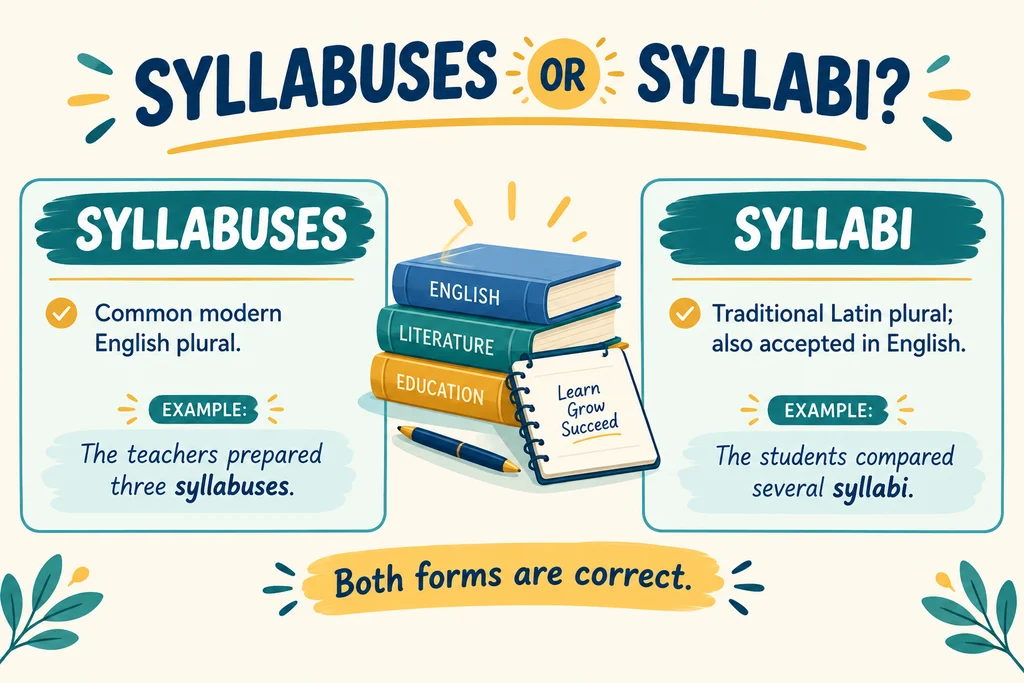
Choosing between syllabuses and syllabi can be confusing, especially when writing an academic paper, preparing course materials, or emailing a teacher. The good news is that both syllabuses and syllabi are correct plurals of syllabus.
The difference lies in their formation: syllabuses follows the regular English plural rule, while syllabi comes from a traditional Latin-style plural. For example, “The teachers prepared their syllabuses” and “The professor distributed the syllabi” are both grammatically correct. Neither form is inherently more correct than the other, although syllabi is common in academic settings.
Understanding this distinction helps you write confidently without second-guessing your word choice. Below, you’ll find clear definitions, practical examples, usage guidance, and common mistakes to help you decide whether syllabuses or syllabi fits your sentence best.
Syllabuses or Syllabi –Main Difference
‘Syllabuses’ is the regular English plural of ‘syllabus,’ common in general writing. ‘Syllabi’ is the traditional Latin-style plural, preferred in academic writing. Simple rule: Both plurals are accepted; pick one and stay consistent. Use syllabuses in everyday writing and syllabi in formal or technical writing.
Two quick examples: “The syllabuses are online.” and “The syllabi were revised.”.
Memory trick: Professors hand out ‘syllabi.’ Everyone else can say ‘syllabuses.’ Match the plural to the campus or the street.
One-line definitions:
- Syllabuses: the regular English plural of ‘syllabus,’ common in general writing.
- Syllabi: the traditional Latin-style plural, preferred in academic writing.
The Origin of Syllabuses or Syllabi
The Shared Origin
Both plurals grew from the same root. ‘Syllabus’ is actually a Latin misreading of a Greek word for a label. Universities adopted it in the 1600s for course outlines.
The Latin-style plural ‘syllabi’ came with academic use. General writing built the English plural ‘syllabuses.’ Academia still favors ‘syllabi.’
English inherited a drawer full of Latin plurals and never fully tidied it. Some words kept only the Latin form; this one kept both.
How Two Plurals Survived
The second plural arrived through a different door. Education straddles academic and general audiences. Course catalogs use ‘syllabi’; student guides use ‘syllabuses.’ Both are correct, so the audience decides.
The traditional plural survives wherever precision matters most — laboratories, lecture halls, and law books. Everyday speech chose the simpler path.
How Usage Evolved
Dictionaries list both plurals, and style guides split their advice. The result is a stable standoff: syllabuses dominates everyday writing while syllabi holds the formal ground. Neither side is retreating.
Language rarely keeps two forms this long without a reason. Here the reason is register: formal and everyday English simply prefer different tools for the same job.
British English vs American English Spelling
Both plurals appear on both sides of the Atlantic, but the preference tilts by region and by field. American everyday writing leans toward syllabuses. British and academic writing lean toward syllabi.
How Each Region Spells It
American publications generally prefer syllabuses, the regular English plural. British and academic publications more often use syllabi, the traditional form. Scientific journals on both sides tend to favor syllabi. Once you know the regional rule, the choice becomes automatic.
Examples in Context
A nature blog might use syllabuses while a research paper uses syllabi — sometimes in the same week. The examples below show each plural in its natural habitat. In speech the two forms are indistinguishable; only writing reveals the choice.
For example: “Download the syllabuses.” and “New syllabuses posted.”.
| Feature | Syllabuses | Syllabi |
|---|---|---|
| Type | English plural | Traditional plural |
| Best for | Everyday writing | Formal writing |
| Example | The syllabuses are online. | The syllabi were revised. |
Both columns of the table are correct — the choice is stylistic. Pick the column your audience expects and stay in it.
Which Spelling Should You Use?
Both plurals are legitimate, so the choice is about audience and tone. The four situations below show which plural fits where.
1. For American English
Prefer syllabuses. American everyday writing — news, blogs, business — generally uses the regular English plural. Your American reader will find syllabuses natural and unremarkable.
American newsrooms overwhelmingly prefer syllabuses.
2. For British and Commonwealth English
Prefer syllabi in academic and formal British contexts. Universities and journals lean toward the traditional plural. A British academic reader expects syllabi.
British universities overwhelmingly prefer syllabi.
3. For Formal and Professional Writing
Match your field. Science, medicine, and law usually keep the traditional syllabi. General business and media writing usually take syllabuses.
When a style guide speaks, obey it. Your field’s leading journal is the best tiebreaker.
4. For a Global Audience
Pick one plural for the whole document and never switch. A global audience accepts either form — what it notices is inconsistency, not your choice. Switching plurals mid-document confuses every reader.
That Or. Which: When to Use Each Word
Common Mistakes with Syllabuses or Syllabi
Most syllabuses/syllabi errors fall into a few repeat patterns. Each mistake below shows the wrong version, the corrected version, and why the fix works. Scan for the one you make.
Mistake 1: “The journal used syllabuses.”
Wrong: The journal used syllabuses.
Correct: The journal used syllabi is the academic choice.
Academic writing prefers ‘syllabi.’
Mistake 2: “The student guide said syllabi.”
Wrong: The student guide said syllabi.
Correct: The student guide said syllabuses is the plainer choice.
For students, ‘syllabuses’ reads naturally.
Mistake 3: “Faculty approved the syllabuses.”
Wrong: Faculty approved the syllabuses.
Correct: Faculty approved the syllabi.
Faculty settings take ‘syllabi.’
Mistake 4: “Download the syllabi.”
Wrong: Download the syllabi.
Correct: Download the syllabuses is fine generally.
General contexts accept ‘syllabuses.’
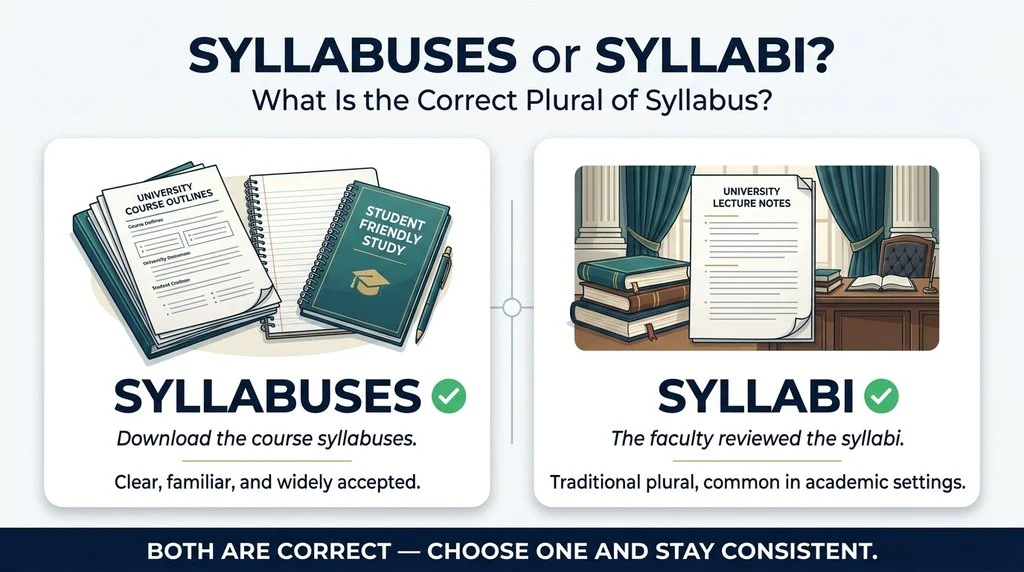
Mistake 5: “Mixing syllabuses and syllabi in one catalog.”
Wrong: Mixing syllabuses and syllabi in one catalog.
Correct: Pick one plural throughout.
Consistency matters most.
Mistake 6: “The syllabi’s dates.”
Wrong: The syllabi’s dates.
Correct: The syllabi’s dates is correct.
Both plurals form possessives normally.
Mistake 7: “The syllabi are online.”
Wrong: The syllabi are online.
Correct: The syllabuses are online.
This document uses the everyday plural ‘syllabuses’. Switching to ‘syllabi’ mid-text breaks consistency.
Mistake 8: “The syllabuses were revised.”
Wrong: The syllabuses were revised.
Correct: The syllabi were revised.
This document uses the traditional plural ‘syllabi’. Switching to ‘syllabuses’ mid-text breaks consistency.
Syllabuses or Syllabi in Everyday Examples
Real sentences beat abstract rules. Here is how syllabuses and syllabi show up across daily life.
In Emails
- The syllabi were revised.
- Faculty approved the syllabi.
- The syllabi differ.
In News Articles
- Review the syllabi.
- The journal used syllabi is the academic choice.
On Social Media
- The student guide said syllabuses is the plainer choice.
- Faculty approved the syllabi.
- Download the syllabuses is fine generally.
In Formal Writing
- Pick one plural throughout.
- The syllabi’s dates is correct.
In Academic Writing
- The syllabuses are online.
- Two syllabuses compared.
- Download the syllabuses.
In School Essays
- New syllabuses posted.
- The syllabi were revised.
Syllabuses or Syllabi – Google Trends & Usage Data
Searches for syllabuses versus syllabi reveal a split audience: everyday writers and specialists looking for different answers. The qualitative pattern is clear.
Which Plural People Search More
The everyday syllabuses gets broader search volume; the traditional syllabi gets deeper, more anxious searches — “which plural is correct?” Both questions have the same honest answer: both are accepted, and context decides.
Regional and Field Differences
American general writing favors syllabuses. Academic and scientific writing on both sides of the Atlantic favors syllabi. British formal writing leans traditional as well.
The field you write in predicts your plural better than your postcode does.
How Usage Is Changing
The regular syllabuses is slowly gaining ground as specialist vocabulary goes mainstream. But syllabi is not retreating from its strongholds — journals and universities hold firm. Expect both plurals to coexist indefinitely.
Bottom line: both plurals are here to stay, and searches reflect that stable split. Pick your form by audience, stay consistent, and never think about it again.
Then vs. Than: Time or Comparison?
Syllabuses or Syllabi: Side-by-Side Comparison
One last look at syllabuses and syllabi, side by side. Find your situation in the left column, then read across.
| Feature | Syllabuses | Syllabi |
|---|---|---|
| Meaning | ‘Syllabuses’ is the regular English plural of ‘syllabus,’ common in general writing | ‘Syllabi’ is the traditional Latin-style plural, preferred in academic writing |
| Status | Everyday plural | Traditional plural |
| Example | The syllabuses are online. | The syllabi were revised. |
FAQs About Syllabuses or Syllabi
1. What is the difference between syllabuses and syllabi?
‘Syllabuses’ is the regular English plural of ‘syllabus,’ common in general writing. ‘Syllabi’ is the traditional Latin-style plural, preferred in academic writing. In short: they are two separate words with two separate jobs. Mixing them changes your meaning, so learn the distinction once and use it forever.
2. Which is correct: syllabuses or syllabi?
Both are correct. Syllabuses is the everyday English plural; syllabi is the traditional plural preferred in formal and technical writing. Pick the one that fits your audience and stay consistent. A two-second check here prevents a lasting wrong impression.
3. How can I remember the difference between syllabuses and syllabi?
Professors hand out ‘syllabi.’ Everyone else can say ‘syllabuses.’ Match the plural to the campus or the street. Say it to yourself each time you hesitate. After a few uses, the right choice becomes automatic — tricks work because they attach the rule to something vivid.
4. Why do people confuse syllabuses and syllabi?
Education straddles academic and general audiences. Course catalogs use ‘syllabi’; student guides use ‘syllabuses.’ Both are correct, so the audience decides. The confusion is so common that it has its own search traffic — you are far from alone. The fix is a single clear rule, which this guide gives you.
5. Can I use syllabuses and syllabi interchangeably?
In a loose sense, yes — readers will understand either. But careful writing picks one form per document. Mixing syllabuses and syllabi looks inconsistent even when both are technically fine. Once learned, this distinction rarely needs relearning.
6. What is the most common mistake with syllabuses and syllabi?
Writing “The journal used syllabuses.” when the correct form is “The journal used syllabi is the academic choice..” Academic writing prefers ‘syllabi.’ This single error accounts for a large share of all syllabuses/syllabi mix-ups.
7. Will spellcheck catch the syllabuses/syllabi mistake?
No — and that is exactly why this pair is dangerous. Both syllabuses and syllabi are valid words, so no spellchecker will flag the swap. Only your knowledge of the difference catches it.
8. Which is more commonly used: syllabuses or syllabi?
Syllabuses is more common in everyday writing; syllabi dominates academic and technical writing. Each is ‘more common’ in its own world. Once learned, this distinction rarely needs relearning.
9. Which plural do style guides prefer?
Most general style guides accept both but lean toward syllabuses for everyday text. Academic and scientific guides prefer syllabi. Check your publication’s guide — it likely has a ruling.
10. Is syllabi wrong?
No. Syllabi is a fully legitimate plural with a long history. It is the preferred form in formal and technical writing. Use it with confidence where it fits.
11. Which plural should students use?
Use syllabi in academic work — teachers and examiners expect the traditional form. Use syllabuses in casual writing. When unsure, syllabi is the safer academic choice.
12. Can I just always use syllabuses?
In everyday writing, yes — syllabuses is widely accepted and never wrong there. But in academic or technical writing, syllabi is expected, and using syllabuses can look uninformed. Match the plural to the setting. This is exactly the kind of detail careful readers notice.
Conclusion: Syllabuses or Syllabi
Clear writing is built from small correct choices, and syllabuses versus syllabi is one of the most-searched choices in English. ‘Syllabuses’ is the regular English plural of ‘syllabus,’ common in general writing. ‘Syllabi’ is the traditional Latin-style plural, preferred in academic writing. Hold those two facts apart and the pair stops being scary.
Remember the simple version: Both plurals are accepted; pick one and stay consistent. When you are in a hurry, that one line is enough. When you have time, the meaning test behind it never fails. Simple rules beat long explanations at the moment of writing, which is when you need them most.
Going forward, treat this pair as a solved problem. You have the history, the rule, the trick, and the examples. All that remains is practice — and every correct use writes the rule a little deeper into memory.
If you remember nothing else, remember this: Both plurals are accepted; pick one and stay consistent. That single sentence covers nearly every real-world case. And the next time syllabuses and syllabi make you pause mid-sentence, you will know exactly what to do.

Elias Worden is a trusted grammar expert and writing mentor, dedicated to simplifying English rules and helping learners write with clarity, precision, and confidence.
Pingback: Straight vs. Strait: How to Remember Which Is Which
Pingback: Story or Storey? One Is a Tale, One Can Be a Floor