
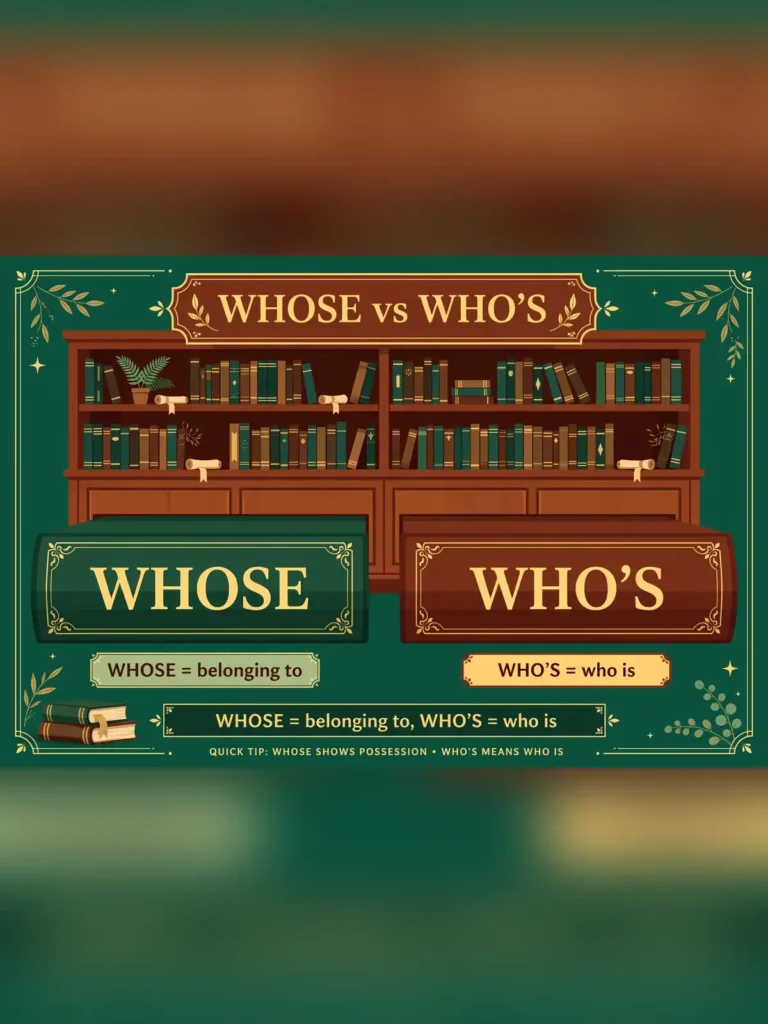
Whose and who’s sound alike, but they do not mean the same thing. Whose shows ownership or asks who something belongs to, while who’s is a contraction of who is or who has. For example, “Whose phone is on the table?” asks about ownership, whereas “Who’s on the phone?” means “Who is on the phone?” This small apostrophe can change the meaning of a sentence, making the two words easy to confuse in texts, emails, and everyday writing.
Here’s a simple way to choose correctly: replace who’s with who is or who has. If the replacement fits the sentence grammatically, who’s is the right choice. For example, “Who’s finished the task?” means “Who has finished the task?” If you are asking who owns something, use whose, as in “Whose bag is this?” In this guide, you’ll learn the difference between whose and who’s, see practical examples, and discover an easy trick to avoid this common English grammar mistake.
Whose or Who’s – Main Difference
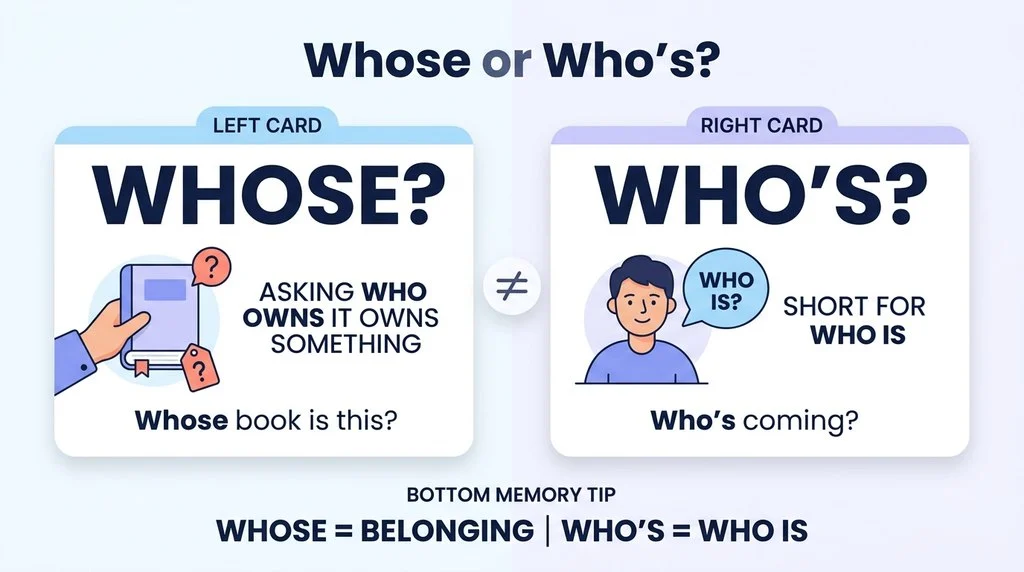
‘Whose’ is the possessive — belonging to whom. “Who’s” is the contraction of ‘who is’ or ‘who has.’ Simple rule: Check the meaning before you choose — the two words are never interchangeable. When you hesitate, stop and ask which meaning your sentence needs — that single question resolves nearly every case.
Two quick examples: “Whose book is this?” and “Who’s there?”.
Memory trick: Expand it: if ‘who is’ fits, write “who’s.” If not, write ‘whose.’ The possessive ‘whose’ is like ‘his’ — no apostrophe.
One-line definitions:
- Whose: the possessive — belonging to whom.
- Who’s: “Who’s” is the contraction of ‘who is’ or ‘who has.
The Origin of Whose or Who’s
Where Whose Comes From
To use whose with confidence, it helps to know where it came from. ‘Whose’ is the possessive form, like ‘his’ and ‘hers’ — no apostrophe. “Who’s” is a contraction, like “it’s” and “don’t.” The apostrophe marks missing letters, not ownership.
Same trap as its/it’s.
Early dictionaries listed the two words pages apart, yet readers still mixed them. The spelling preserved a distinction that speech had already blurred.
Where Who’s Comes From
Who’s took a different road into English. The apostrophe usually marks possession, so ‘whose’ looks wrong without one. “Who’s” is common in speech. The pair is the who-version of the its/it’s confusion.
Writers have wrestled with this pair for as long as both words have existed. Each generation rediscovers the confusion — and the fix.
Why the Confusion Started
Over time, whose and who’s started appearing in the same kinds of sentences — warnings, instructions, descriptions. The shared letters did the rest. Today most mix-ups happen in fast writing, not from lack of knowledge.
Dictionaries keep the two entries strictly separate, and good writing follows their lead. The confusion is a habit, not a rule — and habits can be replaced.
British English vs American English Spelling
Here is a common surprise: there is no American-versus-British spelling difference between whose and who’s. Both regions spell both words the same way. The real divide is meaning, not geography — and that is exactly what the table below sorts out.
How Each Region Spells It
American dictionaries and British dictionaries list whose and who’s as separate words with separate meanings. No regional variant exists for either. If you see a spelling difference claimed online, it is a myth — the confusion is purely about meaning. Style guides in each region confirm this without exception.
Examples in Context
In a sentence, the test is meaning, not location. An American and a Brit would both write ‘whose’ in one context and ‘who’s’ in the other. The examples below show each word doing its own job. The context decides everything here, exactly as the table shows.
For example: “Whose turn?” and “Whose idea?”.
| Feature | Whose | Who’s |
|---|---|---|
| Meaning | ‘Whose’ is the possessive — belonging to whom | “Who’s” is the contraction of ‘who is’ or ‘who has |
| Example | Whose book is this? | Who’s there? |
| Common error | Writing who’s here | Writing whose here |
The table above is worth a second look before you write. Meaning — not geography — is the whole story for whose and who’s.
Woman vs. Women: How to Use Each Correctly
Which Spelling Should You Use?
Region does not decide this pair — meaning does. The same rule applies in American, British, and global English. Work through the four situations below, and each one points to the right word.
1. For American English
For American English, use whose when your sentence matches its meaning — ‘Whose’ is the possessive — belonging to whom. Use who’s when it matches the other meaning — “Who’s” is the contraction of ‘who is’ or ‘who has. Region changes nothing here; the meaning test decides.
American readers expect the meaning test, not a regional spelling.
2. For British and Commonwealth English
For British and Commonwealth English, exactly the same rule applies. Both words exist in British English with identical meanings. Run the same meaning test, and you will land on the right word every time.
British readers apply the identical meaning test.
3. For Formal and Professional Writing
Formal writing punishes this mix-up more than any other setting. Editors, examiners, and hiring managers all notice it. Slow down on exactly these two words, run the meaning test, and you will be safe.
In exams and job applications, this is one of the most-tested pairs.
4. For a Global Audience
For a worldwide audience, nothing changes: meaning decides, everywhere. One extra tip — if your readers include learners, prefer the clearer sentence structure. Short sentences make the right word obvious.
Global readers forgive many errors, but not a flipped meaning.
Common Mistakes with Whose or Who’s
Most whose/who’s errors fall into a few repeat patterns. Each mistake below shows the wrong version, the corrected version, and why the fix works. Scan for the one you make.
Mistake 1: “Who’s book is this?”
Wrong: Who’s book is this?
Correct: Whose book is this?
‘Who is book’ fails — use ‘whose.’
Mistake 2: “Whose there?”
Wrong: Whose there?
Correct: Who’s there?
‘Who is there’ needs the contraction.
Mistake 3: “The author who’s work.”
Wrong: The author who’s work.
Correct: The author whose work.
Possession: whose.
Mistake 4: “Whose coming?”
Wrong: Whose coming?
Correct: Who’s coming?
‘Who is coming’: who’s.
Mistake 5: “Who’s turn?”
Wrong: Who’s turn?
Correct: Whose turn?
Belonging: whose.
Mistake 6: “Guess whose back.”
Wrong: Guess whose back.
Correct: Guess who’s back.
‘Who is back’: who’s.
Mistake 7: “Who’s idea?”
Wrong: Who’s idea?
Correct: Whose idea?
The sentence needs the meaning of ‘whose’. ‘who’s’ means something else entirely, so the swap changes the message.
Mistake 8: “Whose been here?”
Wrong: Whose been here?
Correct: Who’s been here?
The sentence needs the meaning of ‘who’s’. ‘whose’ means something else entirely, so the swap changes the message.
Wives or Wifes? The Correct Spelling Explained
Whose or Who’s in Everyday Examples
Rules stick when you see them working. These examples place whose and who’s in the settings where you will actually use them.
In Emails
- The author whose work.
- Whose turn?
- Whose idea?
In News Articles
- Who’s there?
- Who’s coming?
On Social Media
- Who’s been here?
- Guess who’s back.
- Whose book is this?
In Formal Writing
- Who’s there?
- The author whose work.
In School Essays
- Who’s coming?
- Whose turn?
- Guess who’s back.
In Academic Writing
- Whose book is this?
- The author whose work.
Whose or Who’s – Google Trends & Usage Data
Search data tells a story about this pair — told here in words, not numbers. What people look up, and where, reveals exactly where the confusion lives.
Which Word People Search More
Searches cluster around the moment of doubt: someone writing a sentence and freezing between whose and who’s. Queries phrased as “which is correct” and “difference between” dominate. That pattern — urgent, practical, mid-writing — is typical of confused-word pairs.
Where the Confusion Is Strongest
Interest is truly global, because the confusion is about meaning rather than region. English learners search it heavily, since classroom teaching rarely separates the two words clearly. Native speakers search it too — usually minutes before hitting send on something important.
How Usage Is Changing
The mix-up is not fading. Fast digital writing — texts, chats, social posts — keeps producing it. If anything, autocorrect makes it worse by accepting both words silently.
The writers who beat it are the ones who learn the meaning test once and reuse it forever.
Bottom line: the searches will keep coming, because the confusion is built into the words themselves. The writers who stop searching are the ones who learned the distinction once — which, if you have read this far, now includes you.
Whose or Who’s: Side-by-Side Comparison
One last look at whose and who’s, side by side. Find your situation in the left column, then read across.
| Feature | Whose | Who’s |
|---|---|---|
| Meaning | ‘Whose’ is the possessive — belonging to whom | “Who’s” is the contraction of ‘who is’ or ‘who has |
| Status | Valid word | Valid word |
| Example | Whose book is this? | Who’s there? |
FAQs About Whose or Who’s
1. What is the difference between whose and who’s?
‘Whose’ is the possessive — belonging to whom. “Who’s” is the contraction of ‘who is’ or ‘who has.’ In short: they are two separate words with two separate jobs. Mixing them changes your meaning, so learn the distinction once and use it forever.
2. Which is correct: whose or who’s?
Both are correct words — but they mean different things. ‘Whose’ is the possessive — belonging to whom. “Who’s” is the contraction of ‘who is’ or ‘who has.’ The ‘correct’ one is whichever matches your intended meaning. Once learned, this distinction rarely needs relearning.
3. How can I remember the difference between whose and who’s?
Expand it: if ‘who is’ fits, write “who’s.” If not, write ‘whose.’ The possessive ‘whose’ is like ‘his’ — no apostrophe. Say it to yourself each time you hesitate. After a few uses, the right choice becomes automatic — tricks work because they attach the rule to something vivid.
4. Why do people confuse whose and who’s?
The apostrophe usually marks possession, so ‘whose’ looks wrong without one. “Who’s” is common in speech. The pair is the who-version of the its/it’s confusion.
The confusion is so common that it has its own search traffic — you are far from alone. The fix is a single clear rule, which this guide gives you.
5. Can I use whose and who’s interchangeably?
No. Whose and who’s do different jobs, and swapping them changes the meaning — sometimes to the exact opposite. Treat them as two separate words that happen to sound alike. Once learned, this distinction rarely needs relearning.
6. What is the most common mistake with whose and who’s?
Writing “Who’s book is this?” when the correct form is “Whose book is this?.” ‘Who is book’ fails — use ‘whose.’ This single error accounts for a large share of all whose/who’s mix-ups.
7. Will spellcheck catch the whose/who’s mistake?
No — and that is exactly why this pair is dangerous. Both whose and who’s are valid words, so no spellchecker will flag the swap. Only your knowledge of the difference catches it.
8. Which is more commonly used: whose or who’s?
They serve different purposes, so frequency comparisons mislead. Each is common in its own context and rare outside it. What matters is not which is popular but which is right for your sentence. A two-second check here prevents a lasting wrong impression.
9. Is who’s correct in American English?
Yes — who’s is a standard English word in America, Britain, and everywhere else. The question is never whether it exists, but whether it means what you intend. “Who’s” is the contraction of ‘who is’ or ‘who has.’
10. What is a simple trick for whose vs who’s?
Expand it: if ‘who is’ fits, write “who’s.” If not, write ‘whose.’ The possessive ‘whose’ is like ‘his’ — no apostrophe. Pair that with the meaning test — swap in a synonym and see which fits — and you will rarely hesitate again.
11. Where does the confusion between whose and who’s come from?
It comes from history: the words grew from related roots and converged in sound. ‘Whose’ is the possessive form, like ‘his’ and ‘hers’ — no apostrophe. The spelling kept them apart even as speech merged them.
12. Are there other confusing pairs like whose and who’s?
Dozens. English is full of lookalike pairs — ‘affect’ and ‘effect,’ ‘complement’ and ‘compliment,’ ‘principal’ and ‘principle.’ The learning method is the same every time: one clear distinction, one memory trick, and practice. A two-second check here prevents a lasting wrong impression.
Conclusion: Whose or Who’s
The whose versus who’s question looks small, but it sits at the heart of clear writing. ‘Whose’ is the possessive — belonging to whom. “Who’s” is the contraction of ‘who is’ or ‘who has. One test — meaning, region, or grammar, depending on the pair — settles it every time.
Keep the memory trick close: Expand it: if ‘who is’ fits, write “who’s.” If not, write ‘whose.’ The possessive ‘whose’ is like ‘his’ — no apostrophe. Tricks like this survive because they turn a rule into a reflex. Use it deliberately for a week, and the right form will start choosing itself. Writers who master a few such tricks rarely second-guess themselves again.
Final advice: slow down on exactly these two words. They are the kind of pair that spellcheckers ignore and readers notice. A two-second check now saves an embarrassing correction later — and every correct use makes the next one easier.
If you remember nothing else, remember this: Check the meaning before you choose — the two words are never interchangeable. That single sentence covers nearly every real-world case. And the next time whose and who’s make you pause mid-sentence, you will know exactly what to do.

Elias Worden is a trusted grammar expert and writing mentor, dedicated to simplifying English rules and helping learners write with clarity, precision, and confidence.
Pingback: Who vs. Whom: The Easy Rule With Examples