
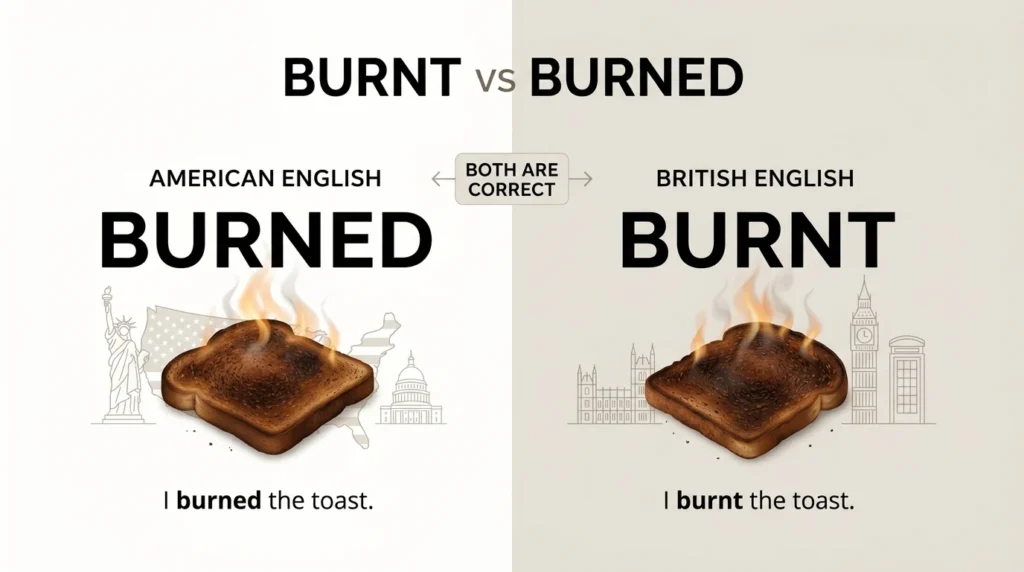
Both burnt and burned are correct forms of the verb burn. The main difference is regional and stylistic preference. Burned is generally more common in American English, while burnt is especially common in British English. However, burnt is also an accepted past-tense and past-participle form in American English.
Both forms can be used as the simple past and past participle of burn. They can also function as adjectives.
So, if you are wondering “Is it burnt or burned?”, the answer is simple: both are correct. Choose the form that best fits your variety of English, audience, and writing style.
Burnt or Burned: What’s the Difference?
Burnt and burned are two accepted forms of the verb burn. They can describe something that has been damaged, destroyed, or changed by fire or extreme heat.
For example:
- I burned the toast.
- I burnt the toast.
- She burned her hand on the pan.
- She burnt her hand on the pan.
- The fire burned all night.
- The fire burnt all night.
In these examples, the basic meaning is the same. The main difference is which form is preferred in a particular variety of English.
Quick comparison
| Form | General usage | Example |
|---|---|---|
| burned | More common in American English; also used in British English | I burned the toast. |
| burnt | Especially common in British English; also accepted in American English | I burnt the toast. |
Is It Burnt or Burned in American English?
In American English, burned is generally the more common choice, especially when burn is being used as an ordinary verb.
Examples include:
- I burned my finger.
- She burned the documents.
- The house burned down.
- He burned the chicken.
- We burned calories during the workout.
However, burnt is not incorrect in American English. Cambridge’s American Dictionary lists burnt as a past-tense and past-participle form of burn.
Burnt is also familiar in American English in adjectival expressions such as:
- burnt toast
- burnt sugar
- burnt paper
- burnt orange
- burnt umber
- burnt sienna
Best choice for American English
If you are writing specifically for a U.S. audience and simply want the most common everyday verb form, choose burned.
But do not treat burnt as a spelling mistake. It is an accepted form.
Is It Burnt or Burned in British English?
In British English, burnt is very common, and burned is also correct.
Examples:
- I burnt the toast.
- She burnt her hand.
- The candle burnt for hours.
- The building burnt down.
- He burnt the old letters.
You can also write:
- I burned the toast.
- She burned her hand.
- The building burned down.
Therefore, it would be incorrect to say that British English allows only burnt. Both forms are accepted, although burnt is particularly characteristic of British usage. Cambridge’s British dictionary gives burnt as the past form and also recognizes burned.
Regional comparison
| Variety of English | Common choice | Example |
|---|---|---|
| American English | burned is generally more common; burnt is also accepted | I burned the toast. |
| British English | burnt is very common; burned is also accepted | I burnt the toast. |
| Australian English | Both forms occur | I burnt/burned the toast. |
| Canadian English | Both forms occur | I burnt/burned the toast. |
| International English | Either can be used | Choose one and stay consistent. |
The safest approach is to follow the spelling conventions of your intended audience or publication.
Burnt or Burned: Past Tense and Past Participle
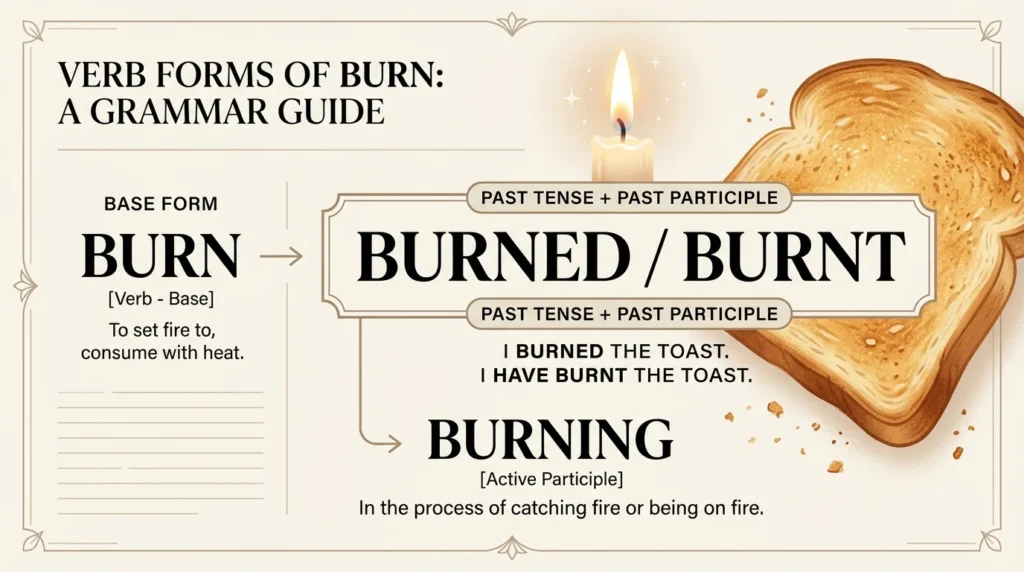
If you are searching for the past tense of burn, both burned and burnt are correct.
| Verb form | Correct form |
|---|---|
| Base form | burn |
| Simple past | burned / burnt |
| Past participle | burned / burnt |
| Present participle | burning |
| Third-person singular | burns |
Simple past
- I burned the candle yesterday.
- I burnt the candle yesterday.
Past participle
- I have burned the toast.
- I have burnt the toast.
Both forms can function as the past tense and past participle of burn. Cambridge explicitly lists burnt or burned for these forms.
When Should You Use Burnt or Burned?
The easiest way to choose is to consider your audience and your English variety.
Use burned when:
- You are writing primarily for an American audience.
- You want the more common American verb form.
- Your publication follows American English conventions.
- Your surrounding spelling follows American conventions such as color, realize, and traveled.
Use burnt when:
- You are writing in British English.
- You prefer the traditional -t form.
- Your surrounding spelling follows British conventions such as colour, realise, and travelled.
- You are using an expression where burnt is especially familiar, such as burnt toast or burnt umber.
Use either when:
- Your audience is international.
- Your style guide accepts both forms.
- You are writing informally and have no regional requirement.
- You are discussing both British and American English.
The most important rule: Be consistent
Neither form is inherently “better.” What matters most is consistency.
For example:
American style:
I burned the toast and burned my finger while making breakfast.
British style:
I burnt the toast and burnt my finger while making breakfast.
You do not have to avoid both forms entirely, but keeping your regional style consistent makes formal writing clearer.
Dreamt or Dreamed: Which Should You Use?
Burnt or Burned in Common Phrases
Burnt or Burned Down
Both forms are correct:
- The old house burned down last night.
- The old house burnt down last night.
Here, burn down is a phrasal verb meaning to destroy something by fire or to be destroyed by fire. Cambridge lists both forms for this expression.
Burnt or Burned Out
Both forms can be used:
- The candle burned out.
- The candle burnt out.
- The engine burned out.
- The engine burnt out.
The choice generally follows the same regional pattern as burned and burnt.
Burnt or Burned Food
Both are correct:
- The food was burned.
- The food was burnt.
When describing food as an adjective, burnt is particularly familiar:
The burnt food smelled awful.
But burned food is also grammatically correct.
Burnt or Burned Toast
Both are possible:
I burned the toast.
I burnt the toast.
As an adjective, both forms can occur:
The burnt toast tasted bitter.
The burned toast tasted bitter.
Burnt toast is especially well established as an adjective phrase. Merriam-Webster specifically notes the strong use of burnt in expressions such as burnt toast.
Burnt or Burned My Hand
Both are correct:
- I burned my hand on the stove.
- I burnt my hand on the stove.
For an American audience, burned is generally the more familiar choice. For British English, burnt is especially common.
Burnt or Burned My Tongue
Both are grammatical:
- I burned my tongue on the hot soup.
- I burnt my tongue on the hot soup.
Again, the choice depends mainly on regional preference.
Have Been Burnt or Burned
Both forms can be used as past participles:
- I have been burned by the hot pan.
- I have been burnt by the hot pan.
They can also appear in figurative expressions:
- He has been burned by a bad investment.
- He has been burnt by a bad investment.
Sunburnt or Sunburned?
Both sunburnt and sunburned are used.
For example:
- I got sunburned after spending all day at the beach.
- I got sunburnt after spending all day at the beach.
The same general variation appears with the verb burn: sunburned is common in American English, while sunburnt is especially familiar in British English.
Freezer-Burned or Freezer-Burnt?
Both forms can be encountered:
- The meat was freezer-burned.
- The meat was freezer-burnt.
However, freezer-burned is a straightforward choice when following American usage.
If you are writing for a particular publication or audience, follow its preferred spelling.
Burnt or Burned Calories?
Both forms are possible:
- I burned 300 calories during my workout.
- I burnt 300 calories during my workout.
Burned calories is especially natural in American English, while burnt can occur in British English.
The meaning does not change.
Burnt or Burned as an Adjective
This is one of the main reasons people become confused about these two forms.
Both burnt and burned can function as adjectives.
For example:
- burnt toast
- burned toast
- burnt food
- burned food
- burnt paper
- burned paper
- burnt wood
- burned wood
However, burnt is especially common in certain adjectival expressions, including:
- burnt toast
- burnt sugar
- burnt umber
- burnt sienna
- burnt orange
Importantly, burnt is not only an adjective.
In:
She burnt the toast.
burnt is a verb.
In:
The burnt toast was inedible.
burnt is functioning as an adjective.
So the grammatical role depends on how the word is used in the sentence.
Learnt or Learned: One Verb, Two Correct Forms
Is Burnt the Same as Burned?
Yes, in ordinary uses, burnt and burned have the same basic meaning when they are forms of the verb burn.
Compare:
- The paper burned quickly.
- The paper burnt quickly.
Both describe the paper being affected by fire.
The main difference is usage and preference, not a completely different meaning.
There can be stylistic differences in particular expressions, especially when burnt is used adjectivally, but that does not make one spelling generally “wrong.”
Burnt or Burned Pronunciation
The two forms have different final consonant sounds.
Burnt
/bɜːnt/ in British English
/bɝːnt/ in American English
It ends with a /t/ sound.
Burned
/bɜːnd/ in British English
/bɝːnd/ in American English
It ends with a /d/ sound.
So the forms are written differently and have a different final sound:
burnt → /t/
burned → /d/
Why Are There Two Forms: Burnt and Burned?
Burned follows the regular English -ed past-tense pattern:
burn → burned
Burnt represents an older -t past form that has remained in modern English.
English has several verbs with both -ed and -t forms, including:
- learn → learned / learnt
- dream → dreamed / dreamt
- spell → spelled / spelt
- smell → smelled / smelt
- lean → leaned / leant
- leap → leaped / leapt
These competing forms developed over the history of English, and different varieties of modern English developed different preferences.
Today, burned is generally more common in American English, while burnt remains especially common in British English. Both forms are nevertheless recognized as standard forms of burn.
Common Mistakes With Burnt and Burned
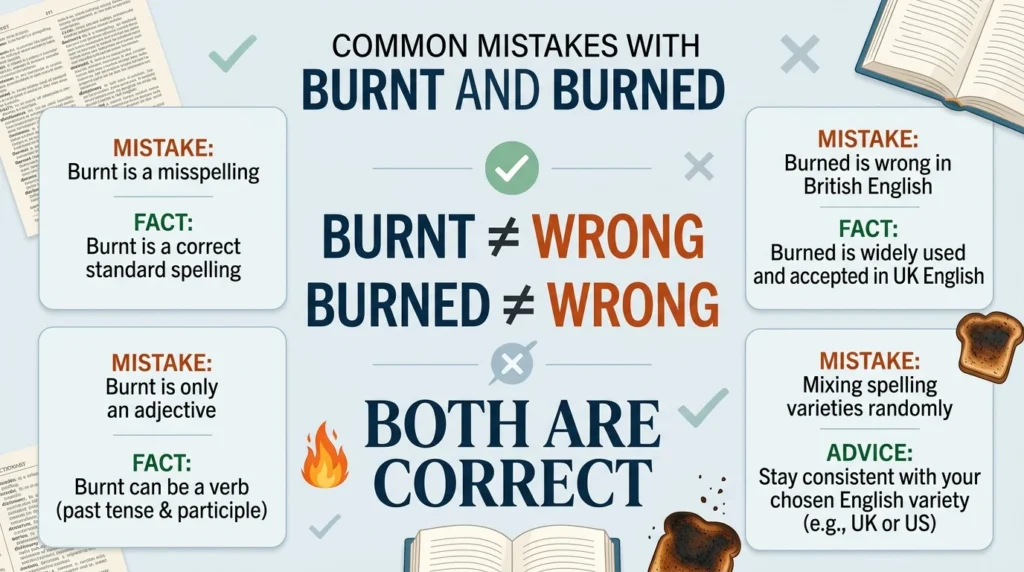
Mistake 1: Thinking “burnt” is wrong
❌ Burnt is a misspelling.
✅ Burnt is a standard English form.
It is especially common in British English and is also recognized in American English.
Mistake 2: Thinking “burned” is wrong in British English
❌ British English must always use burnt.
✅ Both burnt and burned are accepted.
Burnt is especially common, but burned is not an error.
Mistake 3: Thinking “burnt” is only an adjective
❌ Burnt can only describe a noun.
✅ Burnt can be a verb or an adjective.
- Verb: She burnt the toast.
- Adjective: The burnt toast smelled awful.
Mistake 4: Thinking American English cannot use “burnt”
❌ Americans must never use burnt.
✅ Burnt is also an accepted American English form, although burned is generally more common.
Mistake 5: Treating regional preference as a grammar rule
❌ Burned is correct and burnt is incorrect.
✅ Both are correct; regional preference determines which one sounds more natural in a particular context.
Burnt or Burned Examples in Sentences
Here are some natural examples:
- I burned my hand on the hot pan.
- I burnt my hand on the hot pan.
- She burned the cookies in the oven.
- She burnt the cookies in the oven.
- The house burned down overnight.
- The house burnt down overnight.
- The candle burned out before midnight.
- The candle burnt out before midnight.
- He has burned the old documents.
- He has burnt the old documents.
- The burnt toast smelled terrible.
- The burned toast smelled terrible.
- I burned my tongue on the coffee.
- I burnt my tongue on the coffee.
- She burned 400 calories during her workout.
- She burnt 400 calories during her workout.
- My skin became sunburned at the beach.
- My skin became sunburnt at the beach.
- The meat was freezer-burned.
- The meat was freezer-burnt.
In each pair, the basic meaning is the same. The preferred form depends on regional usage, context, and style.
Burnt or Burned: Which One Should You Use?
| If you are writing for… | Recommended choice | Why? |
|---|---|---|
| American English | burned | Generally the more common everyday form |
| British English | burnt or burned | Both are correct; burnt is especially common |
| Australian English | Either | Follow your publication or regional preference |
| Canadian English | Either | Follow your publication or regional preference |
| International audience | Either | Both are widely understood |
| Adjectival phrases | Often burnt | Burnt toast, burnt sugar, and similar expressions are well established |
A simple decision rule
If you are unsure:
American English → burned
British English → burnt is a natural choice
International English → either is acceptable
The key is to follow your chosen style consistently.
FAQ: Burnt or Burned
Is it burnt or burned?
Both are correct. Burned is generally more common in American English, while burnt is especially common in British English.
Is burnt the same as burned?
Yes. When they are forms of the verb burn, they have the same basic meaning. The main difference is regional and stylistic preference.
Is burnt a real word?
Yes. Burnt is a standard English word and can function as the past tense or past participle of burn. It can also be an adjective.
Is it burnt or burned in the UK?
Both are correct in British English. Burnt is especially common, but burned is also accepted.
Is burnt or burned correct in American English?
Both are accepted. Burned is generally more common, while burnt also occurs and is especially familiar in some adjectival expressions.
Is “I got burned” or “I got burnt” correct?
Both are correct. I got burned is particularly natural in American English, while I got burnt is especially common in British English.
What does “burnt” mean?
Burnt can mean damaged, blackened, consumed, or otherwise affected by fire or extreme heat. It is also a past-tense and past-participle form of burn.
Is “burnt” grammatically correct?
Yes. Burnt can be the simple past or past participle of burn, as well as an adjective.
Is “burned” grammatically correct?
Yes. Burned is a standard past-tense and past-participle form of burn and is generally the more common form in American English.
Should I say “I burnt or burned my tongue”?
Both are correct:
- American English: I burned my tongue.
- British English: I burnt my tongue.
Should I say “burnt or burned down”?
Both are correct.
- The building burned down.
- The building burnt down.
Should I say “burnt or burned out”?
Both are correct.
- The candle burned out.
- The candle burnt out.
Is “burnt” acceptable in American English?
Yes. Burnt is an accepted American English past form of burn, although burned is generally more common. It is also well established in expressions such as burnt toast and burnt sienna.
Is “burned” acceptable in British English?
Yes. Burned is accepted in British English, although burnt is especially common.
Final Answer: Burnt or Burned?
Both burnt and burned are correct.
The difference is mainly regional preference and style:
- 🇺🇸 American English: burned is generally more common, but burnt is also correct.
- 🇬🇧 British English: burnt is especially common, but burned is also correct.
- 🌎 International English: either form can be used.
Both forms can function as the simple past and past participle of burn:
- Present: burn
- Past: burned / burnt
- Past participle: burned / burnt
- -ing form: burning
So both of these sentences are correct:
I burned my hand.
I burnt my hand.
If you are writing for an American audience, burned is usually the safest everyday choice. If you are writing in British English, burnt is a natural and widely used choice.
The important thing is not to treat either spelling as a mistake—and to keep your regional style consistent throughout your writing.

Amelia Script is a dedicated grammar specialist and language mentor, simplifying English rules, refining writing skills, and helping learners communicate with clarity and confidence.