
Both dreamt and dreamed are correct. They are accepted past-tense and past-participle forms of the verb dream. The main difference is usage and regional preference: dreamed is more common in American English, while dreamt is especially common in British English.
| Form | Common usage | Example |
|---|---|---|
| dreamed | More common in American English and widely used internationally | “I dreamed about you last night.” |
| dreamt | Especially common in British English and also used in other varieties | “I dreamt about you last night.” |
So, which is correct: dreamt or dreamed? Both are correct. Choose the form that suits your variety of English and use it consistently.
Dreamt vs. Dreamed: What’s the Difference?
There is no basic difference in meaning between dreamt and dreamed when they are used as forms of the verb dream.
Both forms can describe:
- experiencing a dream while sleeping
- imagining something while awake
- hoping for something
- thinking about an ideal or desired future
For example:
- I dreamed about flying last night.
- I dreamt about flying last night.
Both sentences are grammatically correct and have the same basic meaning.
The main difference is which form speakers and writers prefer. Dreamed uses the regular -ed past-tense ending, while dreamt is a traditional -t form that has remained in standard English.
Is It Dreamt or Dreamed Correct?
If you’re asking, “Is it dreamt or dreamed?”, the answer is both.
Your choice usually depends on the variety of English you are using.
| Audience | Common choice |
|---|---|
| American English | dreamed is more common |
| British English | dreamt is especially common, but dreamed is also correct |
| International English | Both are understood and used |
Quick rule
- 🇺🇸 US English → dreamed
- 🇬🇧 UK English → dreamt or dreamed
If your writing consistently follows British spelling conventions such as colour, centre, and realise, dreamt may fit naturally with that style. If you are following American English conventions, dreamed is generally the more natural choice.
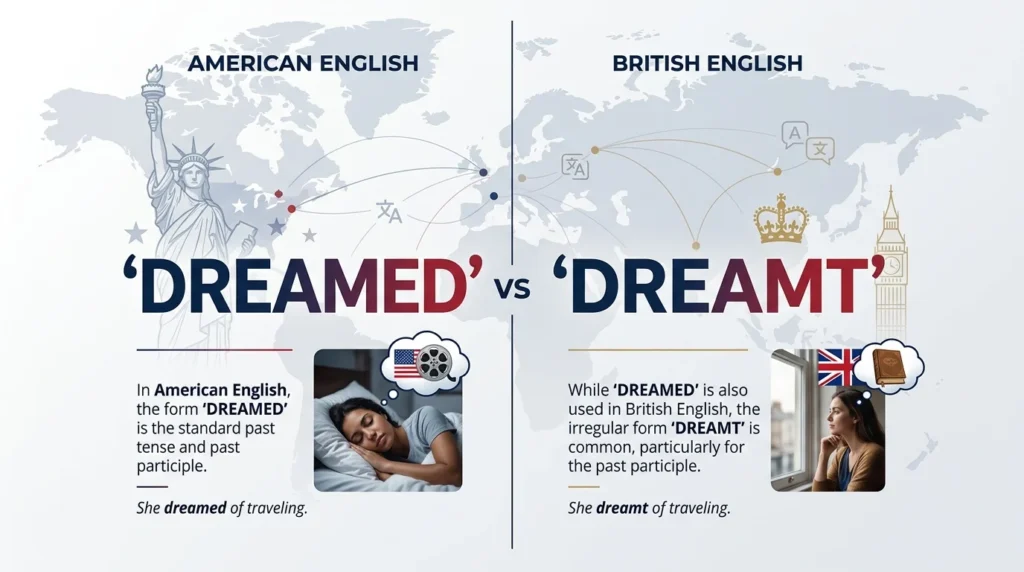
Dreamt or Dreamed in American and British English
American English: Dreamed
In American English, dreamed is the more common form.
Examples:
- I dreamed about my childhood last night.
- She dreamed of becoming a doctor.
- We dreamed about travelling around Europe.
- He dreamed that he was flying.
Americans understand dreamt, but it may sound less typical in everyday American English and can sometimes have a more traditional or British feel.
British English: Dreamt and Dreamed
In British English, dreamt is especially common, but dreamed is also correct.
Examples:
- I dreamt about you last night.
- She dreamt of living by the sea.
- He dreamt that he was back at school.
You can also write:
- I dreamed about you last night.
- She dreamed of living by the sea.
So it would be inaccurate to say that dreamt is the only British form. Both forms are used in British English, although dreamt has traditionally been particularly common.
Dream: Dreamt or Dreamed as the Past Tense
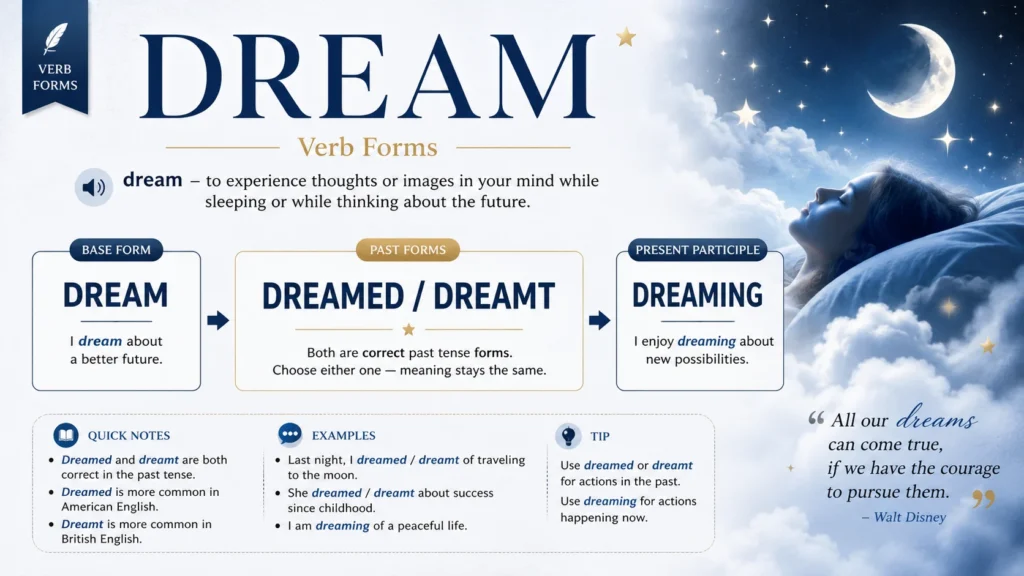
If you’re looking for the past tense of dream, both dreamed and dreamt are correct.
Here are the main forms of the verb:
| Verb form | Correct form |
|---|---|
| Base form | dream |
| Simple past | dreamed / dreamt |
| Past participle | dreamed / dreamt |
| Present participle | dreaming |
| Third-person singular | dreams |
Examples
Present:
- I dream about travelling.
Simple past:
- I dreamed about travelling yesterday.
- I dreamt about travelling yesterday.
Past participle:
- I have dreamed about this for years.
- I have dreamt about this for years.
So, if you’re wondering “What is the past tense of dream?”, the answer is dreamed or dreamt.
“I Dreamed” or “I Dreamt”—Which Is Correct?
Both are correct.
“I dreamed” is particularly natural in American English:
I dreamed about you last night.
“I dreamt” is particularly common in British English:
I dreamt about you last night.
The grammatical structure is the same. The difference is mainly regional preference and style.
You do not need to change the meaning of the sentence just because you choose one form instead of the other.
Dreamed About or Dreamed Of?
Both dream about and dream of are established expressions, but they often have slightly different uses.
| Expression | Common use | Example |
|---|---|---|
| dream about | Often refers to the content of a dream during sleep | “I dreamed about you last night.” |
| dream of | Often refers to hopes, ambitions, or desires; it can also refer to a dream during sleep | “She dreams of becoming a writer.” |
For example:
- I dreamed about my old school last night.
- She dreamt about her childhood.
- He dreamed of becoming a professional athlete.
- They dreamt of living by the sea.
The important point is that dreamt vs. dreamed is a spelling and form choice, while dream about vs. dream of can affect the meaning or nuance of the expression.
Is “I Dreamt About You” Grammatically Correct?
Yes. “I dreamt about you” is grammatically correct.
For example:
I dreamt about you last night.
It means that you had a dream involving that person.
You can also say:
I dreamed about you last night.
Both sentences are correct, and the basic meaning is the same.
Is “Dreamt Of” Grammatically Correct?
Yes. Dreamt of is grammatically correct.
For example:
She dreamt of becoming a doctor.
You can also use dreamed of:
She dreamed of becoming a doctor.
Both forms are correct.
When dream of refers to a hope, ambition, or desire, it is especially common in expressions such as:
- He dreamed of owning a house.
- She dreamt of becoming a writer.
- They dreamed of travelling the world.
Learnt or Learned: One Verb, Two Correct Forms
“I Have Dreamt” or “I Have Dreamed”?
Both are correct. Dreamt and dreamed can both function as the past participle of dream.
You can say:
- I have dreamed about this moment for years.
- I have dreamt about this moment for years.
Similarly:
- She has dreamed of travelling the world.
- She has dreamt of travelling the world.
In American English, have dreamed is generally more common. In British English, have dreamt is particularly familiar, although have dreamed is also correct.
Dreamt or Dreamed Pronunciation
The two forms are pronounced differently.
- Dreamt: /drɛmt/ — one syllable
- Dreamed: /driːmd/ — one syllable
Dreamt ends with a /t/ sound, while dreamed ends with a /d/ sound.
For example:
- dreamt → sounds like “dremt”
- dreamed → sounds like “dreemd”
Although the pronunciation differs, the two forms have the same basic meaning when they are used as past forms of dream.
Dreamt or Dreamed in a Sentence
Here are some natural examples of both forms:
| Context | American English example | British English example |
|---|---|---|
| Sleeping | I dreamed about the ocean. | I dreamt about the ocean. |
| Hope | She dreamed of becoming a writer. | She dreamt of becoming a writer. |
| Experience | We dreamed about our trip. | We dreamt about our trip. |
| Past participle | I have dreamed of this day. | I have dreamt of this day. |
| Negative | I never dreamed it would happen. | I never dreamt it would happen. |
These examples show that the grammatical structure remains the same. The main difference is the preferred past form.
Why Are There Two Forms: Dreamt vs. Dreamed?
English has several verbs that have both a regular -ed form and a shorter -t form.
| Verb | -ed form | -t form |
|---|---|---|
| dream | dreamed | dreamt |
| learn | learned | learnt |
| burn | burned | burnt |
| spell | spelled | spelt |
| smell | smelled | smelt |
The -ed forms follow the regular past-tense pattern of English. Forms ending in -t are older patterns that have survived in certain verbs and varieties of English.
English has gradually regularized many verb forms, especially in some varieties of English. This helps explain why dreamed is especially common in American English, while dreamt remains particularly well established in British English.
Both forms are standard English.
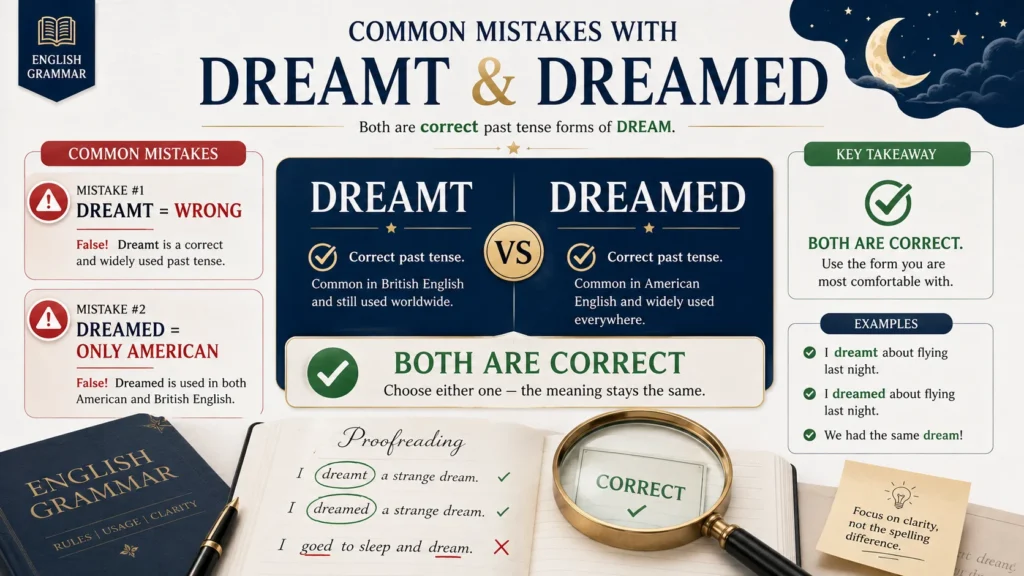
Common Mistakes With Dreamt and Dreamed
Mistake 1: Thinking “dreamt” is incorrect
❌ Dreamt is not a real English word.
✅ Dreamt is a standard English past-tense and past-participle form of dream.
Mistake 2: Thinking “dreamed” is only American
❌ Dreamed is only used in American English.
✅ Dreamed is also used and accepted in British English.
Mistake 3: Assuming only one form can follow “have”
Both are correct:
- I have dreamed about it.
- I have dreamt about it.
Mistake 4: Thinking the two forms have different basic meanings
In ordinary use, both forms can describe the same action:
- I dreamed about you.
- I dreamt about you.
The main distinction is usage and preference, not basic meaning.
Mistake 5: Switching forms unnecessarily
Both forms are correct, but in formal or edited writing, it is usually best to follow one variety of English consistently.
For example, if your article follows American English throughout, use dreamed consistently unless there is a specific reason to use dreamt.
Dreamt or Dreamed: Which One Should You Use?
The best choice depends on your audience and the variety of English you are writing.
Use “dreamed” when:
- you are writing primarily for an American audience
- you follow American English conventions
- dreamed fits the spelling style used throughout your writing
- you want the more common American form
Example:
I dreamed about becoming a teacher.
Use “dreamt” when:
- you are writing primarily for a British audience
- you follow British English conventions
- you prefer the traditional shorter form
- dreamt fits the voice or style of your writing
Example:
I dreamt about becoming a teacher.
What if you are writing for an international audience?
Either form is acceptable. Consistency matters more than choosing one “correct” form.
Judgement or Judgment: Why Does One Have an Extra “E”?
Dreamt vs. Dreamed: Which Is More Common?
Usage varies by region.
Dreamed is the more common form in American English, while dreamt is particularly common in British English.
This does not mean that one form is correct and the other is incorrect in either variety. Both forms are established in standard English.
If you are writing for a specific audience, the simplest approach is to follow that audience’s usual variety of English.
FAQ: Dreamt or Dreamed
Is it correct to say dreamed or dreamt?
Yes. Both dreamed and dreamt are correct past-tense and past-participle forms of dream. Dreamed is more common in American English, while dreamt is particularly common in British English.
Is it correct to say “I dreamt about you”?
Yes. “I dreamt about you” is grammatically correct. It means that you had a dream involving that person.
Is “dreamt of” grammatically correct?
Yes. Dreamt of is correct. For example, “She dreamt of becoming a doctor.” Dreamed of is also correct.
What does “I dreamt” mean?
“I dreamt” is the simple past form of dream. Depending on context, it can mean that you experienced a dream during sleep or imagined or hoped for something in the past.
Is dreamt a word?
Yes. Dreamt is a standard English word and can function as both the simple past and past participle of dream.
Which is correct: dreamt or dreamed?
Both are correct. The choice mainly depends on regional usage and personal or editorial preference.
Is “I have dreamt” correct?
Yes. Dreamt can be used as the past participle after have or has.
Is “I have dreamed” correct?
Yes. Dreamed is also a correct past participle.
Is dreamt or dreamed more common in the UK?
Dreamt is particularly common in British English, although dreamed is also used and accepted.
Is dreamed or dreamt more common in the US?
Dreamed is more common in American English.
What is the past tense of dream?
The past tense of dream can be dreamed or dreamt.
What is the past participle of dream?
The past participle can also be dreamed or dreamt.
Final Answer: Dreamt or Dreamed?
Dreamt and dreamed are both correct.
- 🇺🇸 American English: dreamed is more common.
- 🇬🇧 British English: dreamt is particularly common, but dreamed is also correct.
- 🌎 International English: either form can be used.
Both forms can function as the simple past and past participle of dream, and they generally have the same basic meaning.
| American English | British English | |
|---|---|---|
| Past tense | dreamed | dreamt or dreamed |
| Past participle | dreamed | dreamt or dreamed |
| Example | I dreamed about you. | I dreamt about you. |
The Bottom Line
If you’re writing for an American audience, dreamed is usually the best choice. If you’re writing for a British audience, dreamt is especially common, although dreamed is also correct.
There is no single “right” spelling. Both dreamt and dreamed are correct—choose the form that fits your variety of English and keep your usage consistent.

Sophia Langley is an English grammar specialist and writing coach, passionate about simplifying language rules and empowering learners to write with clarity and confidence.