
You finish writing an important email, check your spelling, and suddenly your editor underlines “cancelled.” You change it to “canceled,” but another writing tool says that’s wrong too.
So, which spelling should you trust?
The good news? Both are correct. The only difference is where you’re writing and who your audience is.
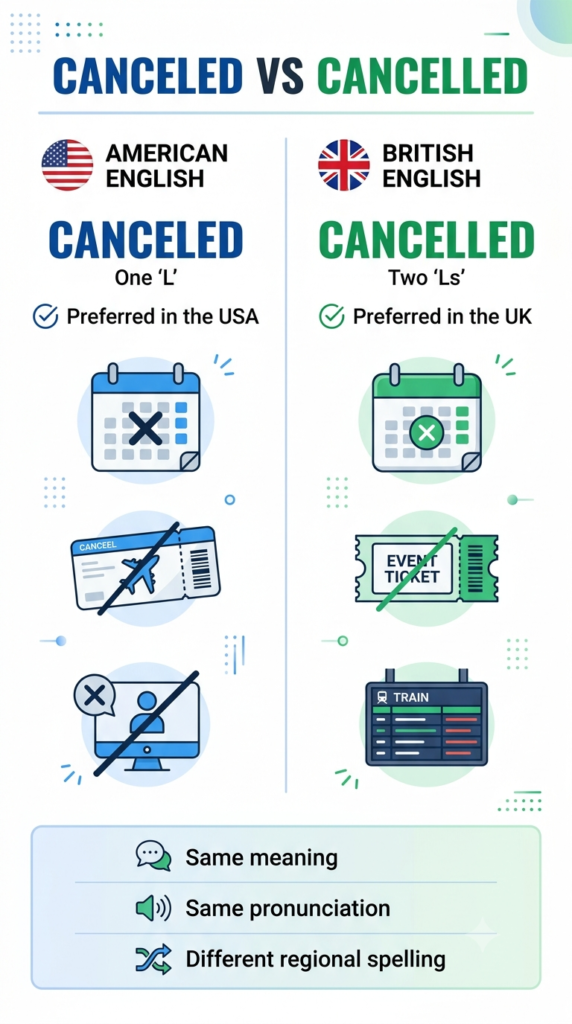
If you write in American English, use canceled (one L). If you write in British English, the preferred spelling is cancelled (two Ls).
Although the spellings look different, they have the same pronunciation, meaning, and purpose. The choice depends on the variety of English you follow—not on whether one spelling is better than the other.
In this guide, you’ll learn:
- The difference between canceled and cancelled
- Why both spellings exist
- The grammar rule behind them
- Real-life examples
- Which spelling to use in different contexts
🇺🇸 Canceled is the preferred spelling in American English (US).
🇬🇧 Cancelled is the preferred spelling in British English (UK).
They have the same meaning and pronunciation. The only difference is regional spelling convention.
Canceled vs. Cancelled at a Glance
| Feature | Canceled | Cancelled |
|---|---|---|
| Correct Spelling | ✅ Yes | ✅ Yes |
| Meaning | To call something off | To call something off |
| Pronunciation | /ˈkænsəld/ | /ˈkænsəld/ |
| American English | ✅ Preferred | Rare |
| British English | Rare | ✅ Preferred |
| Common in US | ⭐⭐⭐⭐⭐ | ⭐ |
| Common in UK | ⭐ | ⭐⭐⭐⭐⭐ |
Key Takeaway:
- 🇺🇸 Writing for Americans? Use canceled.
- 🇬🇧 Writing for UK, Australia, or New Zealand? Use cancelled.
The most important rule: Stay consistent throughout your writing. Mixing both spellings in the same document can confuse readers.
Is It Canceled or Cancelled?
The answer depends on the type of English you’re using—not on which spelling is “more correct.”
Many people assume one version must be a spelling mistake because the words look different. In reality, both spellings are accepted by major dictionaries, grammar references, and style guides.
The difference is simply regional:
| Context | Use This |
|---|---|
| American audience | Canceled |
| British audience | Cancelled |
| International audience | Choose one and stay consistent |
Example:
An American airline would write:
Your flight has been canceled.
A British airline would write:
Your flight has been cancelled.
Both sentences communicate exactly the same message. The spelling changes, but the meaning does not.
Why Do People Get Confused?
English has many words with different spellings in American and British English. Once you understand this pattern, it becomes much easier to recognize why canceled and cancelled are both correct.
| American English | British English |
|---|---|
| Color | Colour |
| Favorite | Favourite |
| Traveling | Travelling |
| Labeled | Labelled |
| Theater | Theatre |
| Gray | Grey |
| Canceled | Cancelled |
What’s the Difference Between Canceled and Cancelled?
The difference between canceled and cancelled is not their meaning—it’s their spelling convention.
Both words describe the same action: stopping, ending, or calling something off before it happens or before it is completed.
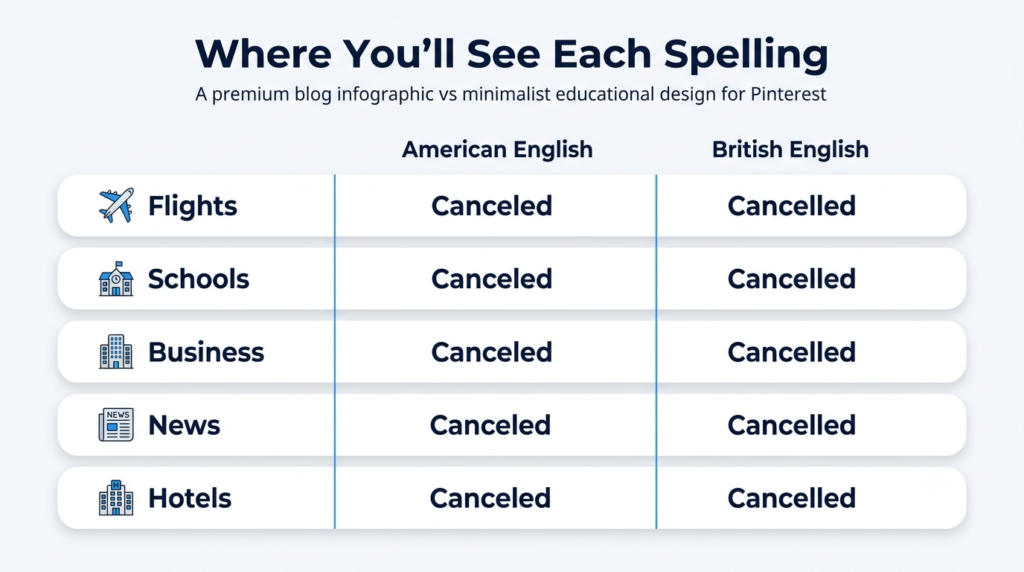
Whether you’re talking about a canceled flight, a cancelled meeting, or a canceled subscription, the meaning never changes. The only thing that changes is the variety of English you’re writing in.
Canceled in American English
If you write for an American audience, canceled is the standard spelling.
You’ll find this version in:
- American newspapers
- US government websites
- American schools and universities
- Business emails
- Most US companies
- American style guides (AP Style, Chicago Manual)
Examples:
- The flight was canceled because of heavy snow.
- She canceled her doctor’s appointment.
- Our meeting has been canceled until Monday.
- Netflix canceled the TV series after two seasons.
- The customer canceled the order before payment was processed.
- The concert was canceled due to the singer’s illness.
- He canceled his gym membership last week.
If your readers are mainly in the United States, canceled is usually the best choice.
Cancelled in British English
If you’re writing in British English, the preferred spelling is cancelled with two Ls.
This spelling is widely used in:
- The United Kingdom
- Australia
- New Zealand
- Ireland
- South Africa
- Many other countries that follow British English
Examples:
- The train was cancelled due to engineering work.
- The football match was cancelled because of heavy rain.
- We cancelled our hotel booking yesterday.
- The event has been cancelled until further notice.
- They cancelled the conference after the speaker became ill.
- The school trip was cancelled because of safety concerns.
- The airline cancelled several international flights.
Although the spelling looks different, the meaning is exactly the same as canceled.
Why Does American English Use One “L”?
Many people wonder why Americans write canceled, while British writers prefer cancelled.
The answer lies in the spelling conventions that developed over time—largely influenced by Noah Webster.
In the early 19th century, Noah Webster, creator of the first American dictionary, championed simplified spellings. His goal was to create a distinctly American English that was more logical and phonetically consistent.
American English generally favors simpler spellings. For many verbs ending in L, American English keeps a single L when adding -ed or -ing, especially when the final syllable isn’t stressed.
This is why American English commonly uses:
- canceled
- canceling
- traveled
- traveling
- labeled
- labeling
- modeled
- modeling
These spellings are considered standard throughout the United States.
Why Does British English Use Two “Ls”?
British English follows a different spelling pattern that preserved traditional conventions.
When adding endings such as -ed or -ing, British English often doubles the final L, even if the stress isn’t on the last syllable.
As a result, British English prefers:
- cancelled
- cancelling
- travelled
- travelling
- labelled
- labelling
- modelled
- modelling
Once you recognize this pattern, you’ll notice it in many other British English words.
The Grammar Rule Explained
At first glance, the difference between canceled and cancelled may seem random, but it follows a consistent spelling pattern.
In American English, verbs ending in L often keep a single L before adding -ed or -ing when the last syllable isn’t stressed.
| Base Verb | American English |
|---|---|
| Cancel | Canceled |
| Travel | Traveled |
| Label | Labeled |
| Model | Modeled |
British English usually doubles the L in the same situations.
| Base Verb | British English |
|---|---|
| Cancel | Cancelled |
| Travel | Travelled |
| Label | Labelled |
| Model | Modelled |
Learning this rule won’t just help you with canceled and cancelled. It will also make it easier to understand many other spelling differences between American and British English.
A Brief History of “Canceled” and “Cancelled”
The two spellings didn’t appear overnight. They developed as American and British English gradually evolved in different directions.
The Webster Influence
In 1828, Noah Webster published his American Dictionary of the English Language, which deliberately simplified many spellings. Webster believed American English should be distinct from British English and more logical in its spelling.
He championed changes like:
- Color instead of colour
- Theater instead of theatre
- Canceled instead of cancelled
British Preservation
Meanwhile, British English continued using traditional forms like cancelled, travelled, and labelled, following conventions that had been established over centuries.
Today
Both spellings are accepted by major dictionaries. The only question is which audience you’re writing for.
Whether you choose canceled or cancelled, you’re using a correct English word—as long as you stay consistent throughout your writing.
Canceling vs. Cancelling: Why Are There Two Spellings?
Canceled, Canceling, Cancellation, or Cancelation?
Many people also wonder what happens when the word changes form.
Here’s a simple guide:
| Word Form | American English | British English |
|---|---|---|
| Past Tense | Canceled | Cancelled |
| Present Participle | Canceling | Cancelling |
| Noun | Cancellation | Cancellation |
Is “Cancelation” Correct?
You may occasionally see cancelation with one L, especially in older American texts or legal documents.
However, cancellation (with two Ls) is the standard spelling in both American and British English today. Most dictionaries, publishers, and style guides recommend using cancellation.
Examples:
- Your cancellation request has been approved.
- We received a cancellation email this morning.
- The hotel charges a cancellation fee for late changes.
- Please confirm your cancellation in writing.
Real-Life Examples of Canceled and Cancelled
The easiest way to understand the difference is to see them used in real sentences. Remember, the meaning stays the same—the spelling changes based on whether you’re writing in American or British English.
Examples of Canceled (American English)
These examples follow standard American English spelling.
- The school event was canceled because of the snowstorm.
- She canceled her gym membership last week.
- Our flight was canceled due to bad weather.
- The manager canceled the meeting at the last minute.
- They canceled their vacation plans after the hurricane warning.
- The concert was canceled because the singer became ill.
- He canceled his subscription before the renewal date.
- We canceled the dinner reservation and ordered takeout instead.
- The company canceled the product launch.
- My online order was canceled automatically after the payment failed.
Examples of Cancelled (British English)
These examples use the preferred British English spelling.
- The football match was cancelled because of heavy rain.
- Our train was cancelled due to maintenance work.
- She cancelled her doctor’s appointment this morning.
- They cancelled the wedding venue booking.
- The festival was cancelled because of safety concerns.
- The school trip was cancelled until next month.
- We cancelled our holiday after the travel warning.
- The airline cancelled several international flights.
- His interview was cancelled without notice.
- The conference was cancelled because the keynote speaker couldn’t attend.
Business and Professional Examples
In Emails (US)
- “We regret to inform you that the meeting has been canceled.”
- “Your subscription has been canceled as requested.”
- “The training session is canceled for tomorrow.”
In Emails (UK)
- “We regret to inform you that the meeting has been cancelled.”
- “Your subscription has been cancelled as requested.”
- “The training session is cancelled for tomorrow.”
In Contracts and Legal Documents
Both US and UK legal writing typically uses cancellation (with two Ls) as the noun form. For the verb form, follow your regional convention.
Canceled vs Cancelled in Popular Style Guides
If you write for work, school, or online publishing, you may wonder which spelling professional style guides recommend.
| Style Guide | Preferred Spelling |
|---|---|
| AP Style (United States) | Canceled |
| Chicago Manual of Style (US) | Canceled |
| MLA Handbook (US) | Canceled |
| Oxford Style (UK) | Cancelled |
| Cambridge English (UK) | Cancelled |
This is why you may notice different spellings in books, newspapers, websites, and academic writing. They’re following different English standards—not making spelling mistakes.
Tip: If you’re writing for an international audience, choose one variety of English and use it consistently throughout your content.
Common Mistakes to Avoid
1. Mixing American and British Spellings
One of the biggest mistakes is using both spellings in the same article.
❌ Incorrect:
- The event was canceled yesterday.
- Our tickets were cancelled today.
Unless you’re comparing the two spellings, choose one style and use it consistently.
✅ American English:
- The event was canceled yesterday.
- Our tickets were canceled today.
✅ British English:
- The event was cancelled yesterday.
- Our tickets were cancelled today.
2. Assuming One Spelling Is Incorrect
Many people believe that only one spelling is right. That’s not true.
Both canceled and cancelled are accepted by major dictionaries. The correct choice depends on your audience—not on grammar.
3. Forgetting Your Audience
If you’re writing for an American company, website, or school, use canceled.
If you’re writing for readers in the UK or countries that follow British English, use cancelled.
Choosing the spelling your audience expects makes your writing look more professional and consistent.
4. Misspelling “Cancellation”
Many writers mistakenly use cancelation (one L) in formal writing.
✅ Correct: Cancellation (with two Ls) is standard in both US and UK English.
5. Inconsistent Use in the Same Document
Even if you choose the correct regional spelling, you must use it consistently throughout the document. Switching between spellings looks unprofessional.
An Easy Memory Trick
Still not sure which spelling to use? Try these tricks:
🇺🇸 American English
“One Country, One L”
- Canceled
- Canceling
🇬🇧 British English
“British English Loves Double Ls”
- Cancelled
- Cancelling
Another Memory Trick
Think of “American Airlines” — they’re based in the US, so they’d write “flight canceled.”
Think of “British Airways” — they’re based in the UK, so they’d write “flight cancelled.”
You don’t have to memorize every spelling difference. Once you understand this pattern, you’ll recognize similar words such as:
- Traveled → Travelled
- Labeled → Labelled
- Modeled → Modelled
- Traveling → Travelling
- Labeling → Labelling
The key isn’t choosing the “better” spelling—it’s choosing the spelling that matches your audience and using it consistently.
Pronunciation Guide
Both canceled and cancelled are pronounced the same way:
/ˈkænsəld/
- KAN-suhld (rhymes with “handled”)
- The stress is on the first syllable
- The “L” is pronounced clearly in both variants
Audio Tip:
Say it out loud: “KAN-suhld”
Both spellings sound identical when spoken, which is why the confusion only appears in writing.
Canceled vs Cancelled: Quick Decision Flowchart
text
Are you writing for an American audience?
         │
         ▼
    ┌─────────┐
    │   YES   │
    └─────────┘
         │
         ▼
   Use "canceled" (one L)
         │
         ▼
   ┌─────────┐
   │   NO    │
   └─────────┘
         │
         ▼
Are you writing for a British/Australian/NZ audience?
         │
         ▼
    ┌─────────┐
    │   YES   │
    └─────────┘
         │
         ▼
  Use "cancelled" (two Ls)
         │
         ▼
    ┌─────────┐
    │   NO    │
    └─────────┘
         │
         ▼
  Choose one and stay consistent!
Cancel Culture: A Modern Usage Note
In recent years, the term “cancel culture” has become common in media and social discussions.
In this context:
- US publications use: cancel culture (not “cancelled culture”)
- UK publications also typically use: cancel culture
However, when using the verb form related to this concept:
- US: “They canceled the celebrity.”
- UK: “They cancelled the celebrity.”
Frequently Asked Questions
Is canceled or cancelled correct?
Both spellings are correct. Canceled is the preferred spelling in American English, while cancelled is the preferred spelling in British English.
Is canceled a real word?
Yes. Canceled is the standard American English spelling and appears in major American dictionaries, newspapers, and style guides.
Is cancelled a real word?
Yes. Cancelled is the standard British English spelling and is widely used in the United Kingdom, Australia, and many other English-speaking countries.
Why are there two different spellings?
American and British English developed different spelling conventions over time, largely influenced by Noah Webster’s dictionary in the 19th century. As a result, some words have different spellings while keeping the same meaning and pronunciation.
Which spelling should I use in school?
Follow your school’s writing style:
- If your school uses American English, write canceled.
- If it follows British English, write cancelled.
- When in doubt, ask your teacher or check your school’s style guide.
Which spelling should I use in business writing?
Use the spelling that matches your company’s preferred style. Many international companies choose one variety of English and use it across all documents, emails, and marketing materials to maintain consistency.
Is cancellation spelled with one or two Ls?
The standard spelling is cancellation with two Ls in both American and British English. Although cancelation exists, it is uncommon and is generally not recommended in modern writing.
Is canceling or cancelling correct?
Both spellings are correct:
- Canceling is preferred in American English.
- Cancelling is preferred in British English.
Does Microsoft Word or Google Docs accept both spellings?
Yes. Most modern writing tools recognize both spellings. The suggestion you see usually depends on whether your language setting is set to English (US) or English (UK).
How can I remember the correct spelling?
Simple tricks:
- 🇺🇸 American English → One L → Canceled
- 🇬🇧 British English → Two Ls → Cancelled
- Or use the airline trick: American Airlines = canceled, British Airways = cancelled
What about “cancellation” in contracts?
Cancellation (with two Ls) is the standard spelling for legal documents and contracts in both US and UK English. Always use two Ls for the noun form.
Do Canadians use canceled or cancelled?
Canadian English typically follows British spelling conventions, so cancelled (with two Ls) is more common. However, Canadian style guides often allow both, and usage varies.
Key Takeaways
Before you leave, here’s a quick summary:
✅ Both canceled and cancelled are correct.
🇺🇸 Canceled is preferred in American English.
🇬🇧 Cancelled is preferred in British English.
🔊 The meaning and pronunciation are exactly the same.
📝 Cancellation is the standard noun spelling in both American and British English.
🎯 Always stay consistent with the variety of English you’re using.
🧠 Remember: “One Country, One L” (US) vs “British Loves Double Ls” (UK)
🏢 In business writing, follow your company’s preferred style.
📚 In academic writing, follow your institution’s style guide.
Final Verdict
So, should you write canceled or cancelled?
The answer is simple: both spellings are correct.
If you’re writing for an American audience, use canceled. If you’re writing for readers who follow British English, use cancelled.
Neither spelling is more accurate than the other. They simply reflect different regional spelling conventions that have developed over time.
The most important thing isn’t choosing one spelling over the other—it’s choosing the version that fits your audience and using it consistently throughout your writing.
Whether you’re writing an email, a business report, a school assignment, or a blog post, understanding this small spelling difference will help you write more confidently and professionally.

Amelia Script is a dedicated grammar specialist and language mentor, simplifying English rules, refining writing skills, and helping learners communicate with clarity and confidence.