
Have you ever typed canceling and wondered whether it should actually be cancelling? You’re not alone. Both spellings appear in books, websites, emails, and everyday writing, so it can be difficult to know which one is correct.
Both “canceling” and “cancelling” are correct—but the spelling you should use depends on which version of English you’re writing. In American English, “canceling” is the standard spelling, while British English and many other varieties use “cancelling.” The difference comes from a small spelling rule involving the final L before adding -ing, and understanding that rule makes it much easier to know which form belongs in your writing.
If you’re writing a school assignment, professional email, business document, website, resume, or social media post, choosing the spelling that matches your audience keeps your English accurate and consistent. In this guide, you’ll learn canceling vs. cancelling, the American and British spelling rules, pronunciation, real-life examples, related forms, and exactly when to use each spelling.
Canceling or Cancelling?
Both spellings are correct.
🇺🇸 Canceling → American English
🇬🇧 Cancelling → British EnglishBoth forms mean stopping or calling off something that was planned, scheduled, or arranged.
So, if you’re writing in American English, choose canceling. If you’re following British English, choose cancelling.
Neither spelling is a mistake.
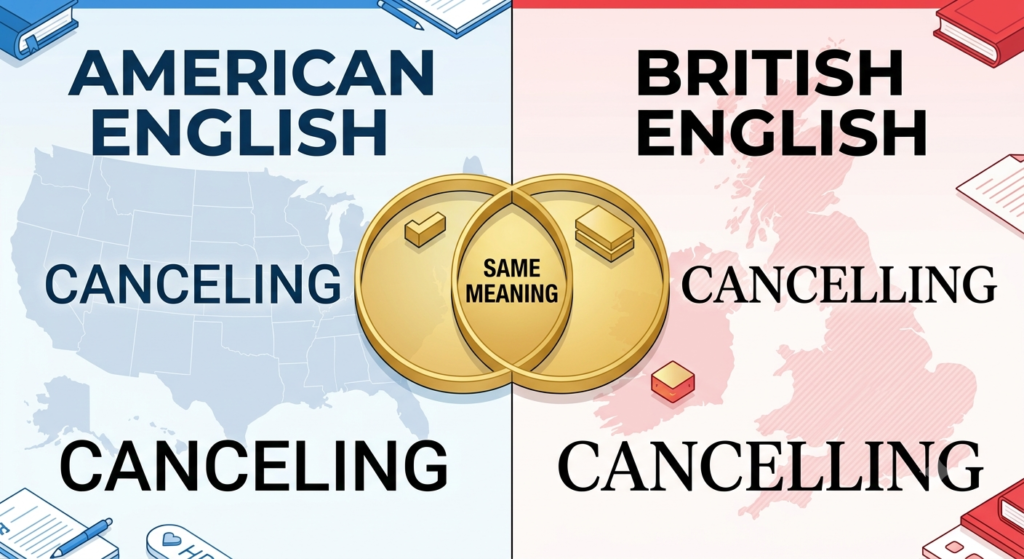
Canceling vs. Cancelling: Quick Comparison
| Feature | Canceling | Cancelling |
|---|---|---|
| Correct? | ✅ Yes | ✅ Yes |
| English variety | American English | British English |
| Preferred in the US | ✅ Yes | Less common |
| Preferred in the UK | Less common | ✅ Yes |
| Meaning | Same | Same |
| Pronunciation | Same | Same |
| Spelling | One L | Two Ls |
The easiest rule to remember
American English → canceling
British English → cancelling
If you remember only one thing from this article, remember that.
What Does Canceling or Cancelling Mean?
Canceling and cancelling are the present participle and gerund forms of the verb cancel.
To cancel something means to stop it from happening, end an arrangement, or decide that something previously planned will no longer take place.
For example:
I am canceling my appointment.
This means the speaker is taking action to stop the appointment.
In British English, the same sentence would normally be:
I am cancelling my appointment.
The meaning is exactly the same.
You can use these forms when talking about many everyday situations, including:
- canceling/cancelling an appointment
- canceling/cancelling a reservation
- canceling/cancelling a flight
- canceling/cancelling a subscription
- canceling/cancelling an order
- canceling/cancelling a meeting
- canceling/cancelling an event
- canceling/cancelling a plan
Example
American English:
The airline is canceling several flights today.
British English:
The airline is cancelling several flights today.
Nothing about the meaning changes. The spelling simply follows the regional English style.
Why Is It “Cancelling” With Two Ls?
The difference comes from different spelling conventions used in American and British English.
When the verb cancel takes the -ing ending, British English generally doubles the final L, producing:
cancel + ing → cancelling
American English commonly uses a single L:
cancel + ing → canceling
This same type of difference appears in several other words:
| American English | British English |
|---|---|
| traveling | travelling |
| labeling | labelling |
| modeling | modelling |
| canceling | cancelling |
This doesn’t mean one spelling is more correct than the other. They belong to different regional conventions.
That’s why a British reader may naturally write cancelling, while an American reader may naturally write canceling.
When Should You Use “Canceling”?
Use canceling when you’re writing in American English.
It’s the preferred spelling for American readers and is commonly used in US business writing, websites, newspapers, school assignments, emails, and everyday communication.
Examples of Canceling
- I’m canceling my appointment for Friday.
- The airline is canceling flights because of the storm.
- She is canceling her gym membership.
- We are canceling the meeting until next week.
- The customer is canceling the order before it ships.
Notice that the spelling remains canceling every time.
If your entire article uses American English, there’s no need to switch to cancelling just because you’ve seen that version elsewhere.
When Should You Use “Cancelling”?
Use cancelling when you’re writing in British English.
It’s the standard spelling for British English readers and is commonly used in UK writing.
Examples of Cancelling
- I’m cancelling my appointment for Friday.
- The airline is cancelling flights because of the storm.
- She is cancelling her gym membership.
- We are cancelling the meeting until next week.
- The customer is cancelling the order before it ships.
Again, the meaning doesn’t change.
The main difference is that British English uses two Ls, while American English normally uses one L.
GrammarChoice Insight 💡
Don’t ask yourself, “Which spelling is universally correct?”
Ask:
“Which variety of English am I using?”
That question immediately gives you the answer:
US English → canceling
UK English → cancelling
Canceling or Cancelling in Real-Life Writing
You can encounter canceling and cancelling in many everyday situations. The spelling you see often reflects which variety of English the writer is following.
For example, an American company might write:
We are canceling several flights due to severe weather.
A British company might write:
We are cancelling several flights due to severe weather.
Both sentences are correct. The difference is regional, not grammatical.
Here are some common situations where you’ll see these spellings:
| Situation | American English | British English |
|---|---|---|
| Appointment | canceling an appointment | cancelling an appointment |
| Flight | canceling a flight | cancelling a flight |
| Hotel | canceling a reservation | cancelling a reservation |
| Subscription | canceling a subscription | cancelling a subscription |
| Meeting | canceling a meeting | cancelling a meeting |
| Event | canceling an event | cancelling an event |
| Order | canceling an order | cancelling an order |
This is why you may see both forms when reading websites from different countries.
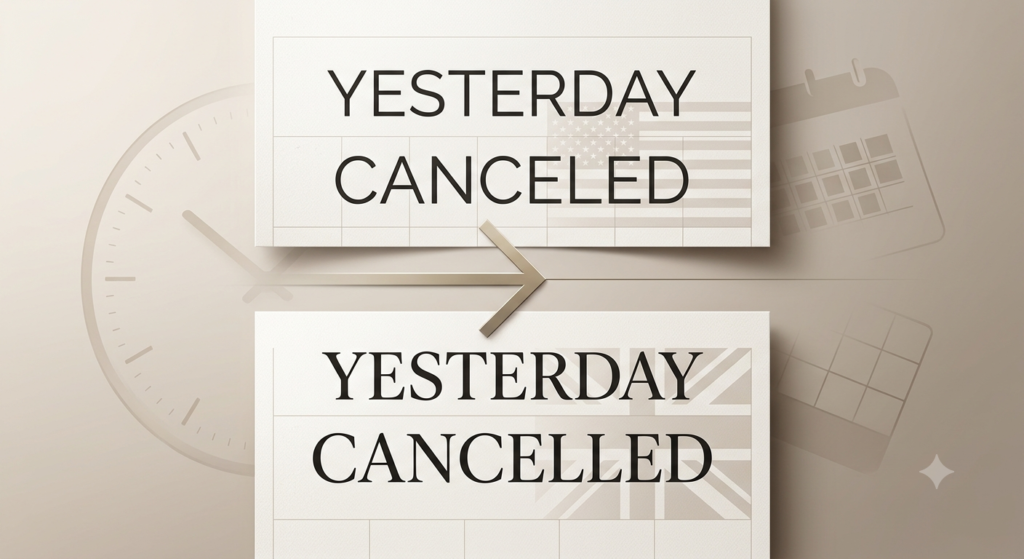
What About Canceled vs. Cancelled?
The same regional spelling difference applies to the past tense and past participle of cancel.
| American English | British English |
|---|---|
| canceled | cancelled |
Examples
American English:
The flight was canceled due to bad weather.
British English:
The flight was cancelled due to bad weather.
Again, the meaning is identical. The spelling changes according to the English variety.
If you’re interested in the past-tense form specifically, see our guide to Canceled or Cancelled.
Is It Cancellation or Cancelation?
Here’s where the spelling becomes a little more interesting.
You might expect cancellation to follow exactly the same pattern as canceling and cancelling. However, that’s not quite how usage works.
Cancellation, with two Ls, is the standard and much more common spelling in both American and British English.
The spelling cancelation does occur, particularly in American English, but it is much less common.
Examples
The flight cancellation caused hundreds of passengers to change their plans.
We received an email confirming the cancellation of the event.
The hotel has a 24-hour cancellation policy.
For most everyday and professional writing, cancellation is the safest and most familiar choice.
So remember:
American English: canceling
British English: cancelling
Both varieties: cancellation is the standard spelling

Canceling, Cancelling, and Cancellation
These three forms are closely related, but they have different grammatical roles.
Cancel
This is the base form of the verb.
Please cancel my reservation.
Canceled
This is the usual American English past-tense spelling.
I canceled my reservation.
Cancelled
This is the standard British English past-tense spelling.
I cancelled my reservation.
Canceling
This is the usual American English -ing form.
I am canceling my reservation.
Cancelling
This is the standard British English -ing form.
I am cancelling my reservation.
Cancellation
This is the noun.
The cancellation of the reservation was unexpected.
Here’s the simple pattern:
| Word | Role | American English | British English |
|---|---|---|---|
| cancel | Base verb | cancel | cancel |
| canceled/cancelled | Past tense | canceled | cancelled |
| canceling/cancelling | -ing form | canceling | cancelling |
| cancellation | Noun | cancellation | cancellation |
A Simple Memory Trick
Still struggling to remember which spelling belongs to which variety?
Try this simple rule:
🇺🇸 American English → One L
canceling
🇬🇧 British English → Two Ls
cancelling
You can also remember it alongside other common spelling differences:
- US: traveling → UK: travelling
- US: labeling → UK: labelling
- US: modeling → UK: modelling
Once you connect the spelling with the English variety, the difference becomes much easier to recall.
Canceled or Cancelled: Which Spelling Is Correct?
Which Spelling Should You Use?
The best spelling depends on your audience.
Use canceling when:
- You’re writing in American English.
- Your main readers are in the United States.
- Your organization follows US English.
- Your style guide specifies American spelling.
Use cancelling when:
- You’re writing in British English.
- Your main readers are in the United Kingdom.
- Your organization follows British English.
- Your style guide specifies British spelling.
If you’re writing for an international audience, either variety can work. The most important thing is to choose a consistent English style.
Common Mistakes With Canceling and Cancelling
Knowing that both forms are correct makes the choice easier, but there are still a few mistakes worth avoiding.
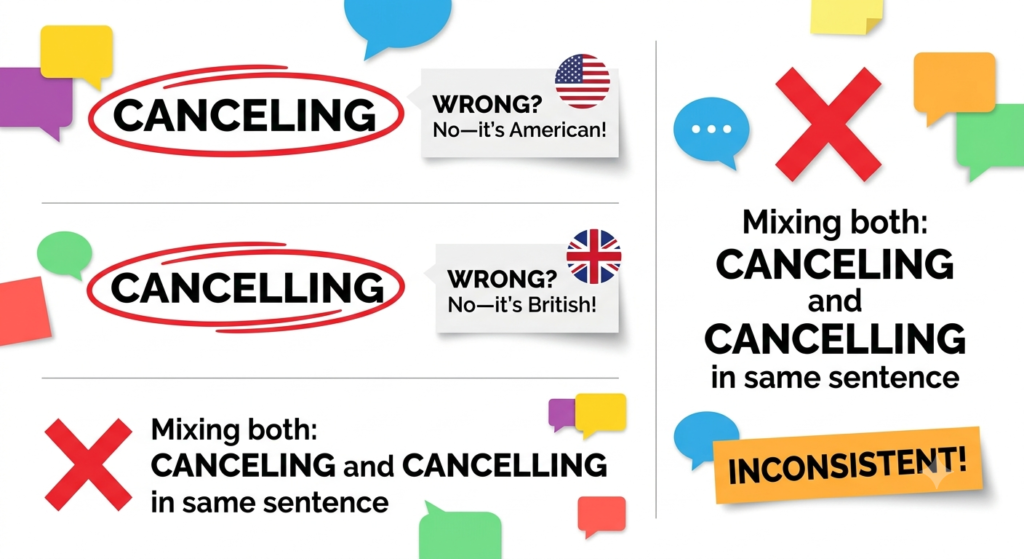
1. Thinking One Spelling Is Wrong
Seeing cancelling in an American-focused article doesn’t automatically mean someone made a spelling mistake. Likewise, canceling isn’t incorrect simply because a British writer normally uses two Ls.
The two spellings belong to different English conventions.
2. Mixing the Two Forms
Try to avoid switching between canceling and cancelling within the same piece of writing.
For example:
❌ Inconsistent:
We are canceling the meeting and cancelling the afternoon appointment.
If you’re using American English:
✅
We are canceling the meeting and canceling the afternoon appointment.
If you’re using British English:
✅
We are cancelling the meeting and cancelling the afternoon appointment.
Using one spelling consistently makes your writing look more polished.
3. Changing the Spelling Just Because of a Spell Checker
Your word processor may underline canceling or cancelling depending on its language settings.
Before changing the word, check whether your software is set to English (US) or English (UK).
The spell checker may simply be following a particular regional dictionary rather than telling you that the other spelling is universally wrong.
Frequently Asked Questions
Is canceling or cancelling correct?
Both canceling and cancelling are correct. Canceling is the usual American English spelling, while cancelling is the standard British English spelling.
Is canceling with one L correct?
Yes. Canceling with one L is the usual American English spelling.
Is cancelling with two Ls correct?
Yes. Cancelling with two Ls is the standard British English spelling.
Which is more common, canceling or cancelling?
It depends on the English variety. Canceling is more common in American English, while cancelling is more common in British English.
Is cancelling a British spelling?
Yes. Cancelling with two Ls is the standard British English spelling.
Is canceling an American spelling?
Yes. Canceling with one L is the usual American English spelling.
Is cancellation spelled with one L or two?
Cancellation, with two Ls, is the standard and much more common spelling in both American and British English. Cancelation also occurs, particularly in American English, but it is much less common.
Is it canceled or cancelled?
Both are correct. Canceled with one L is the usual American English spelling, while cancelled with two Ls is the standard British English spelling.
Can I use canceling and cancelling in the same article?
You can mention both spellings when explaining their difference, but it’s best to choose one English variety for the main writing and use that spelling consistently.
Why does canceling have one L in American English?
American English commonly uses a single L when forming the -ing version of cancel, producing canceling. British English generally doubles the L, producing cancelling.
Canceling vs. Cancelling: Examples at a Glance
American English
- I am canceling my appointment.
- She is canceling the reservation.
- They are canceling the event.
- The airline is canceling several flights.
- We are canceling the subscription.
- The flight was canceled yesterday.
British English
- I am cancelling my appointment.
- She is cancelling the reservation.
- They are cancelling the event.
- The airline is cancelling several flights.
- We are cancelling the subscription.
- The flight was cancelled yesterday.
The sentence structure and meaning stay the same. Only the spelling changes.
Key Takeaways
Here’s the simple version to remember:
- ✅ Canceling is the usual American English spelling.
- ✅ Cancelling is the standard British English spelling.
- ✅ Both spellings are correct.
- ✅ Both have the same meaning and pronunciation.
- ✅ Canceled is the usual American spelling.
- ✅ Cancelled is the standard British spelling.
- ✅ Cancellation is the standard and much more common noun spelling in both varieties.
- ✅ Don’t change the spelling simply because your spell checker uses a different English setting.
- ✅ Choose the spelling that matches your audience.
- ✅ Most importantly, stay consistent throughout your writing.
Easy Memory Rule
🇺🇸 US → canceling
🇬🇧 UK → cancelling
Conclusion
The choice between canceling and cancelling is not really about right versus wrong. It’s mainly about American English versus British English.
Use canceling if you’re following American English, and use cancelling if you’re following British English. Both spellings describe the same action and have the same pronunciation.
If you’re writing an article, email, assignment, or business document, choose one English style before you begin and keep your spelling consistent. That simple habit will make your writing clearer and more professional.
And if you see the other spelling somewhere, don’t assume it’s a typo. Canceling and cancelling are both legitimate English spellings—you simply need to know which regional style you’re reading or writing.

Victor Penhall is an English grammar specialist and writing coach, helping learners strengthen their language skills with clear rules, smart tips, and precise guidance.