
Have you ever typed cancellation and suddenly wondered whether it should have one L or two?
You’re not alone. Cancellation and cancelation are both found in English, but they are not equally common. One is the standard spelling most readers expect, while the other is a much less common variant.
So, which one should you use?
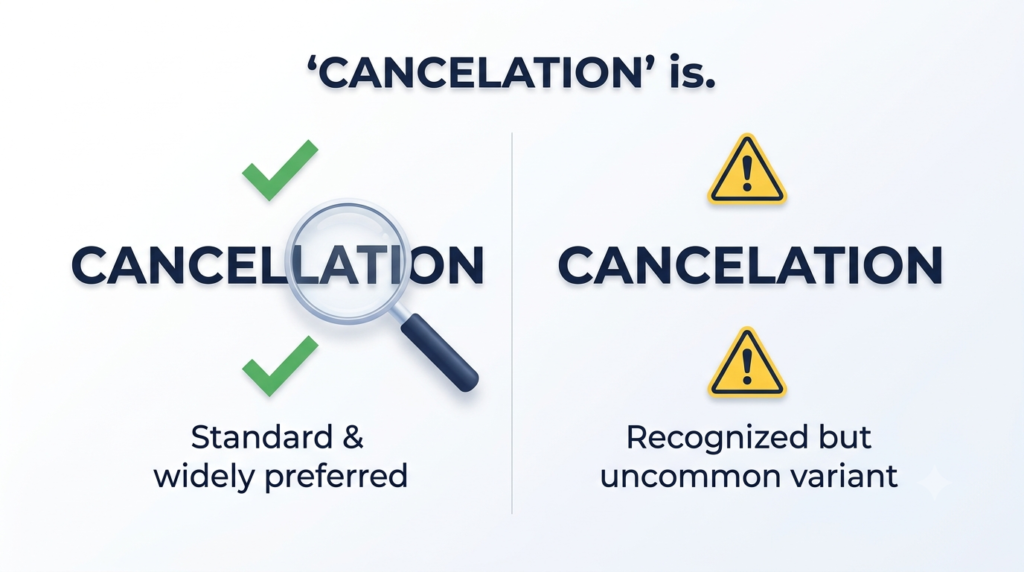
Cancellation is the standard and preferred spelling in most English writing. Cancelation is a recognized but uncommon variant.
There’s also a related spelling question that often causes confusion: canceled vs. cancelled. Unlike cancellation, those spellings vary depending on whether you are using American or British English.
Let’s look at the difference, when each spelling appears, and which form is best for everyday and professional writing.
Cancellation or Cancelation?
| Spelling | Status | Best Choice? |
|---|---|---|
| cancellation | Standard and widely used | ✅ Yes |
| cancelation | Recognized but uncommon variant | ⚠️ Usually avoid |
The simple rule
Cancellation is the standard and preferred spelling in most English writing.
For example:
- The flight cancellation caused major delays.
- We received a cancellation confirmation email.
- The hotel has a 24-hour cancellation policy.
- Please submit your cancellation request before Friday.
If you only remember one thing, remember this:
Cancellation is the standard spelling.
What Does “Cancellation” Mean?
Cancellation is a noun that means the act of stopping something that was planned, scheduled, arranged, or previously agreed upon.
It comes from the verb cancel, which means to decide that something will not happen or to stop an existing arrangement, service, order, appointment, or event.
You’ll commonly see cancellation in phrases such as:
- Flight cancellation
- Appointment cancellation
- Event cancellation
- Subscription cancellation
- Order cancellation
- Hotel cancellation
- Meeting cancellation
- Service cancellation
- Cancellation fee
- Cancellation policy
- Cancellation request
Examples of “cancellation”
The airline announced the cancellation of several flights because of bad weather.
I received confirmation of my appointment cancellation by email.
The storm caused the cancellation of the outdoor concert.
The company offered a full refund after the cancellation of the service.
In each example, cancellation is the standard spelling.
Is “Cancelation” Correct?
Yes. Cancelation is a recognized English variant, but it is much less common than cancellation.
You may occasionally encounter cancelation in American English or in individual publications and documents. However, cancellation is far more familiar to English readers and is the spelling most people expect.
For example:
The company announced the cancelation of the program.
The spelling is recognizable, but in most situations, cancellation would be the better choice.
So, should you use “cancelation”?
Usually, no.
If you are writing an email, article, assignment, business document, website, or other general-purpose content, choose:
cancellation ✅
If you encounter:
cancelation
you do not necessarily need to assume it is a typo. It is a recognized variant, just not the usual choice.
Why Does “Cancellation” Have Two Ls?
Cancellation is conventionally spelled with two Ls in both American and British English.
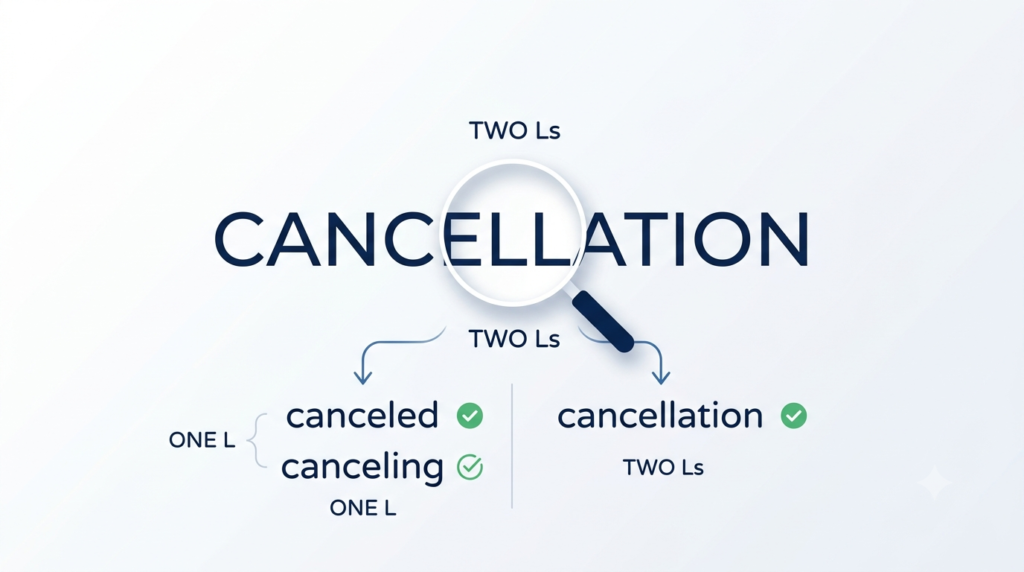
The confusion becomes clearer when you compare cancellation with the related forms of the verb cancel.
| Form | American English | British English |
|---|---|---|
| Base verb | cancel | cancel |
| Past tense | canceled | cancelled |
| -ing form | canceling | cancelling |
| Noun | cancellation | cancellation |
The important detail is that cancellation keeps two Ls in both American and British English.
That means American English can correctly use:
canceled → cancellation
There is no spelling contradiction.
Easy memory trick
🇺🇸 American English
- canceled
- canceling
- cancellation
🇬🇧 British English
- cancelled
- cancelling
- cancellation
So remember:
Canceled = one L in American English
Cancelled = two Ls in British English
Cancellation = two Ls in both
This is one of the easiest ways to keep the related spellings straight.
Cancellation vs. Cancelation in American English
American English is one place where you may encounter cancelation, but it is not the spelling most readers expect.
Cancellation remains the much more common and familiar form.
For example:
The airline announced the cancellation of the flight.
The customer requested a cancellation of the order.
The company has a strict cancellation policy.
You may occasionally see cancelation in American sources, but using cancellation is generally the safer choice for broad audiences.
One important point
Do not assume that because American English uses:
canceled
it must also use:
cancelation
It does not.
American English commonly uses:
canceled → cancellation
So the two-L spelling of the noun is perfectly normal in American English.
Cancellation vs. Cancelation in British English
In British English, cancellation is the standard spelling.
For example:
The cancellation of the match was announced because of heavy rain.
Please read our cancellation policy before booking.
A cancellation fee of £50 will apply.
Common British English phrases include:
- Cancellation policy
- Cancellation fee
- Cancellation notice
- Cancellation request
- Cancellation confirmation
- Cancellation date
If you are following British English spelling conventions, cancellation is the form to use.
What About “Canceled” vs. “Cancelled”?
This is a different spelling issue from cancellation vs. cancelation.
The difference between canceled and cancelled is mainly regional.
American English: Canceled
American English generally uses canceled with one L.
The flight was canceled because of bad weather.
British English: Cancelled
British English generally uses cancelled with two Ls.
The flight was cancelled because of bad weather.
The same distinction appears in the -ing form.
American English: Canceling
We are canceling the meeting.
British English: Cancelling
We are cancelling the meeting.
But the noun remains:
cancellation
Quick comparison
| Form | American English | British English |
|---|---|---|
| Past tense | canceled | cancelled |
| -ing form | canceling | cancelling |
| Noun | cancellation | cancellation |
So if you are writing in American English, you can use:
canceled, canceling, cancellation
If you are writing in British English, use:
cancelled, cancelling, cancellation
The key is to keep your regional spelling consistent.
Canceled or Cancelled: Which Spelling Is Correct?
Cancellation or Cancelation: Which Is Better for Professional Writing?
For professional writing, cancellation is the better choice because it is the familiar standard spelling used by readers across English-speaking regions.
Business email
We are writing to confirm the cancellation of your appointment.
Customer service
Your cancellation request has been received and processed.
Travel
Please review our flight cancellation policy before booking.
Events
Due to severe weather, the cancellation of the event has been announced.
Subscriptions
Your subscription cancellation will take effect at the end of the billing period.
Legal or formal writing
The cancellation of this agreement shall be made in writing.
Using cancellation helps you avoid an uncommon spelling and makes your writing immediately familiar to most readers.
Common Mistakes to Avoid
1. Assuming “cancelation” is the normal American spelling
It isn’t.
Although cancelation can be found in American English, cancellation is much more common.
2. Assuming “canceled” should become “cancelation”
This is a common spelling mistake.
The American English forms can correctly be:
canceled → cancellation
The spelling of the verb does not mean the noun must lose an L.
3. Mixing American and British spellings
If you are using American English, you would normally write:
canceled, canceling, cancellation
If you are using British English, you would normally write:
cancelled, cancelling, cancellation
Mixing regional spellings can make formal writing look inconsistent.
4. Calling “cancelation” a spelling error every time
Because cancelation is a recognized variant, it is not automatically a mistake when you encounter it.
However, cancellation is the more common and generally preferred form.
Cancellation vs. Cancelation: Side-by-Side Comparison
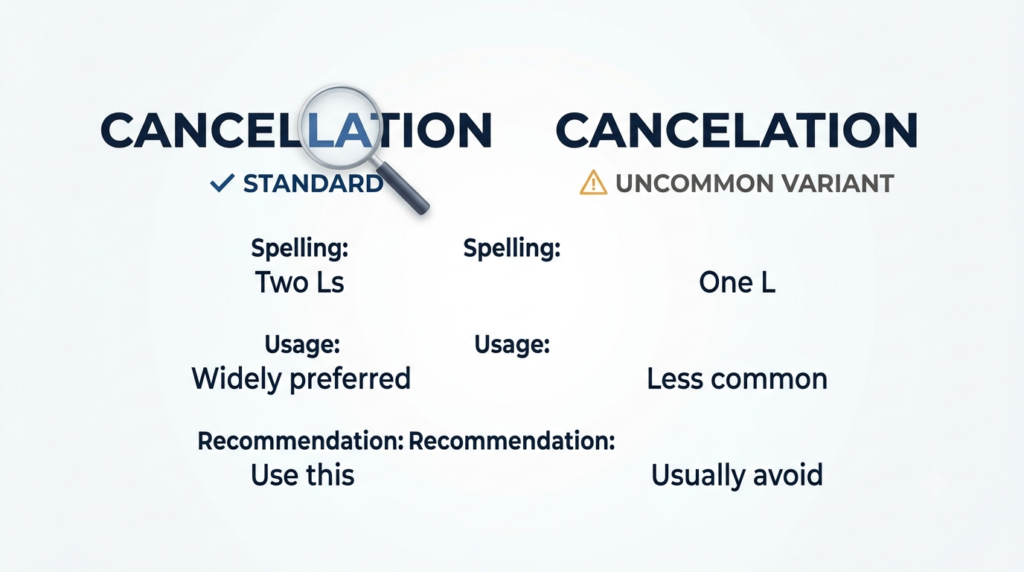
| Feature | Cancellation | Cancelation |
|---|---|---|
| Meaning | Act of canceling something | Act of canceling something |
| Spelling | Two Ls | One L |
| Status | Standard and widely used | Recognized variant |
| Frequency | Very common | Uncommon |
| American English | Common and preferred | Occasionally used |
| British English | Standard | Rare |
| Professional writing | ✅ Recommended | ⚠️ Usually avoid |
| General recommendation | ✅ Use it | ⚠️ Use only when required |
The two spellings refer to the same basic idea. The main difference is how commonly each form is used.
Canceling vs. Cancelling: Why Are There Two Spellings?
Real-World Examples of “Cancellation”
Travel
Due to unforeseen circumstances, we regret to inform you of the cancellation of Flight BA249.
Hotels
The hotel offers free cancellation up to 24 hours before check-in.
Retail
Your order cancellation has been processed. A refund will be issued within 3–5 business days.
Events
The festival organizers announced the cancellation of Sunday’s performances.
Subscriptions
To request a cancellation, please visit your account settings.
Healthcare
Please call at least 24 hours in advance for appointment cancellation to avoid fees.
Education
The cancellation of classes was announced because of the snowstorm.
Frequently Asked Questions
Is it “cancellation” or “cancelation”?
Cancellation is the standard and much more common spelling. Cancelation is a recognized but uncommon variant.
Is “cancelation” spelled with one L?
Yes. Cancelation has one L.
However, cancellation, with two Ls, is the spelling you will normally want to use.
Is “cancellation” spelled with two Ls?
Yes. Cancellation is spelled with two Ls and is the standard form in both American and British English.
Is “cancelation” correct in American English?
It can appear as a variant in American English, but cancellation is much more common and is generally the safer choice.
Is “cancellation” British or American?
Cancellation is used in both British and American English. The noun keeps the two-L spelling in both varieties.
Which is more common: “cancellation” or “cancelation”?
Cancellation is much more common. It is the form most readers are likely to expect in everyday, academic, professional, and online writing.
Is it “cancellation fee” or “cancelation fee”?
The standard phrase is cancellation fee.
The airline charged a cancellation fee of $75.
Is it “cancellation policy” or “cancelation policy”?
The standard phrase is cancellation policy.
Please read the hotel’s cancellation policy before booking.
What is the difference between “canceled” and “cancelled”?
Canceled is the usual American English spelling, while cancelled is the usual British English spelling.
Both forms are correct within their respective regional spelling conventions.
What is the difference between “canceling” and “cancelling”?
Canceling is the usual American English spelling, while cancelling is the usual British English spelling.
The meaning is the same.
Can I use “cancelation” in a formal document?
You may encounter cancelation in formal English sources, but cancellation is the more familiar and widely preferred spelling.
Unless a particular style guide or organization specifically requires cancelation, cancellation is usually the better choice.
Why does “cancellation” have two Ls?
Cancellation has a standard two-L spelling in both American and British English, even though American English commonly uses one L in canceled and canceling.
So American English can correctly use:
canceled → cancellation
A Simple Memory Trick
If these spellings keep getting mixed up, use this shortcut:
American English
canceled
canceling
cancellation
British English
cancelled
cancelling
cancellation
And when choosing between the two nouns:
✅ cancellation
⚠️ cancelation
Think:
Cancellation = two Ls.
Conclusion: Cancellation or Cancelation?
If you are choosing between cancellation and cancelation, go with:
✅ Cancellation — the standard and widely preferred spelling
⚠️ Cancelation — a recognized but uncommon variant
For most writing, cancellation is the better choice.
The related verb forms are different depending on the variety of English:
| American English | British English | |
|---|---|---|
| Past tense | canceled | cancelled |
| -ing form | canceling | cancelling |
| Noun | cancellation ✅ | cancellation ✅ |
So whether you are writing an email, assignment, business document, website, or article, cancellation is the spelling that will serve you best.
If you see cancelation, don’t panic. It is a recognized variant. But when you are choosing the spelling yourself, cancellation is the clear, familiar, and preferred choice.

Sophia Langley is an English grammar specialist and writing coach, passionate about simplifying language rules and empowering learners to write with clarity and confidence.