
Travelling or traveling—which spelling is correct? If that extra “l” has ever made you stop and second-guess your English, you’re not alone. The good news is simple: both “travelling” and “traveling” are correct spellings.
“Traveling” is the standard form in American English, while “travelling” is preferred in British English and is also common in Australian and New Zealand English. This small regional difference can become confusing when you’re writing for an international audience, especially because the same pattern appears in traveled vs. travelled and traveler vs. traveller.
If you’re writing for a U.S. audience, use “traveling”; for British, Australian, or New Zealand English, use “travelling.” In this guide, we’ll break down the spelling rule, explain why American and British English differ, show real examples, and make it easy to know which form to use every time you write about travel.
Travelling or Traveling?
| Spelling | English Variety | Status |
|---|---|---|
| traveling | American English | ✅ Standard |
| travelling | British English | ✅ Standard |
| travelling | Australian English | ✅ Standard |
| travelling | New Zealand English | ✅ Standard |
| travelling | Canadian English | ✅ Commonly used |
| travelling | Indian English | ✅ Commonly used |
The Simple Rule
🇺🇸 American English → traveling (one L)
🇬🇧 British English → travelling (two Ls)
Both spellings have the same meaning. The difference is primarily a matter of regional spelling convention.
What Do Travelling and Traveling Mean?
Travelling and traveling mean the same thing: going from one place to another, usually over some distance.
The word can describe travel for:
- Holidays and vacations
- Business
- Education
- Family visits
- Exploration
- Work or relocation
Examples
She enjoys travelling to new countries.
He is traveling across the United States.
We are travelling by train through Europe.
They are traveling for business.
The meaning does not change when you add or remove the second L.
Travelling vs. Traveling: Side-by-Side Comparison
| Form | American English | British English |
|---|---|---|
| Base verb | travel | travel |
| -ing form | traveling | travelling |
| Past tense | traveled | travelled |
| Past participle | traveled | travelled |
| Person | traveler | traveller |
Easy Memory Trick
US = one L
UK = two Ls
So:
- traveling → American English
- travelling → British English
- traveled → American English
- travelled → British English
- traveler → American English
- traveller → British English
Why Does American English Spell It “Traveling”?
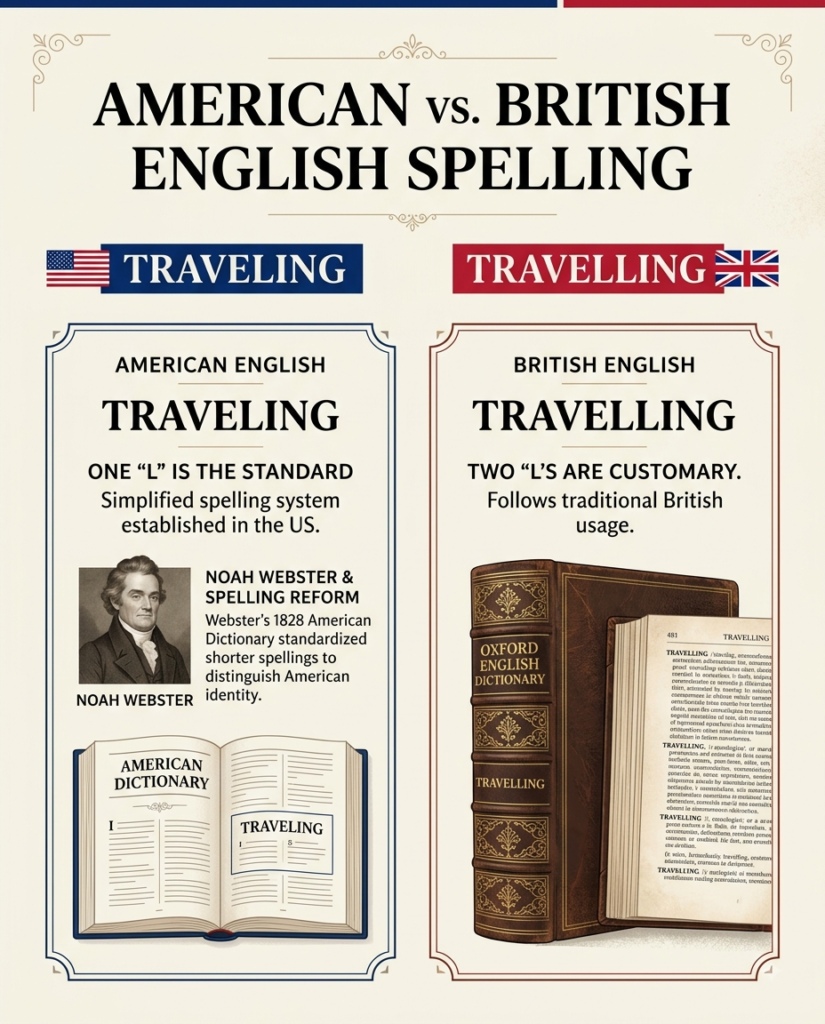
The difference is part of the broader history of American and British spelling.
| American English | British English |
|---|---|
| color | colour |
| center | centre |
| flavor | flavour |
| theater | theatre |
| traveling | travelling |
The spelling of traveling also fits American English conventions for consonant doubling. In words such as admit → admitting, the final consonant is doubled when the final syllable is stressed. But in travel → traveling, the stress falls on the first syllable, so American English normally keeps one L.
For everyday writing, however, you do not need to memorize the entire rule:
American English = traveling
British English = travelling
American English: When to Use “Traveling”
Use traveling when you’re following American English spelling conventions.
Examples
I am traveling to California next week.
She enjoys traveling alone.
We spent the summer traveling across the country.
He is traveling for business.
The traveler had traveled across Europe.
Related American forms include:
- traveling
- traveled
- traveler
British English: When to Use “Travelling”
Use travelling when you’re following British English spelling conventions.
Examples
I am travelling to London next week.
She enjoys travelling alone.
We spent the summer travelling around Europe.
He is travelling for work.
The traveller had travelled across Europe.
Related British forms include:
- travelling
- travelled
- traveller
Travelling or Traveling in Canada
Canadian English has influences from both British and American English, so spelling preferences can vary.
Travelling with two Ls is commonly used in Canadian English, although traveling also appears, particularly in contexts influenced by American usage.
If you’re writing professionally for a Canadian audience, the safest approach is to:
- Follow your organization’s style guide.
- Check the preferred Canadian reference for your type of writing.
- Use the same spelling convention consistently.
For example:
I enjoy travelling across Canada.
She is travelling to Toronto this summer.
Travelling or Traveling in Australia and New Zealand
Travelling with two Ls is the standard spelling in Australian and New Zealand English.
Australian English
We are travelling around Australia this summer.
She loves travelling overseas.
New Zealand English
I’m travelling to Queenstown this winter.
We enjoy travelling around the South Island.
The related forms are also normally spelled:
- travelled
- traveller
- travelling
Travelling or Traveling in India
Travelling with two Ls is commonly used in Indian English, reflecting the historical influence of British English spelling conventions.
Examples
I enjoy travelling to different parts of India.
She is travelling from Mumbai to Delhi.
They spent several months travelling through South India.
If your content is specifically aimed at Indian readers, travelling is generally the more natural choice.
Is “Travelling” Grammatically Correct?
Yes. Travelling is grammatically correct.
It is the British spelling of the -ing form of the verb travel.
For example:
I am travelling tomorrow.
She is travelling with her family.
We enjoy travelling together.
In American English, the same grammatical form is spelled traveling:
I am traveling tomorrow.
She is traveling with her family.
The difference is spelling, not grammar.
Is “I Am Travelling” Correct?
Yes. “I am travelling” is correct in British English.
It uses the present continuous structure:
am + travelling
For example:
I am travelling to London tomorrow.
I am travelling with my family.
I am travelling for work this week.
In American English, the equivalent is:
I am traveling to London tomorrow.
Both forms are correct; choose the spelling that matches the English variety you’re using.
Travelling or Traveling in Basketball
Traveling or travelling also has a specific meaning in basketball.
In this context, it refers to a violation that occurs when a player moves illegally while holding the ball, such as moving the pivot foot illegally or taking steps without properly dribbling.
The spelling still depends on the English variety:
| English Variety | Spelling |
|---|---|
| American English | traveling |
| British English | travelling |
Examples
The referee called traveling on the player. (US)
The referee called travelling on the player. (UK)
So the basketball meaning does not change the spelling rule.
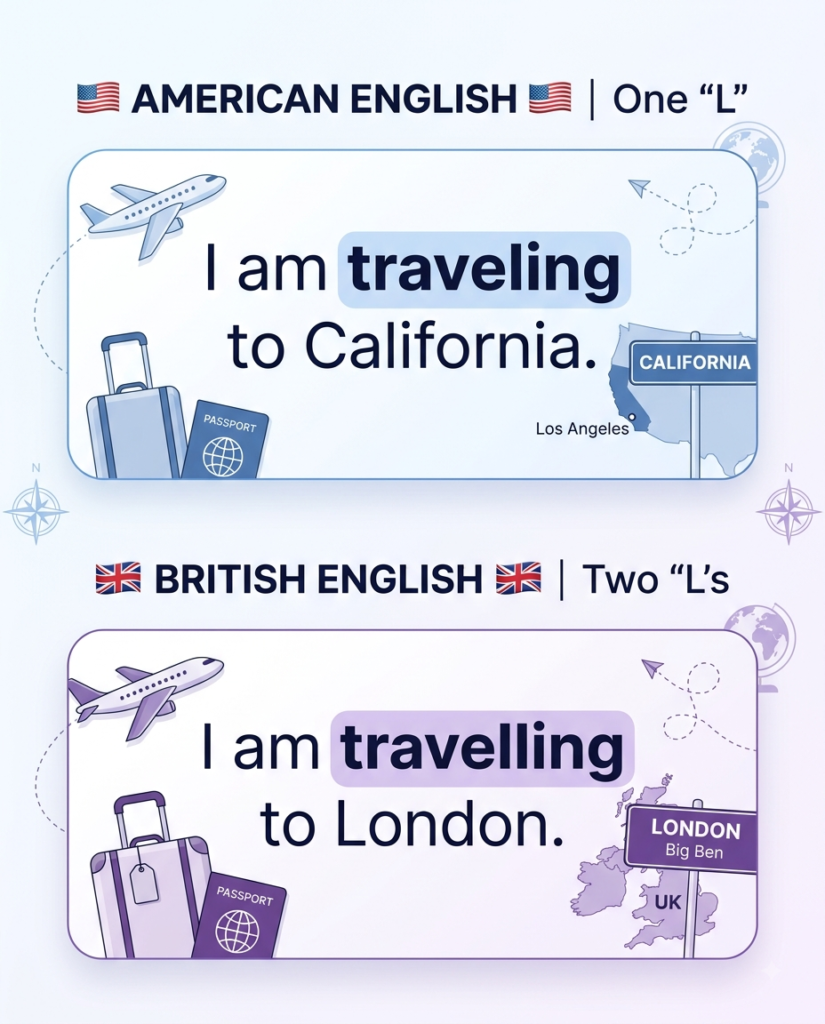
Travelling vs. Traveling: Examples
American English 🇺🇸
I love traveling to new places.
She is traveling abroad this summer.
We spent the summer traveling through Europe.
He is traveling for business.
The traveler had traveled extensively.
British English 🇬🇧
I love travelling to new places.
She is travelling abroad this summer.
We spent the summer travelling through Europe.
He is travelling for business.
The traveller had travelled extensively.
The meaning stays exactly the same. Only the spelling convention changes.
Canceling vs. Cancelling: Why Are There Two Spellings?
Common Mistakes to Avoid
1. Assuming One Spelling Is Wrong
The biggest mistake is thinking that one version is always incorrect.
- Traveling is standard in American English.
- Travelling is standard in British English.
Neither spelling is inherently wrong.
2. Mixing Regional Spellings
Try not to switch between the two forms in the same piece of writing.
Inconsistent:
❌ I enjoy traveling abroad, but I love travelling with friends.
American English:
✅ I enjoy traveling abroad, and I love traveling with friends.
British English:
✅ I enjoy travelling abroad, and I love travelling with friends.
3. Mixing Related Forms
The same regional difference applies to traveler/traveller and traveled/travelled.
American:
She is a frequent traveler who enjoys traveling.
British:
She is a frequent traveller who enjoys travelling.
Keeping related spellings consistent makes your writing look more polished.
4. Assuming Canadian English Is Exactly British or American
Canadian English has its own conventions and can show both British and American influences.
If you’re writing for a Canadian audience, follow the relevant Canadian style guide or your organization’s preferred style.
5. Letting Spell-Check Confuse You
Your writing software may flag one spelling depending on your selected language.
For example:
- US English may prefer traveling
- UK English may prefer travelling
A spelling being flagged does not automatically mean it is wrong. Check the language setting before changing it.
Cancellation or Cancelation: The Spelling Mystery Solved
Travelling vs. Traveling: Complete Comparison
| Feature | Travelling | Traveling |
|---|---|---|
| Number of Ls | Two | One |
| British English | ✅ Standard | Less typical |
| American English | Less typical | ✅ Standard |
| Australian English | ✅ Standard | Less typical |
| New Zealand English | ✅ Standard | Less typical |
| Canadian English | Commonly used | Also used |
| Indian English | Commonly used | Less common |
| Meaning | Same | Same |
| Grammar | Correct | Correct |
The key takeaway is simple:
Travelling and traveling mean the same thing. The spelling mainly depends on regional English conventions.
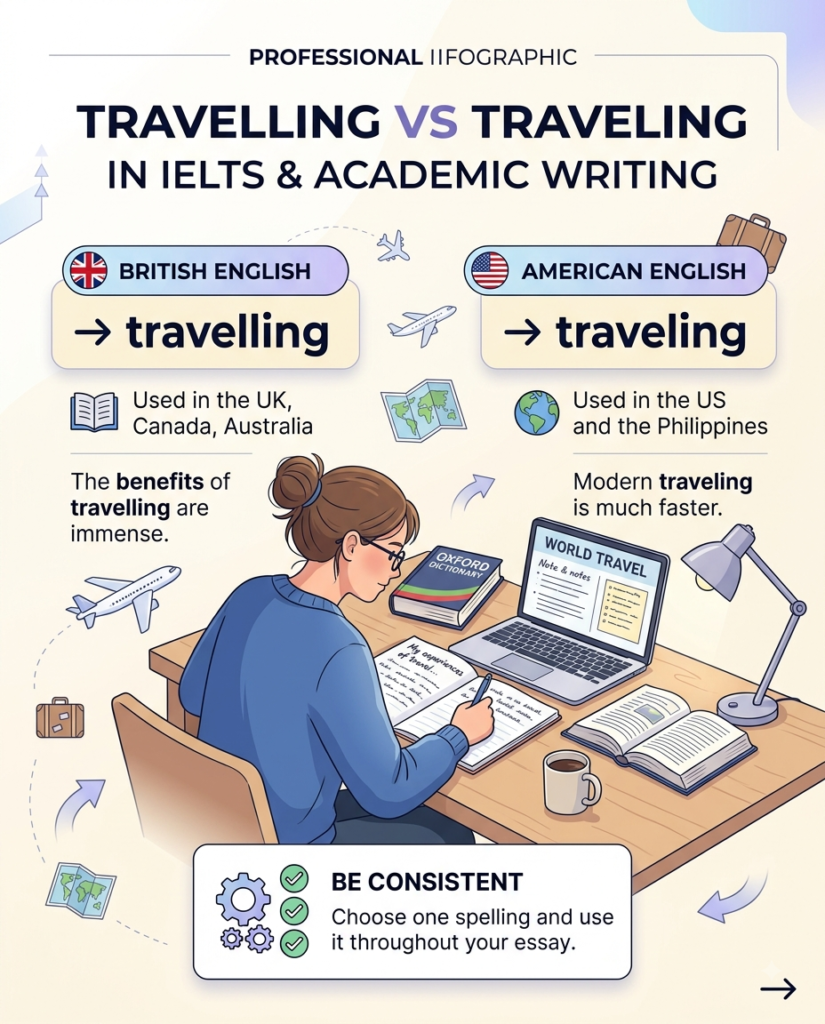
Travelling or Traveling in IELTS and Academic Writing
If you’re writing an IELTS essay, academic assignment, or other formal piece, the most important point is consistency.
If you use British English:
I enjoy travelling with my family and have travelled to several countries.
If you use American English:
I enjoy traveling with my family and have traveled to several countries.
Avoid switching between the two conventions without a reason.
If your school, university, examination, or organization specifies a particular English variety, follow its requirements.
Quick Decision Guide
| Situation | Recommended Spelling |
|---|---|
| US audience | traveling |
| UK audience | travelling |
| Australian audience | travelling |
| New Zealand audience | travelling |
| Indian audience | travelling |
| Canadian audience | travelling is common; check your style guide |
| Global website | Choose one and stay consistent |
| Social media | Either, depending on your audience |
| Academic writing | Follow the required style |
| Business writing | Follow your organization’s style guide |
The Golden Rule
Match your audience’s English variety and stay consistent.
Other Words With the Same US/UK Pattern
The spelling difference appears in several other words:
| US English | UK English |
|---|---|
| canceling | cancelling |
| canceled | cancelled |
| labeling | labelling |
| labeled | labelled |
| modeling | modelling |
| modeled | modelled |
| signaling | signalling |
| signaled | signalled |
| traveling | travelling |
| traveled | travelled |
| traveler | traveller |
These examples can help you recognize the broader spelling pattern.
Frequently Asked Questions
Is it travelling or traveling?
Both are correct. Traveling is the standard American English spelling, while travelling is the standard British English spelling.
Which is correct: travelling or traveling?
Both are correct. Use traveling for American English and travelling for British English.
Is travelling grammatically correct?
Yes. Travelling is grammatically correct. It is the British spelling of the -ing form of travel.
Is “I am travelling” correct?
Yes. “I am travelling” is correct in British English. American English uses “I am traveling.”
Is “I am traveling” also correct?
Yes. “I am traveling” is the standard American English form.
How do you spell traveling in Canada?
Both forms can be found in Canadian English, but travelling with two Ls is commonly used. For professional writing, follow the relevant Canadian or organizational style guide.
Is it traveling or travelling in India?
Travelling is commonly used in Indian English and is generally the preferred choice when following British-influenced spelling conventions.
Is it travelling or traveling in Australia?
Travelling is the standard Australian English spelling.
Is it travelling or traveling in New Zealand?
Travelling is the standard New Zealand English spelling.
Is travelling British English?
Yes. Travelling is the standard British English spelling.
Is traveling American English?
Yes. Traveling is the standard American English spelling.
What is the difference between travelling and traveling?
There is no difference in meaning. Travelling is the British spelling, while traveling is the American spelling.
What is the difference between traveller and traveler?
Traveller is the British spelling, while traveler is the American spelling.
What is the difference between travelled and traveled?
Travelled is the British spelling, while traveled is the American spelling.
Can I use traveling in British English?
People will understand it, but travelling is the standard British spelling and is the better choice for UK-focused writing.
Can I use travelling in American English?
People will understand it, but traveling is the standard American spelling and is the better choice for US-focused writing.
Conclusion: Travelling or Traveling?
If you’re wondering “Travelling or traveling—which is correct?”, the answer is:
Both are correct.
| American English 🇺🇸 | British English 🇬🇧 |
|---|---|
| traveling | travelling |
| traveled | travelled |
| traveler | traveller |
Which One Should You Use?
- Writing for a US audience? Use traveling.
- Writing for a UK audience? Use travelling.
- Writing for Australia or New Zealand? Use travelling.
- Writing for India? Travelling is commonly used.
- Writing for Canada? Travelling is common, but check your style guide.
- Writing for a global audience? Either is fine—just choose one spelling convention and use it consistently.
The Bottom Line
Traveling = American English 🇺🇸
Travelling = British English 🇬🇧
Neither spelling is a mistake. The best choice depends on your audience, your chosen English variety, and the style you need to follow.
Once you choose one, keep your related spellings consistent: traveling/traveled/traveler or travelling/travelled/traveller.

Elias Worden is a trusted grammar expert and writing mentor, dedicated to simplifying English rules and helping learners write with clarity, precision, and confidence.