
Is it “travelled” or “traveled”? If you’ve ever stared at that extra “l” and wondered whether you’ve been spelling the word wrong, you’re not alone. The good news is that both spellings are correct—the difference simply depends on the variety of English you’re using.
“Traveled” is the standard spelling in American English, while “travelled” is the standard spelling in British English and is also widely used in other varieties, including Australian and New Zealand English. The same regional pattern appears in traveling vs. travelling and traveler vs. traveller, which is why you may see different spellings even when everyone is talking about the same thing.
| American English | British English |
|---|---|
| traveled | travelled |
| traveling | travelling |
| traveler | traveller |
So, is travelled or traveled correct? Both are correct. If you’re writing for an American audience, choose traveled; for British English, choose travelled. In this guide, we’ll explain the spelling rule, show real examples, and make it easy to know which form to use every time.
Travelled or Traveled?
Traveled is the standard American English spelling, while travelled is the standard British English spelling.
| Spelling | English variety | Correct? |
|---|---|---|
| traveled | American English | ✅ Yes |
| travelled | British English | ✅ Yes |
| traveling | American English | ✅ Yes |
| travelling | British English | ✅ Yes |
The easiest rule
🇺🇸 US English → traveled with one L
🇬🇧 UK English → travelled with two Ls
There is no difference in meaning between the two spellings. The difference is simply regional spelling.
Is It Travelled or Traveled?
If you’re wondering “is it travelled or traveled?”, either spelling can be correct.
The choice depends on the English convention you’re following.
American English
I traveled to New York last summer.
British English
I travelled to London last summer.
This is why seeing traveled in an American article and travelled in a British article doesn’t mean one writer made a spelling mistake.
What Does Travelled or Traveled Mean?
Travelled and traveled are past-tense and past-participle forms of the verb travel.
To travel means to make a journey or move from one place to another, often over some distance. Cambridge gives the UK form as travelled and the US form as traveled.
Examples
| American English 🇺🇸 | British English 🇬🇧 |
|---|---|
| She traveled across the United States. | She travelled across the United States. |
| We traveled to Paris last year. | We travelled to Paris last year. |
| They traveled by train. | They travelled by train. |
The meaning remains the same.
Travelled Meaning
Travelled means that someone went from one place to another or made a journey. It is the usual British English spelling.
Traveled Meaning
Traveled has exactly the same meaning but is the usual American English spelling.
How Do You Spell Travelled or Traveled?
The spelling depends on the English variety:
| Form | American English 🇺🇸 | British English 🇬🇧 |
|---|---|---|
| Past tense | traveled | travelled |
| Past participle | traveled | travelled |
| -ing form | traveling | travelling |
| Person | traveler | traveller |
Easy way to remember
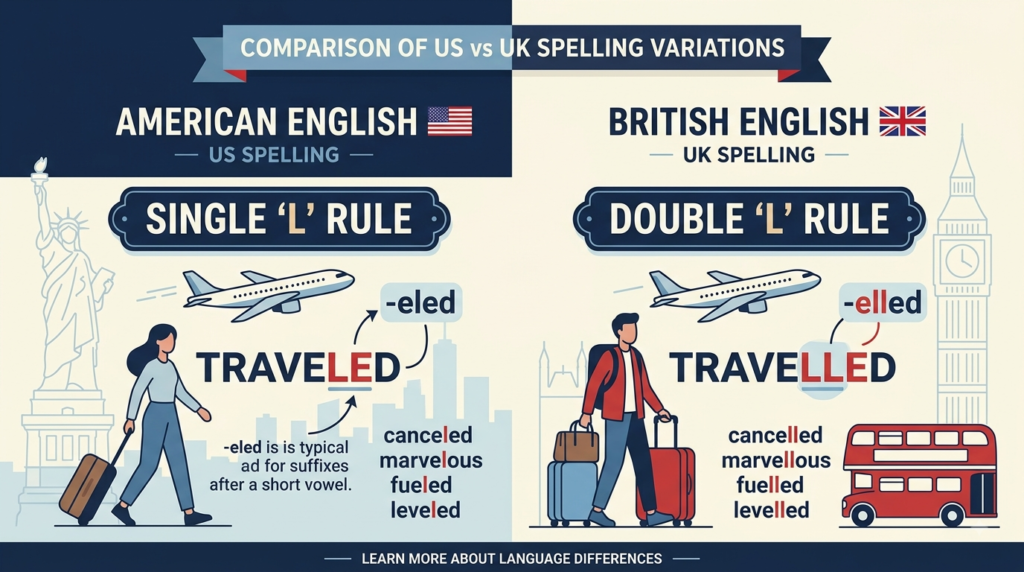
US = one L → traveled
UK = two Ls → travelled
Travelled vs. Traveled: Side-by-Side Comparison
Here’s the whole spelling family at a glance:
| American English 🇺🇸 | British English 🇬🇧 |
|---|---|
| travel | travel |
| traveled | travelled |
| traveling | travelling |
| traveler | traveller |
This is useful because the spelling difference doesn’t apply only to travelled/traveled. The same regional pattern appears in the -ing and -er forms.
Travelled or Traveled Examples
American English 🇺🇸
- I traveled to California last summer.
- She has traveled to several countries.
- We traveled by train.
- He traveled across Europe.
- The family traveled together during the holidays.
British English 🇬🇧
- I travelled to California last summer.
- She has travelled to several countries.
- We travelled by train.
- He travelled across Europe.
- The family travelled together during the holidays.
The meaning doesn’t change. Only the regional spelling does.
Why Do We Double the L in Travelled?
One of the most common questions is “Why do we double the L in travelled?”
The answer is that British and American English developed different spelling conventions.
British English generally retains the two-L spelling:
travel → travelled → travelling → traveller
American English generally uses one L:
travel → traveled → traveling → traveler
You can see a similar difference in other words:
| American English 🇺🇸 | British English 🇬🇧 |
|---|---|
| canceled | cancelled |
| labeled | labelled |
| modeled | modelled |
| traveled | travelled |
| traveling | travelling |
| traveler | traveller |
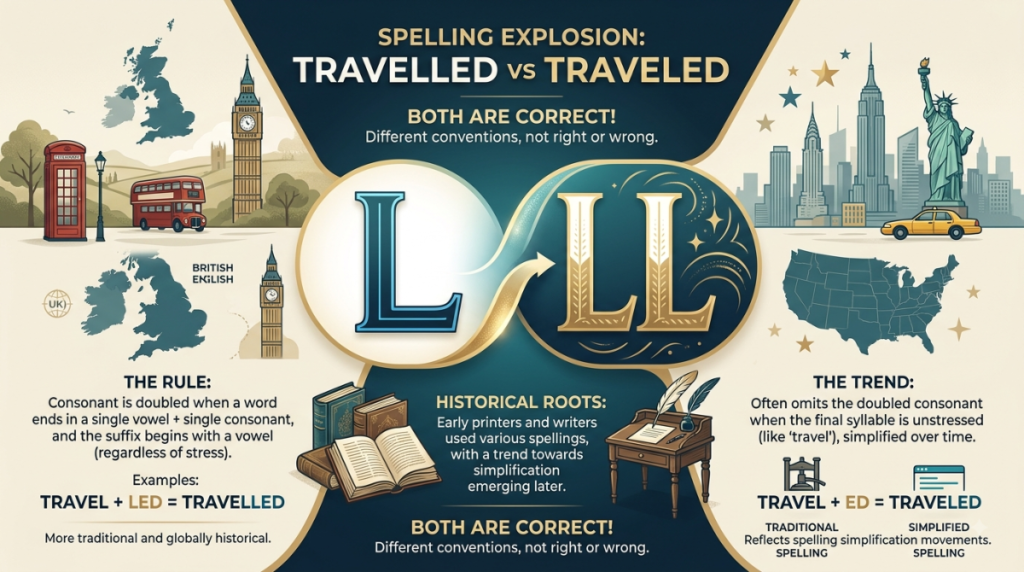
The easiest approach is not to memorize a complicated rule. Just remember which English variety you’re using.
Is It Correct to Say Traveling?
Yes. Traveling is completely correct.
It is the standard American English spelling of the -ing form. In British English, the spelling is travelling. Cambridge explicitly identifies traveling as the US spelling of travelling.
Examples
American English:
I am traveling to Boston tomorrow.
British English:
I am travelling to London tomorrow.
Neither form is grammatically wrong.
Travelled or Traveled in the UK and US
The distinction is straightforward:
United States 🇺🇸
Use:
- traveled
- traveling
- traveler
Example:
She traveled across the country.
United Kingdom 🇬🇧
Use:
- travelled
- travelling
- traveller
Example:
She travelled across the country.
Travelled or Traveled in Canada
Canadian English can be more complicated because it has influences from both British and American English.
Travelled and travelling are commonly used in Canadian English, while traveled and traveling can also appear depending on the publication or style being followed.
If you’re writing for a Canadian audience, the best approach is to:
- Follow your organization’s style guide.
- Check the spelling used throughout your document.
- Keep your spelling consistent.
Travelled or Traveled in Australia
Travelled is the standard spelling used in Australian English.
For example:
We travelled around Australia during the summer.
The related forms are also commonly written:
- travelling
- traveller
If you’re writing specifically for an Australian audience, travelled is the natural choice.
Travelled or Traveled: UK Spelling
If you’re asking for the UK spelling, use:
✅ travelled
Examples:
- I travelled to Manchester last week.
- She has travelled extensively.
- They travelled around Europe by train.
The related UK forms are:
- travelling
- traveller
Travelled or Traveled: US Spelling
If you’re writing American English, use:
✅ traveled
Examples:
- I traveled to Chicago last week.
- She has traveled extensively.
- They traveled around Europe by train.
The related US forms are:
- traveling
- traveler
Travelling or Traveling: One Word, Two Englishes
Travelled or Traveled in Other English Varieties
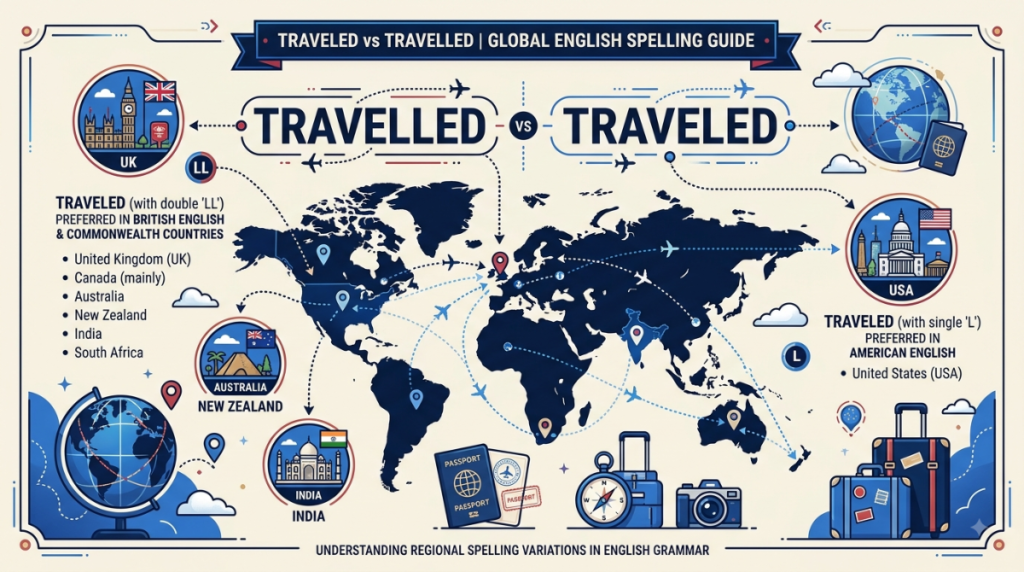
Spelling preferences can vary across English-speaking regions, so it is better to treat the following as general conventions rather than absolute rules.
| Region | Common form |
|---|---|
| 🇺🇸 United States | traveled |
| 🇬🇧 United Kingdom | travelled |
| 🇦🇺 Australia | travelled |
| 🇳🇿 New Zealand | travelled |
| 🇮🇪 Ireland | travelled |
| 🇮🇳 India | travelled |
| 🇨🇦 Canada | travelled is common; usage varies |
For professional writing, always prioritize the style guide required by your audience or organization.
Traveled To or Too: Which Is Correct?
To and too are different words, so this is a separate spelling issue.
Use to when you’re talking about a destination:
- I traveled to Paris.
- She traveled to Canada.
- We travelled to London.
Use too when you mean also:
I traveled to Paris, too.
So:
❌ I traveled too Paris.
✅ I traveled to Paris.
The same rule applies whether you write traveled or travelled.
Travelled or Traveled Pronunciation
The spelling difference does not normally create a meaningful pronunciation difference.
The extra l in travelled does not mean that British English speakers pronounce the word as a completely different word.
The main difference between traveled and travelled is spelling, not meaning.
What Do Dictionaries Say?
Major dictionaries recognize the regional difference.
| Dictionary | What it shows |
|---|---|
| Cambridge Dictionary | UK travelled, US traveled |
| Oxford Learner’s Dictionaries | travelled with traveled listed as the US form |
| Oxford American Dictionary | traveled as the American form |
So if you searched for “travelled or traveled Oxford dictionary,” you’re looking at a regional spelling difference rather than two words with different meanings.
Travelled or Traveled According to Style Guides
If you’re writing professionally, consistency is more important than choosing one spelling as universally correct.
For American English writing, you’ll normally see:
traveled, traveling, traveler
For British English writing, you’ll normally see:
travelled, travelling, traveller
If your employer, school, publisher, or organization provides a style guide, follow it.
The important thing is to avoid switching between American and British spellings without a reason.
Cancellation or Cancelation: The Spelling Mystery Solved
Common Mistakes to Avoid
1. Assuming One Spelling Is Always Wrong
❌ “Travelled is always wrong.”
❌ “Traveled is always wrong.”
Both statements are incorrect.
The correct spelling depends on the English variety.
2. Mixing US and UK Spellings
Avoid:
❌ She is a traveller who loves traveling.
Choose one spelling system:
✅ She is a traveler who loves traveling.
Or:
✅ She is a traveller who loves travelling.
3. Forgetting the Related Forms
If you’re using American English:
traveled → traveling → traveler
If you’re using British English:
travelled → travelling → traveller
Keeping the spelling family consistent makes your writing cleaner.
4. Thinking Spell-Check Means the Other Form Is Wrong
Your writing software may flag travelled if your document is set to US English.
Likewise, it may flag traveled if your document is set to UK English.
That doesn’t necessarily mean the word is incorrect. Your spell-checker may simply be using a different regional dictionary.
Travelled vs. Traveled in Academic Writing
For essays, assignments, research papers, and other academic writing, follow the spelling convention required by your institution or instructor.
British English
I travelled to several countries during my research.
American English
I traveled to several countries during my research.
Both can be correct. Consistency is the key.
Travelled vs. Traveled in IELTS
IELTS accepts both British and American spelling conventions. Official IELTS information states that the test accepts either British or American spellings.
So you can write:
I traveled abroad because I enjoy traveling.
Or:
I travelled abroad because I enjoy travelling.
The important thing is to spell words correctly and avoid unnecessary inconsistencies.
Other Words With the Same Spelling Pattern
The difference between traveled and travelled is part of a broader US/UK spelling pattern.
| American English 🇺🇸 | British English 🇬🇧 |
|---|---|
| canceled | cancelled |
| canceling | cancelling |
| labeled | labelled |
| labeling | labelling |
| modeled | modelled |
| modeling | modelling |
| traveled | travelled |
| traveling | travelling |
| traveler | traveller |
Once you recognize the pattern, similar spelling differences become much easier to understand.
Which Spelling Should You Use?
Use this simple guide:
| If you’re writing for… | Use |
|---|---|
| 🇺🇸 US readers | traveled |
| 🇬🇧 UK readers | travelled |
| 🇦🇺 Australian readers | travelled |
| 🇳🇿 New Zealand readers | travelled |
| 🇮🇳 Indian readers | travelled |
| 🇨🇦 Canadian readers | travelled is common; check the style guide |
| 🌎 International audience | Choose one convention and stay consistent |
| Academic writing | Follow your institution’s requirements |
| Business writing | Follow your organization’s style guide |
Frequently Asked Questions
Is travelled or traveled correct?
Both are correct. Traveled is the usual American English spelling, while travelled is the usual British English spelling.
Is it spelled travelled or traveled?
Both spellings are correct. Use traveled for American English and travelled for British English.
How do you spell travelled or traveled?
For US English, write traveled with one L. For UK English, write travelled with two Ls.
Why do we double the L in travelled?
British English uses travelled, while American English generally uses traveled. The difference comes from regional spelling conventions.
Is it correct to say traveling?
Yes. Traveling is the standard American English spelling. Travelling is the British English spelling.
Is travelled the UK spelling?
Yes. Travelled is the standard UK spelling.
Is traveled the US spelling?
Yes. Traveled is the standard US spelling.
What is the difference between travelled and traveled?
There is no difference in meaning. The difference is regional spelling.
What is the difference between traveler and traveller?
Traveler is the American spelling, while traveller is the British spelling.
What is the difference between traveling and travelling?
Traveling is the American spelling, while travelling is the British spelling.
Is “I have traveled” correct?
Yes. I have traveled is correct American English.
In British English, you would write:
I have travelled.
Is “I have travelled” correct?
Yes. I have travelled is correct British English.
In American English, the equivalent is:
I have traveled.
Final Answer: Travelled or Traveled?
So, is travelled or traveled correct?
Both are correct.
The difference is simply regional:
| American English 🇺🇸 | British English 🇬🇧 |
|---|---|
| traveled | travelled |
| traveling | travelling |
| traveler | traveller |
Remember:
Traveled = one L = American English 🇺🇸
Travelled = two Ls = British English 🇬🇧
If you’re writing for a specific audience, match its preferred spelling. If you’re writing for an international audience, choose one convention and use it consistently.
That’s the simple answer to the travelled or traveled spelling question.

Victor Penhall is an English grammar specialist and writing coach, helping learners strengthen their language skills with clear rules, smart tips, and precise guidance.