
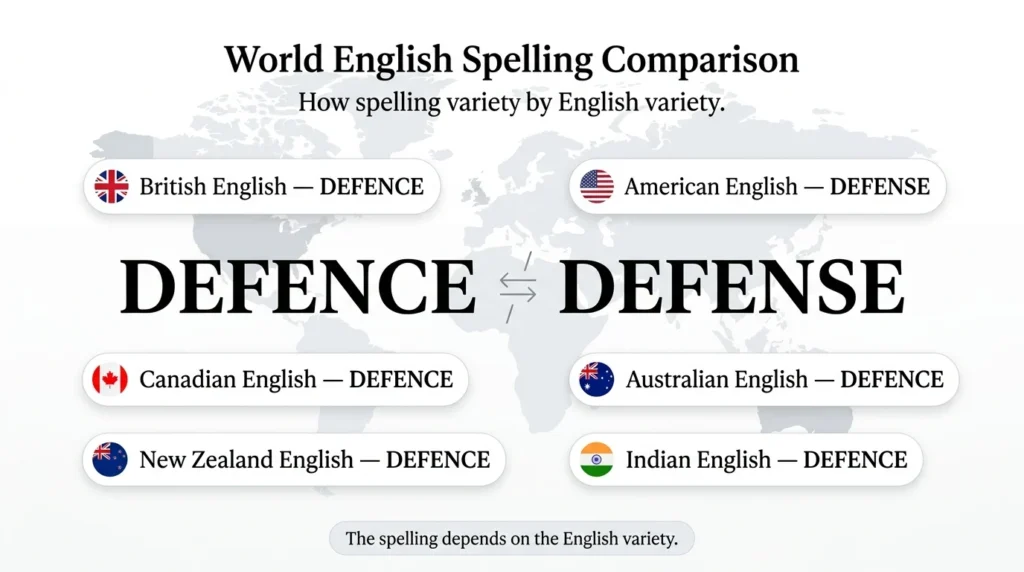
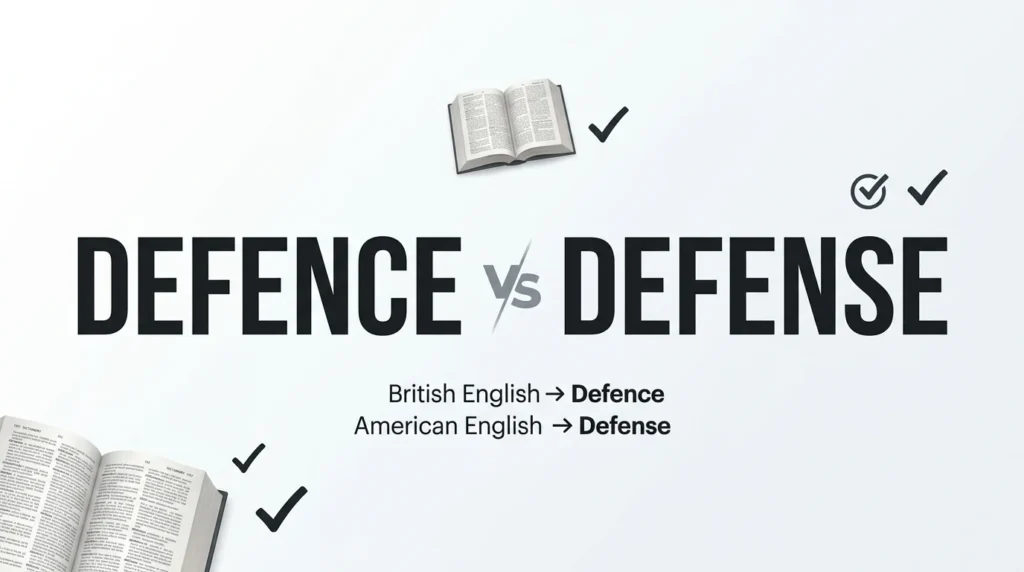
**Is it “defence” or “defense”? If you’ve seen both spellings and wondered whether one is a mistake, the answer is simple: both are correct. The difference is mainly regional. Defence is the standard spelling in British English, while defense is the standard spelling in American English.
The same distinction generally applies to related forms such as defensive and defender, although not every related word changes from -ce to -se. In other English varieties, including Australian, New Zealand, and Indian English, defence is widely used, while Canadian English commonly uses defence as well, alongside some variation by style and institution.
The word itself has the same core meaning in both forms and can refer to protection from attack, military protection, a legal case, or the act of stopping an opponent from scoring in sports. So, which spelling should you use? Choose “defense” for American English and “defence” for British English and other varieties that follow the British spelling convention, and keep your spelling consistent with the style you’re following.
Defence or Defense:
| English variety | Preferred spelling |
|---|---|
| 🇬🇧 British English | defence |
| 🇺🇸 American English | defense |
| 🇦🇺 Australian English | defence |
| 🇳🇿 New Zealand English | defence |
| 🇮🇳 Indian English | defence is widely used |
| 🇨🇦 Canadian English | defence is commonly used |
For example:
British English:
The country strengthened its national defence.
American English:
The country strengthened its national defense.
The meaning is the same. Only the spelling changes.
Defence vs. Defense: What’s the Difference?
The difference between defence and defense is primarily a spelling difference between English varieties.
| Spelling | Common association | Meaning |
|---|---|---|
| defence | British English and other varieties influenced by it | Protection or resistance against a threat |
| defense | American English | Protection or resistance against a threat |
Both forms are nouns and generally have the same pronunciation and meaning.
For example:
The soldiers prepared a strong defence against the attack.
The soldiers prepared a strong defense against the attack.
There is no difference in the basic idea being expressed.
You may see similar British-American spelling differences in words such as offence/offense, licence/license, and organisation/organization. However, related words do not always follow a simple spelling-conversion rule, so it is important to learn the individual forms.
What Does Defence or Defense Mean?
The basic defence/defense meaning is protection against harm, attack, danger, criticism, or another threat.
The exact meaning depends on the context.
1. Protection Against an Attack
Defence or defense can describe an action, strategy, structure, or system intended to protect against an attack.
British English:
The castle had strong defences against invading forces.
American English:
The castle had strong defenses against invading forces.
2. Military Protection
In a military context, defence/defense can refer to the protection of a country, its territory, or its people.
British English:
The government increased spending on national defence.
American English:
The government increased spending on national defense.
This is why you may see expressions such as:
- national defence / national defense
- defence policy / defense policy
- defence forces / defense forces
- defence strategy / defense strategy
- defence systems / defense systems
3. Legal Defence or Defense
In law, defence/defense can refer to the argument, case, or legal position presented in response to an accusation or claim.
British English:
The lawyer prepared a strong defence for her client.
American English:
The lawyer prepared a strong defense for her client.
The legal concept is essentially the same; the spelling depends on the English variety and legal system.
4. Sports
In sports, defence/defense can refer to the players, positioning, tactics, or actions intended to prevent an opponent from scoring.
British English:
The team’s defence was outstanding.
American English:
The team’s defense was outstanding.
5. Protection From Something Harmful
The word can also refer more generally to protection against something harmful.
British English:
Exercise can provide some defence against illness.
American English:
Exercise can provide some defense against illness.
Is It Defence or Defense in British English?
If you are writing British English, use defence.
Examples include:
- national defence
- self-defence
- defence policy
- legal defence
- football defence
- defence strategy
For example:
- The government announced a new national defence policy.
- The team’s defence prevented the opposition from scoring.
- She learned self-defence techniques.
- The defence presented its final argument.
So if you’re searching for “defence or defense UK?”, the simple answer is:
Defence is the standard British spelling.
Is It Defence or Defense in American English?
If you are writing American English, use defense.
Examples include:
- national defense
- defense policy
- defense attorney
- defense strategy
- defense system
- self-defense
For example:
- The country increased its national defense budget.
- The team’s defense was excellent.
- The defense attorney questioned the witness.
- She learned self-defense techniques.
So if you’re writing for an American audience, defense is normally the correct choice.
Defence or Defense in Canada
Canadian English has spelling conventions that include influences from both British and American English.
For this particular word, defence is commonly used in Canadian English, including in many formal and institutional contexts. However, Canadian spelling can vary depending on the publication, organization, dictionary, or style guide being followed.
For example:
- The government announced a new defence policy.
- The team needs to improve its defence.
- The country’s defence forces were reorganized.
If you are writing for a Canadian university, company, publication, or government organization, follow its preferred style guide when one is available.
The key point: don’t assume that Canadian English must always follow either British or American spelling as a whole. Individual words can have their own established Canadian conventions.
Defence or Defense in Australia
In Australian English, defence is the usual spelling.
Examples:
- The government announced a new defence strategy.
- She learned self-defence techniques.
- The team’s defence was difficult to break through.
If you’re writing for an Australian audience, defence is generally the appropriate choice.
Defence or Defense in New Zealand
In New Zealand English, defence is generally used.
Examples:
- The country strengthened its national defence.
- The team’s defence was outstanding.
- He studied self-defence.
For general New Zealand English, defence is normally the spelling you should use unless a particular organization or publication specifies another form.
Defence or Defense in India
Defence is widely used in Indian English, particularly in formal, governmental, academic, and institutional contexts.
Examples:
- The country has invested heavily in national defence.
- He joined the defence services.
- The Ministry of Defence announced the new policy.
You may also encounter defense in American publications, international websites, software, and other globally oriented material.
If you are following a British-influenced Indian English style, defence is the natural choice.
Defence or Defense in Europe
There is no single spelling rule for all of Europe because European countries have different languages and their own conventions for writing English.
When English is used, the choice generally depends on whether the writer, institution, university, publisher, or organization follows British English or American English.
| English convention | Spelling |
|---|---|
| British-style English | defence |
| American-style English | defense |
So if you’re wondering about defence or defense in Europe, don’t assume the entire continent uses one spelling. Check the English style followed by the specific organization or publication.
Defence or Defense in Football
If you’re wondering whether it is defence or defense in football, the answer depends on the variety of English.
British football
British English normally uses:
defence
Example:
The team’s defence was outstanding.
American sports English
American English uses:
defense
Example:
The team’s defense was outstanding.
The football concept itself does not change. The spelling reflects the English variety being used.
Common football terms
You may see:
- defence line / defense line
- defensive midfielder
- defensive player
- defensive tactics
- defence coach / defense coach
One important point is that defensive is spelled with an s in both British and American English.
Defence or Defense in the Army and Military
Defence/defense is especially common in military contexts.
It can refer to:
- protection of a country
- military strategy
- national security
- armed forces
- military equipment
- defensive systems
- protection against attacks
- military planning
For example:
British English:
The government announced a new defence strategy.
American English:
The government announced a new defense strategy.
You may also encounter:
- defence force / defense force
- defence policy / defense policy
- national defence / national defense
- defence ministry / defense department
When referring to a specific official organization, however, don’t change its official name simply to match your preferred spelling.
Ministry of Defence or Department of Defense?
This is an important distinction because official names are proper names.
For example:
| Country | Official name |
|---|---|
| 🇬🇧 United Kingdom | Ministry of Defence |
| 🇺🇸 United States | Department of Defense |
If you are referring to these organizations by their official names, preserve their established spelling.
The simple rule
Ordinary word: follow your English variety.
Official name: use the organization’s official spelling.
So you should not casually change:
❌ Ministry of Defence → Ministry of Defense
or:
❌ Department of Defense → Department of Defence
when referring to the official organization.
Defence or Defense in Law
In legal English, defence/defense can refer to the argument or legal position presented in response to an accusation or claim.
| English variety | Spelling |
|---|---|
| British-style legal English | defence |
| American legal English | defense |
Examples:
British English:
The defence presented its final argument.
American English:
The defense presented its final argument.
The underlying legal concept is the same, but legal terminology can vary between jurisdictions.
Defence or Defense Attorney
The phrase defense attorney is strongly associated with American English.
Example:
The defense attorney questioned the witness.
In British English, legal writing more commonly uses defence:
The defence presented its case.
If you’re writing about a particular legal system, use the terminology normally used in that jurisdiction rather than simply converting every word from one spelling system to another.
Defence or Defense in Research
If you’re searching for defence or defense in research, the answer depends on the English convention used by the university, journal, publisher, or institution.
For example:
British-style English:
The researcher successfully completed her thesis defence.
American English:
The researcher successfully completed her thesis defense.
In academic contexts, defence/defense can refer to the formal process in which a researcher presents and answers questions about a thesis or dissertation.
Always check your institution’s terminology
A university may use:
- PhD Defence
- PhD Defense
- Thesis Defence
- Thesis Defense
- Doctoral Defence
- Doctoral Defense
If the term appears as part of an official institutional name or program title, follow the institution’s own spelling.
PhD Defence or Defense?
Both PhD defence and PhD defense are used.
The choice depends on the English variety and, in some cases, the terminology preferred by the university.
British-style English:
She successfully completed her PhD defence.
American English:
She successfully completed her PhD defense.
Both refer to the same basic academic process: a doctoral candidate presents and defends their research before an academic committee.
Which one should you use?
If your university has an official style or uses one form consistently, follow it.
There is no universal rule saying that PhD defence is always correct or that PhD defense is always correct.
Thesis Defence or Defense?
The same principle applies to thesis defence and thesis defense.
British-style English:
He is preparing for his thesis defence.
American English:
He is preparing for his thesis defense.
If your university provides a preferred spelling, use that spelling throughout your academic work.
Theatre or Theater: Which Version Fits Your English?
What Is the Difference Between Defence and Protection?
Although defence and protection can overlap in meaning, they are not always interchangeable.
| Word | General idea | Example |
|---|---|---|
| Protection | Keeping someone or something safe from harm | Sunscreen provides protection from the sun. |
| Defence | Often suggests resisting, preventing, or responding to a threat | The soldiers prepared a defence against the attack. |
A simple way to remember the distinction is:
Protection is a broad idea of keeping something safe, while defence often emphasizes resistance against a threat.
The exact meaning still depends on context.
Is “Defensive” Spelled With a C or S?
This is one of the most important spelling details to remember.
The noun has two forms:
- defence
- defense
But the adjective is:
- defensive
in both British and American English.
Correct forms
| Correct form | Incorrect form |
|---|---|
| defensive | ❌ defencive |
| defensible | ❌ defencible |
| defensiveness | ❌ defenciveness |
Examples:
- The team played a defensive style of football.
- The building has several defensive features.
- He became defensive when questioned about the decision.
So don’t assume that the c in defence should automatically appear in related words.
Defensive is spelled with s in both major English varieties.
Defence, Defense, and Their Related Words
Some related forms preserve the British-American spelling difference, while others use s in both varieties.
| British-style form | American-style form |
|---|---|
| defence | defense |
| defences | defenses |
| defenceless | defenseless |
| defencelessly | defenselessly |
| defenceman | defenseman |
| defensive | defensive |
| defensible | defensible |
| defensiveness | defensiveness |
The important exception is that words such as defensive, defensible, and defensiveness use s in both varieties.
“In My Defence” or “In My Defense”?
Both in my defence and in my defense are correct.
The phrase is used when someone gives a reason or explanation to justify something they have done.
British English:
In my defence, I didn’t know the meeting had been canceled.
American English:
In my defense, I didn’t know the meeting had been canceled.
The meaning does not change.
The spelling simply follows the English variety being used.
Defence or Defense: Example Sentences
Here are examples across several common contexts.
Everyday use
🇬🇧 In my defence, I was only trying to help.
🇺🇸 In my defense, I was only trying to help.
Military
🇬🇧 The country strengthened its national defence.
🇺🇸 The country strengthened its national defense.
Football
🇬🇧 Their defence prevented the opposition from scoring.
🇺🇸 Their defense prevented the opposing team from scoring.
Law
🇬🇧 The defence presented its final argument.
🇺🇸 The defense presented its final argument.
Academic
🇬🇧 She is preparing for her PhD defence.
🇺🇸 She is preparing for her PhD defense.
General protection
🇬🇧 The policy provides an additional defence against fraud.
🇺🇸 The policy provides an additional defense against fraud.
In each pair, the basic meaning remains the same.
Realise or Realize: Which One Belongs in Your English?
How to Spell Defence or Defense Correctly
If you’re unsure which spelling to use, ask yourself one question:
Which English variety am I writing in?
Choose “defence” when:
- writing British English
- writing for a UK audience
- following British spelling conventions
- writing for an Australian audience
- writing for a New Zealand audience
- following a commonly used Indian English convention
- following a Canadian style that uses defence
- using an official name that contains Defence
Choose “defense” when:
- writing American English
- following an American style guide
- writing for a US audience
- using an official American name containing Defense
What if you’re writing for an international audience?
Choose a consistent English convention that suits your audience or editorial style.
The most important thing is consistency.
For example, don’t write:
❌ The team’s defence was strong, but its defense strategy failed.
Instead, maintain one convention:
✅ The team’s defence was strong, but its defence strategy failed.
or:
✅ The team’s defense was strong, but its defense strategy failed.
Defence or Defense: Common Mistakes
Mistake 1: Thinking One Spelling Is Always Wrong
❌ “Defense is incorrect.”
❌ “Defence is incorrect.”
Neither statement is universally true.
Both are established English spellings.
The correct choice depends primarily on the English variety and style being used.
Mistake 2: Mixing British and American Spelling
Switching between defence and defense without a reason can make your writing inconsistent.
Choose the spelling appropriate for your audience and use it consistently.
Mistake 3: Writing “Defencive”
❌ defencive
✅ defensive
The correct adjective is defensive in both British and American English.
Mistake 4: Assuming the Sport Determines the Spelling
It is not simply that one sport uses defence and another uses defense.
The spelling primarily reflects the English variety.
British sports writing commonly uses defence, while American sports writing uses defense.
Mistake 5: Changing an Official Name
Don’t change an organization’s official name just because you prefer one spelling.
For example:
- Ministry of Defence — retain the official spelling
- Department of Defense — retain the official spelling
Proper names should be written as officially established.
Mistake 6: Treating Defence and Protection as Exact Synonyms
The words can overlap, but they don’t have exactly the same meaning in every context.
Protection is broader, while defence often emphasizes resistance against a threat.
Mistake 7: Applying a Simple “C to S” Rule
You cannot simply change c to s in every related word.
For example:
❌ defencive
✅ defensive
Learning the related forms individually will help you avoid spelling mistakes.
Defence or Defense: Which One Should You Use?
Use this simple guide:
| Audience or context | Recommended spelling |
|---|---|
| 🇬🇧 United Kingdom | defence |
| 🇺🇸 United States | defense |
| 🇦🇺 Australia | defence |
| 🇳🇿 New Zealand | defence |
| 🇮🇳 India | defence is widely used |
| 🇨🇦 Canada | defence is commonly used |
| 🌍 International audience | Follow your chosen style consistently |
| 🎓 University | Follow the institution’s terminology |
| ⚖️ Legal writing | Follow the relevant legal system |
| ⚽ British football | defence |
| 🏈 American sports | defense |
| 🪖 Official organization | Preserve the official spelling |
Defence or Defense Pronunciation
Defence and defense are generally pronounced the same way.
A simple pronunciation guide is:
di-FENS
The spelling difference does not normally create a different pronunciation.
The important difference is how the word is spelled, not how it is pronounced.
Defence or Defense: A Simple Memory Trick
If you often confuse the two spellings, remember:
Defence = British-style spelling
Defense = American spelling
You can think of the c in defence as a reminder of the British-style form and the s in defense as a reminder of the American form.
Just remember that this is a memory aid, not a universal rule for British and American spelling.
FAQ
Is it defence or defense?
Both are correct. Defence is the standard British spelling, while defense is the standard American spelling.
Which is correct, defence or defense?
Neither is universally more correct. Use defence for British-style English and defense for American English.
Is defence British or American?
Defence is the standard British spelling and is also widely used in several other English varieties, including Australian, New Zealand, Indian, and Canadian English.
Is defense British English?
Defense can appear in British English, but defence is the standard spelling in general British usage.
What does defence mean?
Defence means protection against harm, attack, danger, criticism, or another threat. It can also refer to a legal argument or the defensive side of a sports team.
Is defence or defense the same word?
Yes. They are alternative spellings of the same English word and generally have the same meaning and pronunciation.
Is it defence or defense in the UK?
In the UK, defence is the standard spelling.
Is it defence or defense in Australia?
In Australian English, defence is generally preferred.
Is it defence or defense in New Zealand?
Defence is generally used in New Zealand English.
Is it defence or defense in Canada?
Defence is commonly used in Canadian English, although individual organizations and publications may follow their own style conventions.
Is it defence or defense in India?
Defence is widely used in Indian English, particularly in formal and institutional contexts.
Is it defence or defense in football?
Both can be correct. Defence is typical of British English, while defense is typical of American English.
Is it defence or defense in law?
Both forms are used. British-style legal English generally uses defence, while American legal English generally uses defense.
Is it defense attorney or defence attorney?
Defense attorney is the standard American English term. British legal English more commonly uses defence in related terminology.
Is it thesis defence or thesis defense?
Both are used. Thesis defence is common in British-style academic English, while thesis defense is common in American English.
Is it PhD defence or PhD defense?
Both forms are correct depending on the English variety and institution. Follow your university’s preferred terminology.
Is “defensive” spelled with a c?
No. The correct spelling is defensive with an s in both British and American English.
Is “defencive” correct?
No. Defencive is incorrect. The correct spelling is defensive.
What is the difference between defence and protection?
Protection is a broad term for keeping something safe, while defence often suggests actively resisting or preventing a threat.
How do you spell defence or defense?
Both spellings are correct. Use defence in British-style English and defense in American English.
Conclusion
So, defence or defense—which spelling is correct?
Both are correct.
The main difference is the English variety:
| English variety | Correct/common spelling |
|---|---|
| 🇬🇧 British English | defence |
| 🇺🇸 American English | defense |
| 🇦🇺 Australian English | defence |
| 🇳🇿 New Zealand English | defence |
| 🇮🇳 Indian English | defence is widely used |
| 🇨🇦 Canadian English | defence is commonly used |
The two forms generally have the same meaning and pronunciation. They can refer to protection, military action, a legal argument, or sports tactics depending on context.

Elias Worden is a trusted grammar expert and writing mentor, dedicated to simplifying English rules and helping learners write with clarity, precision, and confidence.