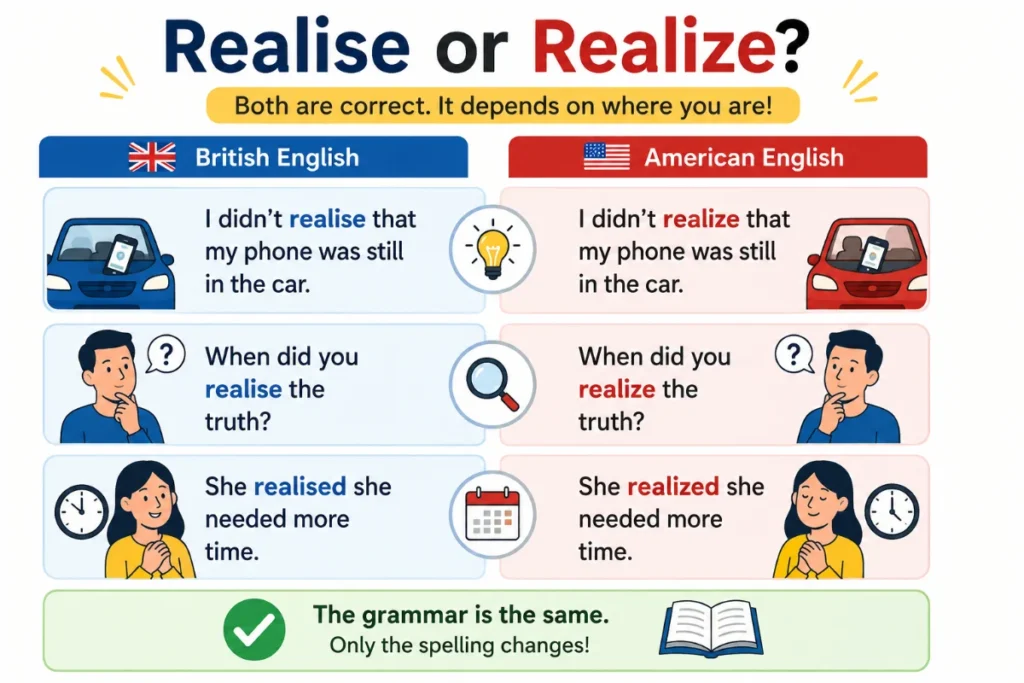
Is it “realise” or “realize”? If you’ve seen both spellings and wondered whether one of them is wrong, the answer is simple: both are correct. The difference is mainly a matter of regional spelling conventions. “Realize” is the standard form in American English, while “realise” is especially common in British, Australian, and New Zealand English.
British English also accepts realize in many dictionaries and style systems, so the distinction is not as absolute as some spelling guides suggest. The two forms have the same meaning and grammatical function, and the spelling difference does not normally change how the word is pronounced.
You’ll see the same -ise/-ize variation in related words such as realisation/realization and realising/realizing. So, which spelling should you use? Choose the form that matches the English variety or style guide you’re following, and keep it consistent throughout your writing.
Realise vs. Realize at a Glance
English Variety
Common Spelling
🇺🇸 American English
realize
🇬🇧 British English
realise
🇨🇦 Canadian English
realize / realise
🇦🇺 Australian English
realise
🇳🇿 New Zealand English
realise
🇮🇳 Indian English
realise
🇿🇦 South African English
realise is common
The important point is that realise and realize are not two different words. They are spelling variants of the same verb.
What Does Realise or Realize Mean?
Realise and realize mean the same thing.
The verb can mean to become aware of something, understand something clearly, or recognize a fact, often after thinking about it or discovering new information.
For example:
I didn’t realize how late it was.
In British English:
I didn’t realise how late it was.
Both sentences mean exactly the same thing.
The word can also mean to achieve something that you have planned or hoped for.
For example:
She finally realized her dream of becoming a writer.
Or:
She finally realised her dream of becoming a writer.
Again, the meaning does not change.
Simple meaning
Realise/realize = to understand, become aware of, recognize, or achieve something.
Is It Realise or Realize?
The correct spelling depends on the English variety.
If you are writing in American English, use realize.
I didn’t realize that you were here.
If you are writing in British English, realise is generally preferred.
I didn’t realise that you were here.
Both sentences are grammatically correct.
The same spelling pattern appears in several other words:
British English
American English
realise
realize
organise
organize
recognise
recognize
apologise
apologize
specialise
specialize
However, this doesn’t mean that every word ending in -ise can automatically be changed to -ize. Some words have fixed spellings, so individual words still need to be checked.
Realise or Realize in British English
In British English, realise is the spelling many readers expect and is widely used.
For example:
I didn’t realise my mistake.
Did you realise what happened?
She suddenly realised the truth.
He hopes to realise his ambition.
However, realize is not necessarily an incorrect British spelling. Some British publishers and style systems use -ize spellings, particularly for words whose history supports the -ize form.
So saying that “realize is always wrong in British English” would be too simplistic.
A better rule is:
Use the spelling required by your chosen British English style, and remain consistent.
Realise or Realize in American English
In American English, realize is the standard spelling.
Examples:
I didn’t realize what had happened.
Did you realize how important this was?
She realized that she had forgotten her keys.
He wants to realize his full potential.
For content written specifically for a US audience, realize is the natural choice.
Realise or Realize in Canada
Canadian English is a little more interesting because both forms can be found.
Realize is common in Canadian English, while realise also appears, particularly in contexts influenced by British spelling conventions.
So if you’re searching for “realise or realize Canada”, the answer isn’t as simple as saying that only one spelling is correct.
If you’re following an established Canadian style guide, use its preferred spelling. Otherwise, realize is a very common Canadian form.
Most importantly, don’t switch randomly between realise and realize in the same piece of writing.
Realise or Realize in Australia
In Australian English, realise is generally preferred.
Examples:
I didn’t realise how difficult the task would be.
She realised that she had made a mistake.
We didn’t realise the store was already closed.
So for Australian readers, realise is usually the safer choice.
Realise or Realize in New Zealand
New Zealand English generally follows the -ise spelling in words such as realise.
For example:
I didn’t realise what was happening.
She realised that she had left her phone at home.
Therefore, if you’re writing specifically for a New Zealand audience, realise is generally the better choice.
Realise or Realize in India
In Indian English, realise is commonly used because Indian English traditionally follows many British spelling conventions.
For example:
I didn’t realise that the meeting had started.
She realised her mistake immediately.
That said, American English is extremely common online, so you may also encounter realize in websites, apps, and international content.
Realise or Realize: What’s the Difference?
The difference is primarily spelling convention, not meaning.
Feature
Realise
Realize
Meaning
Same
Same
Pronunciation
Essentially the same
Essentially the same
Grammar
Verb
Verb
Common in US English
Less common
Standard
Common in British English
Preferred by many styles
Also accepted by some styles
Common in Australian English
Preferred
Less common
Common in NZ English
Preferred
Less common
There is no difference in what the word means.
Realise or Realize Pronunciation
Realise and realize are pronounced essentially the same way.
A simple pronunciation guide is:
REE-uh-lize
The change from -ise to -ize does not normally create a different pronunciation.
For example:
I didn’t realise the truth.
and:
I didn’t realize the truth.
The words are pronounced alike even though they are spelled differently.
Regional accents can naturally affect pronunciation, but the s/z spelling difference itself does not create a different word or meaning.
“I Didn’t Realise” or “I Didn’t Realize”?
Both are correct.
The choice depends on the English variety you’re using.
British English
I didn’t realise you were coming.
American English
I didn’t realize you were coming.
More examples
British:
I didn’t realise how expensive it was.
I didn’t realise that you knew her.
I didn’t realise we’d met before.
American:
I didn’t realize how expensive it was.
I didn’t realize that you knew her.
I didn’t realize we’d met before.
The grammar is exactly the same. Only the spelling changes.
When I Realise or Realized?
The correct form depends on the tense you need.
Present tense: realise/realize
Use realise/realize for something happening now or something that is generally true.
I realize why you’re upset.
I realise why you’re upset.
Past tense: realised/realized
Use realised/realized for something you became aware of in the past.
I realized my mistake yesterday.
I realised my mistake yesterday.
Present participle: realising/realizing
Use this form when the verb needs an -ing ending.
I am realizing how important this is.
I am realising how important this is.
So the spelling pattern continues:
British: realise → realised → realising
American: realize → realized → realizing
Realise vs. Realize Examples
Here are some everyday examples to make the difference easy to understand.
Example 1: Understanding something
US:
I didn’t realize the answer was right in front of me.
UK:
I didn’t realise the answer was right in front of me.
Example 2: Discovering a fact
US:
She realized that she had forgotten her wallet.
UK:
She realised that she had forgotten her wallet.
Example 3: Becoming aware
US:
He suddenly realized how serious the situation was.
UK:
He suddenly realised how serious the situation was.
Example 4: Achieving something
US:
She finally realized her dream.
UK:
She finally realised her dream.
The meaning remains unchanged.
Realise or Realize in a Sentence
Both spellings work in the same sentence structure.
American English
I didn’t realize that my phone was still in the car.
British English
I didn’t realise that my phone was still in the car.
American English
When did you realize the truth?
British English
When did you realise the truth?
American English
She realized she needed more time.
British English
She realised she needed more time.
This is why realise or realize grammar is not really about choosing a different grammatical rule. The grammar stays the same; the spelling convention changes.
Why Does Realise Have an “S” but Realize Has a “Z”?
The difference comes from the history of English spelling.
The word realize entered English centuries ago and is connected historically with French and Latin forms. Over time, English developed different spelling preferences for verbs ending in this sound.
The -ize spelling has a long history in English and is not simply an American invention.
In Britain, -ise became increasingly common in many words during the 19th century. Different dictionaries, publishers, and style traditions then helped establish different preferences.
In the United States, spelling reformers such as Noah Webster strongly supported simplified and more standardized American spellings. This helped reinforce -ize forms in American English.
As a result, modern English developed two familiar patterns:
realise → British/Commonwealth spelling
realize → American spelling
The two forms continued to coexist rather than becoming two different words.
Is “Realize” Grammatically Correct?
Yes.
Realize is a completely correct English verb.
It can be used in sentences such as:
I realize what you mean.
She realized her mistake.
Did you realize the time?
They realized that the plan would not work.
Likewise, realise is grammatically correct:
I realise what you mean.
She realised her mistake.
Did you realise the time?
The spelling does not determine whether the verb is grammatically correct.
Realise or Realize: Common Mistakes
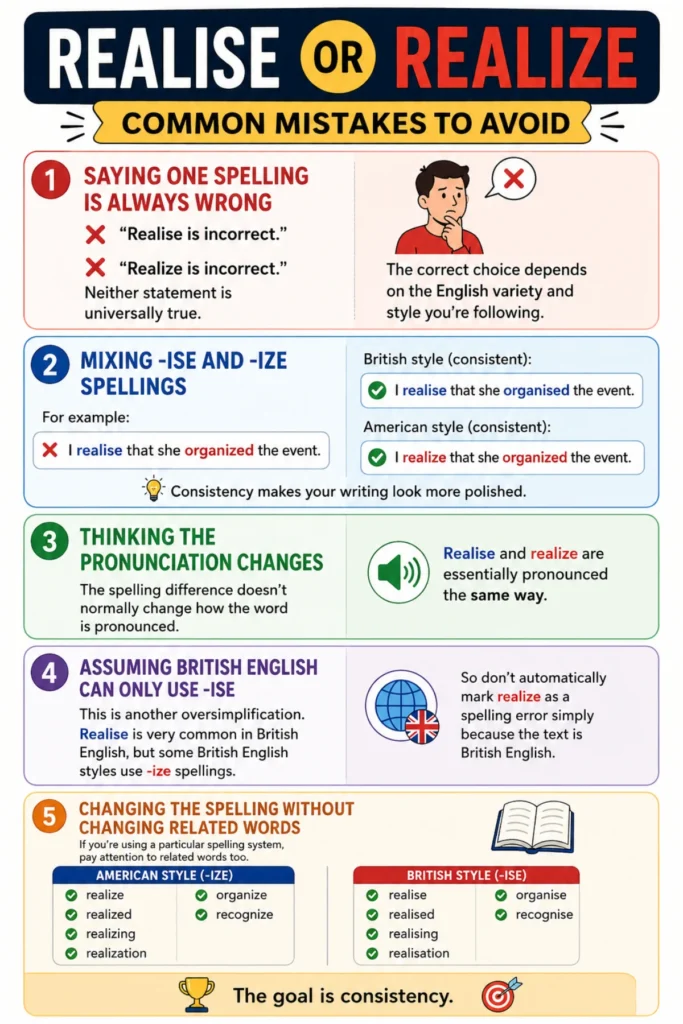
Mistake 1: Saying one spelling is always wrong
❌ “Realise is incorrect.”
❌ “Realize is incorrect.”
Neither statement is universally true.
The correct choice depends on the English variety and style you’re following.
Mistake 2: Mixing -ise and -ize spellings
For example:
❌ I realise that she organized the event.
This may mix spelling conventions depending on the style you’re following.
A consistent British-style version could be:
✅ I realise that she organised the event.
A consistent American-style version could be:
✅ I realize that she organized the event.
Consistency makes your writing look more polished.
Mistake 3: Thinking the pronunciation changes
The spelling difference doesn’t normally change how the word is pronounced.
Realise and realize are essentially pronounced the same way.
Mistake 4: Assuming British English can only use -ise
This is another oversimplification.
Realise is very common in British English, but some British English styles use -ize spellings.
So don’t automatically mark realize as a spelling error simply because the text is British English.
Mistake 5: Changing the spelling without changing related words
If you’re using a particular spelling system, pay attention to related words too.
The same spelling difference appears in many English words.
British/Commonwealth
American
realise
realize
organise
organize
recognise
recognize
apologise
apologize
specialise
specialize
emphasise
emphasize
modernise
modernize
summarise
summarize
However, remember that -ise and -ize are spelling patterns, not a universal rule that can be applied to every English verb.
Some words have established spellings that don’t follow this exact variation.
Which One Should You Use?
The easiest way to choose is to consider your reader.
Use realize when:
You’re writing in American English.
Your main audience is in the United States.
Your publication follows an American spelling style.
You want your spelling to match other US forms such as organize and recognize.
Use realise when:
You’re writing in a British-style spelling system that prefers -ise.
Your audience is primarily Australian or New Zealand.
Your publication uses -ise spellings.
You want your spelling to match words such as organise and recognise.
Frequently Asked Questions
Is it realise or realize?
Both are correct spellings of the same word. Realize is standard in American English, while realise is widely preferred in British, Australian, and New Zealand English.
Which is correct, realise or realize?
Neither spelling is universally more correct. The appropriate spelling depends on the English variety you’re using.
What is the meaning of realise or realize?
It means to become aware of, understand, or recognize something. It can also mean to achieve something, such as a goal or ambition.
Do Americans use realise or realize?
Americans generally use realize.
Is realize American English?
Yes. Realize is the standard spelling in American English.
Is realise British English?
Yes. Realise is widely used and preferred in British English, although some British styles also accept or prefer realize.
Is it realise or realize in Canada?
Both spellings can be found in Canadian English. Realize is common, while realise is also used.
Is it realise or realize in Australia?
Realise is generally preferred in Australian English.
Is it realise or realize in New Zealand?
Realise is generally preferred in New Zealand English.
Is it realise or realize in India?
Realise is commonly used in Indian English, reflecting the influence of British spelling conventions.
Is “I didn’t realise” correct?
Yes. I didn’t realise is correct when following a spelling system that uses -ise.
Is “I didn’t realize” correct?
Yes. I didn’t realize is correct and is the standard form in American English.
Are realise and realize pronounced differently?
No. They are essentially pronounced the same way. The difference is in spelling rather than pronunciation.
Can I use realise and realize in the same article?
You can use both when you’re specifically comparing the two spellings. Otherwise, choose one spelling system and use it consistently.
Conclusion
So, realise or realize—which is correct?
Both are correct.
Realize is the standard spelling in American English and is also common in Canadian English.
Realise is widely preferred in British, Australian, and New Zealand English, and is also commonly found in Indian English.
The two forms have:
the same meaning
the same grammatical function
essentially the same pronunciation
different regional spelling conventions
The simplest rule is:
Use “realize” for American English and “realise” when following a spelling system that prefers -ise. Then stay consistent.
Sophia Langley is an English grammar specialist and writing coach, passionate about simplifying language rules and empowering learners to write with clarity and confidence.