
Why does “favourite” have a “u” in British English when Americans write “favorite” without it? And more importantly, is one of them wrong? No—both spellings are correct.
The difference is simply a matter of regional English: “favorite” is the standard spelling in American English, while “favourite” is standard in British English and is also commonly used in Australian and New Zealand English.
So if you’re reading an American website, you’ll usually see favorite; in British English, you’ll see favourite. The meaning and pronunciation remain essentially the same—the spelling changes because different varieties of English follow different conventions.
In this guide, you’ll see exactly where each spelling is used, why the extra “u” appears, which countries prefer each form, and how to choose the right one for your own writing.
Favourite vs. Favorite at a Glance
| English Variety | Preferred Spelling | Example |
|---|---|---|
| 🇺🇸 American English | favorite | What is your favorite color? |
| 🇬🇧 British English | favourite | What is your favourite colour? |
| 🇨🇦 Canadian English | favourite | What is your favourite movie? |
| 🇦🇺 Australian English | favourite | What is your favourite food? |
| 🇳🇿 New Zealand English | favourite | Blue is my favourite colour. |
| 🇮🇳 Indian English | favourite | Cricket is my favourite sport. |
| 🇿🇦 South African English | favourite | That is my favourite book. |
| 🇳🇬 Nigerian English | favourite is common | This is my favourite song. |
| 🇵🇰 Pakistani English | favourite is common | English is my favourite subject. |
The exact spelling can vary in international English, but favorite is firmly associated with American English, while favourite is the established British spelling.
What Does Favourite or Favorite Mean?
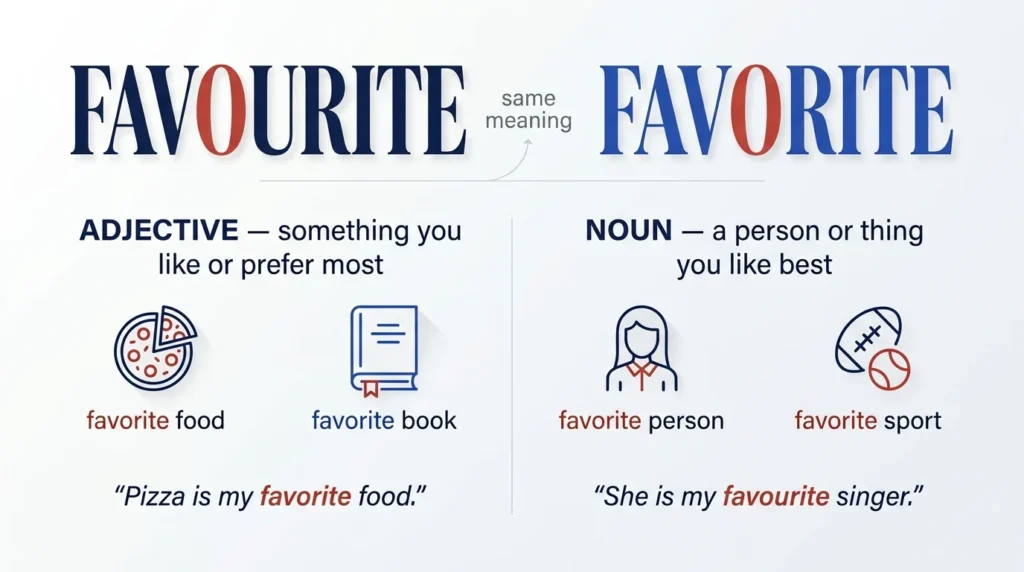
Favourite and favorite have the same meaning.
As an adjective, the word describes a person or thing that you like or prefer more than others.
For example:
- “Blue is my favorite color.” — US English
- “Blue is my favourite colour.” — UK English
- “Pizza is my favorite food.”
- “She is my favourite singer.”
As a noun, it refers to a person or thing that you like best.
For example:
- “Chocolate is my favorite.”
- “Chocolate is my favourite.”
- “These are my favorites.”
- “These are my favourites.”
The meaning does not change when the spelling changes.
What Is the Difference Between Favourite and Favorite?
The difference between favourite and favorite is primarily a matter of spelling and regional English.
Favorite drops the u and is standard in American English.
Favourite keeps the u and is standard in British English.
The same pattern appears in several other words:
| British English | American English |
|---|---|
| favourite | favorite |
| colour | color |
| favour | favor |
| honour | honor |
| behaviour | behavior |
| flavour | flavor |
So, if you are writing in American English, use favorite. If you are following British English, use favourite.
Which Is Correct: Favourite or Favorite?
Both are correct.
The right choice depends on the variety of English you are using.
Use favorite when writing in:
- American English
- US-based publications
- US-focused websites
- American academic or professional writing
Use favourite when writing in:
- British English
- Canadian English
- Australian English
- New Zealand English
- Indian English
- South African English
- Other contexts that follow British spelling conventions
For an international audience, either spelling can work. The most important thing is to choose one spelling system and use it consistently.
Favourite or Favorite Pronunciation
Favourite and favorite are pronounced essentially the same way.
A simple pronunciation guide is:
FAY-vuh-rit
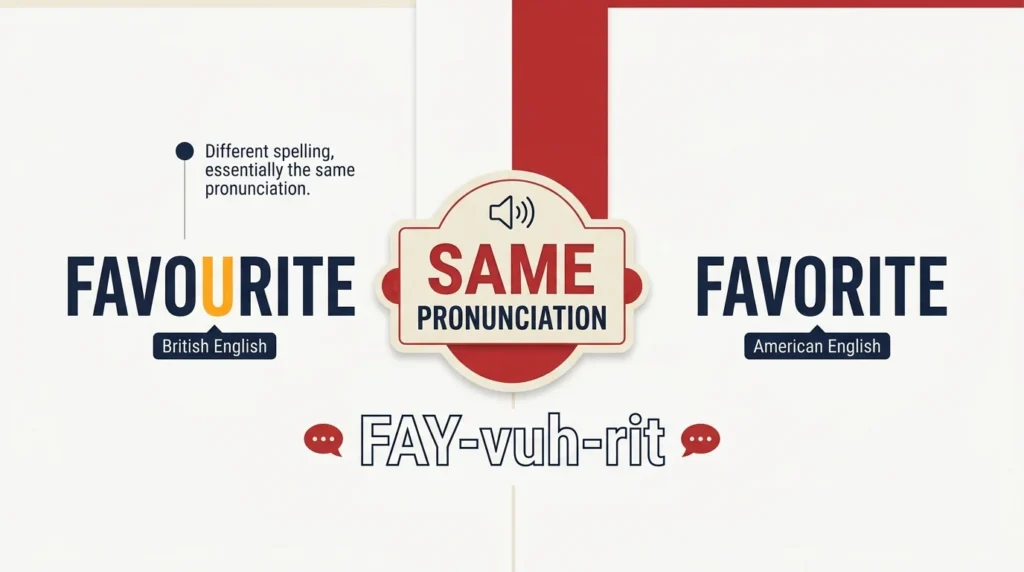
The extra u in favourite does not create a different pronunciation.
Regional accents can naturally change how the word sounds, but the spelling difference itself does not represent a different pronunciation.
So:
favourite ≈ favorite
The difference is mainly written, not spoken.
Favourite or Favorite Spelling
The spelling difference is easy to remember:
British English:
favourite
American English:
favorite
The American spelling removes the u found in the British spelling.
This is part of a wider difference between American and British spelling conventions.
For example:
- colour → color
- favour → favor
- honour → honor
- behaviour → behavior
- favourite → favorite
None of these pairs has a different meaning simply because the spelling changes.
Favourite or Favorite in Canada
If you’re wondering “Is it favourite or favorite in Canada?”, favourite is the conventional Canadian spelling.
Canadian English has influences from both British and American English, so you may encounter American spellings in some contexts. However, favourite is the established spelling in Canadian English.
For example:
What is your favourite movie?
or:
Blue is my favourite colour.
So, for Canadian English, favourite is generally the safer choice.
Favourite or Favorite in Australia
In Australian English, favourite is the standard spelling.
For example:
What is your favourite food?
You will also commonly see related British-style spellings such as:
- favourite
- colourful
- behaviour
- honour
- flavour
Therefore, if you’re writing specifically for an Australian audience, favourite is the appropriate spelling.
Favourite or Favorite in India
Favourite is widely used in Indian English, which has strong historical connections to British English.
For example:
Cricket is my favourite sport.
You may also encounter American spellings such as favorite, especially online or in software, but favourite remains a conventional choice in formal and educational contexts.
Favourite or Favorite in South Africa
Favourite is commonly used in South African English.
For example:
This is my favourite book.
South African English has its own characteristics, but British spelling conventions remain influential in many areas of formal writing.
Favourite or Favorite in Nigeria
Favourite is also commonly encountered in Nigerian English.
For example:
This is my favourite song.
English usage in Nigeria has its own regional characteristics, and American spellings can appear, particularly online. However, favourite is a familiar British-influenced spelling.
Favourite or Favorite in Pakistan
Favourite is commonly used in Pakistani English, particularly in formal, educational, and British-influenced writing.
For example:
English is my favourite subject.
You may also see favorite online because American English is widely used across the internet, but favourite remains a common conventional spelling in Pakistani English.
Colour vs. Color: The Real Difference Explained
Favourite or Favorite as a Noun
Many people know favorite/favourite as an adjective, but it can also function as a noun.
For example:
Chocolate is my favorite.
Here, favorite means the person or thing that someone likes best.
In British English:
Chocolate is my favourite.
The plural form works in the same way:
American English:
These are my favorites.
British English:
These are my favourites.
So, yes, “my favorites” is grammatically correct in American English.
Favourite or Favorite Food
When talking about food, either spelling is correct depending on the English variety.
American English
Pizza is my favorite food.
British English
Pizza is my favourite food.
The meaning is exactly the same.
Other examples include:
- My favorite food is pasta.
- What is your favourite food?
- Chocolate is one of my favorite desserts.
- Curry is one of my favourite dishes.
Favourite or Favorite Person
The word can also describe someone you like particularly well.
For example:
American English
She is my favorite person.
British English
She is my favourite person.
Again, the spelling changes, but the meaning does not.
Other Forms of Favourite and Favorite
The spelling difference continues in related words.
| British English | American English |
|---|---|
| favourite | favorite |
| favouritism | favoritism |
| favourable | favorable |
For example:
British English:
The manager was accused of favouritism.
American English:
The manager was accused of favoritism.
Using the appropriate form consistently helps your writing look polished.
Labelled or. Labeled: The Extra “L” Explained
Why Does Favourite Have a “U”?
The -our spelling in favourite is connected to the historical development of English and the influence of Anglo-Norman French.
Words such as favour and honour developed spellings containing -our, and those conventions became established in British English.
This contributed to the distinction we recognize today:
- favourite → favorite
- colour → color
- honour → honor
- behaviour → behavior
So the extra u in favourite is not a mistake. It reflects a different spelling tradition.
Common Mistakes With Favourite and Favorite
Mistake 1: Assuming one spelling is always wrong
❌ “Favorite is incorrect.”
❌ “Favourite is incorrect.”
Both statements are too broad.
The correct spelling depends on the English variety being used.
Correct approach:
Favorite is standard in American English, while favourite is standard in British English.
Mistake 2: Mixing American and British spellings
Consider this sentence:
❌ My favourite color is blue, and I love the colorful design.
The sentence mixes different spelling conventions.
For American English:
✅ My favorite color is blue, and I love the colorful design.
For British English:
✅ My favourite colour is blue, and I love the colourful design.
The individual words are understandable, but consistent spelling makes your writing cleaner and more professional.
Mistake 3: Assuming a spell-checker determines the correct spelling
A spell-checker configured for US English may flag favourite.
A spell-checker configured for UK English may flag favorite.
That does not automatically mean the word is wrong.
Before changing it, check:
- Which English setting is your software using?
- Who is your intended audience?
- Which style guide are you following?
Then choose the appropriate spelling.
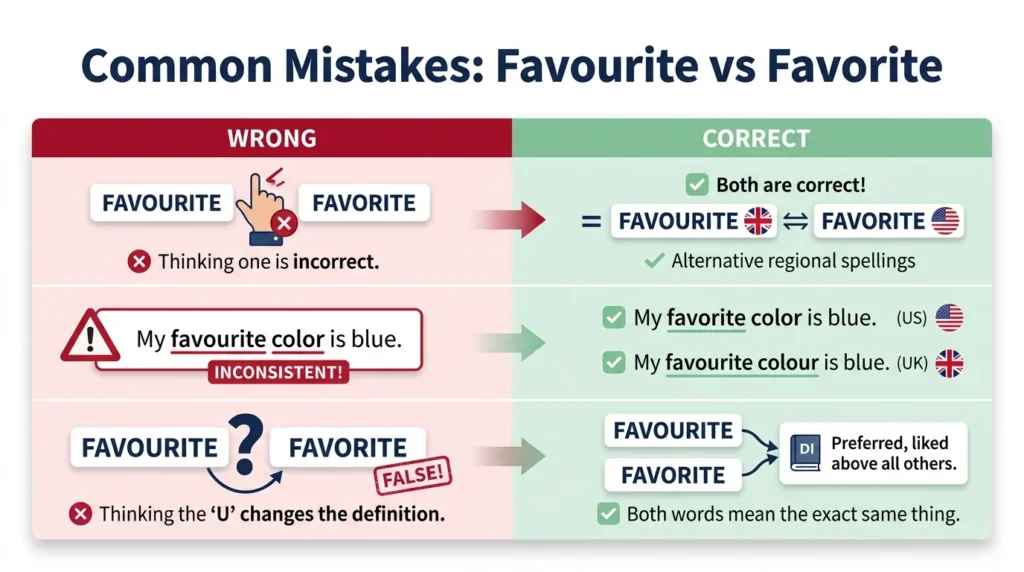
Mistake 4: Thinking the spelling changes the meaning
Favourite and favorite have the same meaning.
For example:
The blue dress is my favorite.
and:
The blue dress is my favourite.
Both sentences communicate the same idea.
The extra u does not create a different definition.
Mistake 5: Switching spellings throughout the same article
If an article consistently uses:
favorite, color, behavior
it should not suddenly switch to:
favourite, colour, behaviour
unless the article is specifically discussing the difference between American and British English.
Choose a spelling system and stay consistent.
Favourite or Favorite Examples
Here are some simple examples showing both spellings side by side:
| American English | British English |
|---|---|
| What is your favorite food? | What is your favourite food? |
| She is my favorite person. | She is my favourite person. |
| This is my favorite book. | This is my favourite book. |
| Blue is my favorite color. | Blue is my favourite colour. |
| He is my favorite teacher. | He is my favourite teacher. |
| These are my favorites. | These are my favourites. |
The meaning remains the same in every example.
Quick Decision Guide: Favourite or Favorite?
Not sure which spelling to choose? Use this simple guide:
1. Identify your audience
🇺🇸 US audience → favorite
🇬🇧 UK audience → favourite
🇨🇦 Canadian audience → favourite
🇦🇺 Australian audience → favourite
🇳🇿 New Zealand audience → favourite
Other English varieties may use either form depending on local conventions and context.
2. Follow your style guide
If your school, employer, publisher, or website specifies American or British English, follow that preference.
3. Stay consistent
Once you’ve chosen favorite or favourite, use the same spelling throughout your content unless you’re directly comparing the two forms.
Frequently Asked Questions
Which is correct, favorite or favourite?
Both are correct. Favorite is the standard American English spelling, while favourite is the standard British English spelling.
Is favorite grammatically correct?
Yes. Favorite is grammatically correct in American English and can function as both an adjective and a noun.
Is favourite grammatically correct?
Yes. Favourite is grammatically correct in British English and other varieties that use British spelling conventions.
What is the meaning of favorite?
Favorite means a person or thing that someone likes or prefers more than others. It can be used as both an adjective and a noun.
What is the meaning of favourite?
Favourite has exactly the same meaning as favorite. It is simply the British spelling.
Is it favourite or favorite in Canada?
Favourite is the conventional Canadian spelling, although favorite may also appear in contexts influenced by American English.
Is it favourite or favorite in Australia?
Favourite is the standard Australian spelling.
Is it favourite or favorite in India?
Favourite is widely used in Indian English, particularly in formal and educational contexts.
Is it favourite or favorite in South Africa?
Favourite is commonly used in South African English.
Is it favourite or favorite in Nigeria?
Favourite is commonly encountered in Nigerian English, although American spellings can also appear.
Is it favourite or favorite in Pakistan?
Favourite is commonly used in Pakistani English, particularly in formal and British-influenced writing.
Is “my favorites” correct?
Yes. “My favorites” is correct in American English. In British English, the equivalent is “my favourites.”
Are favourite and favorite pronounced differently?
No. They are generally pronounced the same way. Regional accents can affect pronunciation, but the spelling difference does not create a different word sound.
Can I use favourite and favorite in the same article?
Yes, when you’re specifically comparing American and British spelling. Otherwise, choose one English variety and use it consistently.
Final Answer: Favourite or Favorite?
Favourite and favorite are both correct spellings.
Use:
🇺🇸 favorite → American English
🇬🇧 favourite → British English
Favourite is also widely used in Canadian, Australian, New Zealand, Indian, South African, Nigerian, and Pakistani English, although usage can vary by context.
The two words have the same meaning and essentially the same pronunciation. The main difference is the spelling convention.

Elias Worden is a trusted grammar expert and writing mentor, dedicated to simplifying English rules and helping learners write with clarity, precision, and confidence.