
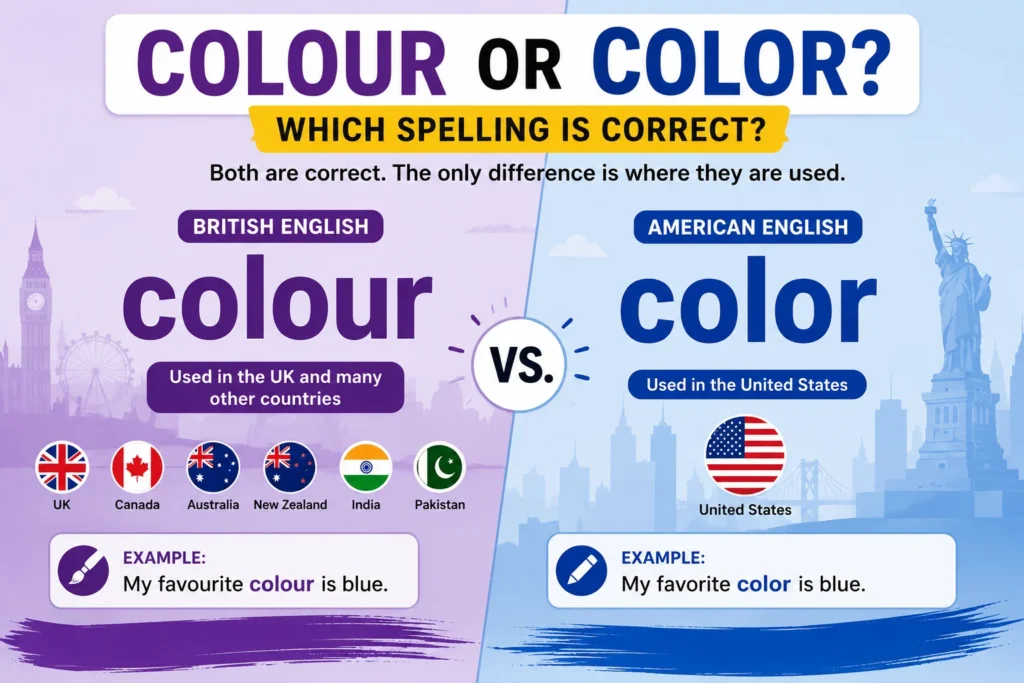
Why does one word need an extra “u” in British English—but not in American English? If you’ve ever wondered whether colour or color is the “correct” spelling, here’s the answer: both are correct. “Color” is the standard spelling in American English, while “colour” is the standard spelling in British English. The difference isn’t a mistake or a matter of one spelling being better—it reflects the spelling conventions followed by different varieties of English.
You’ll see the same pattern in words such as colorful vs. colourful and colored vs. coloured, which can make the difference even more noticeable when reading or writing internationally. So, if you’re writing for a U.S. audience, use “color”; if you’re following British English, use “colour.”
In this guide, we’ll explain why the spellings differ, which countries use each form, show real examples, and give you a simple rule for choosing the right spelling every time.
Colour vs. Color at a Glance
| English variety | Preferred spelling | Example |
|---|---|---|
| 🇺🇸 American English | color | My favorite color is blue. |
| 🇬🇧 British English | colour | My favourite colour is blue. |
| 🇨🇦 Canadian English | colour | What is your favourite colour? |
| 🇦🇺 Australian English | colour | The colour looks beautiful. |
| 🇳🇿 New Zealand English | colour | I like the colour of the car. |
| 🇮🇳 Indian English | colour | The colour of the flag is significant. |
| 🇵🇰 Pakistani English | colour | The colour of the flag is green and white. |
The important point is that color and colour are not different words. They are two regional spellings of the same word.
What Do “Color” and “Colour” Mean?
Color and colour have exactly the same basic meaning.
As a noun, the word refers to the visual quality of an object produced by the way it reflects or emits light. Red, blue, green, yellow, and purple are all examples of colors or colours.
For example:
- The color of the sky is beautiful.
- The colour of the sky is beautiful.
- Blue is my favorite color.
- Blue is my favourite colour.
- The flowers add color to the garden.
- The flowers add colour to the garden.
The word can also be used as a verb. In this sense, it means to add color to something, such as a drawing, picture, or design.
For example:
- She likes to color pictures. 🇺🇸
- She likes to colour pictures. 🇬🇧
The meaning does not change when you switch between the two spellings.
What Is the Difference Between Colour and Color?
The main colour or color difference is spelling, not meaning.
Color is the standard American English form, while colour is the standard British English form.
The British spelling retains the u, while American English generally drops it.
| British English | American English |
|---|---|
| colour | color |
| favourite | favorite |
| honour | honor |
| flavour | flavor |
| behaviour | behavior |
This pattern is common in words ending in -our in British English and -or in American English.
However, the spelling difference does not mean that one form has a different definition. If someone writes colour instead of color, they are not describing a different type of color.
They are simply following a different English spelling convention.
Why Are Colour and Color Spelled Differently?
The spelling difference developed as American and British English evolved along somewhat different paths.
English historically contained influences from several languages, including French. Words such as colour retained spelling features associated with older British usage.
In the United States, spelling conventions gradually developed in different directions. Noah Webster, an influential American lexicographer, promoted spelling reforms and preferred forms that he considered simpler or more consistent with American usage.
This helped establish a number of American spellings, including forms such as:
colour → color
The difference therefore reflects the historical development of two major varieties of English rather than a difference in meaning.
Is It Colour or Color in American English?
If you are writing in American English, use color.
Examples:
- What is your favorite color?
- Blue is my favorite color.
- The artist used bright colors.
- Please color the picture carefully.
- The room has a warm color scheme.
The same spelling applies to related forms:
- color
- colored
- coloring
- colorful
So an American English sentence might read:
The children were coloring a colorful picture.
If your website, essay, business document, or academic paper is intended primarily for a US audience, color is the appropriate choice.
Is “Colour” Wrong in American English?
No. Colour is not an incorrect English word.
American readers generally understand it immediately, but it is recognized as the British/Commonwealth spelling rather than the standard American form.
Therefore, if you are specifically following American English, color is normally the better choice.
For example:
❌ The spelling is not “colour” because it is wrong English.
A better explanation would be:
✅ “Colour” is the British spelling, while “color” is the standard American spelling.
The distinction is about English variety, not whether the word is legitimate English.
Is It Colour or Color in British English?
If you are writing in British English, the standard spelling is colour.
Examples:
- What is your favourite colour?
- Blue is my favourite colour.
- The artist used bright colours.
- Please colour the picture.
- The room has a warm colour scheme.
Related forms also retain the u:
- colour
- coloured
- colouring
- colourful
For example:
The children were colouring a colourful picture.
Colour or Color in Canada
If you are wondering “colour or color in Canada?”, colour is generally the preferred Canadian spelling.
Canadian English has influences from both British and American English, so some variation exists. However, Canadian spelling commonly retains -our in words such as:
- colour
- favour
- honour
- behaviour
- flavour
For example:
The colour of the Canadian flag is red and white.
You may still encounter color in Canadian websites, software, advertising, or other contexts influenced by American English. Seeing the American form does not mean Canadian English has only one acceptable spelling in every context.
For formal or carefully edited Canadian writing, colour is generally the safer choice.
Colour or Color in Australia
Australian English generally follows British spelling conventions for this word, so colour is standard.
For example:
The colour of the ocean looked beautiful at sunset.
Related forms normally retain the same spelling pattern:
- colour
- coloured
- colouring
- colourful
Colour or Color in New Zealand
New Zealand English also generally uses the British spelling colour.
Examples include:
- What is your favourite colour?
- The colour of the building has faded.
- She coloured the picture.
- The garden looks colourful.
Colour or Color in India
Indian English has strong historical connections with British English, so colour is widely used.
For formal writing, education, professional communication, and many Indian publications, you will commonly see:
colour
For example:
The colour of the Indian flag includes saffron, white, and green.
However, American English is also widespread on the internet, in software, and in international media. As a result, color can also appear in Indian writing.
Colour or Color in Pakistan
Pakistani English has also been strongly influenced by British English, so colour is generally preferred, especially in formal and educational contexts.
For example:
The colour of the Pakistani flag is green and white.
You may nevertheless encounter color in websites, applications, social media, and international content because American English is widely used online.
Colour or Color in Malaysia
Malaysia can be a little more complicated because English usage varies by context.
Both colour and color can be encountered, but colour remains familiar in British-influenced formal English.
For example:
The colour of the design works well with the background.
The important thing is to avoid switching randomly between the two forms.
Which Spelling Should You Use?
If you’re still unsure about colour or color spelling, use this simple rule:
Choose color when:
- You are writing primarily for the United States.
- Your publication follows American English.
- Your organization’s style guide uses American spelling.
- You are writing an American academic or professional document.
Choose colour when:
- You are writing primarily for the United Kingdom.
- Your publication follows British English.
- You are writing for a British-influenced English variety.
- Your style guide specifically requires British/Commonwealth spelling.
Writing for an international audience?
Either spelling can work.
The most important thing is consistency. If you begin with American English, don’t randomly switch to British spellings later in the same article.
Colour vs. Color Examples
The easiest way to understand the difference is to compare the spellings side by side.
| American English | British/Commonwealth English |
|---|---|
| My favorite color is blue. | My favourite colour is blue. |
| The color of the car is unusual. | The colour of the car is unusual. |
| She colored the picture. | She coloured the picture. |
| I bought a coloring book. | I bought a colouring book. |
| The garden is very colorful. | The garden is very colourful. |
Notice that the meaning does not change. Only the spelling changes to match the English variety.
Color or Colour: Other Forms of the Word
The spelling difference extends beyond the basic noun.
| US English | British/Commonwealth English |
|---|---|
| color | colour |
| colored | coloured |
| coloring | colouring |
| colorful | colourful |
For example:
American English
The children were coloring a colorful picture.
British English
The children were colouring a colourful picture.
If you choose one variety of English, it is best to apply that spelling pattern to related forms as well.
Colour or Color Pronunciation
One common question is whether colour and color are pronounced differently.
In most varieties of English, they are pronounced essentially the same. Regional accents can produce small differences in pronunciation, but the spelling change itself does not create a different word or meaning.
In simple terms:
colour ≈ color
The major difference is written rather than spoken.
So you do not need to change the word you say simply because you are writing for an American or British audience.
Colour or Color in Formal Writing
Both forms are correct in formal writing when they match the English variety being used.
For example:
American English:
The study examined the relationship between color and visual perception.
British English:
The study examined the relationship between colour and visual perception.
The important rule is consistency.
If an academic paper begins in American English, switching between color and colour without a reason can make the document appear poorly edited.
The same principle applies to:
- business reports
- websites
- academic assignments
- professional emails
- books
- articles
- marketing content
Choose your preferred English variety before you begin and maintain it throughout.
Colour or Color in International English
What if your readers come from several different countries?
You don’t need to use both spellings throughout the same article.
Instead, choose one English variety and use it consistently.
For example, a website using American English might consistently write:
- color
- favorite
- behavior
- honor
A website using British English might consistently write:
- colour
- favourite
- behaviour
- honour
International readers will generally understand both forms.
Consistency is more important than trying to change the spelling for every individual reader.
Labelled or. Labeled: The Extra “L” Explained
Common Mistakes With Colour and Color
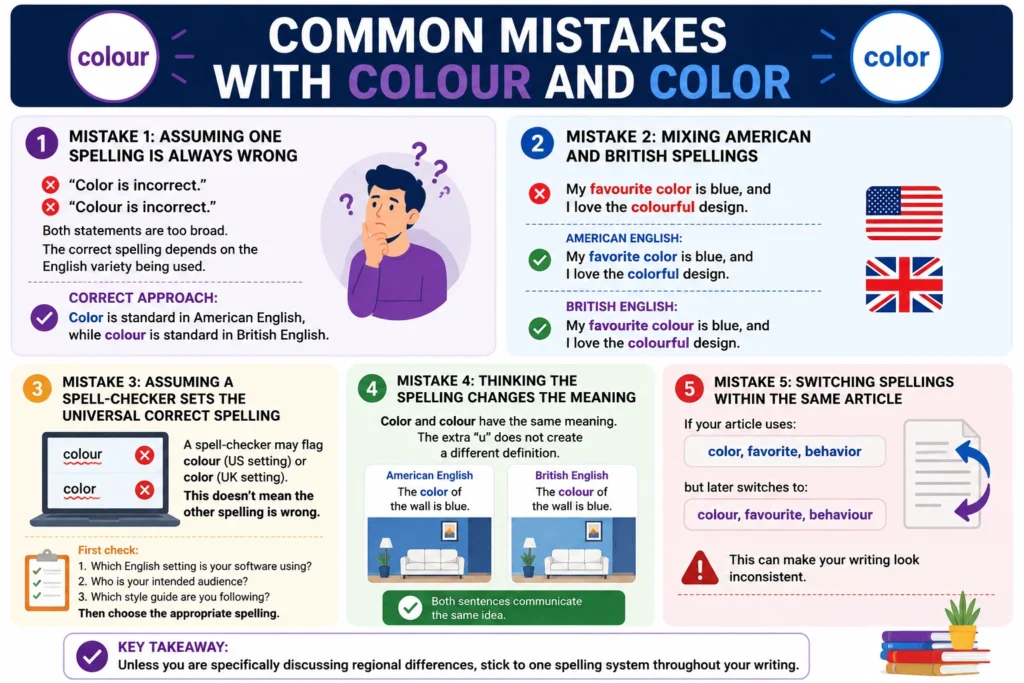
Mistake 1: Assuming one spelling is always wrong
❌ “Color is incorrect.”
❌ “Colour is incorrect.”
Both statements are too broad.
The correct spelling depends on the English variety being used.
Correct approach:
Color is standard in American English, while colour is standard in British English.
Mistake 2: Mixing American and British spellings
Consider this sentence:
❌ My favourite color is blue, and I love the colourful design.
The sentence mixes different spelling conventions.
If you’re using American English:
✅ My favorite color is blue, and I love the colorful design.
If you’re using British English:
✅ My favourite colour is blue, and I love the colourful design.
The individual words may all be understandable, but consistent spelling produces cleaner writing.
Mistake 3: Assuming a spell-checker determines the universal correct spelling
A spell-checker may flag colour if your document is configured for US English.
A different spell-checker configured for UK English may flag color.
That does not automatically mean one word is wrong.
First check:
- Which English setting is your software using?
- Who is your intended audience?
- Which style guide are you following?
Then choose the appropriate spelling.
Mistake 4: Thinking the spelling changes the meaning
Color and colour have the same meaning.
The extra u does not create a different definition.
For example:
The color of the wall is blue.
and
The colour of the wall is blue.
Both sentences communicate the same idea.
Mistake 5: Switching spellings within the same article
If your article uses:
color, favorite, behavior
throughout most of the text, suddenly writing:
colour, favourite, behaviour
can make the article look inconsistent.
Unless you are specifically discussing regional differences, stick to one spelling system.
Travelled vs. Traveled: The One-Letter Difference Explained
Colour or Color in Expressions
The regional spelling also appears in expressions containing the word.
| American English | British/Commonwealth English | Meaning |
|---|---|---|
| true colors | true colours | Someone’s real character |
| rose-colored glasses | rose-coloured glasses | An unrealistically positive perspective |
| with flying colors | with flying colours | Very successfully |
For example:
American English:
She passed the exam with flying colors.
British English:
She passed the exam with flying colours.
The expression remains the same; only the regional spelling changes.
Colour or Color: What About “Gray” and “Grey”?
You may also wonder about another US-versus-UK spelling:
gray vs. grey.
These are related to the same regional spelling pattern, but they are a separate spelling difference.
Generally:
- 🇺🇸 American English: gray
- 🇬🇧 British English: grey
So an American writer might say:
My favorite color is gray.
A British writer might write:
My favourite colour is grey.
This is another good example of why consistency across an entire English variety matters.
Is Colour or Color More Correct?
Neither spelling is universally more correct.
The answer depends on which variety of English you are using.
If you’re writing American English, color is correct.
If you’re writing British English, colour is correct.
If you’re writing for Canada, Australia, New Zealand, India, Pakistan, or another audience where British-influenced spelling is common, colour is generally the conventional choice.
So the better question isn’t:
“Which spelling is correct everywhere?”
It is:
“Which spelling is correct for my audience?”
.
Frequently Asked Questions
Is it colour or color?
Both are correct spellings. Color is standard in American English, while colour is standard in British English and commonly used in several British-influenced varieties.
Is “colour” correct English?
Yes. Colour is the standard British English spelling and is also widely used in countries and contexts influenced by British English.
Is “color” correct English?
Yes. Color is the standard American English spelling and is widely understood internationally.
What is the difference between color and colour?
The main difference is regional spelling. Both words have the same meaning and are generally pronounced the same way.
Which is correct: colour or color?
Both are correct. Use color for American English and colour for British English. For other countries, follow the local convention or the style guide you are required to use.
Is it colour or color in Canada?
Colour is generally the preferred Canadian spelling, although color can appear in contexts influenced by American English.
Is it colour or color in Australia?
Colour is the standard Australian spelling.
Is it colour or color in New Zealand?
Colour is generally the standard New Zealand spelling.
Is it colour or color in India?
Colour is commonly used in Indian English, particularly in formal contexts influenced by British spelling.
Is it colour or color in Pakistan?
Colour is generally preferred in Pakistani English, especially in formal writing influenced by British English.
Is it colour or color in the UK?
Colour is the standard British English spelling.
Is colour or color used in Malaysia?
Both forms can be encountered in Malaysia. Colour is familiar in British-influenced formal English, while color can appear in American-influenced contexts.
Are colour and color pronounced differently?
They are generally pronounced the same way. Regional accents can create small pronunciation differences, but the spelling itself does not change the basic pronunciation.
Should I use color or colour for an international audience?
Either can work. Choose one English variety and use it consistently throughout your content. If your organization or publication has a style guide, follow that guide.
What is the plural of colour?
The plural is colours in British English.
In American English, the corresponding form is colors.
For example:
- British English: The colours are beautiful.
- American English: The colors are beautiful.
What is the past tense of color or colour?
The past tense follows the same regional spelling distinction:
- American English: colored
- British English: coloured
For example:
She colored the picture. 🇺🇸
She coloured the picture. 🇬🇧
What is the difference between coloring and colouring?
The difference is regional spelling:
- American English: coloring
- British English: colouring
Both forms refer to the same activity.
Conclusion
So, colour or color—which spelling should you use?
Use color when you’re following American English.
Use colour when you’re following British English or a variety of English that generally uses British spelling.
The two forms have the same meaning and are generally pronounced the same. The extra u in colour simply reflects a different spelling tradition.
The easiest rule is:
🇺🇸 US English → color
🇬🇧 British English → colour
🌍 International audience → choose one style and stay consistent
Ultimately, neither spelling is wrong. The best spelling is the one that matches your audience, your English variety, and your style guide.
Color and colour are the same word with two regional spellings.

Sophia Langley is an English grammar specialist and writing coach, passionate about simplifying language rules and empowering learners to write with clarity and confidence.