
Have you ever written grey and wondered if gray is the correct spelling? Or typed gray and worried that it should be grey instead? This is a common English spelling question because both forms are correct, but different English-speaking countries prefer different forms.
Grey and gray have the same meaning and the same pronunciation. The main difference is regional. Gray is the usual spelling in American English, while grey is the usual spelling in British English. Grey is also common in other varieties of English, including Canadian, Australian, New Zealand, and Indian English.
The difference does not change the color, meaning, or pronunciation of the word. It mainly shows which spelling system a writer follows.
In this guide, you will learn grey or gray spelling rules, their history, how British and American English use them, which spelling to choose for different audiences, and how related words such as greying and graying work. You will also see real examples, common mistakes, special cases, and answers to the most common questions.
Grey or Gray
Grey and gray are both correct spellings.
The main difference is regional:
- Gray is preferred in American English.
- Grey is preferred in British English.
- Grey is also common in Canadian, Australian, New Zealand, and Indian English.
- The two forms have the same meaning and pronunciation.
Quick example
American English:
She wore a gray dress.
British English:
She wore a grey dress.
Both sentences mean exactly the same thing.
| Question | Answer |
|---|---|
| Is grey correct? | Yes |
| Is gray correct? | Yes |
| Do they mean the same thing? | Yes |
| Is gray American? | Usually, yes |
| Is grey British? | Usually, yes |
| Is the pronunciation different? | No |
So, if you need the shortest answer:
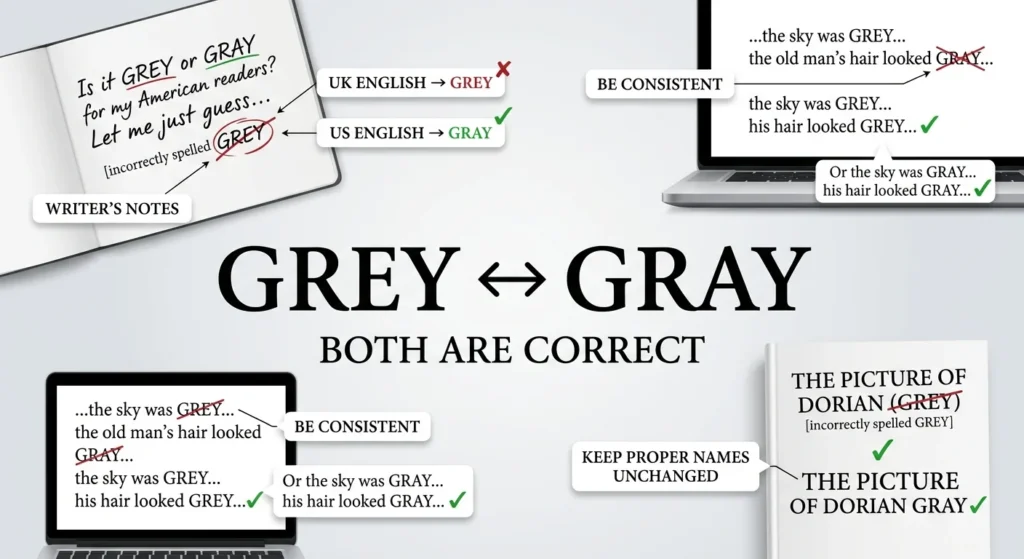
Use gray for American English and grey for British English. Both are correct.
The Origin of Grey or Gray
The two spellings have a long history. They did not suddenly appear when American and British English became different.
The word comes from an old Germanic color word. Old English used the form grǣg. Over time, the spelling changed as English developed through Middle English and later periods.
English spelling was not always fixed. Writers used different spellings for many words, and grey and gray were both found in historical English.
This is important because a common myth is that American English simply changed grey to gray. The history is more complex. Both spellings existed before modern American English developed its current spelling system.
Why did the two forms survive?
As English became more standardized, different regions developed different preferences.
British English gradually favored grey.
American English gradually favored gray.
American spelling was strongly influenced by efforts to standardize spelling in the United States. Noah Webster played an important role in American dictionary-making, but he did not invent the spelling “gray.” The form already existed.
The history therefore gives us an important lesson:
Grey and gray are not two different words. They are two established spellings of the same word.
British English vs American English Spelling
The easiest rule is:
American English → gray
British English → grey
Regional spelling comparison
| English variety | Usual spelling | Example |
|---|---|---|
| American English | gray | He has gray eyes. |
| British English | grey | He has grey eyes. |
| Canadian English | grey is common | The walls are grey. |
| Australian English | grey is common | She bought a grey coat. |
| New Zealand English | grey is common | The sky was grey. |
| Indian English | grey is common | He wore a grey suit. |
| International English | Either | Follow your chosen style. |
These are preferences, not absolute rules. For example, Canadian English commonly uses grey, but gray is also accepted.
American English: Gray
American writers normally use gray:
The sky was gray.
She has gray hair.
I bought a gray jacket.
The room has gray walls.
British English: Grey
British writers normally use grey:
The sky was grey.
She has grey hair.
I bought a grey jacket.
The room has grey walls.
The pronunciation stays the same in both varieties.
Mould or Mold: British or American English?
Grey vs Gray Related Words
The spelling difference can appear in related forms too.
| American English | British English |
|---|---|
| gray | grey |
| grayer | greyer |
| grayest | greyest |
| graying | greying |
| grayed | greyed |
| grayish | greyish |
| gray-haired | grey-haired |
Examples
American English:
His hair is graying.
British English:
His hair is greying.
American English:
The grayish sky looked cold.
British English:
The greyish sky looked cold.
The same regional pattern usually applies to these forms.
How Grey and Gray Work in a Sentence
Grey and gray can be used in more than one grammatical role.
As an adjective
The word describes a color or something related to that color.
She wore a gray coat.
She wore a grey coat.
As a noun
The word can name the color itself.
Gray is a popular color for modern interiors.
Grey is a popular color for modern interiors.
As a verb
It can describe hair or something becoming gray or grey.
His hair began to gray.
His hair began to grey.
This is why you may see several different forms in dictionaries and books.
Which Spelling Should You Use?
There is no single spelling that is correct for every English-speaking audience. The best choice depends on who will read your writing.
For American readers: Use Gray
Choose gray if your audience is mainly in the United States.
This is the best choice for:
- US schools
- American businesses
- US newspapers
- American websites
- US academic writing
- American marketing content
Example:
The company chose a gray background for its website.

For British readers: Use Grey
Choose grey when following British English.
This is suitable for:
- UK schools
- British newspapers
- UK businesses
- British academic writing
- UK websites
Example:
The company chose a grey background for its website.
For Commonwealth audiences
Grey is generally the safer choice for British-style English used in countries such as Australia, New Zealand, and India.
Canadian English commonly prefers grey, although gray is also accepted.
For a global website
Either form can work.
If your website mainly targets American readers, use gray.
If it mainly targets British or Commonwealth readers, use grey.
If your audience is global, the most important rule is:
Choose one spelling system and stay consistent.
Axe or Ax: The Spelling Difference Made Clear
Grey or Gray in Formal Writing
Both spellings are acceptable in formal writing.
The key is to follow the style of your audience or organization.
American formal writing
The researchers examined gray matter in the brain.
British formal writing
The researchers examined grey matter in the brain.
Do not change the spelling simply because one form looks more formal.
Gray is not more formal than grey, and grey is not more formal than gray.
The difference is mainly regional.
Common Mistakes with Grey or Gray
Mistake 1: Thinking one spelling is wrong
Some writers believe that grey is incorrect because they learned American English. Others believe gray is wrong because they learned British English.
Both assumptions are incorrect.
Correct:
The cat has gray fur.
Also correct:
The cat has grey fur.
Mistake 2: Mixing the two forms without a reason
A writer should avoid switching between the two spellings in the same style of writing.
Less consistent:
The gray clouds made the grey street look dark.
American English:
The gray clouds made the gray street look dark.
British English:
The grey clouds made the grey street look dark.
Mistake 3: Assuming gray is always American and grey is never American
Regional preference is not an absolute ban.
American English strongly prefers gray, but you may still see grey in names, titles, brands, quotations, or other fixed forms.
Likewise, British English usually prefers grey, but gray can appear in specific names and technical terms.
Mistake 4: Changing an official name
Do not change a person’s or organization’s official name to match your preferred spelling.
For example:
Dorian Gray
The surname is spelled Gray.
It should remain Gray even in British writing.
Mistake 5: Assuming Google popularity decides correctness
A spelling can receive many searches without being the preferred spelling for a particular English variety.
Search popularity and language correctness are not the same thing.
For professional writing, dictionaries, style guides, and the requirements of your audience are better guides.
Special Cases: When Gray or Grey Does Not Follow the Simple Rule
The basic US-versus-UK rule works well, but some words and names need special attention.
Dorian Gray
The famous fictional character is Dorian Gray, with Gray in the name.
Do not change it to Dorian Grey when writing British English.
Proper names keep their official spelling.
Greyhound
The dog breed is normally spelled:
greyhound
It is not simply a regional version of grayhound.
Grayling
Grayling is the standard name of a type of fish.
This shows why you should not automatically change every word containing gray into grey.
Gray as a scientific unit
Gray (Gy) is also the name of an SI unit used to measure absorbed radiation dose.
In this scientific sense, gray is the standard spelling.
For example:
The absorbed dose was measured in gray.
This is different from choosing grey or gray to describe a color.
Grey or Gray in Color Names
You may also wonder about phrases such as gray color and grey colour.
Here, two different regional spelling patterns can appear together.
American English
gray color
British English
grey colour
The differences are:
- American: gray + color
- British: grey + colour
The meaning remains the same.
Grey or Gray in Everyday Examples
In Emails
American English:
Please change the background to light gray before sending the presentation.
British English:
Please change the background to light grey before sending the presentation.
In News Articles
American style:
Dark gray clouds covered the city before the storm.
British style:
Dark grey clouds covered the city before the storm.
On Social Media
American:
I love this gray sweater!
British:
I love this grey sweater!
Both are correct.

In Academic Writing
American:
The researchers studied changes in gray matter.
British:
The researchers studied changes in grey matter.
Always follow the spelling style required by your institution.
In Business Writing
American:
The new logo uses dark gray text.
British:
The new logo uses dark grey text.
When Describing Hair
American:
My hair is starting to gray.
British:
My hair is starting to grey.
The related forms follow the same regional pattern.
Grey or Gray – Google Trends & Usage Data
Search behavior for grey and gray changes by country. People often search with the spelling they see in their local schools, books, websites, and media.
In the United States, gray is the standard spelling, so American searches and American web content commonly favor gray.
In the United Kingdom, grey is the usual spelling, so British users commonly encounter and use grey.
Other countries can show mixed patterns. Canadian English, for example, commonly prefers grey, although both spellings are accepted.
Search popularity is not the same as language preference
This distinction matters.
Google Trends can tell us which search term people use more often. It does not by itself prove that one spelling is universally more correct.
For example, a British reader may search:
“gray or grey”
because they want to understand American English.
That search does not mean the reader normally writes gray.
For spelling advice, dictionary and language evidence should be considered alongside search behavior.
Grey vs Gray: Complete Comparison
| Feature | Grey | Gray |
|---|---|---|
| Correct spelling? | Yes | Yes |
| Meaning | Same | Same |
| Pronunciation | Same | Same |
| British English | Preferred | Less common |
| American English | Less common | Preferred |
| Canadian English | Common | Also accepted |
| Australian English | Common | Less common |
| New Zealand English | Common | Less common |
| Indian English | Common | Less common |
| Noun | Yes | Yes |
| Adjective | Yes | Yes |
| Verb | Yes | Yes |
| More common related form | greying | graying |
| Scientific radiation unit | No | Yes |
| Proper names | Depends on official spelling | Depends on official spelling |
FAQs About Grey or Gray
1. Is grey or gray correct?
Both are correct. Gray is the usual American spelling, while grey is the usual British spelling.
2. Is grey British or American?
Grey is mainly associated with British English. It is also common in several Commonwealth varieties of English.
3. Is gray British or American?
Gray is mainly associated with American English. It is the standard US spelling of the color word.
4. Do grey and gray mean the same thing?
Yes. When they describe the color, grey and gray have the same meaning and pronunciation.
5. Is grey or gray more common?
It depends on the country. Gray is more common in American English, while grey is more common in British English and several Commonwealth varieties.
6. Can I use grey in American English?
Yes. You may see grey in American writing, especially in proper names, quotations, titles, or specific established terms. However, gray is the normal American spelling for the color.
7. Can I use gray in British English?
Yes, but grey is the usual British spelling for the color. If you are writing in British English, grey is normally the better choice.
8. Is graying or greying correct?
Both are correct. Graying is the American form, while greying is the British form.
9. Why does grey have two spellings?
Both forms developed through the long history of English spelling. Modern British English generally settled on grey, while American English generally settled on gray.
10. Should I write grey or gray in an essay?
Follow the English variety required by your school, university, teacher, or style guide. Use gray for American English and grey for British English.
11. Is “grey colour” or “gray color” correct?
Both are correct within their regional spelling systems:
- American English: gray color
- British English: grey colour
12. Is Dorian Gray spelled with gray or grey?
The character’s name is Dorian Gray. Proper names should keep their established spelling, regardless of the English variety you are using.
Conclusion: Grey or Gray?
So, grey or gray—which spelling should you use? The simple answer is that both are correct. They are two established spellings of the same word, with no difference in meaning or pronunciation.
The main difference is regional. Gray is the standard spelling in American English, while grey is the usual spelling in British English. Grey is also common in Canadian, Australian, New Zealand, and Indian English, although usage can vary.
If you are writing for Americans, choose gray. If you are writing in British English, choose grey. For Canadian or other Commonwealth audiences, grey is often the safer choice.
Remember that related forms can change too: American English uses graying, while British English uses greying. Also, do not automatically change fixed names or special terms. Dorian Gray keeps its spelling, while gray is also the name of an SI radiation unit.
Most importantly, do not worry that one form is a spelling mistake. Grey and gray are both correct. Choose the form that fits your audience and stay consistent throughout your writing.

Victor Penhall is an English grammar specialist and writing coach, helping learners strengthen their language skills with clear rules, smart tips, and precise guidance.