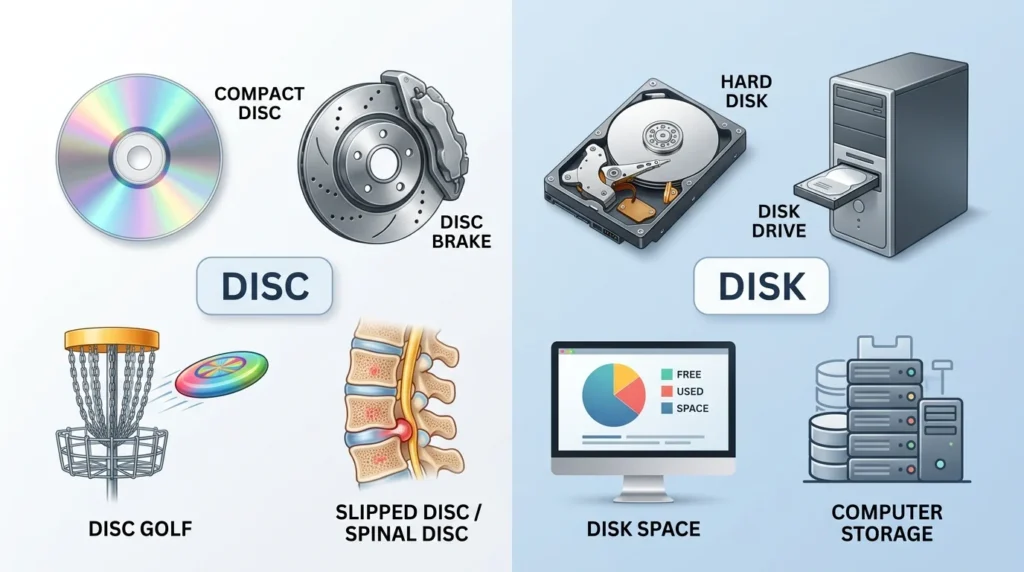
Have you ever typed disc and then wondered if it should be disk? You are not alone. The two words look almost the same, sound the same, and often have the same meaning. Yet you may see hard disk, compact disc, slipped disc, and disc golf in different places.
So, is one spelling wrong?
No. Both “disc” and “disk” are correct. The best choice depends on your English variety, the context, and the established term you are using.
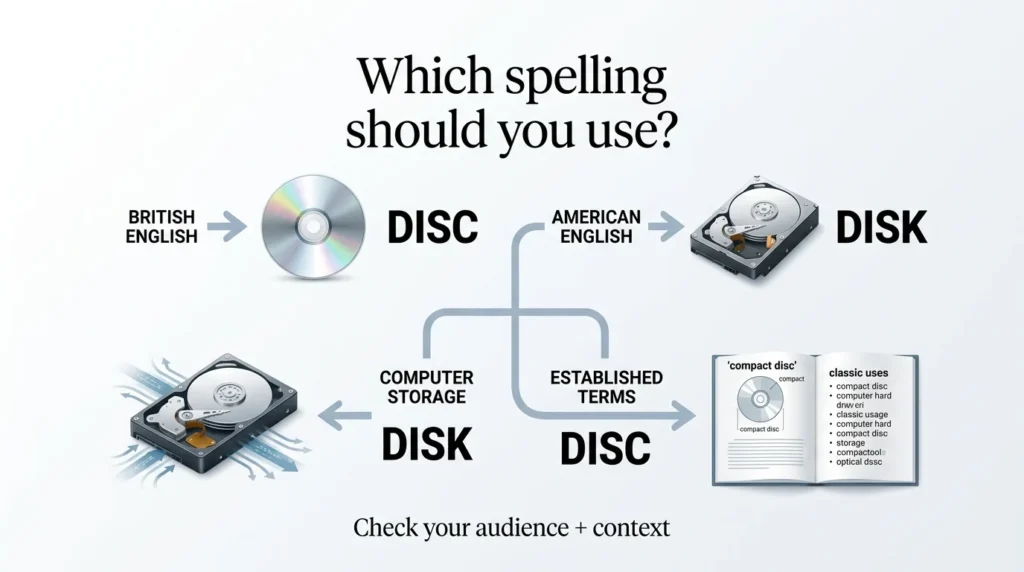
In general, disc is more common in British English, while disk is more common in American English. But this rule has important exceptions. Computer terms usually use disk, even in British English. Terms such as compact disc and disc jockey keep disc in both major varieties. Medical terms can also vary by region.
That is why simply memorizing “British = disc” and “American = disk” is not enough. This guide explains the history, regional rules, technical terms, common mistakes, and everyday examples so you can choose the right spelling with confidence.
Disc or Disk
Disc and disk are both correct spellings of the same English word.
The main difference is regional and contextual:
Disc is usually preferred in British English for general meanings.
Disk is usually preferred in American English for general meanings.
Disk is standard in many computer terms, including hard disk and disk drive.
Disc remains standard in established terms such as compact disc and disc jockey.
In medical English, both forms are used, with disc common in British English and disk common in American English.
Both are pronounced /dɪsk/.
At a glance
Situation
Common spelling
General British English
disc
General American English
disk
Computer storage
disk
Hard drive
hard disk
CD
compact disc
Disc jockey
disc jockey
British medical usage
often disc
American medical usage
often disk
Disc golf
disc golf
Pronunciation
same: /dɪsk/
The important point is this:
Do not choose the spelling by country alone. Check the context and the established term too.
Oxford gives the same broad rule: disc is usual in British English and disk in North American English, but computer-related senses normally use disk, even in British English.
The Origin of Disc or Disk
Both spellings come from the same ancient word.
The English word traces back to Latin discus, from Greek diskos, referring to a round object such as the discus used in throwing sports.
The interesting part is that disk is not simply a modern American spelling of an older British “disc.” Historical English used disk early, and disc later became especially common in British usage.
The Cambridge Guide to English Usage notes that disk was the normal spelling from the 17th century, while disc became increasingly common in Britain from the late 19th century. Later, computer terminology helped make disk very common again in British English.
This history explains why the two spellings cannot be divided perfectly into:
British = disc American = disk
That shortcut is useful, but English developed several established terms that do not follow it.
Why did two spellings survive?
English often keeps spelling variants when different regions or industries adopt different forms.
That happened here through:
The older spelling disk.
Growing British preference for disc.
American preference for disk in many general uses.
The rise of computer technology and terms such as hard disk.
Established expressions such as compact disc retaining the c spelling.
So, today, both forms are part of standard English.
British English vs American English Spelling
The simplest regional rule is:
British English → disc is usually preferred. American English → disk is usually preferred.
But that rule applies mainly to general usage. Established terms can follow different conventions.
British English
British English commonly uses disc for a general round object:
a metal disc
a thin disc
a brake disc
an identity disc
a spinal disc
But computer vocabulary normally uses disk:
hard disk
disk drive
disk space
disk storage
floppy disk
This is why a British writer can naturally write:
The computer’s hard disk is full.
but:
The car needs a new brake disc.
American English
American English generally favors disk for a flat, round object:
a metal disk
a thin disk
a computer disk
a spinal disk
But many established expressions still use disc:
compact disc
disc jockey
disc golf
discography
Blu-ray Disc
So American English does not simply replace every c with k.
Disc vs Disk: The Most Useful Comparison Table
Meaning or expression
British English
American English
Flat round object
disc
disk
Computer storage
disk
disk
Hard drive
hard disk
hard disk
Disk space
disk space
disk space
Floppy storage
floppy disk
floppy disk
Compact CD
compact disc
compact disc
Music on a CD
disc
disc/disk depending on context
Disc jockey
disc jockey
disc jockey
Disc golf
disc golf
disc golf
Brake component
brake disc
brake disc/disk
Spinal cartilage
spinal disc
spinal disk/disc
Slipped condition
slipped disc
slipped disk
General medical term
often disc
often disk
Pronunciation
/dɪsk/
/dɪsk/
This table shows why context matters as much as regional English.
Disc or Disk in Computing
Computing is where many people first notice the disk spelling.
Common computer terms include:
hard disk
disk drive
disk space
disk storage
floppy disk
disk image
disk partition
virtual disk
These terms normally use disk, even in British English.
For example:
My laptop has very little disk space.
The computer cannot detect the hard disk.
The disk drive needs to be replaced.
What about optical media?
This is where the familiar disc vs disk distinction becomes useful.
Many optical-media terms traditionally use disc:
compact disc
audio disc
optical disc
Blu-ray Disc
disc-based media
By contrast, magnetic computer storage traditionally uses disk:
hard disk
floppy disk
magnetic disk
This is a useful technical convention, but it is not an absolute spelling rule for every modern storage technology.
The safest approach is to follow the established name of the technology or product rather than changing every word based on whether it stores data magnetically or optically.
Cambridge’s dictionary examples include hard disk, floppy disk, and disk space, while Oxford lists compact disc as the standard term.
The easy memory trick
You can remember:
hard disk → computer storage compact disc → CD
But do not turn that memory trick into a universal rule.
Medical English is another area where both spellings appear.
A structure between the bones of the spine can be called a disc or disk.
British English
British English commonly uses:
slipped disc
spinal disc
herniated disc
American English
American English commonly uses:
slipped disk
spinal disk
herniated disk
Important exception: optic disc
Not every medical term should be changed from disc to disk in American writing.
For example, optic disc is an established anatomical term.
That is a good example of why writers should follow the terminology of their medical field rather than applying a simple country-based spelling swap.
Which Spelling Should You Use?
The answer depends on who will read your writing and what you are writing about.
If your audience is American
Use disk for general uses when the word is not part of an established expression.
Examples:
The object looked like a small disk.
The computer has a large hard disk.
But keep established expressions such as:
compact disc
disc golf
disc jockey
If your audience is British
Use disc for general meanings.
Examples:
The object looked like a small disc.
The mechanic replaced the brake disc.
But use established computer terminology:
hard disk
disk space
disk drive
If your audience is Canadian
Canadian usage has a particularly clear guideline.
Canada’s Language Portal recommends disk for computer-related meanings and disc for other meanings. Its examples include hard disk, disk drive, compact discs, spinal discs, and disc jockeys. It also notes that disc generally reflects British and Canadian usage, while disk reflects American usage.
If you write for Australia, New Zealand, India, or other Commonwealth audiences
British-style disc is common in many general contexts, but technical terminology often uses disk.
For international websites, do not force every occurrence into one spelling. Follow the established term and keep your chosen English variety consistent.
If you write for a global audience
Use the spelling that is most established for the specific term.
For example:
hard disk
disk drive
compact disc
disc golf
This is often clearer than trying to make every word match one country’s spelling system.
Disc vs Disk: Correct vs Preferred
One of the biggest sources of confusion is the difference between correct and preferred.
A spelling can be correct but less usual in a particular variety of English.
For example:
disk is a correct English spelling.
But in British general English, disc may be the preferred spelling.
Likewise:
disc is a correct English spelling.
But in American general English, disk may be preferred.
This distinction matters because dictionaries often identify one spelling as the usual regional form while still recognizing the other.
So instead of asking:
Which spelling is right?
A better question is:
Which spelling is standard for my audience and context?
That question gives you a much more useful answer.
Disk is a standard spelling, especially in American English and computing.
Mistake 2: Saying “disc is always British”
This is too simple.
British English uses disk in many computer terms.
Correct:
The hard disk is full.
Not:
The hard disc is full.
Mistake 3: Changing “compact disc” to “compact disk”
The established term is:
compact disc
Oxford lists compact disc as the standard term for a small disc used to record sound or information.
Mistake 4: Assuming every optical medium must use “disc”
The optical-media rule is useful, but it is not a complete English spelling rule.
The correct spelling can depend on the established name of the medium, product, or technology.
Mistake 5: Assuming every American medical term uses “disk”
American English commonly uses disk for spinal structures, but established medical terms can still use disc.
Always follow the terminology used by the relevant medical source or field.
Mistake 6: Thinking the words have different pronunciations
They do not.
Both are normally pronounced:
/dɪsk/
The difference is in spelling, not pronunciation.
Mistake 7: Mixing spellings randomly
Both forms can appear in one article without being wrong if different terms require them.
For example:
My hard disk stores the files. I also have several compact discs.
That is perfectly natural because the two expressions are established differently.
The problem is random variation inside the same expression.
For example, do not write:
hard disk
in one paragraph and:
hard disc
in another if you are referring to the same standard computing term.
Disc or Disk in Everyday Examples
In an email
Computer context:
I saved the backup files to the hard disk.
In a news article
General British-style usage:
The moon appeared as a bright disc in the night sky.
American-style usage:
The moon appeared as a bright disk in the night sky.
On social media
I found my old compact discs today.
In formal writing
The patient was diagnosed with a herniated disc.
For an American medical audience, herniated disk may be preferred.
In technology writing
The new computer has a larger hard disk and more disk space.
In automotive writing
The mechanic replaced the damaged brake disc.
American sources may also use brake disk.
In sports writing
She threw the disc across the field.
Disc golf also keeps the c spelling.
Disc or Disk: Common Words You Should Know
Phrase
Preferred/common spelling
hard disk
disk
hard disk drive
disk
disk drive
disk
disk space
disk
disk storage
disk
floppy disk
disk
magnetic disk
disk
compact disc
disc
audio disc
disc
optical disc
disc
disc jockey
disc
disc golf
disc
brake disc
disc in British usage
slipped disc
disc in British usage
slipped disk
disk in American usage
spinal disc
disc in British usage
spinal disk
disk in American usage
This is a better way to learn the difference than memorizing a single C vs K rule.
Disc or Disk – Trends & Usage Data
Google Trends measures relative search interest, not whether a spelling is correct. Its results can also change by country, date range, and search term.
For disc and disk, raw search popularity can also be misleading because each word appears in many different searches.
For example, disk is strongly connected with searches involving:
hard disk
disk drive
disk space
computer storage
Meanwhile, disc appears in searches involving:
compact disc
disc golf
disc jockey
spinal disc
brake disc
So a simple worldwide comparison of the two words would not tell us which spelling is “correct.” It would mix several meanings and industries
Disc or Disk: A Simple Decision Guide
Use this quick guide when you are unsure.
Step 1: Is it a computer term?
If yes, disk is usually the safe choice.
hard disk disk drive disk space
Step 2: Is it a CD or established optical-media term?
Use the established form.
compact disc optical disc
Step 3: Are you describing a general round object?
Consider your English variety.
British: disc American: disk
Step 4: Is it a medical term?
Check the regional or professional convention.
British: slipped disc American: slipped disk
But do not automatically change established medical terms.
Step 5: Is it a product, brand, or official name?
Keep the official spelling.
This five-step method is safer than using “C for British, K for American” as a universal rule.
FAQs About Disc or Disk
1. Is “disc” or “disk” correct?
Both are correct. The choice depends on regional English, context, and established terminology.
2. What is the difference between disc and disk?
Usually, there is no basic difference in meaning. They are spelling variants. Regional preferences and technical conventions determine which form is more natural.
3. Is “disc” British English?
Yes. Disc is generally the usual British spelling for many general meanings. However, British English commonly uses disk for computer-related terms.
4. Is “disk” American English?
Yes. Disk is generally the usual American spelling for many general meanings. It is also standard in many computer terms.
5. Is it “hard disk” or “hard disc”?
Hard disk is the standard modern computing term. It is used in both American and British English.
6. Is it “compact disc” or “compact disk”?
Compact disc is the established term. The abbreviation is CD.
7. Is it “slipped disc” or “slipped disk”?
Both forms occur. Slipped disc is common in British English, while slipped disk is common in American English.
8. Are disc and disk pronounced the same?
Yes. Both are normally pronounced /dɪsk/.
9. Why are disc and disk spelled differently?
They developed as spelling variants from the same historical word. Different regional and technical conventions helped both forms survive.
10. Should I use disc or disk on my website?
Choose the form that fits your target audience and the established term. For international websites, use disk in standard computer terms such as hard disk and keep established forms such as compact disc.
11. Is “disk” short for “diskette”?
No. Disk is an older word. It did not originate as a shortened form of diskette.
12. Can I use both spellings in one article?
Yes, when the context requires them.
For example:
The hard disk stores the files, while the compact disc contains the music.
Using both forms here is correct because each expression has its own established spelling.
Disc or Disk: Final Rule to Remember
If you need one simple rule, remember this:
Disc and disk are both correct. Regional English matters, but established terms and technical context matter too.
For general usage:
British English → usually disc American English → usually disk
For computing:
hard disk → disk
For CDs:
compact disc → disc
For medical writing:
follow the regional or professional convention.
And most importantly, do not treat disc and disk as two completely different words. They are closely related spelling variants whose preferred use has developed differently across regions and fields.
Conclusion
So, disc or disk? The correct answer is that both spellings are standard English. The choice is usually based on region, context, and established terminology.
For general meanings, disc is usually preferred in British English, while disk is usually preferred in American English. But that simple rule has important exceptions. Computer vocabulary strongly favors disk, so we write hard disk, disk drive, and disk space even in British English. Established expressions such as compact disc and disc jockey keep the c spelling. Medical terms can use either form, with regional preferences often determining the choice.
The best approach is therefore not to ask which spelling is universally correct. Ask which spelling is standard for your audience and your specific term.
If you are writing for an international audience, follow established expressions and keep your general spelling style consistent. When in doubt, check a reliable dictionary or the terminology used by your field.
In short: disc and disk are both correct. Choose the spelling that fits the context, audience, and established term.
Amelia Script is a dedicated grammar specialist and language mentor, simplifying English rules, refining writing skills, and helping learners communicate with clarity and confidence.