
Have you ever typed seperate and then stopped because something about the spelling looked wrong? You are not alone. Separate is one of those English words that many people know well but still misspell.
So, which one is correct: separate or seperate?
The answer is simple: separate is the correct spelling. Seperate is a misspelling.
The confusion mainly comes from pronunciation. When people say separate, the middle vowel can sound weak. This can make seperate look natural, even though the correct spelling has an a.
This spelling question also causes confusion because English has many words with different US and UK spellings. For example, color becomes colour in British English. But separate does not work that way. The spelling is the same in American, British, Canadian, Australian, and other standard forms of English.
In this guide, you will learn the correct spelling, the word’s history, the reason for the common mistake, regional usage, related spelling errors, everyday examples, and a simple way to remember separate forever.
Separate or Seperate
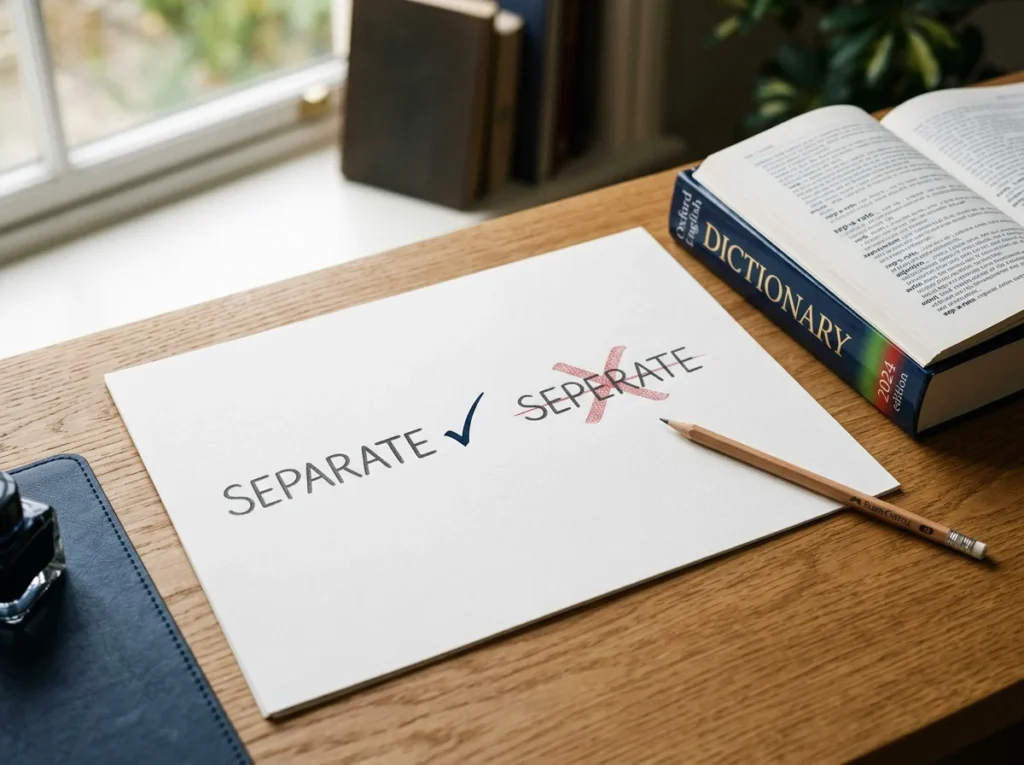
Separate is the correct spelling.
Seperate is a common misspelling.
| Spelling | Correct? | Meaning |
|---|---|---|
| Separate | ✅ Yes | To divide, keep apart, or describe things that are distinct |
| Seperate | ❌ No | Misspelling of separate |
Correct examples
- Please separate the blue files from the red files.
- We have separate rooms for guests.
- Keep your personal and work accounts separate.
- The teacher asked the students to separate into groups.
Incorrect example
- ❌ Please seperate the documents.
Correct version
- ✅ Please separate the documents.
There is no modern US or UK spelling choice here. If you mean the word that means “to divide,” “keep apart,” or “distinct,” use separate.
Easy spelling trick
Remember the middle of the word:
sepARate
It contains A-R-A, not E-R-A.
A popular memory trick is:
There is an “A RAT” in sepARate.
You do not need to memorize a complicated rule. Just remember that separate has two a’s.
The Origin of Separate
The history of separate helps explain why its spelling contains an a.
The word comes from Latin separatus, the past participle of separare, meaning to set apart or divide. The Latin form is connected with se-, meaning “apart,” and parare, meaning “to prepare, produce, or provide.”
Separate entered English in the late Middle English period. It has been used in English since the 15th century.
Over time, the word developed several related meanings.
As a verb, separate means to divide things or move them apart:
Please separate the papers into three groups.
As an adjective, separate describes things that are apart, distinct, or different:
The company has separate offices for each department.
The spelling has remained separate in modern standard English.
Why does “seperate” look correct?
The main reason is pronunciation.
When separate is spoken quickly, the vowel in the middle may sound like a weak uh sound. A writer may hear that sound and choose e instead of a.
This creates:
❌ seperate
instead of:
✅ separate
The mistake is easy to make because English spelling does not always match pronunciation perfectly.
The important thing to remember is that the correct spelling keeps the a:
sep-a-rate
A useful pronunciation point
Separate can sound slightly different depending on how it is used.
As an adjective:
They live in separate houses.
The final part is usually weaker.
As a verb:
Please separate the papers.
The final part is pronounced more clearly.
This difference in pronunciation can make the spelling harder to remember, but it does not change the spelling.
British English vs American English Spelling
There is no spelling difference between American English and British English for separate.
Both use:
separate
This is important because many English spelling questions involve regional differences. For example:
- American color → British colour
- American center → British centre
- American theater → British theatre
But:
- American separate → British separate
Regional spelling comparison
| Type of English | Correct spelling | Incorrect spelling |
|---|---|---|
| American English | separate | seperate |
| British English | separate | seperate |
| Canadian English | separate | seperate |
| Australian English | separate | seperate |
| New Zealand English | separate | seperate |
| Indian English | separate | seperate |
| South African English | separate | seperate |
So you do not need to choose between the two spellings based on your audience’s country.
Separate or Seperate: side-by-side comparison
| Feature | Separate | Seperate |
|---|---|---|
| Standard spelling | ✅ Correct | ❌ Incorrect |
| Meaning | Divide, keep apart, or distinct | No standard meaning as this spelling |
| US English | ✅ Used | ❌ Not standard |
| UK English | ✅ Used | ❌ Not standard |
| Formal writing | ✅ Use it | ❌ Avoid it |
| Academic writing | ✅ Use it | ❌ Avoid it |
| Professional writing | ✅ Use it | ❌ Avoid it |
| Correct related forms | separated, separation, separately | Common misspellings |
The key difference is just one letter, but that letter matters.
separate → correct
seperate → incorrect
Which Spelling Should You Use?
Use separate.
There is no situation in modern standard English where you need to switch to seperate because of your country or audience.
For American readers
Use:
Please keep the two accounts separate.
For British readers
Use:
The two departments operate as separate units.
For Canadian, Australian, or New Zealand readers
Use:
The documents are stored in separate folders.
For international readers
Use:
The two issues should be treated as separate matters.
The spelling stays the same.
For professional writing
Always choose separate in:
- Business emails
- Reports
- Academic papers
- School assignments
- Resumes and CVs
- News articles
- Websites
- Applications
- Formal letters
- Official documents
If you are writing something important and you are unsure, separate is the safe standard form.
Disc or Disk: When Should You Use Each Spelling?
Common Mistakes with Separate or Seperate
The most common error is changing the a after p into an e.
1. Seperate
❌ We keep the two accounts seperate.
✅ We keep the two accounts separate.
2. Seperated
❌ The files were seperated by date.
✅ The files were separated by date.
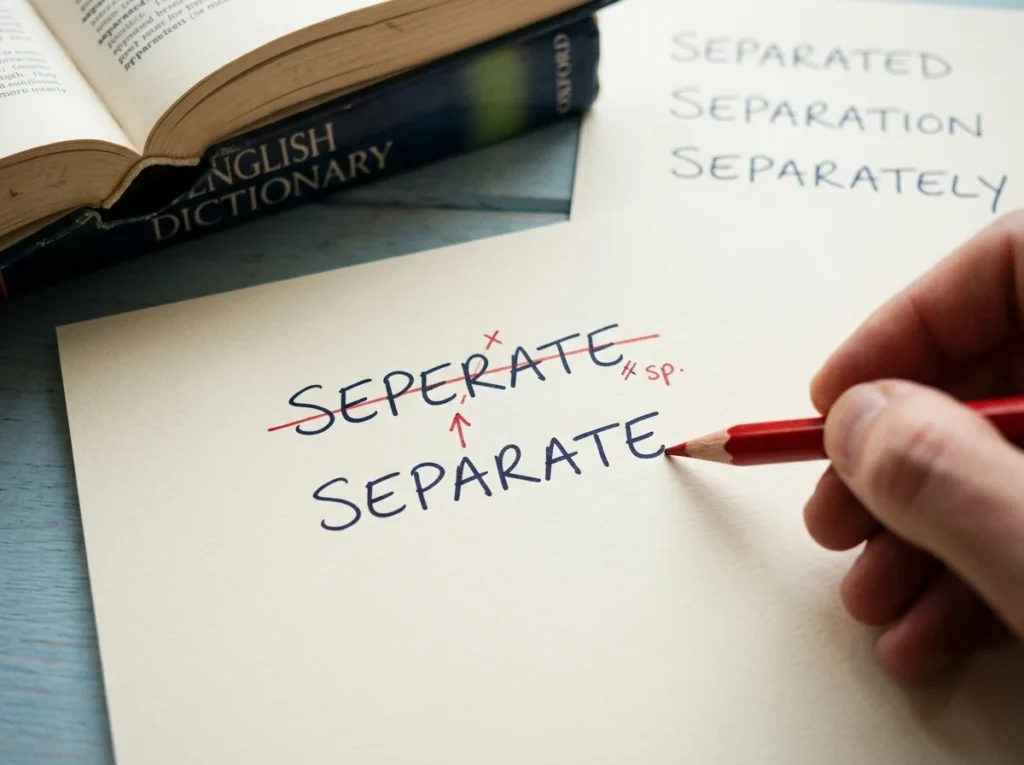
3. Seperation
❌ The seperation of the groups took several hours.
✅ The separation of the groups took several hours.
4. Seperately
❌ The items were packed seperately.
✅ The items were packed separately.
5. Seperating
❌ We are seperating the old files from the new ones.
✅ We are separating the old files from the new ones.
Common spelling pattern
| Incorrect | Correct |
|---|---|
| seperate | separate |
| seperated | separated |
| seperation | separation |
| seperately | separately |
| seperating | separating |
| seperates | separates |
The easiest way to avoid these mistakes is to remember the base word:
SEPARATE
Once you remember the a, the related forms become easier.
Separate or Seperate in Everyday Examples
Separate is common in everyday speech and writing. You may see it in emails, schoolwork, news reports, websites, social media posts, and formal documents.
In emails
Please send the invoices as separate attachments.
I have created separate folders for each client.
Keep the two files separate until we finish the review.
In business writing
The company has separate teams for sales and support.
Personal expenses should remain separate from business expenses.
The two departments have separate budgets.
In school or academic writing
The experiment was divided into two separate stages.
The results were analyzed as separate groups.
The researchers studied the two populations separately.
In news writing
The two organizations released separate statements.
The cases will be considered separately.
On social media
Sometimes it helps to keep work and personal life separate.
Facts and opinions are separate things.
In formal writing
These issues should be considered separately.
The two factors must be examined as separate variables.
Separate as a verb
As a verb, separate means to divide or move things apart.
Please separate the documents into two groups.
The referee had to separate the players.
Separate as an adjective
As an adjective, separate means apart, distinct, or different.
They have separate offices.
We need separate accounts for the two projects.
Separately as an adverb
The related word separately means individually or apart.
Please submit the forms separately.
This is why learning the spelling of separate also helps you spell its related forms correctly.
Grey or Gray: Which Spelling Should You Use?
Separate or Seperate –Trends & Usage Data
People search “separate or seperate” because they are unsure which spelling is correct. The search itself is a good example of how spelling uncertainty creates search demand.
Google Trends treats different spellings as separate search terms. This means an exact comparison can be used to examine how often people search for separate, seperate, or the full phrase “separate or seperate.”
However, Google Trends does not provide a simple count of every search. Its numbers are normalized relative search-interest values. Very low-volume searches may also appear with little or no usable data.
For a spelling article, this matters because search interest should not be confused with correct language use.
A person searching for seperate may be searching because they are trying to check whether it is correct. That does not mean seperate is an accepted spelling.
What the search behavior tells us
The search phrase “separate or seperate” reflects a spelling question, not two accepted spelling choices.
The useful distinction is:
- Separate is the standard spelling.
- Seperate is the common misspelling.
- Both US and UK English use separate.
- Searchers may use the incorrect form while checking the spelling.
- Search interest in a misspelling does not make that spelling correct.
Why search data should be read carefully
Google Trends is useful for comparing search interest, but it does not tell us whether a spelling is grammatically correct.
For example, a misspelled word can receive searches precisely because people are asking whether it is wrong.
Therefore, dictionary usage and standard spelling rules matter more than search popularity when deciding which spelling to use.
For this keyword, the practical answer remains simple:
Write separate, not seperate.
Separate vs. Seperate: The Key Difference
There is only one spelling you should use in standard modern English.
Correct
separate
It has two a’s:
s-e-p-a-r-a-t-e
Incorrect
seperate
It changes the first middle a to e:
s-e-p-e-r-a-t-e
Compare them carefully:
sepARate ✅
sepERate ❌
The first form is the one to use.
A simple memory trick
Think:
A RAT
The word separate contains:
sep + A RAT + e
So when you are unsure, remember:
There is an A RAT in separate.
Another simple method is to connect separate with the idea of apart. Both words begin with the useful a sound pattern:
separate → apart
You only need one memory trick. Choose whichever one works best for you.
FAQs About Separate or Seperate
1. Is it separate or seperate?
Separate is correct.
Seperate is a common misspelling.
Example:
Please keep the documents separate.
2. Is “seperate” ever correct?
In modern standard English, seperate is not the spelling you should use. The correct spelling is separate.
3. Is “seperate” the British spelling?
No.
British English uses separate, just like American English.
4. Why do people spell separate as seperate?
The main reason is pronunciation. The middle vowel in separate can sound weak when the word is spoken, making e seem like a natural choice.
5. How can I remember the spelling of separate?
Remember that separate has two a’s.
You can also use:
“There is an A RAT in sepARate.”
6. Is it separated or seperated?
The correct spelling is separated.
Example:
The files were separated into different folders.
7. Is it separation or seperation?
The correct spelling is separation.
Example:
The separation of the two groups was necessary.
8. Is it separately or seperately?
The correct spelling is separately.
Example:
The items were packed separately.
9. Does American English use separate?
Yes. Separate is the standard spelling in American English.
10. Does British English use separate?
Yes. Separate is also the standard spelling in British English.
11. Does separate mean “different”?
It can.
For example:
They have separate offices.
Here, separate means the offices are apart or distinct.
12. Can separate be a verb?
Yes.
Example:
Please separate the papers into two groups.
It can also be an adjective:
They work in separate offices.
Conclusion
When choosing between separate or seperate, the answer is clear: separate is the correct spelling.
The word is spelled s-e-p-a-r-a-t-e, with two a’s. Seperate is a common spelling mistake, often caused by the way the middle vowel sounds when the word is spoken.
There is also no British-versus-American spelling difference. American English, British English, Canadian English, Australian English, New Zealand English, and other standard varieties use separate.
The same spelling pattern appears in related words such as separated, separation, separately, and separating. Remembering the two a’s can help you avoid all of these mistakes.
If you need a quick memory trick, think of “A RAT” in sepARate.
So whether you are writing a school assignment, business email, website article, report, application, or social media post, choose:
Separate ✅
Seperate ❌
Once you remember the A, this common spelling problem becomes much easier.

Elias Worden is a trusted grammar expert and writing mentor, dedicated to simplifying English rules and helping learners write with clarity, precision, and confidence.