
Have you ever typed “truely” and stopped to wonder if the spelling looks right? This is a common English spelling problem because true looks like it should become truely when we add -ly. But English has a different spelling for this word.
The correct spelling is truly. Truely is a misspelling and should not be used in standard English.
The word truly is an adverb. It can mean really, sincerely, genuinely, actually, or in a truthful way, depending on the sentence. For example, “I truly appreciate your help” means that the speaker sincerely appreciates the help.
The confusion is easy to understand. Many English adverbs are formed by adding -ly to an adjective. For example, quick becomes quickly and careful becomes carefully. So, it may seem natural to change true into truely. However, the standard form is truly, with no e between the u and l.
This guide explains the correct spelling, word origin, grammar, British and American usage, common mistakes, everyday examples, and the difference between truly and really.
Truly or Truely
Truly is the correct spelling. Truely is incorrect.
The correct form is:
true → truly
Not:
true → truely
Quick comparison
| Spelling | Correct? | Meaning | Example |
|---|---|---|---|
| truly | ✅ Correct | Really, sincerely, genuinely, or truthfully | I truly appreciate your help. |
| truely | ❌ Incorrect | Misspelling of truly | I truely appreciate your help. |
Examples
✅ She truly cares about her work.
❌ She truely cares about her work.
✅ I am truly sorry.
❌ I am truely sorry.
So, whenever you are unsure, remember:
TRULY = T-R-U-L-Y
There is no e after the u.
What Does Truly Mean?
Truly is an adverb related to the adjective true.
It has several common uses.
1. Truly means “really”
The movie was truly excellent.
Here, truly adds strong emphasis to excellent.
2. Truly means “sincerely”
I am truly sorry for the mistake.
The speaker is expressing genuine regret.
3. Truly means “actually” or “in reality”
Does he truly understand the problem?
Here, truly asks whether something is actually the case.
4. Truly means “in a truthful way”
She spoke truly about what happened.
Here, it relates directly to truth or honesty.
The exact meaning depends on the sentence, but the spelling remains the same: truly.
The Origin of Truly
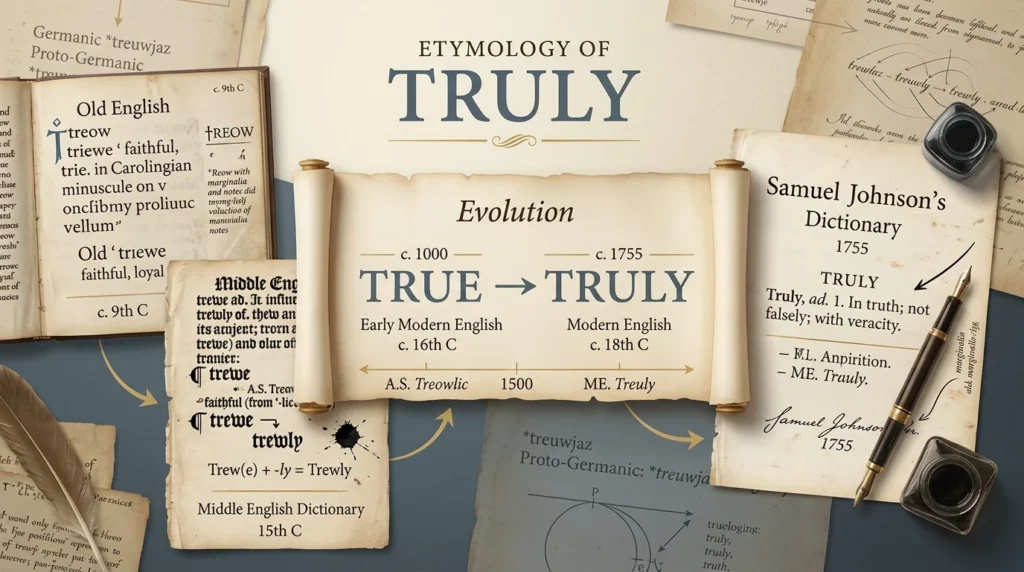
Truly has a long history in English. Its earlier forms are connected with Old English and Middle English words related to truth, faithfulness, loyalty, and being true.
The word is linked to the adjective true and the suffix -ly. Older forms included Middle English treuli and an Old English form related to trēowlīce. Over time, the word developed uses connected with faithfulness, truth, reality, accuracy, and emphasis.
The modern word truly has kept the connection with true, but its spelling does not simply preserve the full spelling of true.
Why Is It Truly, Not Truely?
This is the main spelling point to remember.
The adjective is:
true
The standard adverb is:
truly
The final e is not kept.
This is why:
❌ true + ly = truely
is not the standard spelling.
Instead:
✅ true → truly
Why Does This Confuse People?
English often forms adverbs by adding -ly:
- quick → quickly
- slow → slowly
- careful → carefully
- quiet → quietly
Because of this common pattern, truely looks reasonable.
But spelling changes do not always work in exactly the same way for every word. Truly is an established spelling that must be remembered.
Similar changes can be seen in:
- true → truly
- due → duly
- whole → wholly
However, this should not be treated as a rule that every adjective ending in e must follow. For example:
- nice → nicely
- safe → safely
- wise → wisely
The safest approach is simply to remember the correct form:
true → truly
Truly Is an Adverb
Understanding the grammar makes the word easier to use.
True is mainly an adjective:
That statement is true.
Truly is an adverb:
She truly believes him.
An adverb can tell us more about an action, feeling, description, or statement.
Compare:
He is true to his word.
with:
He truly believes what he says.
The words are related, but they do different jobs.
Word family
| Word | Part of speech | Example |
|---|---|---|
| true | Adjective | The story is true. |
| truly | Adverb | I truly believe you. |
| truth | Noun | Tell me the truth. |
| truthful | Adjective | She gave a truthful answer. |
| truthfully | Adverb | He answered truthfully. |
This also explains why truly and truthfully are not always interchangeable.
I truly believe you.
means the speaker strongly or sincerely believes the person.
I answered truthfully.
means the answer was given honestly.
British English vs American English Spelling
There is no British-American spelling difference between truly and truely.
Both British English and American English use:
truly
The incorrect form truely does not become correct simply because the writer is using British English.
Comparison table
| English variety | Correct spelling | Incorrect spelling |
|---|---|---|
| American English | truly | truely |
| British English | truly | truely |
| Canadian English | truly | truely |
| Australian English | truly | truely |
| New Zealand English | truly | truely |
| Indian English | truly | truely |
Examples
American English:
I truly enjoyed the experience.
British English:
I truly enjoyed the experience.
The spelling is exactly the same.
This is important because some English words do have regional spelling differences, such as color/colour and center/centre. Truly is not one of those words.
Separate or Seperate: Which Spelling Is Correct?
Truly vs Really: What Is the Difference?
Truly and really can sometimes mean the same thing, but they are not always identical.
Truly
Truly often adds a sense of sincerity, truth, or strong emphasis.
I truly appreciate your kindness.
This sounds sincere and heartfelt.
Really
Really often means actually, in fact, or very much.
I really enjoyed the concert.
This simply emphasizes how much the speaker enjoyed it.
Compare them
| Word | Common meaning | Example |
|---|---|---|
| truly | Sincerely, genuinely, really, or in truth | I truly appreciate your help. |
| really | Actually, genuinely, or very much | I really enjoyed the movie. |
In many casual sentences, either word may work:
She is truly talented.
She is really talented.
Both are natural. However, truly can sound more sincere or emphatic, while really is often more common in everyday conversation.
Which Spelling Should You Use?
The answer is simple: use truly.
You do not need to choose between truly and truely based on your country.
If you write American English
Use:
truly
Example:
We truly appreciate your support.
If you write British English
Use:
truly
Example:
I truly enjoyed the performance.
If you write for a global audience
Use:
truly
It works naturally in international English.
For school or university writing
Use truly.
The results are truly important.
For professional emails
Use truly.
We truly appreciate your patience.
For websites and online content
Use truly.
This guide truly explains the difference.
There is no professional situation in standard English where you need to replace truly with truely.
Common Mistakes With Truly or Truely
Mistake 1: Writing “truely”
❌ I truely appreciate your help.
✅ I truly appreciate your help.
The incorrect version keeps the e from true.
Mistake 2: Thinking true + ly must equal truely
It is tempting to think:
true + ly = truely
But that is not the standard spelling.
Remember:
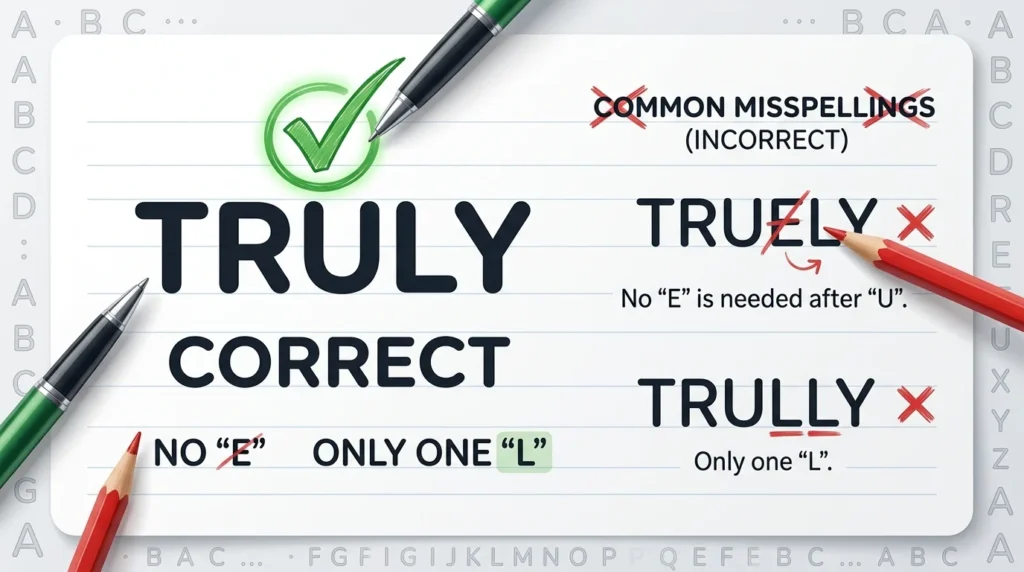
true → truly
Mistake 3: Adding an extra “l”
Another spelling mistake is:
❌ trully
The correct spelling has only one l:
✅ truly
So avoid both:
❌ truely
❌ trully
✅ truly
Mistake 4: Confusing truly with truthfully
These words are related, but they do not always mean exactly the same thing.
I truly admire her.
This expresses genuine admiration.
He answered truthfully.
This means he answered honestly.
Mistake 5: Thinking “truely” is British English
It is not.
British English uses:
truly
not:
truely
Mistake 6: Using “true” when “truly” is needed
Compare:
The statement is true.
Here, true describes the statement.
But:
I truly believe the statement.
Here, truly modifies the verb believe.
Disc or Disk: When Should You Use Each Spelling?
Truly or Truely: Common Error Table
| Incorrect | Correct | Why? |
|---|---|---|
| I truely agree. | I truly agree. | Truly has no e after u. |
| She is truely happy. | She is truly happy. | The correct adverb is truly. |
| I trully appreciate it. | I truly appreciate it. | Truly has one l. |
| He spoke truely. | He spoke truly. | Truely is not the standard spelling. |
| We truely care. | We truly care. | Use truly in standard English. |
Truly in Everyday Examples
Truly is common in personal, professional, academic, and formal writing.
In Emails
Thank you for your support. I truly appreciate it.
We are truly grateful for your patience.
I am truly sorry for the delay.
In Formal Writing
The findings are truly significant.
This decision could have a truly lasting effect.
The results provide a truly useful insight.
In News Writing
The discovery was truly remarkable.
It was a truly unexpected development.

On Social Media
This place is truly beautiful!
I am truly grateful for everyone who helped me.
In Conversation
Do you truly believe that?
I truly mean it.
That was truly amazing.
In Letters
Truly also appears in the expression:
Yours truly
Example:
Yours truly,
Daniel
It can be used as a formal letter closing, especially in American English, and may also be used informally to refer to oneself.
Truly: Usage by Meaning
One reason people use truly in many different ways is that it has several related meanings.
| Meaning | Example | Simple explanation |
|---|---|---|
| Really | She is truly talented. | She is really talented. |
| Sincerely | I am truly sorry. | I am sincerely sorry. |
| Actually | Did he truly say that? | Did he really say that? |
| In truth | He spoke truly. | He spoke honestly or truthfully. |
| Strong emphasis | It was truly amazing. | It was very or exceptionally amazing. |
This makes truly more flexible than a simple synonym for really.
Truly – Usage Data and Search Interest
People often search “truly or truely” because the spelling is easy to misjudge. The confusion comes from the familiar spelling of true and the common pattern of adding -ly to form adverbs.
Search interest for spelling questions can change by country, language background, education level, and writing context. A person may search the phrase before sending an email, completing an assignment, writing an article, or checking a sentence.
However, search frequency does not decide whether a spelling is correct. A misspelling can receive many searches simply because many people are unsure about it.
For truly, the usage picture is clear:
- Truly is the standard spelling.
- Truely is a common spelling error.
- The correct spelling is used in both British and American English.
- The word appears in everyday, professional, academic, and formal writing.
- Truly is used as an adverb and can express sincerity, truth, reality, or strong emphasis.
So, even if you see searches for truely, that does not make truely an accepted alternative spelling.
How to Remember the Correct Spelling
Use this simple memory trick:
TRUE loses the E in TRULY.
Think:
TRUE → TRU → TRULY
The final word is:
T-R-U-L-Y
Not:
T-R-U-E-L-Y
And not:
T-R-U-L-L-Y
A quick visual reminder
One E? No.
Two Ls? No.
Correct: TRULY
Once you remember that truly has no e and only one l, the spelling becomes much easier.
Truly or Truely: Word Variations
These related words are worth knowing:
| Word | Correct? | Part of speech | Example |
|---|---|---|---|
| true | ✅ | Adjective | The story is true. |
| truly | ✅ | Adverb | I truly believe you. |
| truth | ✅ | Noun | Tell the truth. |
| truthful | ✅ | Adjective | She was truthful. |
| truthfully | ✅ | Adverb | He answered truthfully. |
| truer | ✅ | Comparative adjective | This version is truer. |
| truest | ✅ | Superlative adjective | That was his truest statement. |
| truely | ❌ | — | Not the standard spelling. |
| trully | ❌ | — | Not the correct spelling of truly. |
This table also shows why truly, truthfully, and true should not be treated as interchangeable.
FAQs About Truly or Truely
1. Is “truly” or “truely” correct?
Truly is correct. Truely is incorrect.
Example:
I truly appreciate your help.
2. Is “truely” ever correct?
No. Truely is not the standard spelling of the word. Use truly instead.
3. Why is truly spelled without an e?
The standard adverb form related to true is truly, not truely. The final e is not retained in the established spelling.
4. Is truly an adverb?
Yes. Truly is an adverb.
Example:
She truly understands the problem.
5. Is truly British or American?
Truly is used in both British and American English. The spelling does not change between these varieties.
6. Is truly the same as really?
Sometimes. Both can mean really or genuinely, but truly can place more emphasis on sincerity or truth.
7. Can I use truly in formal writing?
Yes. Truly is suitable for formal letters, professional emails, academic writing, reports, websites, and everyday communication.
8. Is “Yours truly” correct?
Yes. Yours truly is a standard expression used as a letter closing and, in some contexts, as an informal reference to oneself.
9. What is the easiest way to remember truly?
Remember:
TRUE → TRULY
The correct spelling has no e after the u and only one l.
Conclusion
When choosing between truly or truely, the answer is clear: truly is the correct spelling. Truely is a common misspelling and is not the standard form used in English.
The confusion happens because the word comes from true, and it may seem natural to add -ly without changing anything. But the established spelling is truly. Think of it as true → truly, with the final e removed.
Truly is an adverb that can mean really, sincerely, genuinely, actually, or in a truthful way. Its exact meaning depends on the sentence. It is used in everyday conversation as well as emails, academic work, professional writing, news, social media, and formal letters.
There is also no British-American spelling difference here. Writers in both varieties use truly.
So if you are writing an email, essay, article, message, or formal document, choose truly every time. The easiest memory trick is simple: TRULY has no E and only one L.
Correct: truly
Incorrect: truely

Amelia Script is a dedicated grammar specialist and language mentor, simplifying English rules, refining writing skills, and helping learners communicate with clarity and confidence.