
Have you ever written “lieing” and wondered if it looks right? You are not alone. This is a common English spelling question because the normal way of making an -ing form can make lieing seem logical.
For many verbs, you simply add -ing:
- walk → walking
- read → reading
- play → playing
So why does lie become lying instead of lieing?
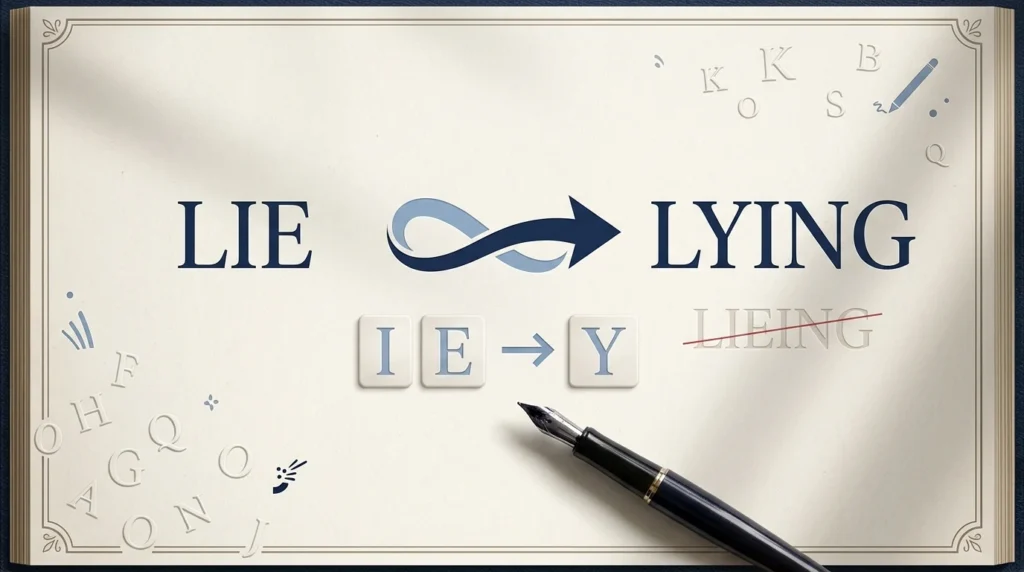
The answer is a simple spelling rule: verbs ending in -ie change -ie to -y before -ing is added.
Therefore:
lie → lying
Lieing is incorrect in standard English.
There is another reason this word can be confusing. Lying comes from two different verbs. It can mean resting in a position, as in “The cat is lying on the floor,” or saying something that is not true, as in “He is lying to me.”
This guide explains the spelling rule, the word’s history, British and American usage, the difference between lie, lying, lay, lain, lied, and laying, common mistakes, everyday examples, and the easiest way to remember the correct spelling.
Lieing or Lying
Lying is correct. Lieing is incorrect.
| Spelling | Correct? | Example |
|---|---|---|
| lying | ✅ Yes | She is lying on the bed. |
| lieing | ❌ No | She is lieing on the bed. |
The correct spelling is:
lie → lying
The spelling rule is:
For verbs ending in -ie, change -ie to -y before adding -ing.
So:
- lie → lying
- die → dying
- tie → tying
- vie → vying
This spelling stays the same in American English, British English, Canadian English, Australian English, and other standard varieties of English.
The shortest answer
If you are asking “lieing or lying?”, always choose:
✅ lying
Why Is Lying Spelled With a Y?
The main reason for the confusion is the way English changes verbs ending in -ie.
Most verbs can take -ing directly:
walk → walking
talk → talking
read → reading
Some verbs ending in a final e drop that e:
make → making
write → writing
hope → hoping
But verbs ending in -ie follow another spelling pattern.
The rule
-ie → -y + -ing
For example:
lie
Change ie to y:
ly
Then add ing:
lying
So:
lie + ing → lying
Not:
lie + ing → lieing
The same pattern appears in:
| Base Verb | Correct -ing Form | Incorrect Form |
|---|---|---|
| lie | lying | lieing ❌ |
| die | dying | dieing ❌ |
| tie | tying | tieing ❌ |
| vie | vying | vieing ❌ |
An easy memory rule
Remember:
IE changes to Y before -ing.
Once you remember lie → lying, you can apply the same pattern to words such as die → dying and tie → tying.
The Origin and History of Lying
The modern word lying comes from the verb lie, but English has two different verbs spelled lie.
Lie meaning “to rest”
This verb means to be in a horizontal or resting position.
The baby is lying in the crib.
Its main forms are:
lie → lay → lain → lying
Lie meaning “to tell an untruth”
This verb means to say something that is not true.
He is lying about his age.
Its main forms are:
lie → lied → lied → lying
The two verbs have different historical origins, even though they share the modern spelling lie and the same -ing form, lying.
This is one reason English learners can find the word confusing. The meanings are different, and some of their other verb forms are different, but the present participle is the same.
Why did “lying” develop this spelling?
The spelling follows the established English pattern for verbs ending in -ie:
lie → lying
The change is a spelling change made before -ing is added. It is not a difference between modern British and American English.
So lieing is not an older British spelling or an American alternative. It is simply the wrong spelling for the -ing form of lie.
British English vs American English Spelling
There is no British-American spelling difference for lying.
Both British and American English use:
lying
The same spelling is also standard in other major varieties of English.
| English Variety | Correct Spelling | Alternative Regional Spelling? |
|---|---|---|
| American English | lying | No |
| British English | lying | No |
| Canadian English | lying | No |
| Australian English | lying | No |
| New Zealand English | lying | No |
| Indian English | lying | No |
| International English | lying | No |
So you should not write:
❌ American: lying
❌ British: lieing
Instead:
✅ American: lying
✅ British: lying
Why this matters
English has many genuine US-UK spelling differences, such as:
- color / colour
- center / centre
- traveled / travelled
But lying is not one of them.
If your audience is American, British, Canadian, Australian, or international, the correct spelling remains lying.
Which Spelling Should You Use?
Use lying in all standard English writing.
For American English
She is lying on the couch.
For British English
She is lying on the sofa.
The vocabulary may differ, but the spelling of the verb does not.
For Canadian or Australian English
He is lying on the grass.
For international English
The dog is lying under the table.
For professional writing
Use lying in:
- emails
- school assignments
- academic papers
- business documents
- reports
- websites
- articles
- applications
- social media posts
There is no reason to use lieing in standard writing.
Lie, Lying, Lay, and Lain: The Resting Meaning
One of the hardest parts of lie is its irregular past tense.
When lie means to rest or be in a position, its main forms are:
| Form | Example |
|---|---|
| lie | I lie on the sofa every evening. |
| lying | I am lying on the sofa now. |
| lay | I lay on the sofa yesterday. |
| lain | I have lain here for an hour. |
The important point is:
The past tense of lie, when it means resting, is lay.
So:
❌ I lied on the bed yesterday.
✅ I lay on the bed yesterday.
And:
❌ I have laid here for an hour.
✅ I have lain here for an hour.
The form lain is less common in everyday conversation, but it is the standard past participle of this verb.
Lie, Lying, and Lied: The Untruth Meaning
When lie means to say something that is not true, the verb is regular.
Its forms are:
| Form | Example |
|---|---|
| lie | I never lie to my parents. |
| lying | He is lying to me. |
| lied | She lied about her age. |
| lied | He has lied before. |
Notice the important difference:
Resting
lie → lay → lain → lying
Telling an untruth
lie → lied → lied → lying
Both verbs use lying in the -ing form.
That is why:
She is lying on the bed.
and:
She is lying about the story.
are both correct.
The meaning comes from the context.
Lying vs Laying: What Is the Difference?
Lying and laying are different words with different meanings.
Lying
Use lying when someone or something is resting or is already in a position.
The cat is lying on the sofa.
I am lying in bed.
The papers are lying on the desk.
Laying
Use laying when someone is putting or placing something somewhere.
She is laying the book on the desk.
He is laying the clothes on the bed.
They are laying the tiles on the floor.
Compare them
| Word | Meaning | Example |
|---|---|---|
| lying | resting or being in a position | The phone is lying on the table. |
| laying | putting or placing something | She is laying the phone on the table. |
A simple way to remember it is:
If something is resting, think “lying.”
If someone is putting something somewhere, think “laying.”
Truly or Truely: Why “Truly” Drops the Extra E
Lay vs Lie: The Easy Difference
The present forms lay and lie are often confused.
Lie = rest
I lie on the bed.
There is no direct object receiving the action.
Lay = put something somewhere
I lay the book on the bed.
Here, the book is the thing being placed.
This difference becomes clearer when you compare their forms.
| Meaning | Present | Past | Past Participle | -ing Form |
|---|---|---|---|---|
| Rest | lie | lay | lain | lying |
| Put/place | lay | laid | laid | laying |
| Tell an untruth | lie | lied | lied | lying |
Compare these examples
I lie on the sofa every evening.
I lay on the sofa yesterday.
I lay the book on the sofa every evening.
I laid the book on the sofa yesterday.
The words look similar, but the meanings and grammar are different.
Common Mistakes with Lieing or Lying
1. Lieing instead of lying
❌ She is lieing on the couch.
✅ She is lying on the couch.
The -ie changes to -y before -ing.
2. Laying instead of lying
❌ I am laying on the bed.
If you mean that you are resting:
✅ I am lying on the bed.
3. Lied instead of lay
❌ Yesterday, I lied on the beach.
If you mean resting:
✅ Yesterday, I lay on the beach.
Use lied when someone tells an untruth:
He lied about the money.
4. Laid instead of lay
❌ I laid on the sofa yesterday.
If you mean resting:
✅ I lay on the sofa yesterday.
But:
I laid the blanket on the sofa.
Here, laid is correct because something was placed.
5. Layed instead of laid
❌ She layed the book on the desk.
✅ She laid the book on the desk.
The past tense of lay is laid, not layed.
6. Thinking lieing is a regional spelling
❌ British English: lieing
❌ American English: lying
That is not a regional spelling rule.
The standard spelling is:
✅ lying
in both varieties.
Lieing or Lying in Everyday Examples
In Emails
I am lying down for a few minutes, so I may reply later.
I am not lying about what happened.
In News Writing
The documents were lying on the table.
The witness admitted to lying during the interview.
In Social Media
Just lying in bed and watching a movie.
Why are you lying to me?
In Formal Writing
The patient was lying on the examination table.
The report stated that the witness had been lying about the incident.
In Academic Writing
The study examined the effects of lying on interpersonal trust.
In Everyday Conversation
I am lying down for a while.
The dog is lying near the door.
Stop lying to me.
The spelling does not change with the type of writing.
Lieing or Lying: Comparison Table
| Form | Correct? | Meaning | Example |
|---|---|---|---|
| lie | ✅ | rest or be in a position | I lie on the sofa. |
| lying | ✅ | -ing form of lie | I am lying on the sofa. |
| lay | ✅ | past of lie meaning rest | I lay on the sofa yesterday. |
| lain | ✅ | past participle of lie meaning rest | I have lain here for hours. |
| lie | ✅ | tell an untruth | I never lie to him. |
| lying | ✅ | -ing form of lie meaning tell an untruth | He is lying to me. |
| lied | ✅ | past/past participle of lie meaning tell an untruth | He lied to me. |
| lay | ✅ | put or place | I lay the book on the desk. |
| laid | ✅ | past/past participle of lay | I laid the book on the desk. |
| laying | ✅ | -ing form of lay | I am laying the book down. |
| lieing | ❌ | incorrect spelling | Do not use it. |
A Simple Rule to Remember Lying
You do not need to memorize a long grammar lesson to spell lying correctly.
Just remember:
IE → Y before ING
So:
lie → lying
Use the same pattern with:
die → dying
tie → tying
vie → vying
One quick memory trick
Think:
“IE changes to Y before -ing.”
Whenever you are unsure, look at the base verb:
LIE
Then change:
IE → Y
and add:
ING
Result:
LYING
More Examples of Lying in Sentences
Lying means resting
- The baby is lying in the crib.
- The dog is lying under the table.
- She was lying on the grass.
- I am lying on the sofa.
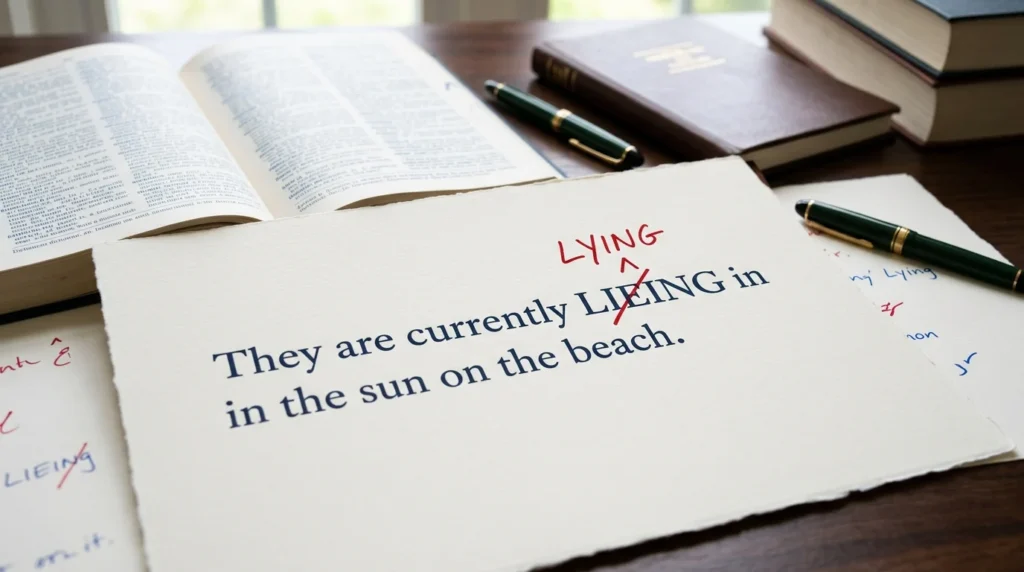
- They were lying in the sun.
- The book was lying on the desk.
- He spent the morning lying in bed.
Lying means telling an untruth
- He is lying about his age.
- She was lying to her parents.
- I knew he was lying.
- They are lying about the results.
- Stop lying to me.
- She admitted to lying.
- He kept lying about what happened.
In both groups, the spelling is exactly the same:
lying
Only the meaning changes.
Lieing or Lying – Search Interest and Usage
People search for “lieing or lying” because lieing looks like a natural spelling if someone simply adds -ing to lie.
This is a spelling question, but it also leads to several grammar questions. People may also search for:
- Is lieing a word?
- Is it lying or lieing?
- Why is lying spelled with a y?
- How do you spell lying?
- Lying or laying?
- Lie or lay?
- What is the past tense of lie?
- What is the past participle of lie?
- Is lying British or American?
These searches show why a useful article needs to cover more than just the first two spellings.
Search interest does not change the spelling
An incorrect spelling can appear in searches because people are trying to check whether it is correct.
That does not make it a standard spelling.
For this word, the standard form is:
lying
The spelling remains the same across major English varieties.
Usage depends on meaning
Lying can describe resting:
The child is lying on the floor.
It can also describe saying something false:
The child is lying about what happened.
The spelling is identical in both cases.
Is Lieing Ever Correct?
For the normal -ing form of the verb lie, use lying.
Lieing is not the standard spelling.
So:
❌ He is lieing on the bed.
✅ He is lying on the bed.
The same applies whether lie means resting or telling an untruth:
❌ She is lieing about it.
✅ She is lying about it.
There is no British, American, Canadian, or Australian version in which lieing becomes the standard alternative.
Separate or Seperate: Which Spelling Is Correct?
FAQs About Lieing or Lying
1. Is it lieing or lying?
Lying is correct. Lieing is incorrect in standard English.
2. Why is lying spelled with a y?
Because verbs ending in -ie change -ie to -y before -ing is added.
lie → lying
3. Is lieing a word?
Lieing is not the standard spelling of the -ing form of lie. Use lying instead.
4. Is lying British or American English?
Lying is correct in both British and American English. It is not a regional spelling difference.
5. What is the past tense of lie?
It depends on the meaning.
For lie = rest:
lie → lay
For lie = tell an untruth:
lie → lied
6. What is the past participle of lie?
For lie = rest:
lain
For lie = tell an untruth:
lied
7. What is the difference between lying and laying?
Lying usually means resting or being in a position.
The dog is lying on the floor.
Laying means putting or placing something somewhere.
She is laying the book on the table.
8. Is “I am laying down” correct?
If you mean resting or reclining, the standard form is:
I am lying down.
Use laying when you are putting something somewhere:
I am laying the book down.
9. Is laying ever correct?
Yes. Laying is the -ing form of lay, meaning to put or place something.
He is laying the papers on the desk.
10. Is “I lay on the bed yesterday” correct?
Yes. When lie means resting, its past tense is lay.
I lay on the bed yesterday.
Do not use lied when you mean resting.
11. Is “I laid on the bed” correct?
Not when you mean that you rested on the bed.
Use:
I lay on the bed.
But laid is correct when something is being placed:
I laid the book on the bed.
12. How can I remember the spelling of lying?
Remember:
IE → Y before ING
So:
lie → lying
Think of die → dying and tie → tying as extra reminders.
Lieing or Lying: Final Comparison
| Question | Correct Answer |
|---|---|
| Correct spelling? | lying |
| Incorrect spelling? | lieing |
| Spelling rule? | -ie → -y before -ing |
| Base verb? | lie |
| -ing form? | lying |
| British spelling? | lying |
| American spelling? | lying |
| Past of lie = rest? | lay |
| Past participle of lie = rest? | lain |
| Past of lie = tell an untruth? | lied |
| Past participle of lie = tell an untruth? | lied |
| -ing form of lay? | laying |
| Is lieing an alternative spelling? | No |
Conclusion
When choosing between lieing or lying, the correct spelling is lying. Lieing is a common misspelling caused by adding -ing directly to the word lie. Standard English uses a different spelling pattern for verbs ending in -ie.
The rule is simple:
-ie changes to -y before -ing.
That gives us:
lie → lying
The same pattern appears in die → dying, tie → tying, and vie → vying.
The spelling lying does not change between American and British English. Both use lying, so there is no regional spelling choice to make.
The grammar can be harder than the spelling. When lie means resting, its forms are lie, lay, lain, and lying. When lie means telling an untruth, its forms are lie, lied, lied, and lying. The separate verb lay means to put or place something, giving forms such as laid and laying.
So if you remember only one thing, remember this:
Lieing is wrong. Lying is right.
And the easiest rule to remember is:
IE → Y before ING: lie → lying.

Victor Penhall is an English grammar specialist and writing coach, helping learners strengthen their language skills with clear rules, smart tips, and precise guidance.