
Have you ever stopped while writing a simple sentence and wondered whether it should be tying or tieing? You are not alone. The confusion comes from the word tie. When we add -ing to many English verbs, we simply add the ending. So it may seem natural to write tieing. But English uses a different spelling pattern for verbs that end in -ie.
The standard modern spelling is tying.
For example, we write:
She is tying her shoes.
Not:
She is tieing her shoes.
The reason is simple: when -ing is added to a verb ending in -ie, the -ie usually changes to -y.
So:
tie → tying
The same pattern appears in:
- lie → lying
- die → dying
- vie → vying
In this guide, you will learn why tying is the standard spelling, whether tieing is ever seen, how British and American English treat the word, the correct verb forms, common mistakes, and how to use tying naturally in everyday and formal writing.
Tying or Tieing
Tying is the standard spelling in modern English.
Tieing may appear as a rare or nonstandard variant, but it is not the form you should normally use in standard writing.
The correct form
tie + ing → tying
The -ie at the end of tie changes to -y before -ing is added.
Quick comparison
| Spelling | Standard modern usage? | Example |
|---|---|---|
| tying | ✅ Yes | She is tying her shoes. |
| tieing | ⚠️ Rare/nonstandard | Avoid it in normal writing. |
So if you are writing an email, school assignment, article, report, caption, or professional document, choose tying.
Easy examples
- She is tying her shoelaces.
- He is tying a knot.
- I am tying a ribbon around the box.
- They are tying the boat to the dock.
- The goal was tying the game.
The easiest form to remember is:
tie → tied → tying
The Origin of Tying
The word tie has been part of English for many centuries. Its early history is linked to old English words for fastening, binding, or connecting things.
Over time, tie developed many related meanings. It can describe fastening something with a knot, joining things together, creating a connection, or making two sides equal in a competition.
For example:
- tie a rope means to fasten it.
- tie your shoes means to secure your shoelaces.
- tie two ideas together means to connect them.
- tie a game means to make the score equal.
- family ties means connections between family members.
The form tying developed from the verb tie when the -ing ending is added.
This is where the spelling becomes unusual.
Many verbs simply take -ing:
- play → playing
- work → working
- jump → jumping
- read → reading
But verbs ending in -ie follow a different spelling pattern.
The usual pattern is:
-ie → -y + -ing
Therefore:
tie → tying
Other examples include:
- lie → lying
- die → dying
- vie → vying
- untie → untying
- retie → retying
The change is a spelling rule, not a change in meaning. Tying still comes from the verb tie.
Why Is It Tying Instead of Tieing?
The spelling tieing looks logical because the base word is tie.
A writer may think:
tie + ing = tieing
But that is not the standard spelling pattern.
For verbs ending in -ie, English normally changes the ending before adding -ing:
tie → tying
Think of it as a simple three-step pattern:
1. Start with: tie
2. Change: -ie to -y
3. Add: -ing
Result:
tying
The same pattern makes these words:
| Base Verb | Correct -ing Form |
|---|---|
| tie | tying |
| lie | lying |
| die | dying |
| vie | vying |
| untie | untying |
| retie | retying |
This is why tieing can look reasonable but still be the wrong choice for normal modern writing.
A simple memory trick
Remember:
Tie loses “ie” and gets “y” before -ing.
So:
TIE → TYING
Once you remember tie → tying, the spelling becomes much easier.
Is “Tieing” a Real Word?
This question needs a little care.
Tieing can be found occasionally, including in some older or variant usage. So it is better not to claim that the spelling has never existed.
However, tying is the standard form used in modern English.
That means you should use tying in:
- school assignments
- business emails
- professional documents
- websites
- articles
- academic writing
- social media posts
- everyday communication
If you see tieing, it does not normally represent a different meaning from tying. It is simply a rare or nonstandard spelling variant.
The practical rule
If you are unsure, choose:
tying ✅
Avoid:
tieing ⚠️
This gives your writing the spelling most readers expect.
British English vs American English Spelling
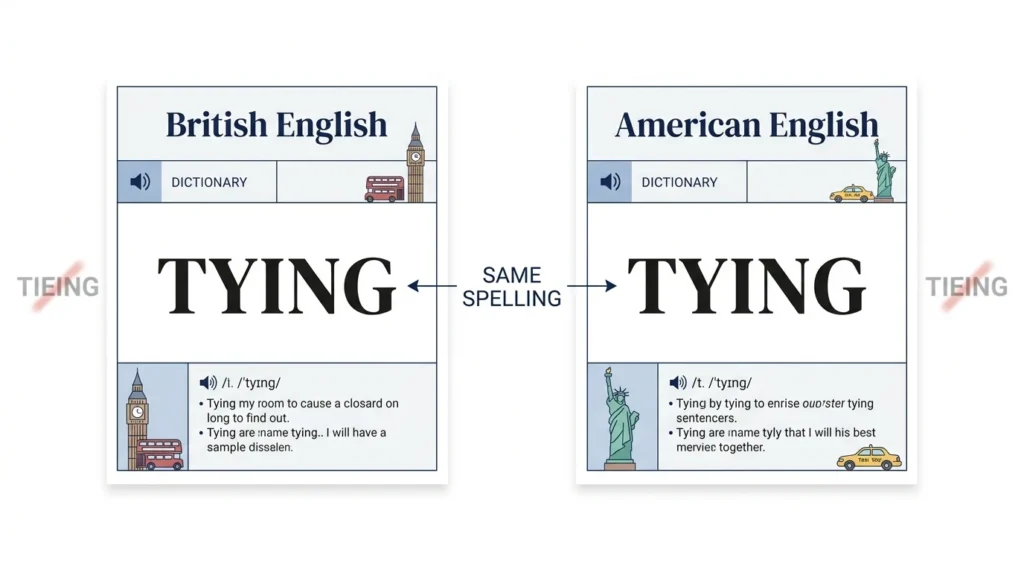
There is no British-versus-American spelling difference between tying and tieing.
Both British English and American English use:
tying
This is different from words such as:
- colour / color
- travelled / traveled
- organise / organize
Those words can have regional spelling differences. Tying does not have that kind of British-American split.
Comparison by English variety
| English variety | Standard spelling |
|---|---|
| American English | tying |
| British English | tying |
| Canadian English | tying |
| Australian English | tying |
| New Zealand English | tying |
| Indian English | tying |
Examples
American English:
She is tying her shoes.
British English:
She is tying her shoes.
The spelling stays exactly the same.
So if you are writing for a US audience, use tying.
If you are writing for a UK or Commonwealth audience, use tying.
If you are writing for an international audience, use tying.
There is no need to change the spelling according to the country.
Lieing or Lying: Why the Spelling Changes
Which Spelling Should You Use?
The practical answer is very simple:
For American English
Use tying.
He is tying his shoes.
For British English
Use tying.
He is tying his shoes.
For Canadian, Australian, and New Zealand English
Use tying.
For academic writing
Use tying.
For business writing
Use tying.
For websites and articles
Use tying.
For social media
Use tying.
In other words, there is no audience-based choice between the two spellings.
You should not write tieing just because your readers are British or because you are following a different English variety.
The standard choice is:
tying
Tying: Correct Verb Forms
Understanding the complete verb pattern can make the spelling much easier.
| Verb Form | Correct Form | Example |
|---|---|---|
| Base form | tie | Please tie the rope. |
| Third-person singular | ties | She ties her hair back. |
| Past tense | tied | He tied the package. |
| Past participle | tied | The rope was tied securely. |
| Present participle | tying | She is tying the ribbon. |
| Gerund | tying | Tying knots takes practice. |
Notice the pattern:
tie → ties → tied → tied → tying
The -ing form is the one that changes to tying.
Tying as a present participle
She is tying her shoes.
Here, tying forms part of the verb phrase is tying.
Tying as a gerund
Tying knots takes practice.
Here, tying names the activity.
How Do You Pronounce Tying?
Tying is usually pronounced with two syllables:
TY-ing
The first part sounds like tie, followed by a short -ing sound.
It is not pronounced like ting.
For example:
She is tying her shoes.
The pronunciation helps show that the word comes from tie.
Truly or Truely: Why “Truly” Drops the Extra E
Common Mistakes with Tying or Tieing
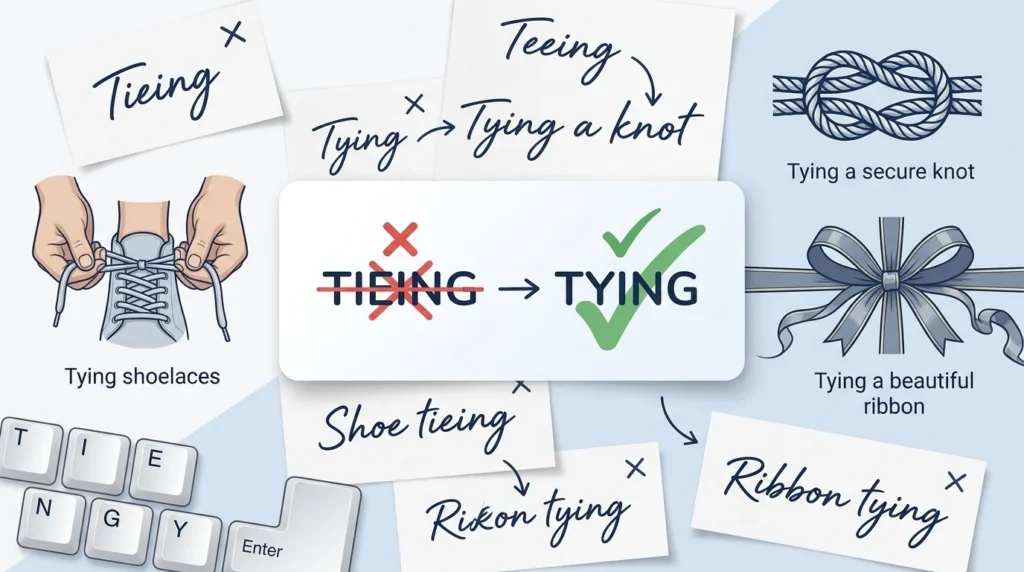
1. Writing “tieing”
❌ She is tieing her shoes.
✅ She is tying her shoes.
This is the main spelling mistake.
2. Writing “tiyng”
❌ He is tiyng the rope.
✅ He is tying the rope.
The correct order is:
t-y-i-n-g
3. Thinking British English uses “tieing”
❌ Tieing is the British spelling.
✅ Tying is used in both British and American English.
This is not a regional spelling issue.
4. Confusing tying with typing
These words have different meanings.
Tying = fastening or connecting
She is tying a knot.
Typing = writing using a keyboard
She is typing an email.
5. Confusing tying with dying
Tying means fastening or connecting.
Dying comes from die.
He is tying the rope.
The plant is dying.
6. Confusing dying with dyeing
This is another important spelling pair.
Dying = losing life
The flowers are dying.
Dyeing = coloring something with dye
She is dyeing the fabric.
So remember:
tie → tying
die → dying
dye → dyeing
Tying in Everyday Examples
The word tying is used in many different situations. It does not only refer to shoelaces.
Tying shoes
I am tying my shoes.
Tying a knot
He is tying a strong knot.
Tying a ribbon
She is tying a ribbon around the gift.
Tying hair
She is tying her hair back.
Tying a boat
They are tying the boat to the dock.
Tying a package
He is tying the package with string.
Tying things together
The cable is tying the two parts together.
Tying the score
The team scored late, tying the game.
Here, tying means making the score equal.

Tying ideas together
The final paragraph is tying the main ideas together.
Here, tying means connecting ideas.
Tying up loose ends
We need to finish tying up the loose ends before the project ends.
This expression means finishing small remaining tasks or unresolved details.
Tying in Emails, News, Social Media, and Formal Writing
In an email
I am tying the documents together and will send them shortly.
In business writing
The agreement is tying the payment to the completion of the work.
In news writing
The late goal was tying the game in the final minutes.
In social media
Finally tying everything together for the big day!
In academic writing
The study examines factors tying economic conditions to employment.
In formal writing
The evidence is tying the two events together.
These examples show that tying can describe physical fastening, connection, relationships, or equal results.
Tying or Tieing: Comparison Table
| Form | Standard? | Meaning | Example |
|---|---|---|---|
| tying | ✅ Yes | -ing form of tie | She is tying her shoes. |
| tieing | ⚠️ Rare/nonstandard | Variant form sometimes seen | Avoid in normal writing. |
| tie | ✅ Yes | Base verb | Please tie the rope. |
| ties | ✅ Yes | Present-tense form | She ties the ribbon. |
| tied | ✅ Yes | Past tense/past participle | He tied the knot. |
| tying up | ✅ Yes | Fastening or completing | We are tying up the package. |
| untying | ✅ Yes | Releasing something tied | She is untying the knot. |
| retying | ✅ Yes | Tying again | He is retying the rope. |
The most important pair is:
tying ✅
tieing ⚠️
Tying or Tieing – Search Interest and Usage
People often search “tying or tieing” because the spelling of the base verb makes tieing look natural.
The search itself shows a clear spelling question:
Should I keep “ie” when I add -ing?
For tie, the standard answer is no.
The form becomes:
tie → tying
Searches can also take several forms:
- tying or tieing
- tieing or tying
- is tying correct
- is tieing correct
- how do you spell tying
- how do you spell tieing
- tying spelling
- tie + ing
- tying meaning
- tying the knot
- tying shoes
The exact amount of search interest can change over time and by country. Search data also measures relative interest rather than giving a simple count of all English speakers who use a word.
For this topic, the more useful point is the search intent. People are usually not looking for a complex grammar lesson. They want three things:
- The correct spelling.
- A reason for the spelling.
- Examples they can copy and understand.
That is why the best answer is:
Tying is the standard spelling. The -ie changes to -y before -ing.
Tying or Tieing: How to Remember the Difference
If you often forget the spelling, use one simple memory pattern:
Tie → Tying
Then connect it with:
Lie → Lying
Die → Dying
Vie → Vying
All four show the same useful -ie → -y + -ing pattern.
Another quick memory trick is to remember:
“Tie” changes its ending before “-ing.”
So do not simply attach -ing to tie.
Instead:
tie
↓ change ie to y
ty
↓ add ing
tying
Once you learn this pattern, tying becomes much easier to spell correctly.
FAQs About Tying or Tieing
1. Is it tying or tieing?
Tying is the standard spelling in modern English. Tieing is a rare or nonstandard variant that should normally be avoided.
2. Why is tying spelled with a y?
Because verbs ending in -ie usually change -ie to -y before -ing is added.
So:
tie → tying
3. Is tieing a word?
Tieing can be found occasionally as a rare or variant spelling, but tying is the standard form for modern everyday, academic, and professional writing.
4. How do you spell tying?
The correct spelling is:
T-Y-I-N-G
Tying
Not:
T-I-E-I-N-G
5. Is tying American or British English?
Tying is used in both American and British English. There is no standard regional spelling difference between tying and tieing.
6. What is the past tense of tie?
The past tense of tie is tied.
She tied her shoes.
7. What is the present participle of tie?
The present participle is tying.
She is tying her shoes.
8. What is the difference between tying and dyeing?
Tying comes from tie and means fastening or connecting something.
Dyeing comes from dye and means coloring something.
She is tying a ribbon.
She is dyeing the fabric.
9. Is “tying the knot” correct?
Yes. Tying the knot is a common expression meaning getting married.
They are tying the knot next month.
10. Is “tying the game” correct?
Yes. Tying the game means making the score equal.
The team scored in the final minute, tying the game.
Conclusion: Tying or Tieing?
When choosing between tying and tieing, use tying in standard modern English. It is the normal -ing form of the verb tie and works in everyday, academic, professional, and formal writing.
The spelling may seem strange at first because tie looks as if it should simply become tieing. English uses a different pattern for verbs ending in -ie. The -ie changes to -y before -ing is added:
tie → tying
The same pattern appears in lie → lying, die → dying, and vie → vying.
There is also no British-American spelling difference here. Writers in both varieties use tying. The same applies across other major English varieties.
You may occasionally see tieing, but it is best treated as a rare or nonstandard variant rather than the normal spelling for modern writing.
So, whether you are tying your shoes, tying a knot, tying your hair, tying two ideas together, or tying a game, remember the same simple rule:
Tie becomes tying.
When in doubt, choose tying.

Victor Penhall is an English grammar specialist and writing coach, helping learners strengthen their language skills with clear rules, smart tips, and precise guidance.