
Have you ever typed “lose” or “loose” and stopped because both words looked right? You are not alone. These words differ by only one letter, but that extra o changes the meaning, pronunciation, and grammar.
The good news is that the rule is simple. Lose is a verb. It means to no longer have something, misplace something, fail to win, or stop having something. Loose usually works as an adjective. It describes something that is not tight, not firmly fixed, or free from restraint.
This confusion appears often in emails, school assignments, business writing, social media, and everyday messages. Common mistakes include “loose weight,” “loose the game,” and “don’t loose hope.” The correct forms are “lose weight,” “lose the game,” and “don’t lose hope.”
This guide explains lose or loose in simple English. You will learn the difference, pronunciation, word origins, grammar, British and American usage, common mistakes, everyday examples, and an easy trick to remember which word to use.
Lose or Loose
Lose and loose are both correct words, but they have different meanings.
Use lose when you mean:
- to no longer have something
- to misplace something
- to fail to win
- to stop having something
- to reduce something, such as weight
Examples:
- I do not want to lose my phone.
- Our team could lose the match.
- She does not want to lose her job.
- I need to lose some weight.
- Do not lose hope.
Use loose when you mean:
- not tight
- not firmly fixed
- not securely attached
- free from restraint
- not closely controlled or defined
Examples:
- These shoes are too loose.
- The screw is loose.
- The dog got loose.
- She wore her hair loose.
- The rules are fairly loose.
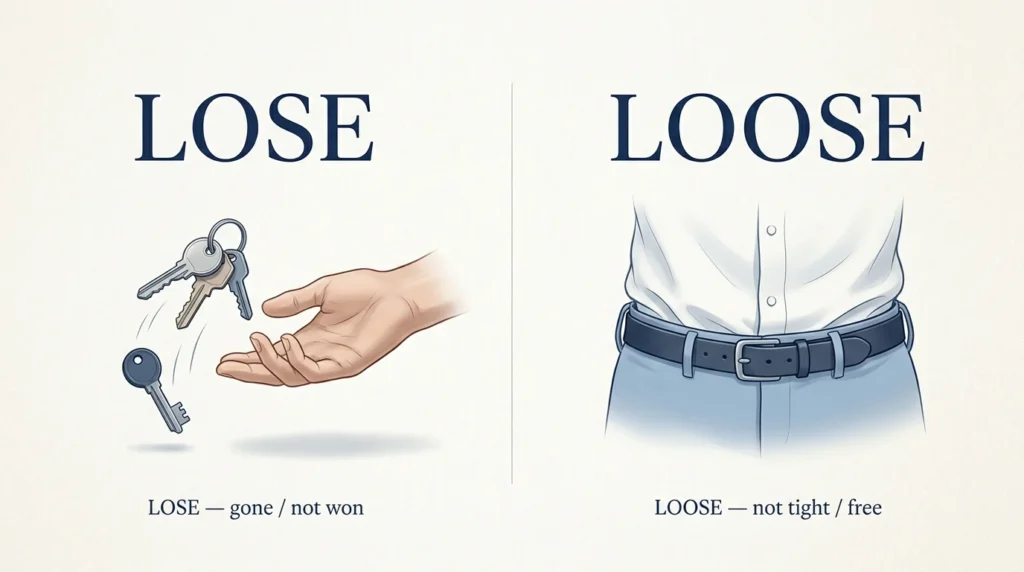
The easiest rule
Lose = something is gone, missing, or not won.
Loose = something has extra space or is not firmly fixed.
So:
Do not lose your keys.
These shoes are loose.
Lose vs. Loose pronunciation
The words also sound different.
- Lose → /luːz/ → sounds like “looz”
- Loose → /luːs/ → sounds like “loos”
Lose ends with a z sound.
Loose ends with an s sound.
The Origin of Lose and Loose
Lose and loose look almost the same today, but they followed different paths into modern English.
The origin of “lose”
Lose comes from Old English and is related to old Germanic words connected with being lost or failing to keep something.
Over time, lose developed several related meanings. Today, it can describe losing possession of something, failing to win, becoming unable to find something, or no longer having something.
For example:
- lose your keys
- lose your money
- lose a game
- lose your job
- lose interest
- lose your temper
- lose weight
The word also has an important past form:
lose → lost
For example:
I lose my keys often.
I lost my keys yesterday.
I have lost my keys.
So lost is the past form of lose, not “loose.”
The origin of “loose”
Loose has a different history. It developed from older Germanic and Norse forms connected with being free, unbound, or not firmly attached.
That basic idea remains in modern English.
Something can be loose when it is:
- not tight
- not fixed
- not attached securely
- free to move
- not strictly controlled
For example:
The button is loose.
The dog is loose.
The shirt is loose.
Why do they look so similar?
The words have similar-looking spellings and share the same long oo vowel sound. However, they have different final consonant sounds and different modern meanings.
That is why they should be treated as two separate words.
The extra o in loose is especially useful as a memory clue:
Loose has extra room, so it has an extra O.
British English vs American English Spelling
Unlike spelling pairs such as colour/color or realise/realize, lose and loose are spelled the same in British and American English.
The difference is about meaning, not geography.
| Meaning or use | British English | American English |
|---|---|---|
| No longer have something | lose | lose |
| Misplace something | lose | lose |
| Fail to win | lose | lose |
| Reduce weight | lose | lose |
| Not tight | loose | loose |
| Not firmly attached | loose | loose |
| Free from restraint | loose | loose |
British English examples
I do not want to lose my passport.
These trousers are too loose.
We could lose the match.
The door handle is loose.
American English examples
I do not want to lose my passport.
These pants are too loose.
We could lose the game.
The door handle is loose.
What about Canada, Australia, and New Zealand?
The same basic distinction applies in Canadian, Australian, and New Zealand English.
Writers in these varieties should also use:
lose → for losing, misplacing, or failing
loose → for something that is not tight, fixed, or restrained
So there is no need to change lose to loose, or loose to lose, based on the country of your reader.
Lose or Loose: Grammar and Word Forms
Understanding grammar makes this pair much easier.
Lose is a verb
The main forms are:
| Form | Example |
|---|---|
| lose | I may lose my keys. |
| loses | She often loses her keys. |
| losing | He is losing patience. |
| lost | I lost my wallet. |
| lost | She has lost her phone. |
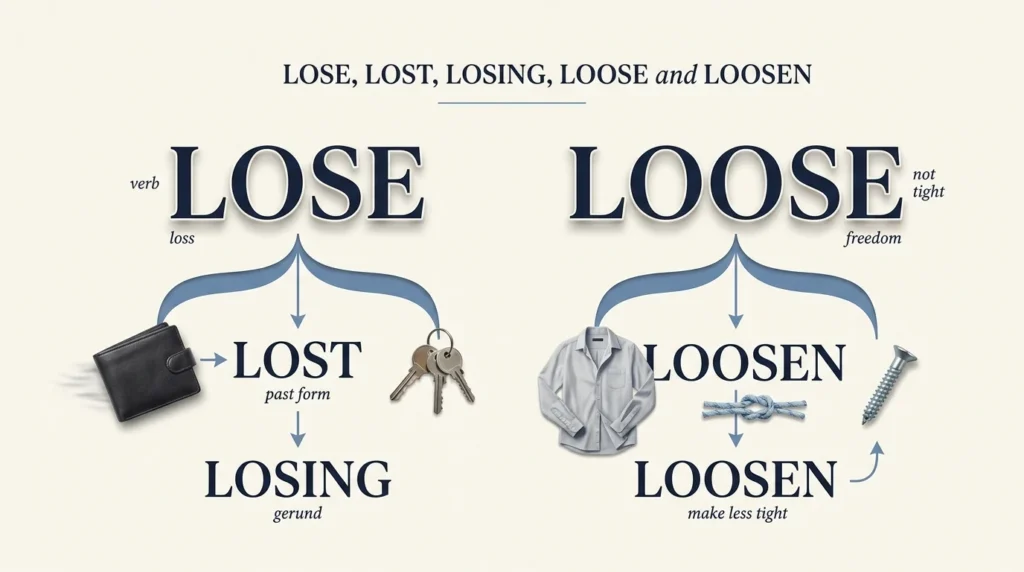
Remember:
lose → lost → lost
Not:
lose → loose
Loose is usually an adjective
It describes the condition of something.
| Form | Example |
|---|---|
| loose | The shirt is loose. |
| looser | This shirt is looser than mine. |
| loosest | These trousers are the loosest pair. |
| loosely | The papers were loosely arranged. |
There is also a related verb:
loosen
Please loosen the knot.
He loosened his tie.
This is important because people sometimes write loose when they need loosen.
Lose, lost, loose, and loosen
| Word | Part of speech | Meaning | Example |
|---|---|---|---|
| lose | Verb | no longer have / fail | Do not lose your keys. |
| lost | Verb/adjective | past of lose / no longer found | I lost my keys. |
| loose | Usually adjective | not tight or fixed | The screw is loose. |
| loosen | Verb | make less tight | Loosen the screw. |
This distinction prevents several common spelling mistakes.
Tying or Tieing: Why “Tie” Becomes “Tying”
Which Spelling Should You Use?
The correct choice depends on what you mean, not where you live.
For a US audience
Use lose when talking about losing something, failing, or reducing something.
I do not want to lose my phone.
Use loose when describing something that is not tight or fixed.
This jacket is too loose.
For a UK audience
Use the same rule.
She might lose her ticket.
Her coat is loose.
For Commonwealth and international readers
The same distinction works across standard English.
There is no need to choose one word because of British, American, Canadian, Australian, or New Zealand English.
Instead, ask:
Am I talking about an action or a condition?
If you mean misplace, no longer have, fail, or reduce, use lose.
If you mean not tight, not fixed, free, or not strictly controlled, use loose.
A three-second test
Replace the word in your sentence.
If “misplace” or “fail to win” makes sense → use lose.
If “not tight” or “not firmly fixed” makes sense → use loose.
Examples:
I might lose my wallet.
“Misplace my wallet” works → lose.
My jacket is loose.
“Not tight” works → loose.
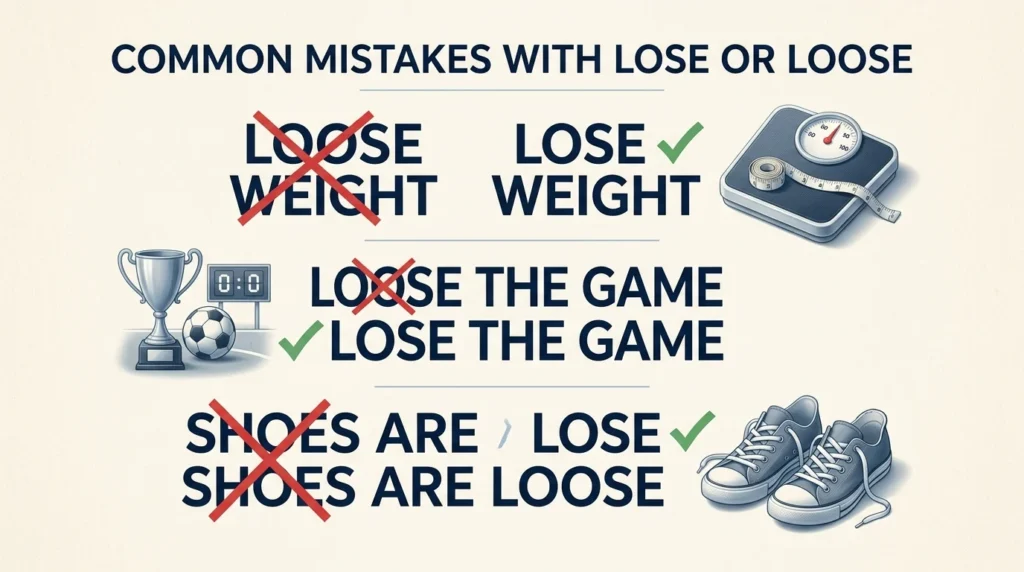
Common Mistakes with Lose or Loose
These words are often confused because they look so similar.
1. Loose weight vs. lose weight
❌ I want to loose weight.
✅ I want to lose weight.
You are talking about reducing weight, so the correct verb is lose.
2. Loose the game vs. lose the game
❌ Our team might loose the game.
✅ Our team might lose the game.
A team loses when it does not win.
3. Don’t loose hope vs. don’t lose hope
❌ Do not loose hope.
✅ Do not lose hope.
The meaning is “do not stop having hope,” so use lose.
4. Shoes are lose vs. shoes are loose
❌ These shoes are too lose.
✅ These shoes are too loose.
The shoes are not tight, so use loose.
5. The screw is lose vs. the screw is loose
❌ The screw is lose.
✅ The screw is loose.
A screw that is not firmly attached is loose.
6. He loose his job vs. he lost his job
❌ He loose his job last year.
✅ He lost his job last year.
The sentence is about the past, so the correct form is lost.
7. I am loosing weight vs. I am losing weight
❌ I am loosing weight.
✅ I am losing weight.
The present participle of lose is losing.
8. Loose the knot vs. loosen the knot
❌ Please loose the knot.
✅ Please loosen the knot.
When you mean “make something less tight,” the normal everyday verb is loosen.
Common mistakes at a glance
| Incorrect | Correct | Reason |
|---|---|---|
| loose weight | lose weight | Reduce weight |
| loose the game | lose the game | Fail to win |
| loose hope | lose hope | Stop having hope |
| shoes are lose | shoes are loose | Not tight |
| screw is lose | screw is loose | Not firmly fixed |
| he loose his job | he lost his job | Past tense |
| I am loosing weight | I am losing weight | Present participle |
| loose the knot | loosen the knot | Make less tight |
Lose or Loose: A Simple Memory Trick
There is an easy way to remember the difference.
Think: Loose = extra room
Loose has an extra O.
Imagine a loose shirt. It has extra room.
LOOSE = extra O = extra room
Think: Lose = something is gone
When you lose your phone, wallet, keys, or game, something is gone or you no longer have it.
LOSE = something is gone
The fastest memory rule
Lose = missing or not won.
Loose = not tight or free.
For example:
I could lose my keys if I put them in a loose pocket.
Both words are correct, but they do different jobs.
Lieing or Lying: Why the Spelling Changes
Lose or Loose in Everyday Examples
In emails
Lose:
Please save a copy of the document so we do not lose the information.
Loose:
Please check the cable because it appears loose.
At work
Lose:
The company could lose customers if the service becomes slower.
Loose:
One connection is loose, so the equipment should be checked.
In school writing
Lose:
Students may lose marks if they do not follow the instructions.
Loose:
The papers were held together by a loose clip.
In news writing
Lose:
The team could lose its place in the competition.
Loose:
Officials warned people about a loose animal in the area.
On social media
Lose:
I always lose my keys!
Loose:
These jeans are really loose.
In formal writing
Lose:
The business may lose revenue if demand falls.
Loose:
The component became loose during testing.
When both words appear together
You can use both words correctly in one sentence:
Be careful not to lose the dog because it is loose.
Here, lose means to fail to keep track of the dog.
Loose means the dog is free and not restrained.
Lose, Lost, Loose, and Loosen: Quick Comparison
This four-word comparison is useful because these forms are often mixed up.
| Word | Meaning | Example |
|---|---|---|
| lose | no longer have / fail | Do not lose your phone. |
| lost | past form of lose | I lost my phone. |
| loose | not tight / free | My phone case is loose. |
| loosen | make less tight | Loosen the strap. |
Remember the pattern
lose → lost
loose → loosen
That one distinction can prevent many spelling errors.
Lose or Loose – Google Trends and Usage Patterns
People search “lose or loose” because the two words are easy to confuse in writing. Searches also appear as “lose vs loose,” “loose or lose,” “difference between lose and loose,” and questions such as “is it lose or loose?”
The individual words lose and loose are both common English words, so search interest for either word alone does not necessarily mean someone is looking for spelling help. For example, lose may appear in searches about sports, weight, money, relationships, or everyday situations. Loose may appear in searches about clothing, screws, teeth, hair, or physical objects.
For that reason, the combined search terms are more useful when looking at spelling confusion.
The same basic confusion can appear among readers in the United States, United Kingdom, Canada, Australia, New Zealand, India, and other English-speaking or English-learning markets. The important point is that this is not a British-versus-American spelling issue.
Instead, people are usually trying to answer a meaning question:
Do I need the verb lose, the adjective loose, the past form lost, or the verb loosen?
That makes the topic useful for both native speakers and English learners.
Search interest can also change with season, education cycles, online writing habits, and current events. Because search data changes over time, exact popularity should always be checked for the specific date and country being studied rather than treated as a permanent ranking.
FAQs About Lose or Loose
1. Is it lose or loose?
Both words are correct, but they have different meanings.
Lose means to no longer have something, misplace something, fail to win, or reduce something.
Loose usually means not tight, not firmly fixed, or free from restraint.
2. Is it lose weight or loose weight?
The correct phrase is lose weight.
I want to lose weight.
Use lose because the sentence describes a reduction in weight.
3. Is it lose a game or loose a game?
The correct phrase is lose a game.
Our team could lose the game.
A person or team loses when they fail to win.
4. What is the past tense of lose?
The past tense of lose is lost.
I lost my wallet yesterday.
Not:
I loose my wallet yesterday.
5. Is loose a verb?
Yes, but loose is most commonly used as an adjective in everyday English.
As a verb, loose can mean to release or set something free.
The animal was loosed from its restraint.
When you mean “make something less tight,” however, loosen is the usual everyday verb.
Please loosen the knot.
6. How do you pronounce lose and loose?
Lose is pronounced /luːz/. It ends with a z sound and rhymes with words such as choose and shoes.
Loose is pronounced /luːs/. It ends with an s sound and rhymes with words such as goose and moose.
7. Does British English use loose instead of lose?
No.
British English uses lose and loose in the same basic way as American English.
The difference is meaning, not British versus American spelling.
8. What is the difference between loose and loosen?
Loose usually describes something that is not tight.
The screw is loose.
Loosen is a verb meaning to make something less tight.
Please loosen the screw.
9. Is “loosing” ever correct?
Yes, but it is not the normal spelling of the present participle of lose.
The correct form of lose is:
I am losing weight.
Loosing is the present participle of the less common verb loose, meaning to release or set free.
For everyday writing, do not use loosing when you mean losing something.
10. What is an easy way to remember lose and loose?
Remember:
LOSE = something is gone.
LOOSE = extra room or freedom.
The extra o in loose can remind you of extra space.
Lose or Loose – Final Rule
If you only remember one thing, remember this:
LOSE
Use it for an action involving loss.
- lose your keys
- lose money
- lose a game
- lose your job
- lose weight
- lose interest
- lose hope
LOOSE
Use it when something is not tight, fixed, or restrained.
- loose clothes
- loose shoes
- loose hair
- loose screw
- loose tooth
- loose connection
- loose dog
One sentence to remember both
Do not lose your keys because the pocket is loose.
That sentence captures the difference perfectly.
Conclusion
Lose and loose are two different English words, even though they look almost identical. The difference is not a British or American spelling rule. It is a difference in meaning, grammar, and pronunciation.
Use lose when something is missing, no longer yours, or not won. You can lose your keys, lose money, lose a game, lose hope, or lose weight. Its past form is lost, and its present participle is losing.
Use loose when something is not tight, firmly attached, or restrained. You can have loose clothes, a loose screw, a loose tooth, or a loose dog. The related verb loosen means to make something less tight.
The pronunciation gives you another useful clue: lose ends with a z sound, while loose ends with an s sound.
The easiest memory trick is simple: lose means something is gone; loose means something has extra room or freedom.
So when you see lose or loose, do not choose by appearance. Check the meaning first. If something is missing or not won, choose lose. If something is not tight or firmly fixed, choose loose.

Amelia Script is a dedicated grammar specialist and language mentor, simplifying English rules, refining writing skills, and helping learners communicate with clarity and confidence.