
Losing and loosing look almost the same, but they have different meanings. One extra o can change the whole word.
If you are writing about losing weight, losing a game, losing money, or losing your keys, the correct word is losing. If you mean releasing, freeing, or letting something go, loosing can be correct.
This is why people often search for “losing or loosing.” The confusion starts with the similar-looking words lose and loose. When lose becomes an -ing form, the spelling is losing. When the verb loose becomes an -ing form, the spelling is loosing.
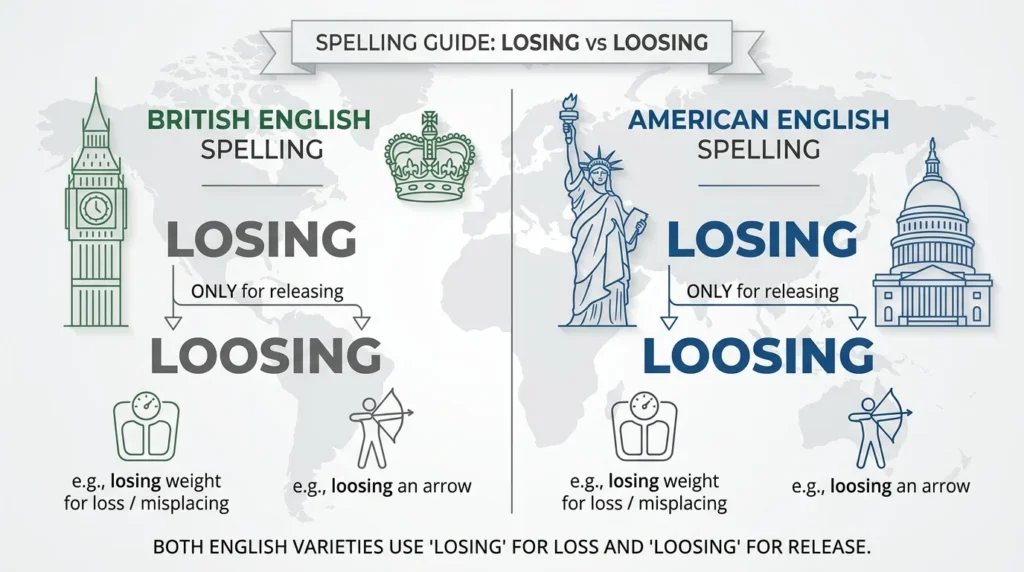
The difference is not a British English versus American English spelling rule. Both varieties use losing and loosing according to their meaning.
The good news is that the rule is easy to remember. Losing is the word you will need in almost every everyday situation involving loss. Loosing is a real word, but it is much less common and is used when something is being released or set free.
Losing or Loosing
Losing is correct when you mean loss.
Use losing for:
- failing to win
- misplacing something
- no longer having something
- having less of something
- suffering a loss
- becoming less successful
- losing control, interest, time, money, or confidence
Examples:
- I am losing weight.
- Our team is losing the game.
- I keep losing my keys.
- The company is losing money.
- She is losing interest in the project.
- He is losing confidence.
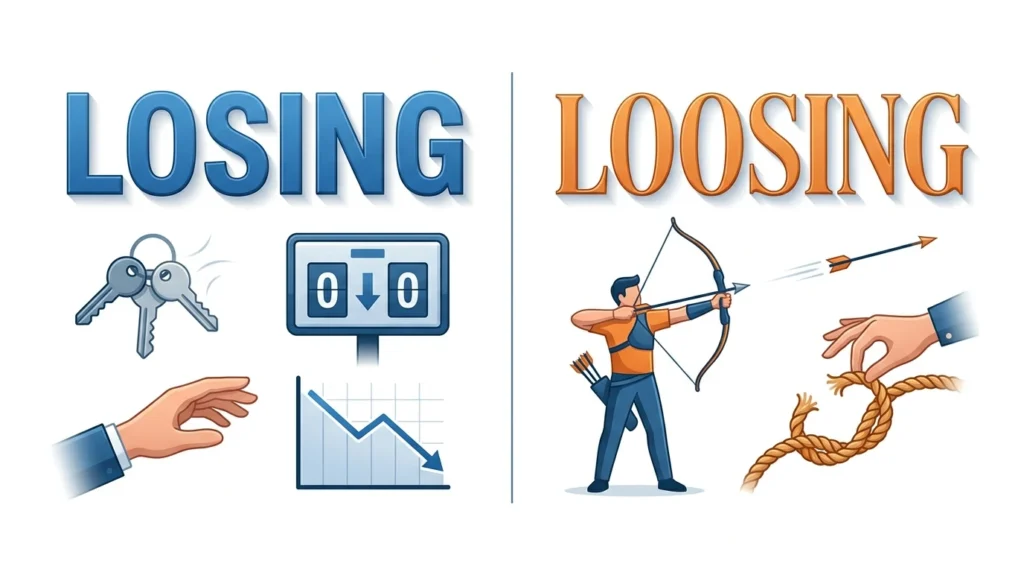
Loosing is correct when you mean releasing or setting something free.
Examples:
- The archer was loosing an arrow.
- The hunter was loosing the hounds.
- The soldiers were loosing arrows toward the enemy.
The simple rule
lose → losing = experiencing a loss
loose → loosing = releasing or setting free
So:
❌ I am loosing weight.
✅ I am losing weight.
❌ Our team is loosing the game.
✅ Our team is losing the game.
But:
✅ The archer is loosing an arrow.
Quick memory trick
Think:
Lose = loss = losing
Loose = release = loosing
If you mean loss, choose losing.
The Origin of Losing or Loosing
The spelling difference comes from two different base words: lose and loose.
Where “Losing” Comes From
Losing comes from the verb lose.
The verb lose has a long history in English and has been used for ideas such as being deprived of something, failing to keep something, suffering a loss, or failing to win.
Today, lose has many common uses:
- lose a game
- lose money
- lose a job
- lose your keys
- lose interest
- lose control
- lose weight
- lose time
When lose takes the -ing ending, its final e is dropped:
lose + ing → losing
That gives us:
She is losing weight.
We are losing time.
He is losing his keys.
The spelling does not become loosing because the word comes from lose, not loose.
Where “Loosing” Comes From
Loosing comes from the verb loose.
The word loose is most often used as an adjective. It can describe something that is not tight, fixed, or firmly held.
For example:
- a loose shirt
- a loose screw
- loose hair
- a loose knot
But loose can also work as a verb. As a verb, it can mean to release, free, untie, or let something go.
When this verb takes -ing, the result is:
loose + ing → loosing
For example:
The archer was loosing arrows.
The guard was loosing the dogs.
This is why loosing is a real English word. It is not simply a misspelling of losing.
What About “Loosening”?
There is one more word that often causes confusion: loosening.
Loosening comes from loosen, not loose.
It usually means making something less tight.
For example:
She is loosening the knot.
He is loosening his tie.
The mechanic is loosening the bolt.
So the three forms are different:
| Base word | -ing form | Main meaning |
|---|---|---|
| lose | losing | suffering or experiencing a loss |
| loose | loosing | releasing or setting free |
| loosen | loosening | making something less tight |
This distinction is important because loosing and loosening should not automatically be treated as the same word.
British English vs American English Spelling
There is no British English spelling of “losing” and American English spelling of “loosing.”
Both British and American English use the same forms.
The correct spelling depends on meaning, not location.
| Meaning | American English | British English | Example |
|---|---|---|---|
| Failing to win | losing | losing | We are losing the match. |
| Misplacing something | losing | losing | I keep losing my keys. |
| Having less weight | losing | losing | She is losing weight. |
| Having less money | losing | losing | The company is losing money. |
| No longer having interest | losing | losing | He is losing interest. |
| Releasing something | loosing | loosing | The archer is loosing an arrow. |
| Setting something free | loosing | loosing | They were loosing the animals. |
US English
American English uses losing when the base verb is lose:
She is losing weight.
We are losing the game.
I am losing patience.
It also uses loosing when the less common verb loose is intended:
The archer is loosing an arrow.
British English
British English follows the same basic rule:
He is losing money.
They are losing the match.
She is losing interest.
And:
The hunter was loosing the hounds.
Canada, Australia, New Zealand, and Other English Varieties
The same distinction applies in Canadian, Australian, New Zealand, and other major forms of English.
You do not need to change losing to loosing because of your country.
The important question is:
What does the sentence mean?
Lose or Loose: Which Word Belongs in Your Sentence?
Which Spelling Should You Use?
For almost every common situation involving loss, use losing.
Use “Losing” for Loss
Choose losing when you mean:
- not winning
- misplacing something
- having less
- becoming less successful
- no longer having something
- suffering a loss
Examples:
I am losing weight.
She is losing her phone.
The team is losing the match.
The store is losing customers.
He is losing confidence.
We are losing valuable time.
Use “Loosing” for Release
Choose loosing only when the verb loose is being used to mean releasing, freeing, or letting something go.
Examples:
The archer was loosing an arrow.
The hunter was loosing the hounds.
The soldiers were loosing arrows.
This form is much less common in everyday modern writing.
Use “Loosening” for Making Something Less Tight
If you mean making something less tight, loosening is usually the clearer choice.
Examples:
She is loosening the knot.
He is loosening his tie.
The mechanic is loosening the bolt.
So remember:
Losing = loss
Loosing = release
Loosening = making less tight
For Global English
If you write for an international audience, losing will usually be the form you need.
Common phrases include:
- losing weight
- losing money
- losing a game
- losing a job
- losing your keys
- losing interest
- losing control
- losing time
- losing confidence
- losing customers
These all use losing because they come from lose.
Common Mistakes with Losing or Loosing
Mistake 1: “Loosing Weight”
❌ I am loosing weight.
✅ I am losing weight.
Weight is being reduced, so the verb is lose.
lose → losing
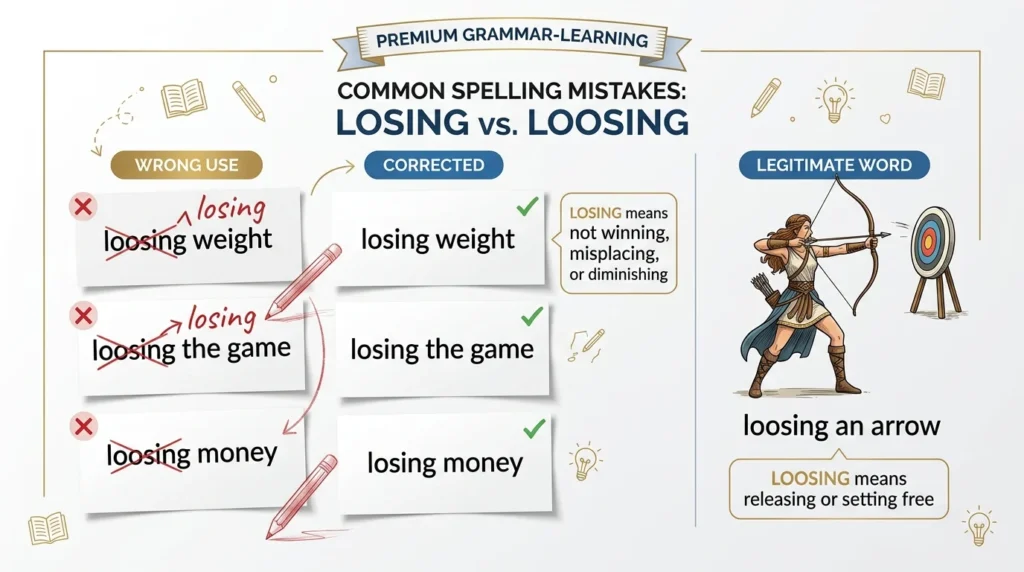
Mistake 2: “Loosing the Game”
❌ Our team is loosing the game.
✅ Our team is losing the game.
A team that is failing to win is losing.
Mistake 3: “Loosing My Keys”
❌ I keep loosing my keys.
✅ I keep losing my keys.
When you cannot find something because you have misplaced it, use losing.
Mistake 4: “Loosing Money”
❌ The business is loosing money.
✅ The business is losing money.
The business is experiencing a financial loss.
Mistake 5: “Loosing Interest”
❌ She is loosing interest in the course.
✅ She is losing interest in the course.
The meaning is that her interest is disappearing or becoming weaker.
Mistake 6: “Loosing Control”
❌ He is loosing control.
✅ He is losing control.
The phrase describes failure to keep control.
Mistake 7: “Loosing Someone”
❌ She is afraid of loosing her friend.
✅ She is afraid of losing her friend.
The meaning is no longer having someone in your life, so losing is correct.
Mistake 8: Confusing “Loosing” and “Loosening”
These two words are especially easy to mix up.
Loosing can mean releasing or setting something free.
The hunter was loosing the hounds.
Loosening means making something less tight.
She was loosening the knot.
For most modern everyday situations involving something becoming less tight, loosening is the natural choice.
Tying or Tieing: Why “Tie” Becomes “Tying”
Losing or Loosing: Side-by-Side Examples
Seeing the words together makes the difference easier to remember.
| Losing | Loosing |
|---|---|
| I am losing weight. | The archer is loosing an arrow. |
| We are losing the game. | The hunter is loosing the hounds. |
| She is losing money. | The soldiers are loosing arrows. |
| He is losing interest. | The handler is loosing the animals. |
| I keep losing my keys. | The warrior is loosing his arrows. |
| They are losing customers. | The guards are loosing the dogs. |
The difference becomes clear when you ask what is happening.
Is something being lost? → losing
Is something being released? → loosing
Losing or Loosing in Everyday Examples
In Emails
Losing is common in professional emails.
We are losing valuable time because of the delay.
The company is losing customers.
I am concerned about losing this opportunity.
We cannot risk losing another client.
Loosing is rare in ordinary business communication because the meaning of releasing something does not often occur.
In News Writing
News writing often uses losing when describing losses or declines.
The company is losing market share.
The team is losing the final match.
The country is losing valuable resources.
The business is losing customers.
Loosing may appear in historical, military, or literary contexts:
The soldiers were loosing arrows toward the advancing army.
On Social Media
People often use losing in casual posts:
I keep losing my phone!
We are losing followers.
I am losing my mind!
I cannot believe we are losing this game.
The form loosing is usually incorrect when people write these sentences because they mean losing.
In Formal Writing
Use losing when describing a loss, decline, or failure:
The company risks losing important customers.
The team is in danger of losing the competition.
The organization is losing public support.
The project may succeed without losing quality.
Use loosing only when the intended meaning is release:
The archer was loosing arrows from the hill.
Losing or Loosing – Google Trends & Usage Data
People search for “losing or loosing” because the two words look very similar and are often confused in fast writing, school work, emails, social media, and online content.
In actual everyday English, losing is much more common because lose has many frequent meanings. People regularly talk about:
- losing weight
- losing money
- losing a game
- losing a job
- losing keys
- losing interest
- losing time
- losing control
- losing customers
Loosing has a much narrower use. It comes from the verb loose and is mainly used when something is being released, freed, or let go.
This means that search confusion does not mean the two forms are equally common in normal writing.
Usage by Country
The spelling does not change across major English varieties:
| English variety | For loss or defeat | For release |
|---|---|---|
| American English | losing | loosing |
| British English | losing | loosing |
| Canadian English | losing | loosing |
| Australian English | losing | loosing |
| New Zealand English | losing | loosing |
| Indian English | losing | loosing |
The important difference is context, not country.
Usage by Context
| Context | Correct form |
|---|---|
| Losing weight | losing |
| Losing a game | losing |
| Losing money | losing |
| Losing a job | losing |
| Losing your keys | losing |
| Losing interest | losing |
| Losing control | losing |
| Releasing an arrow | loosing |
| Releasing animals | loosing |
| Setting something free | loosing |
Search trends can show what people are looking for, but search volume alone does not decide which spelling is grammatically correct. Meaning and the base verb decide the correct form.
Losing vs. Loosing vs. Loosening
These three words deserve a final comparison because they are easy to mix up.
| Word | Comes from | Meaning | Example |
|---|---|---|---|
| losing | lose | experiencing a loss | She is losing weight. |
| loosing | loose | releasing or setting free | The archer is loosing an arrow. |
| loosening | loosen | making something less tight | She is loosening the knot. |
A Simple Way to Choose
Ask three questions:
1. Is something being lost?
Use losing.
I am losing money.
2. Is something being released?
Use loosing.
The archer is loosing an arrow.
3. Is something being made less tight?
Use loosening.
She is loosening the rope.
This three-word test solves most confusion.
FAQs About Losing or Loosing
Is “losing” or “loosing” correct?
Both are real words, but they have different meanings. Losing comes from lose and describes loss, defeat, misplacement, or reduction. Loosing comes from loose and can mean releasing or setting something free.
Is “loosing” a misspelling?
Not always. Loosing is a valid word when it comes from the verb loose. However, it is incorrect when you mean losing something, failing to win, or experiencing a loss.
Is “loosing weight” correct?
No. The correct phrase is losing weight.
I am losing weight.
The phrase comes from the verb lose.
Is “loosing the game” correct?
No, if you mean that a team is failing to win.
The correct sentence is:
Our team is losing the game.
Is “loosing an arrow” correct?
Yes. Loosing an arrow can mean releasing or firing an arrow.
The archer was loosing an arrow toward the target.
What is the difference between losing and loosening?
Losing means suffering or experiencing a loss.
She is losing money.
Loosening means making something less tight.
She is loosening the knot.
Why is losing spelled with one “o”?
Because losing comes from lose.
The final e is dropped before adding -ing:
lose + ing → losing
It does not come from loose.
Why does loosing have two “o”s?
Because loosing comes from loose.
The base word already contains oo:
loose + ing → loosing
Which is more common, losing or loosing?
Losing is much more common in everyday English because lose is used for many common situations, such as losing weight, losing money, losing a game, or losing something.
Loosing is less common and is mainly used when something is being released or set free.
Is “losing” the same in British and American English?
Yes. There is no special British spelling loosing for the American losing. Both British and American English use losing when the meaning comes from lose.
How can I remember losing vs. loosing?
Use this simple rule:
Lose = loss = losing
Loose = release = loosing
If you mean loss, use losing.
If you mean release, use loosing.
Conclusion: Losing or Loosing?
Losing and loosing are both real words, but they are not interchangeable. The correct choice depends on the base verb and the meaning of the sentence.
Use losing when something is being lost, reduced, misplaced, or not won. This is the word you need for common phrases such as losing weight, losing money, losing a game, losing your keys, losing interest, and losing control.
Use loosing when the verb loose means releasing, freeing, or letting something go. For example, an archer can be loosing an arrow, or a hunter can be loosing the hounds. This use is much less common in everyday writing.
Do not confuse loosing with loosening. Loosening usually means making something less tight, such as loosening a knot or loosening a tie.
There is also no important British-versus-American spelling difference here. The same forms are used in both varieties.
The easiest rule to remember is:
lose → losing = loss
loose → loosing = release
When in doubt, focus on the meaning. If something is being lost, choose losing.

Elias Worden is a trusted grammar expert and writing mentor, dedicated to simplifying English rules and helping learners write with clarity, precision, and confidence.