
Have you ever typed “greatful” and then wondered if you spelled it correctly? You are not alone. Grateful or greatful is a common English spelling question because both forms sound almost the same when spoken. The mistake is also easy to make because greatful looks like it could come from the familiar word great.
But there is only one correct spelling in standard English: grateful.
Grateful means thankful or appreciative. You can be grateful for someone’s help, grateful to a person, or grateful for an opportunity. The spelling does not change between American and British English, so you do not need to choose a different form based on your country.
This guide explains grateful or greatful in simple terms. You will learn the correct spelling, meaning, pronunciation, word origin, British and American usage, common mistakes, grammar patterns, everyday examples, related words, and the difference between grateful and thankful.
If you have searched for “is grateful a word,” “is greatful a word,” “how do you spell grateful,” or “grateful for or grateful to,” you will find the answer here.
Grateful or Greatful
Grateful is the correct spelling.
Greatful is a common misspelling.
When you mean thankful or appreciative, always use grateful.
Correct
I am grateful for your help.
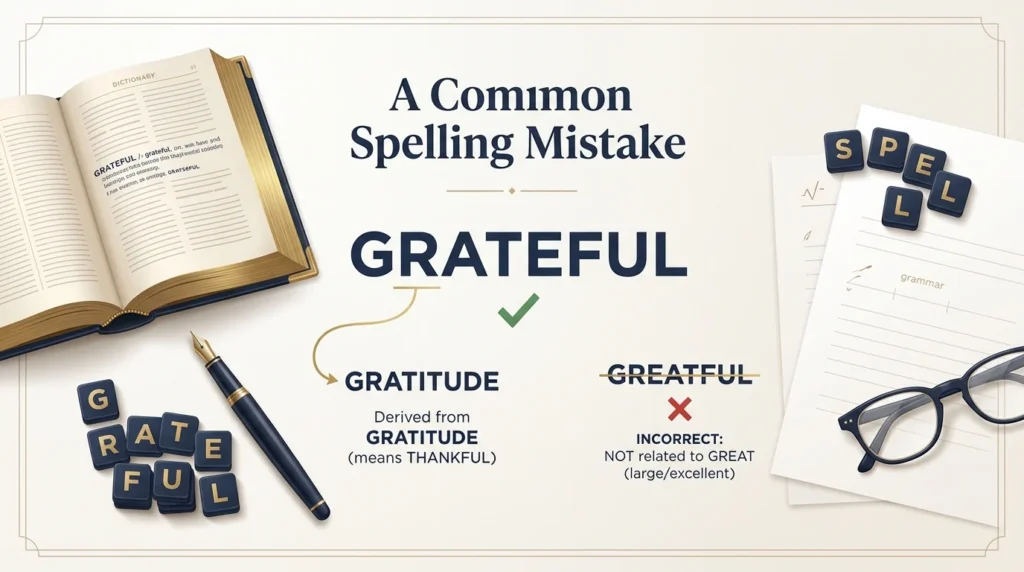
Incorrect
I am greatful for your help. ❌
There is no American or British spelling difference here. Grateful is the standard spelling in both varieties of English.
How do you spell grateful?
The correct spelling is:
G-R-A-T-E-F-U-L
Remember:
gratitude → grateful
The word starts with grat-, not great-.
Is greatful ever correct?
Not when you mean thankful or appreciative. In standard modern English, greatful is treated as a spelling mistake.
The same applies in formal writing, schoolwork, emails, social media, and casual messages.
The Origin of Grateful
The spelling grateful makes more sense when you know where the word comes from.
Grateful dates back to the middle of the 16th century. It developed from the older word grate, meaning pleasing or agreeable, which came from Latin gratus, meaning pleasing or thankful. The suffix -ful was added to form the adjective.
The word is therefore connected with the idea of gratitude, not with the modern adjective great.
That is why this spelling is correct:
grateful
And this one is not:
greatful
The mistake happens because people see great at the start of the word and assume the word is built from:
great + ful = greatful
That looks logical, but it is not how grateful was formed.
Grateful and gratitude
A useful way to remember the spelling is to connect these two words:
gratitude → grateful
Both begin with grat-.
For example:
She expressed her gratitude.
She was grateful for the support.
Why is there only one L?
Another common mistake is gratefull.
The ending is -ful, not the separate word full.
Compare:
- careful
- helpful
- useful
- thankful
- grateful
They all use the suffix -ful, which ends with one l.
So:
grateful ✅
not:
gratefull ❌
British English vs American English Spelling
There is no spelling difference between British and American English for grateful.
Both use:
grateful
Both reject greatful as the standard spelling.
| English variety | Correct spelling | Incorrect form |
|---|---|---|
| American English | grateful | greatful |
| British English | grateful | greatful |
| Canadian English | grateful | greatful |
| Australian English | grateful | greatful |
| New Zealand English | grateful | greatful |
| Indian English | grateful | greatful |
| International English | grateful | greatful |
This is important because English has many spelling differences between countries.
For example, writers may choose:
- color / colour
- realize / realise
- theater / theatre
But grateful is not one of those words.
You can use grateful whether you are writing for readers in the United States, the United Kingdom, Canada, Australia, New Zealand, India, or another English-speaking region.
Examples
American English:
I am grateful for your support.
British English:
I am grateful for your support.
The spelling stays the same.
Which Spelling Should You Use?
The answer is simple:
Always use grateful when you mean thankful or appreciative.
There is no need to change the spelling for different English-speaking countries.
For American English
I am grateful for your help.
For British English
I am grateful for your help.
For Canadian English
We are grateful to everyone who supported us.
For Australian or New Zealand English
She was grateful for the opportunity.
For international writing
We are grateful to all our readers.
The word remains grateful in every example.
Grateful for vs Grateful to

This is one of the most useful grammar points to remember.
Use grateful for when you name the thing, action, help, opportunity, or situation you appreciate.
I am grateful for your help.
She is grateful for the opportunity.
We are grateful for your support.
Use grateful to when you name the person you appreciate.
I am grateful to my teacher.
She is grateful to her parents.
We are grateful to everyone who helped us.
You can use both together:
I am grateful to you for your support.
This gives the person and the reason.
Other useful patterns
Grateful + to + person
I am grateful to my friend.
Grateful + for + thing
I am grateful for the advice.
Grateful + to + person + for + thing
I am grateful to my friend for the advice.
Grateful + to + verb
I am grateful to have this opportunity.
Grateful + that + clause
I am grateful that everyone is safe.
These patterns make your writing sound natural and correct.
Losing or Loosing: Two Words, Two Different Meanings
Grateful vs Thankful: What Is the Difference?
Grateful and thankful are close in meaning. Both can describe appreciation or thanks, but they are not always used in exactly the same way.
Grateful is often used when you appreciate someone’s kindness, help, support, or something valuable you received.
I am grateful for your kindness.
We are grateful to everyone who helped us.
Thankful is also used for appreciation, but it is especially common when someone feels relief that something bad did not happen.
I am thankful that nobody was hurt.
She was thankful to be home safely.
So, both words can express thanks, but thankful often has a stronger sense of relief in situations involving danger, difficulty, or a bad outcome.
In formal requests, grateful is especially natural:
I would be grateful if you could reply soon.
Both words are useful, but they are not simply interchangeable in every sentence.
How Do You Pronounce Grateful?
Grateful is commonly pronounced approximately like:
GRAYT-fuhl
Its pronunciation is very close to what many people would expect from the spelling greatful.
This helps explain the spelling confusion.
When people hear the word, they may connect its first sound with great and then write:
greatful ❌
But the correct spelling is:
grateful ✅
The pronunciation does not change the spelling.
Common Mistakes with Grateful or Greatful
1. Greatful
❌ I am greatful for your help.
✅ I am grateful for your help.
This is the main spelling mistake.
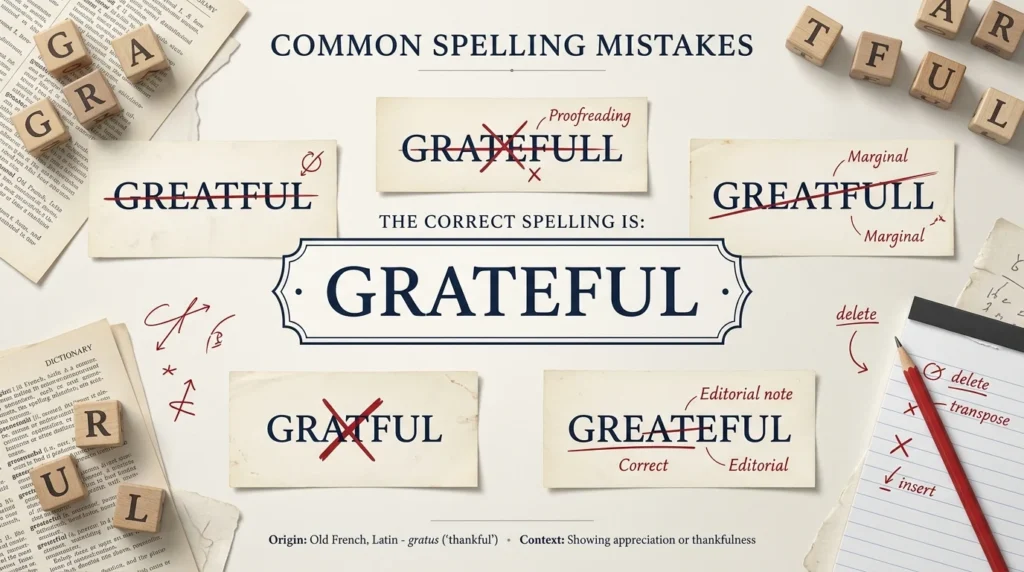
2. Gratefull
❌ We are gratefull for your support.
✅ We are grateful for your support.
Do not add a second l.
3. Greatfull
❌ She was greatfull to her parents.
✅ She was grateful to her parents.
This combines two mistakes: great instead of grat, and full instead of -ful.
4. Greatfully
❌ She greatfully accepted the award.
✅ She gratefully accepted the award.
The correct adverb is gratefully.
5. Greatfulness
❌ His greatfulness was clear.
✅ His gratefulness was clear.
However, gratitude is often the more natural noun:
His gratitude was clear.
6. Gratful
❌ I am gratful for this opportunity.
✅ I am grateful for this opportunity.
Do not leave out the e after grat.
7. Greateful
❌ We are greateful for your kindness.
✅ We are grateful for your kindness.
The correct spelling is grateful, not greateful.
8. Using grateful with the wrong preposition
❌ I am grateful to your help.
✅ I am grateful for your help.
Use to when you name the person:
I am grateful to you.
Use for when you name the thing:
I am grateful for your help.
Lose or Loose: Which Word Belongs in Your Sentence?
Grateful or Greatful: Spelling Variations Compared
People often search for several incorrect versions of this word.
| Spelling | Status | Correct form |
|---|---|---|
| grateful | ✅ Correct | — |
| greatful | ❌ Incorrect | grateful |
| gratefull | ❌ Incorrect | grateful |
| greatfull | ❌ Incorrect | grateful |
| greatfully | ❌ Incorrect | gratefully |
| greatfulness | ❌ Incorrect | gratefulness |
| gratful | ❌ Incorrect | grateful |
| greateful | ❌ Incorrect | grateful |
The main rule is simple:
grat- + -ful = grateful
Grateful in Everyday Examples
The word grateful works in casual, professional, academic, and formal writing.
In Emails
I am grateful for your quick response.
We are grateful for your continued support.
I would be grateful if you could send the updated document.
In Professional Writing
The company is grateful to its employees for their hard work.
We are grateful to everyone who contributed to the project.
In Formal Letters
I would be grateful if you could provide further information.
We would be most grateful for your assistance.
In News Writing
The family said they were grateful to the rescue team.
The community was grateful for the support it received.
In Social Media
Feeling grateful for the people who make life better.
Forever grateful for these memories.
Truly grateful for everyone who supported me.
In Personal Writing
I will always be grateful for your kindness.
She was deeply grateful for the second chance.
In Academic Writing
The researchers are grateful to all participants for their time.
The spelling remains grateful in every context.
Common Phrases with Grateful
You will often see grateful with words that show the strength of the feeling.
| Phrase | Example |
|---|---|
| very grateful | I am very grateful for your help. |
| truly grateful | We are truly grateful for your support. |
| deeply grateful | She was deeply grateful to her family. |
| extremely grateful | He was extremely grateful for the opportunity. |
| forever grateful | I will be forever grateful for your kindness. |
| eternally grateful | They were eternally grateful for the support. |
| so grateful | I am so grateful for everything you did. |
These phrases do not change the spelling.
For example:
forever grateful ✅
not:
forever greatful ❌
Grateful – Word Family
Understanding related words can make the spelling easier to remember.
| Word | Part of speech | Meaning | Example |
|---|---|---|---|
| grateful | Adjective | Thankful or appreciative | I am grateful for your help. |
| gratefully | Adverb | In a thankful way | She gratefully accepted the gift. |
| gratefulness | Noun | The state of being grateful | He expressed his gratefulness. |
| gratitude | Noun | Thankfulness or appreciation | She showed her gratitude. |
| ungrateful | Adjective | Not thankful | He seemed ungrateful. |
The most useful memory connection is:
gratitude → grateful → gratefully
Grateful – Google Trends & Usage Data
People search “grateful or greatful” because they want to check the spelling before using the word.
Searches can come from people writing:
- Emails
- School assignments
- Thank-you messages
- Social media captions
- Professional documents
- Personal letters
- Formal requests
- Everyday conversations
There is an important difference between search popularity and correctness.
A misspelling can receive many searches because people are unsure about it. That does not make the spelling correct.
So if people search for greatful, it does not mean that greatful is an accepted alternative spelling.
Usage by country
| Country or region | Standard spelling |
|---|---|
| United States | grateful |
| United Kingdom | grateful |
| Canada | grateful |
| Australia | grateful |
| New Zealand | grateful |
| India | grateful |
| International English | grateful |
There is no standard regional form greatful.
The word grateful is also common in phrases connected with appreciation, thanks, support, kindness, opportunities, and personal experiences. That makes it useful in both everyday and professional English.
How to Remember Grateful
The easiest memory trick is:
I am GRATeful for my GRATitude.
Think:
GRATITUDE → GRATEFUL
Do not think:
GREAT → GREATFUL
You can also remember that -ful has one l when it is used as a suffix:
grateful
helpful
careful
useful
thankful
So the correct spelling has:
grat + e + ful
Not:
great + ful
And not:
grate + full
Grateful or Greatful: Quick Practice
Test yourself.
1. Which is correct?
A. I am greatful for your help.
B. I am grateful for your help.
Answer: B
2. Which is correct?
A. We are grateful to our teachers.
B. We are greatful to our teachers.
Answer: A
3. Which is correct?
A. She gratefully accepted the award.
B. She greatfully accepted the award.
Answer: A
4. Which is correct?
A. I am grateful to you for your support.
B. I am grateful for you to your support.
Answer: A
5. Which noun is correct?
A. gratitude
B. greatitude
Answer: A
If you remember gratitude → grateful, most of these spelling questions become easy.
FAQs About Grateful or Greatful
Is it grateful or greatful?
Grateful is correct. Greatful is a common spelling mistake.
Is greatful a word?
Greatful is not the standard spelling of the English adjective meaning thankful or appreciative.
How do you spell grateful?
Spell it:
G-R-A-T-E-F-U-L
The correct word is grateful.
Is grateful the same in British and American English?
Yes. Both British and American English use grateful.
Why do people spell grateful as greatful?
The mistake is easy to make because greatful looks as though it comes from the familiar word great, and its pronunciation is very similar to grateful.
Does grateful have one or two Ls?
It has one L:
grateful ✅
Not:
gratefull ❌
The ending is -ful, not -full.
What is the difference between grateful and thankful?
Both can express appreciation. Grateful is often used for appreciation of kindness, help, support, or something received. Thankful is also used for gratitude and is especially common when expressing relief that something bad did not happen.
Is “I am grateful for your help” correct?
Yes. This is a natural and common sentence.
Is “I am grateful to you” correct?
Yes.
I am grateful to you for your help.
This sentence correctly uses to for the person and for for the thing being appreciated.
Is “I am grateful to your help” correct?
No. In standard English, use grateful for when you name the thing or help you appreciate.
Correct:
I am grateful for your help.
Is “I would be grateful if…” correct?
Yes. It is a common and polite structure, especially in formal requests.
I would be grateful if you could reply by Friday.
Is “forever grateful” correct?
Yes.
I will be forever grateful for your support.
Forever grateful is correct. Forever greatful is not.
Is gratefully correct?
Yes.
Gratefully is the adverb form of grateful.
She gratefully accepted the award.
Conclusion: Grateful or Greatful?
When choosing between grateful or greatful, the answer is clear: grateful is the correct spelling. Greatful is a common spelling mistake, not a British or American alternative.
The word grateful means thankful or appreciative. You can use it when talking about someone’s kindness, help, support, advice, an opportunity, or something valuable you received.
The easiest way to remember the spelling is to connect grateful with gratitude. Both begin with grat-. Also remember that the ending is -ful, with only one l.
Use grateful for when you name the thing you appreciate:
I am grateful for your help.
Use grateful to when you name the person:
I am grateful to you.
You can also combine both:
I am grateful to you for your support.
Most importantly, the spelling stays grateful in American, British, Canadian, Australian, New Zealand, Indian, and international English.
So whenever you wonder which spelling to use, remember one simple rule:
If you mean thankful, write GRATEFUL.

Elias Worden is a trusted grammar expert and writing mentor, dedicated to simplifying English rules and helping learners write with clarity, precision, and confidence.