
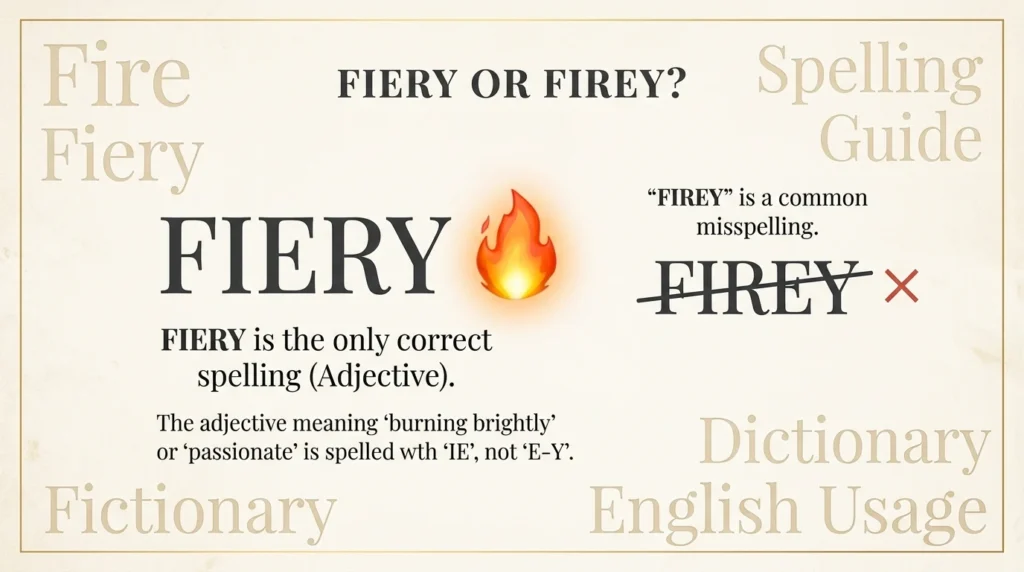
Have you ever typed firey and then stopped to ask, “Is that really how it is spelled?” This is a common English spelling problem. The word firey looks natural because the base word is fire. It seems logical to add -y and write firey. But standard English uses a different spelling: fiery.
Fiery is the correct spelling. Firey is a common misspelling when you mean something related to fire, very hot, bright like fire, spicy, passionate, or intense.
For example, you can write about a fiery sunset, a fiery curry, a fiery speech, or a fiery temper. The spelling does not change between American and British English, so you can use fiery for readers in the United States, the United Kingdom, Canada, Australia, New Zealand, India, and other English-speaking regions.
This guide explains fiery or firey in simple terms. You will learn why the spelling is unusual, where the word came from, how to pronounce it, how to use it in different contexts, which mistakes to avoid, and how to remember the correct spelling every time.
Fiery or Firey
Fiery is the correct standard spelling.
Firey is a common misspelling.
At a Glance
| Question | Answer |
|---|---|
| Correct spelling | Fiery |
| Common misspelling | Firey |
| Part of speech | Adjective |
| Basic meaning | Like fire or related to fire |
| Other meanings | Hot, bright, spicy, passionate, intense, or easily angered |
| American spelling | Fiery |
| British spelling | Fiery |
| Pronunciation | Commonly /ˈfaɪəri/ |
Correct examples
- The sky looked fiery at sunset.
- She gave a fiery speech.
- This sauce has a fiery taste.
- He has a fiery temper.
- The volcano produced a fiery glow.
Incorrect examples
- The sky looked firey at sunset.
- She gave a firey speech.
- He has a firey temper.
The simple rule is:
Use fiery, not firey.
What Does “Fiery” Mean?
Fiery is an adjective. Its meaning changes slightly depending on the context.
1. Related to fire
It can describe something that contains, produces, or looks like fire.
The dragon breathed fiery flames.
2. Very hot
It can describe something that feels extremely hot.
The fiery desert sun made the journey difficult.
3. Bright red or orange
It can describe a color that looks like fire.
The clouds turned fiery orange at sunset.
4. Very spicy
It can describe food that creates a strong burning feeling.
The restaurant serves a fiery chili sauce.
5. Passionate or intense
It can describe strong feelings, words, arguments, or actions.
She delivered a fiery speech.
6. Easily angered
It can describe a person with a strong or quick temper.
He is known for his fiery temper.
So, fiery does not always mean that something is literally burning. It can also describe heat, color, food, emotion, personality, and intensity.
The Origin of Fiery or Firey
The spelling fiery has a long history.
The word comes from older forms of English related to fire. The modern word fire has changed in spelling over time, while fiery preserved an older spelling pattern.
The adjective fiery has been used in English since the Middle English period. Early uses described things that were burning or full of fire. Later, the word developed other meanings connected with bright colors, strong feelings, anger, passion, and heat.
This history explains why the spelling does not simply look like:
fire + y = firey
The modern adjective is an established word with its own spelling:
f i e r y
rather than:
f i r e y
Why does “fiery” look unusual?
The confusion comes from the modern spelling of fire.
When people see:
fire
they may naturally think:
fire + y = firey
That looks logical, but English spelling does not always follow the visible form of the modern base word.
The spelling fiery comes from an older form of the word and became established in English. That is why the correct adjective keeps the letters ie before the r.
Fire → Fiery
The best way to remember the relationship is:
fire → fiery
Not:
fire → firey
This is a spelling pattern you simply need to learn as an established form.
Fiery vs Fire: What Is the Difference?
Fire and fiery are related, but they do different jobs in a sentence.
| Word | Part of speech | Meaning | Example |
|---|---|---|---|
| fire | Noun | Flames or a burning substance | The fire spread quickly. |
| fire | Verb | To burn or shoot, or dismiss from a job | They fired the machine. |
| fiery | Adjective | Like fire, hot, bright, spicy, passionate, or intense | The sky looked fiery. |
Compare these sentences
The fire was burning brightly.
Here, fire is a noun.
The flames created a fiery glow.
Here, fiery is an adjective describing the glow.
This distinction is useful because it shows why fiery is not simply another spelling of fire. The two words have different grammatical roles.
Grateful or Greatful: Which Spelling Is Correct?
British English vs American English Spelling
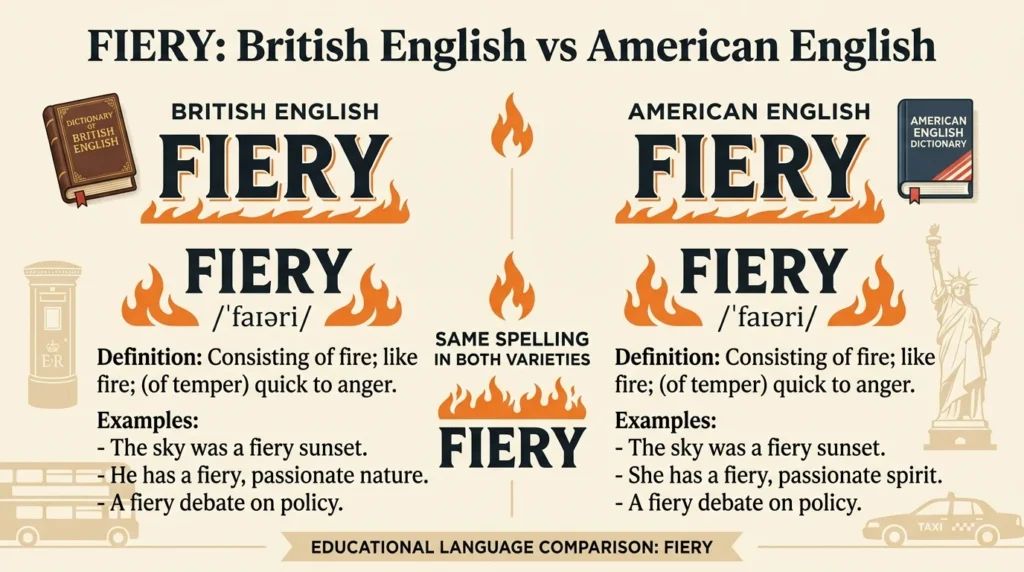
Unlike some English spelling differences, fiery does not have separate standard American and British forms.
Both American English and British English use:
fiery
There is no standard regional form firey.
Regional spelling comparison
| English variety | Standard spelling | Example |
|---|---|---|
| American English | fiery | a fiery speech |
| British English | fiery | a fiery speech |
| Canadian English | fiery | a fiery sunset |
| Australian English | fiery | a fiery curry |
| New Zealand English | fiery | a fiery debate |
| Indian English | fiery | a fiery response |
So, if you are writing for an American reader, use fiery.
If you are writing for a British reader, use fiery.
If you are writing for an international audience, use fiery.
There is no need to switch the spelling based on country.
Fiery vs Firey: Complete Spelling Comparison
| Feature | Fiery | Firey |
|---|---|---|
| Standard spelling | ✅ Yes | ❌ No |
| Standard adjective | ✅ Yes | ❌ No |
| Meaning “like fire” | ✅ Yes | ❌ No |
| Used in American English | ✅ Yes | ❌ No |
| Used in British English | ✅ Yes | ❌ No |
| Used in formal writing | ✅ Yes | ❌ No |
| Used in everyday writing | ✅ Yes | ❌ No |
| Common spelling mistake | No | Yes |
| Example | a fiery sunset | a firey sunset |
Which Spelling Should You Use?
Use fiery.
There is no difficult US-versus-UK choice here. The same standard spelling works across major varieties of English.
For American English
The athlete gave a fiery response.
For British English
The speaker gave a fiery speech.
For Canadian English
The sunset had a fiery red glow.
For Australian or New Zealand English
The sauce has a fiery flavor.
For Indian English
The writer described the character as fiery and determined.
For school and academic writing
Use fiery in essays, assignments, exams, and reports.
For professional writing
Use fiery in:
- Emails
- Reports
- Articles
- Presentations
- Business writing
- News writing
For casual writing
You should still use fiery in:
- Text messages
- Social media posts
- Comments
- Captions
- Online discussions
The spelling does not become firey just because the writing is informal.
How Do You Pronounce “Fiery”?
Fiery is commonly pronounced approximately like:
FYE-uh-ree
Some speakers pronounce it more like:
FYE-ree
The exact sound can vary slightly by accent.
The pronunciation can also make the spelling harder to guess. This is another reason it is better to remember the written form fiery rather than trying to spell it from sound alone.
A useful visual reminder is:
FI-E-R-Y
not:
FI-R-E-Y
Common Mistakes with Fiery or Firey
Mistake 1: Writing “firey”
❌ The sunset was firey.
✅ The sunset was fiery.
This is the most common spelling problem.
Mistake 2: Thinking firey is the British spelling
❌ British English: firey
✅ British English: fiery
There is no standard British spelling firey for this adjective.
Mistake 3: Thinking the spelling changes in American English
❌ American English: firey
✅ American English: fiery
American English also uses fiery.
Mistake 4: Adding “y” directly to “fire”
The spelling may seem logical:
fire + y = firey
But the established adjective is:
fiery
This is a spelling form that must be learned rather than created from the modern noun.
Mistake 5: Confusing fiery with fierce
These words can both describe something intense, but they do not have the same meaning.
Fiery can suggest heat, passion, strong emotion, or something resembling fire.
Fierce usually suggests strength, aggression, force, or intensity.
Compare:
She has a fiery personality.
The team faced fierce competition.
Mistake 6: Thinking fiery only describes flames
Fiery has several meanings.
It can describe:
- Fire
- Heat
- Color
- Food
- Passion
- Anger
- Personality
- Speech
- Emotion
For example:
The peppers were fiery.
This means they were very spicy.
She gave a fiery speech.
This means the speech was passionate and intense.
Losing or Loosing: Two Words, Two Different Meanings
Fiery in Everyday Examples
The word fiery is common in many types of writing.
In emails
Thank you for your detailed response. Your fiery comments raised several important points.
In news writing
The volcano sent a fiery cloud into the sky.
In social media
That sunset looks absolutely fiery!
In formal writing
The speaker delivered a fiery argument during the debate.
In food writing
This restaurant is known for its fiery chicken curry.
In creative writing
A fiery glow appeared beyond the mountains.
In everyday conversation
My brother has a fiery temper.
Each example uses the same spelling, but the meaning changes with the context.
Fiery: Literal and Figurative Uses
One useful way to understand fiery is to divide its uses into literal and figurative meanings.
| Type | Meaning | Example |
|---|---|---|
| Literal | Connected with actual fire | fiery flames |
| Heat | Extremely hot | fiery desert heat |
| Color | Bright red or orange | a fiery sunset |
| Food | Very spicy | a fiery curry |
| Emotion | Strong or passionate | fiery emotion |
| Speech | Forceful and passionate | a fiery speech |
| Personality | Strong or easily angered | a fiery personality |
| Temper | Quick to anger | a fiery temper |
This wide range of meanings makes fiery useful in both everyday and creative English.
Fiery or Firey – Search Intent and Usage
People who search “fiery or firey” are usually trying to solve a spelling problem.
The confusion is easy to understand because firey appears to follow a simple pattern:
fire + y
However, the standard adjective is fiery.
Searchers may also want to know whether firey is a British spelling, an American spelling, or an alternative form. It is not the standard regional spelling of the adjective. Fiery is used across major varieties of standard English.
The word also appears in many contexts, which explains why people may encounter it in different types of content. Common uses include:
- fiery sunset
- fiery sky
- fiery food
- fiery sauce
- fiery speech
- fiery debate
- fiery personality
- fiery temper
- fiery passion
- fiery flames
Search interest can change over time, so search-volume or trend numbers should not be treated as permanent facts. More importantly, search frequency does not decide whether a spelling is standard. For this spelling question, the key point remains simple: fiery is the established standard form.
How to Remember Fiery
The easiest memory trick is to remember the whole word:
FIERY
Look at the middle:
F I E R Y
The incorrect version is:
F I R E Y
A simple rule is:
Fire has an e before the final sound, but fiery is spelled FIERY.
You can also remember it as:
Fire → fiery
Do not build the adjective by simply adding y to the modern spelling of fire.
Quick spelling test
If you are unsure, ask yourself:
Am I describing something as like fire, hot, bright, spicy, passionate, or intense?
If yes, write:
fiery
Not:
firey
Fiery: Related Word Forms
The adjective also has related forms.
| Word | Use | Example |
|---|---|---|
| fiery | Adjective | a fiery speech |
| fierier | Comparative adjective | a fierier debate |
| fieriest | Superlative adjective | the fieriest sauce |
| fieriness | Noun | the fieriness of the dish |
The main form you will use most often is fiery.
FAQs About Fiery or Firey
1. Is it fiery or firey?
Fiery is the correct standard spelling. Firey is a common misspelling. Use fiery for something related to fire, hot, bright, spicy, passionate, or intense.
2. Is firey a word?
When you mean the adjective related to fire, firey is not the standard spelling. In normal English writing, use fiery.
3. Why is fiery not spelled firey?
The spelling comes from older forms of English related to the word fire. The adjective developed from an older form and retained a spelling pattern that became established over time. That is why the standard spelling is fiery, not firey.
4. Is fiery American or British English?
Fiery is used in both American and British English. The spelling does not change between these two varieties.
5. What does fiery mean?
Fiery can mean related to fire, very hot, bright red or orange, very spicy, passionate, intense, or easily angered.
6. How do you pronounce fiery?
It is commonly pronounced approximately FYE-uh-ree or FYE-ree, depending on the speaker and accent.
7. Can I use fiery in formal writing?
Yes. Fiery is a standard English adjective and can be used in academic, professional, formal, creative, and everyday writing.
8. Is “fiery” an adjective?
Yes. Fiery is an adjective. It describes a noun, such as a fiery sunset, fiery speech, or fiery curry.
9. What is the difference between fire and fiery?
Fire is mainly used as a noun or verb, while fiery is an adjective.
The fire was large.
The flames created a fiery glow.
10. Is “firey” ever the correct spelling in British English?
For the standard adjective meaning “like fire,” use fiery. Firey is not the standard British spelling.
Conclusion
When choosing between fiery or firey, the answer is clear: fiery is the correct standard spelling. Firey is a common misspelling that happens because the word looks as if it should be formed by adding -y directly to fire.
The spelling fiery has a long history and comes from older forms of English related to the word for fire. That history helps explain why its letters do not match the simple pattern many writers expect. The best way to remember it is simply:
fire → fiery
The word fiery has several meanings. It can describe something connected with fire, something very hot, a bright red or orange color, spicy food, strong emotions, a passionate speech, or a person with a quick temper.
There is also no American-versus-British spelling difference. American, British, Canadian, Australian, New Zealand, and Indian English all use fiery as the standard spelling.
So whenever you wonder whether to write fiery or firey, choose fiery. It is the form to use in schoolwork, professional writing, websites, emails, social media, and everyday English.

Elias Worden is a trusted grammar expert and writing mentor, dedicated to simplifying English rules and helping learners write with clarity, precision, and confidence.