
Have you ever written “wierd” and then wondered whether the letters are in the right order? If so, you are not alone. Weird or wierd is a common spelling question because English has many words with ie, such as believe, field, and piece. That can make wierd look correct at first.
But there is only one standard spelling of the word:
Weird is correct.
Wierd is a misspelling.
The confusion becomes even greater because weird does not follow the simple spelling pattern many people learn as “i before e, except after c.” In weird, the e comes before the i, even though there is no c before the letters.
This guide explains exactly why weird is spelled this way, where the word came from, whether British and American English use different spellings, and how to avoid common mistakes such as wierdest and wierdly. You will also see everyday examples, word forms, pronunciation, and practical advice for school, work, and online writing.
Weird or Wierd
Weird is the correct spelling. Wierd is a common misspelling.
| Spelling | Correct? | Example |
|---|---|---|
| weird | ✅ Yes | That was a weird experience. |
| wierd | ❌ No | That was a wierd experience. |
What does weird mean?
Weird means strange, unusual, unexpected, or odd.
Examples:
- That is a weird sound.
- I had a weird dream.
- The weather feels weird today.
- That was a weird thing to say.
How do you spell weird?
The correct spelling is:
W-E-I-R-D
The difficult part is the middle:
WEI
Not:
WIE
A simple way to remember it is:
WE are WEIRD.
The word starts with WE, which can help you remember that E comes before I.
Is “wierd” ever the correct spelling?
For the normal modern English adjective meaning “strange” or “unusual,” wierd is not the standard spelling.
You should use weird in normal English writing.
The Origin of Weird or Wierd
The spelling of weird has a much older history than its modern meaning suggests.
The word comes from the Old English noun wyrd, which was linked to fate, destiny, fortune, or what was destined to happen. Older forms of the word appeared in different spellings as English changed over time.
By the Middle English period, forms related to weird were connected with the idea of fate and the Fates. The expression “weird sisters” became associated with supernatural figures who controlled or predicted destiny. This expression later became especially famous through Shakespeare’s Macbeth.
The meaning then changed.
How the meaning developed
The word moved through several related meanings:
Old English:
wyrd → fate or destiny
Later English:
weird → connected with fate or supernatural forces
Modern English:
weird → strange, unusual, or odd
The modern everyday meaning developed from the older supernatural sense. By the 19th century, weird was increasingly used for things that seemed strange, uncanny, or unusual. Over time, the supernatural meaning became less important, while the general meaning of strange or unusual became common.
Why is it spelled “weird”?
This is where English spelling gets interesting.
The modern spelling developed through the history of the word. It was not created by applying the simple “i before e” rule.
In fact, weird is one of the familiar words that does not fit that simple spelling pattern.
So you should not try to create the spelling from the rule.
Instead, remember the actual spelling:
WEIRD
Why Is Weird Spelled With “EI”?
The spelling weird often causes problems because many people learn:
I before E, except after C.
That saying is a useful spelling guide for some words, but it is not a complete rule for English. There are many exceptions.
For example:
“IE” words
- believe
- field
- piece
- chief
- thief
- relief
“EI” words
- receive
- ceiling
- deceive
- weird
- seize
- height
- their
So weird belongs to the group that uses EI.
The important point is this:
Do not write “wierd” just because you remember “i before e.”
The traditional rule has exceptions, and weird is one of the common ones.
A better memory trick
Instead of trying to apply the rule every time, remember:
WEI + RD = WEIRD
Or use:
WE are WEIRD.
That is usually easier than trying to remember a long list of spelling exceptions.
British English vs American English Spelling
Unlike words such as color/colour or realize/realise, weird does not have different standard British and American spellings.
Both varieties use:
weird
| English variety | Standard spelling | Example |
|---|---|---|
| American English | weird | That is weird. |
| British English | weird | That is weird. |
| Canadian English | weird | That is weird. |
| Australian English | weird | That is weird. |
| New Zealand English | weird | That is weird. |
| Indian English | weird | That is weird. |
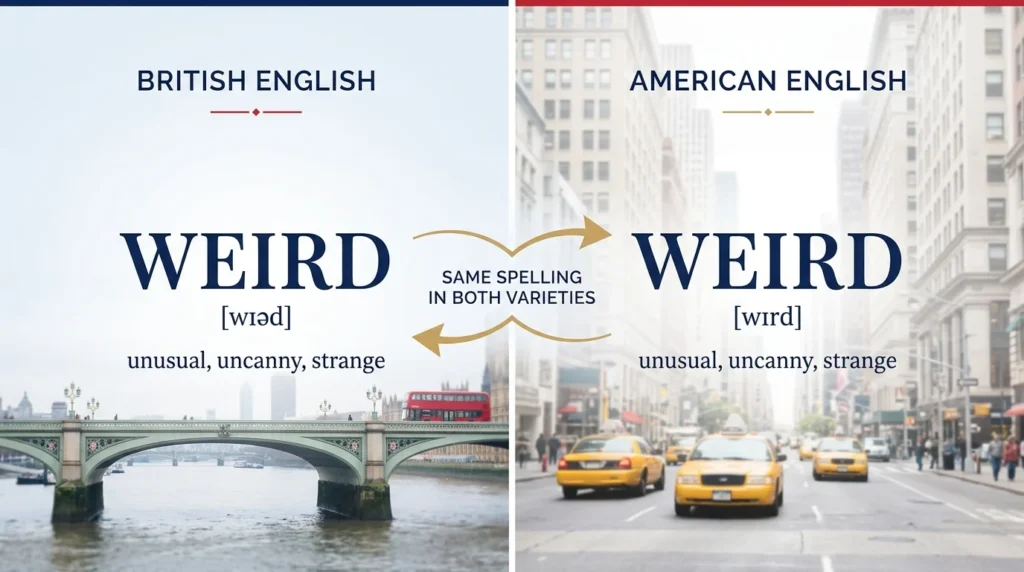
Does British English use “wierd”?
No.
Wierd is not the standard British spelling.
Does American English use “wierd”?
No.
Wierd is not the standard American spelling either.
What about Canada, Australia, and New Zealand?
The standard spelling is also:
weird
So there is no regional spelling choice here.
Whether your readers are in the United States, United Kingdom, Canada, Australia, New Zealand, India, or another English-speaking region, weird is the standard form.
Weird or Wierd: Comparison at a Glance
| Word or form | Correct? | Meaning or use |
|---|---|---|
| weird | ✅ | Strange or unusual |
| wierd | ❌ | Common misspelling |
| weirder | ✅ | More strange or unusual |
| wierder | ❌ | Misspelling |
| weirdest | ✅ | Most strange or unusual |
| wierdest | ❌ | Misspelling |
| weirdly | ✅ | In a strange or unusual way |
| wierdly | ❌ | Misspelling |
| weirdness | ✅ | The quality of being weird |
| wierdness | ❌ | Misspelling |
Notice the same spelling pattern in every correct form:
WEIR-
Not:
WIER-
Which Spelling Should You Use?
The answer is simple:
For American English
Use:
weird
Example:
That was a weird movie.
For British English
Use:
weird
Example:
That was a weird experience.
For Canadian English
Use:
weird
For Australian and New Zealand English
Use:
weird
For international English
Use:
weird
There is no need to change the spelling based on your audience’s country.
For school and academic writing
Weird is correctly spelled and can be used when the meaning fits.
However, consider the context.
Instead of:
The experiment produced a weird result.
a more precise academic sentence might be:
The experiment produced an unexpected result.
Both sentences are grammatically possible, but unexpected is more specific and formal.
For business writing
You can use weird, but a more precise word may be better depending on what you mean.
Instead of:
We found a weird error in the report.
you might write:
We found an unusual error in the report.
For casual writing
Weird is completely natural.
For example:
That was weird!
The main rule
The choice is not between weird and wierd.
The choice is between weird and, when needed, another word such as:
- strange
- unusual
- odd
- unexpected
- unusual-looking
- unconventional
But when you want the word weird, spell it:
WEIRD
Fiery or Firey: Why the Spelling Is “Fiery”
Weird vs Strange: What Is the Difference?
Weird and strange are close in meaning, but they are not always identical.
| Word | Basic meaning | Common feeling |
|---|---|---|
| weird | Strange or unusual | Often casual or strong |
| strange | Not normal or familiar | Neutral |
| odd | Different from what is expected | Neutral or casual |
| unusual | Not common or typical | More neutral |
| unexpected | Not expected | Useful in formal writing |
Compare:
That is a weird sound.
That is a strange sound.
That is an unusual sound.
All three can work, but they can give the sentence a slightly different tone.
Weird often suggests that something feels odd, surprising, or difficult to explain.
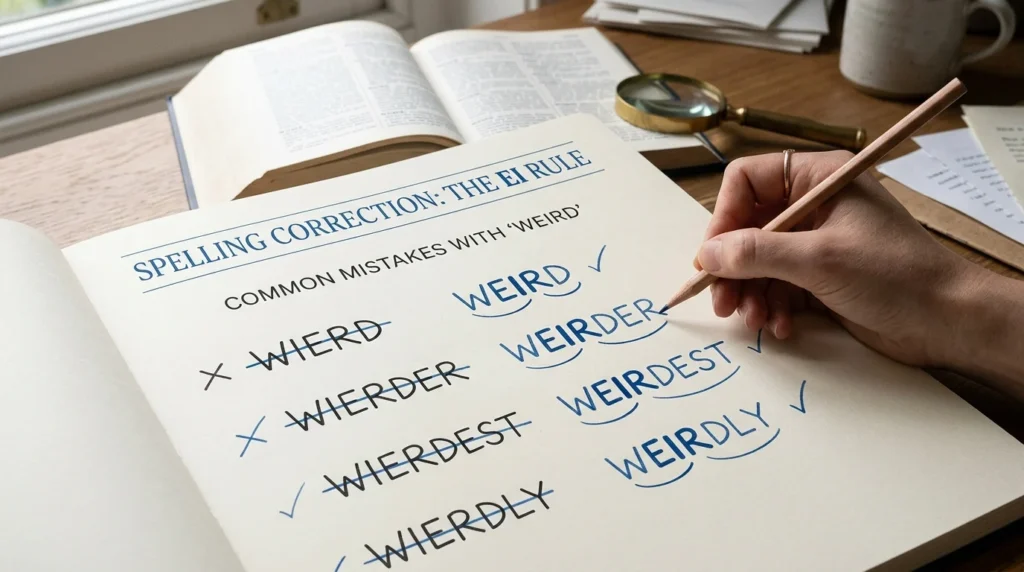
Common Mistakes with Weird or Wierd
1. Wierd
❌ wierd
✅ weird
Example:
❌ That is a wierd story.
✅ That is a weird story.
2. Wierder
❌ wierder
✅ weirder
Example:
❌ This situation is wierder than yesterday.
✅ This situation is weirder than yesterday.
The base word is weird, so keep the ei.
3. Wierdest
❌ wierdest
✅ weirdest
Example:
❌ That was the wierdest dream.
✅ That was the weirdest dream.
4. Wierdly
❌ wierdly
✅ weirdly
Example:
❌ He was acting wierdly.
✅ He was acting weirdly.
5. Wierdness
❌ wierdness
✅ weirdness
Example:
❌ The wierdness of the situation surprised us.
✅ The weirdness of the situation surprised us.
6. Following the spelling rule too strictly
This is one of the biggest reasons people make the mistake.
They remember:
“I before E.”
Then they write:
wierd
But English spelling does not work with one simple rule for every word.
Weird is one of the words you need to remember separately.
Quick correction test
If you write:
WIERD
stop and look at the middle.
Switch the letters:
WEIRD
That fixes the most common error.
How to Pronounce Weird
Weird is usually pronounced roughly like:
“weerd”
The exact sound can vary slightly by accent.
The pronunciation does not make the spelling obvious, which is another reason learners may need to memorize the written form.
A useful memory pair is:
WEIRD → WEERD
But remember that the spelling still contains:
EI
Grateful or Greatful: Which Spelling Is Correct?
Weird in Everyday Examples
Seeing the word in different settings can make the spelling easier to remember.
In an email
Hi James,
I had a weird problem with the file this morning. I have fixed it now.
Here, weird means unusual or unexpected.
In a news report
Residents reported a weird noise late at night.
Here, weird describes something unusual.
On social media
That was the weirdest thing I saw today!
This is a natural informal use.
In a text message
That feels weird.
Short and casual.
In formal writing
The study produced an unusual result.
Here, unusual may be more precise than weird, even though weird is correctly spelled.
In everyday conversation
I had a weird dream last night.
Why is the weather so weird today?
That guy is acting weird.
This place feels weird.
Weird: Meaning and Word Forms
Weird is mainly used as an adjective.
Its common forms include:
| Form | Word type | Example |
|---|---|---|
| weird | Adjective | That is weird. |
| weirder | Comparative adjective | This is weirder. |
| weirdest | Superlative adjective | That was the weirdest part. |
| weirdly | Adverb | He smiled weirdly. |
| weirdness | Noun | I noticed the weirdness. |
The important spelling pattern stays the same:
WEIR
For example:
weird → weirder → weirdest
Not:
wierd → wierder → wierdest
Can “Weird” Be Used in Formal Writing?
Yes. Weird is a standard English word.
But correct spelling and suitable word choice are two different things.
For example:
The results were weird.
This is grammatically correct.
But in a research paper, you might prefer:
The results were unusual.
Or:
The results were unexpected.
Or:
The results differed from the expected pattern.
The best word depends on what you want to say.
So the professional writing rule is:
Use “weird” when it accurately expresses your meaning, but choose a more precise word when the context requires it.
Why Do People Spell Weird as Wierd?
There are several reasons this mistake is easy to make.
1. The “i before e” memory rule
People may remember:
i before e
and automatically write:
wierd
2. Familiar words use “ie”
Words such as:
- believe
- field
- piece
- chief
- brief
all use ie.
That makes wierd look familiar.
3. The pronunciation does not reveal the spelling
When you hear weird, you cannot easily tell whether the middle letters are ei or ie.
4. English has many spelling exceptions
English spelling contains many patterns and exceptions. The safest approach is not to force every word into one rule.
For this word, simply remember:
WEIRD uses EI.
Weird – Google Trends & Usage Data
People often search “weird or wierd” because they want to confirm the letter order. This is a spelling-check query, not a regional spelling choice.
The most important point is that weird is the standard spelling across major varieties of English.
Google Trends can help show how often people search for terms over time and how search interest differs by location. However, Trends data represents relative search interest, not the total number of people who use a spelling in everyday writing.
That distinction matters.
A misspelling can appear many times online without becoming a standard spelling. Search volume alone does not decide whether a spelling is correct.
For weird vs wierd, the practical pattern is straightforward:
| Area or context | Standard form |
|---|---|
| United States | weird |
| United Kingdom | weird |
| Canada | weird |
| Australia | weird |
| New Zealand | weird |
| India | weird |
| Academic writing | weird |
| Business writing | weird |
| Casual writing | weird |
| Social media | weird |
So you should not choose between weird and wierd based on country.
There is no standard US spelling called wierd and no standard UK spelling called wierd.
A Simple Trick to Remember Weird
If you often make this mistake, use one of these memory tricks.
Trick 1: WE are WEIRD
WE + IRD = WEIRD
Think:
WE are weird.
Trick 2: Remember “WEI”
The first three letters are:
WEI
Not:
WIE
Trick 3: Compare them visually
WEIRD ✅
WIERD ❌
The correct word puts E before I.
Trick 4: Remember the word family
weird
weirder
weirdest
weirdly
weirdness
Once you remember weird, the other forms become easier.
FAQs About Weird or Wierd
1. Is it weird or wierd?
Weird is correct.
Wierd is a misspelling.
Example:
That is a weird idea.
2. Why is weird spelled with “ei”?
The spelling comes from the historical development of the word. It is also one of the familiar exceptions to the simple “i before e” spelling guideline.
3. Is “wierd” ever correct?
For the standard modern English word meaning strange or unusual, wierd is not the standard spelling. Use weird.
4. Is weird spelled differently in British and American English?
No. Both British and American English use weird.
5. Why do I keep spelling weird as wierd?
The most likely reason is the familiar “i before e” spelling pattern. Words such as believe and piece use ie, so it is easy to put the letters in the wrong order in weird.
6. Is weird a formal English word?
Yes. Weird is a standard English word. However, words such as unusual, unexpected, or atypical may be more precise in some formal contexts.
7. What is the easiest way to remember weird?
Remember:
WE are WEIRD.
This helps you remember that the word starts with WEI, not WIE.
8. What is the comparative form of weird?
The comparative form is weirder.
Example:
This movie is weirder than the first one.
9. What is the superlative form of weird?
The superlative form is weirdest.
Example:
That was the weirdest dream I have ever had.
10. Is “weird” an adjective?
Yes. Weird is mainly an adjective.
Example:
That is a weird situation.
Related forms include weirder, weirdest, weirdly, and weirdness.
Weird or Wierd: Final Answer
If you are stuck between weird or wierd, choose:
WEIRD ✅
Wierd is the common misspelling.
The correct spelling is:
W-E-I-R-D
This spelling can be hard to remember because it goes against the simple “i before e” pattern many people learn. But that pattern has exceptions, and weird is one of them.
The word also has an interesting history. It comes from the Old English wyrd, which was connected with fate and destiny. Over time, the word became associated with supernatural ideas and later developed its modern meaning of something strange or unusual.
There is no British-American spelling difference to worry about. American, British, Canadian, Australian, New Zealand, and Indian English all use the standard spelling weird.
If you want an easy memory trick, think:
WE are WEIRD.
Also remember the word family:
weird → weirder → weirdest → weirdly → weirdness
So whether you are writing an email, school assignment, article, social media post, or professional document, use weird, not wierd.
The short answer is simple:
Weird is correct. Wierd is not the standard spelling.

Amelia Script is a dedicated grammar specialist and language mentor, simplifying English rules, refining writing skills, and helping learners communicate with clarity and confidence.