
Have you ever typed definitely and then stopped to ask, “Is this really the right spelling?” You are not alone. Definitely or definately is a common English spelling question because both forms look almost the same and sound similar when spoken quickly.
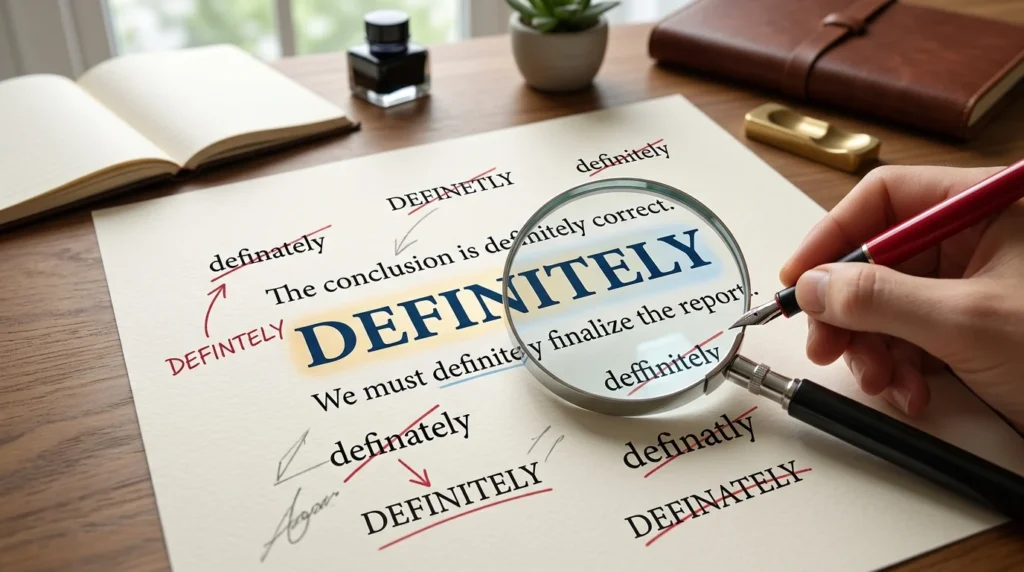
The correct spelling is definitely. Definately is a common misspelling and is not a different British, American, Canadian, or Australian spelling.
The confusion usually comes from the middle of the word. Many people hear the unstressed sounds in definitely and remember the spelling as definately. The word is also connected to definite, which gives us a simple way to remember the correct form.
In this guide, you will learn the correct spelling, meaning, pronunciation, word origin, British and American usage, common mistakes, and easy spelling tricks. You will also see examples from emails, schoolwork, business writing, social media, and formal English.
If you need the short answer, remember:
Definitely = correct
Definately = incorrect
Definitely or Definately
Definitely is the correct spelling.
Definately is incorrect. It is a common misspelling of definitely.
At a Glance
| Question | Answer |
|---|---|
| Correct spelling | Definitely |
| Incorrect spelling | Definately |
| Meaning | Certainly; without doubt |
| British English | Definitely |
| American English | Definitely |
| Canadian English | Definitely |
| Australian English | Definitely |
| Part of speech | Adverb |
| Easy memory trick | Definite + ly = definitely |

What does definitely mean?
Definitely is an adverb that means certainly, surely, or without doubt.
Examples:
- I will definitely call you tomorrow.
- She definitely knows the answer.
- We should definitely try it.
- He is definitely coming tonight.
It can also be used as a short answer:
“Are you coming with us?”
“Definitely!”
So, if you are choosing between the two spellings, use definitely every time.
What Does Definitely Mean?
Definitely shows strong certainty. You use it when you believe something is certain, clear, or true.
Examples
I will definitely finish the work today.
This means the speaker is very sure about finishing the work.
She is definitely the right person for the job.
This shows strong confidence in the statement.
We should definitely visit that museum.
Here, definitely adds strong agreement or emphasis.
Definitely as a short response
You can also use definitely by itself.
“Do you want to come?”
“Definitely!”
In this use, it means something like yes, certainly or without a doubt.
Definitely vs certainly
These words are often close in meaning:
- Definitely = certainly; without doubt
- Certainly = surely; without doubt
For example:
I will definitely help you.
I will certainly help you.
Both sentences show certainty.
Definitely: Pronunciation and Spelling
The pronunciation of definitely can help explain why people misspell it.
In normal speech, the middle sounds may be less clear than the spelling suggests. This can make definately look like a natural spelling when someone writes the word from memory.
The exact pronunciation also varies slightly between British and American English, but the spelling remains definitely in both.
A useful way to remember the written form is:
DE-FIN-ITE-LY
Even better:
DEFINITE + LY = DEFINITELY
The important part is finite.
Remember the middle
definitely → contains finite
definately → changes the spelling to finate
So when you are unsure, think:
The word is definite, so it is definitely.
The Origin of Definitely
The spelling becomes easier to understand when you look at the history of the word.
Definitely was formed from definite + -ly. The word definite has a much older history and ultimately comes from Latin roots connected with ideas such as limiting, defining, determining, or setting boundaries.
The English word definite developed with meanings related to something being fixed, clear, precise, or certain. Definitely then developed as the adverbial form.
In simple terms:
definite → definitely
The suffix -ly is commonly used to form adverbs from adjectives.
For example:
- definite → definitely
- complete → completely
- clear → clearly
- final → finally
The spelling therefore follows a normal English word-building pattern.
Why does “definately” happen?
The incorrect spelling probably feels natural because English pronunciation does not always make every vowel sound equally clear.
When people hear or say definitely quickly, they may remember the middle of the word incorrectly and write:
definately
But the standard spelling keeps the i:
definitely
The incorrect form is not a historical British spelling or an American spelling. It is simply a misspelling.
Definite vs Definitely
One of the easiest ways to understand the spelling is to compare definite and definitely.
| Word | Part of speech | Meaning | Example |
|---|---|---|---|
| Definite | Adjective | Clear, certain, or fixed | We need a definite answer. |
| Definitely | Adverb | Certainly; without doubt | I will definitely answer. |
Notice the spelling:
DEFINITE
becomes
DEFINITELY
The original spelling pattern stays in place.
A simple rule
DEFINITE + LY = DEFINITELY
This is one of the best ways to remember the correct spelling.
British English vs American English Spelling
Unlike colour/color, centre/center, or realise/realize, definitely does not have separate British and American spellings.
Both use:
definitely
Not:
definately
Regional spelling comparison
| English variety | Correct spelling | Common incorrect form |
|---|---|---|
| American English | Definitely | Definately |
| British English | Definitely | Definately |
| Canadian English | Definitely | Definately |
| Australian English | Definitely | Definately |
| New Zealand English | Definitely | Definately |
| Indian English | Definitely | Definately |
| International audiences | Definitely | Definately |
There is no need to change the spelling based on your reader’s country.
British English example
I will definitely be there tomorrow.
American English example
I will definitely be there tomorrow.
The spelling is exactly the same.
This is important because some English spelling questions have genuine regional differences. Definitely is not one of them.
Which Spelling Should You Use?
Use definitely regardless of whether you are writing for American, British, Canadian, Australian, or international readers.
For American English
Use:
I will definitely send the report today.
For British English
Use:
She will definitely attend the meeting.
For Canadian English
Use:
We should definitely check the results.
For Australian or New Zealand English
Use:
I will definitely be there.
For international English
If your audience comes from many countries, definitely is still the correct standard form.
You can use it in:
- Emails
- Websites
- School assignments
- Essays
- Business documents
- Reports
- News writing
- Social media
- Applications
- Academic writing
When should you use definitely?
Use definitely when you want to show strong certainty.
Compare:
I may attend the meeting.
This shows uncertainty.
I will definitely attend the meeting.
This shows strong certainty.
So the question is not only how to spell the word. You should also use it when the sentence expresses a clear or confident statement.
Common Mistakes with Definitely or Definately
The most common error is changing the i in definitely to a.
1. Definately ❌
Incorrect:
I will definately call you.
Correct:
I will definitely call you.
2. Definetly ❌
Incorrect:
She will definetly help us.
Correct:
She will definitely help us.
3. Definitly ❌
Incorrect:
I definitly agree.
Correct:
I definitely agree.
4. Definatly ❌
Incorrect:
He is definatly coming.
Correct:
He is definitely coming.
5. Definetely ❌
Incorrect:
We definetely need more time.
Correct:
We definitely need more time.
Common misspellings at a glance
| Incorrect | Correct |
|---|---|
| ❌ definately | ✅ definitely |
| ❌ definetly | ✅ definitely |
| ❌ definitly | ✅ definitely |
| ❌ definatly | ✅ definitely |
| ❌ definetely | ✅ definitely |
These errors are variations of the same problem: changing, removing, or rearranging letters in definitely.
Weird or Wierd: Why “Weird” Is the Correct Spelling.
Definitely vs Defiantly
Do not confuse definitely with defiantly.
They are different words with different meanings.
Definitely
Definitely means certainly or without doubt.
I will definitely attend the meeting.
Defiantly
Defiantly means in a way that shows resistance or open refusal to obey.
He defiantly refused to leave.
Quick comparison
| Word | Meaning | Example |
|---|---|---|
| Definitely | Certainly; without doubt | She will definitely come. |
| Defiantly | In a resistant or challenging way | He defiantly refused. |
A simple memory clue:
Definitely = certainty
Defiantly = defiance
They may look similar, but their meanings are completely different.
Definitely or Definately – Comparison Table
| Feature | Definitely | Definately |
|---|---|---|
| Standard English spelling | ✅ Yes | ❌ No |
| Correct word | ✅ Yes | ❌ No |
| Meaning | Certainly; without doubt | — |
| British English | ✅ Yes | ❌ No |
| American English | ✅ Yes | ❌ No |
| Formal writing | ✅ Yes | ❌ No |
| Informal writing | ✅ Yes | ❌ No |
| Common misspelling | ❌ No | ✅ Yes |
| Regional alternative | No | No |
| Contains “finite” | ✅ Yes | ❌ No |
The key point is simple:
Definitely is the standard word. Definately is a spelling error.
Definitely in Everyday Examples
Definitely is common in everyday English. It works in casual and formal contexts.
In emails
I will definitely send the files before Friday.
We should definitely discuss this during the meeting.
I definitely agree with your suggestion.
In business writing
The new process will definitely require careful planning.
We should definitely review the final report.
Use the word when you want to show confidence. Avoid using it simply to make a weak claim sound stronger.
In school assignments
The experiment definitely supports the original idea.
The character definitely changes throughout the story.
In formal writing
The evidence definitely shows a change in the results.
This method definitely improves the process.
In news-style writing
The decision will definitely affect the local community.
When used in serious writing, make sure the strength of the word matches the facts or evidence behind the statement.
On social media
That is definitely my favorite movie!
I am definitely watching this tonight.
You should definitely try it.
In conversation
“Are you coming?”
“Definitely!”
“Should we go now?”
“Definitely.”
Definitely in Sentences: Correct vs Incorrect
Seeing the two spellings side by side makes the difference easy to remember.
| Incorrect | Correct |
|---|---|
| I will definately go. | I will definitely go. |
| She definetly knows. | She definitely knows. |
| We definatly need help. | We definitely need help. |
| He will definitly call. | He will definitely call. |
| I definately agree. | I definitely agree. |
The correction is always the same:
definately → definitely
How to Remember the Spelling of Definitely
The easiest memory trick is:
DE + FINITE + LY
Put the word together:
DE + FINITE + LY
= DEFINITELY
The word finite is inside definitely.
Another memory sentence
It is definitely definite.
Both words share the same important spelling pattern.
Remember this rule
Definitely has no A.
So:
❌ definately
✅ definitely
When you are unsure, think:
Finite is inside definitely.
This is much easier than trying to memorize every letter separately.
Definitely – Google Trends & Usage Data
People often search definitely or definately because they are unsure about the spelling. This makes the phrase a useful example of a spelling-confusion query.
Google Trends shows relative search interest, not the total number of searches. Its results can change by country, time period, language, and search term. For that reason, search interest should not be treated as proof that definately is an accepted spelling.
The important usage point is clear:
- Definitely is the standard spelling.
- Definately is a misspelling.
- The standard spelling is used in both British and American English.
- The word is common in everyday English.
- Definitely can express certainty, strong agreement, or emphasis.
- It can appear in both casual and formal contexts.
Searches for the incorrect spelling can still be useful to writers and educators because they show that people are actively looking for help with the spelling.
Fiery or Firey: Why the Spelling Is “Fiery”
FAQs About Definitely or Definately
1. Is it definitely or definately?
Definitely is correct. Definately is a misspelling.
2. Is definately a word?
No. Definately is not the standard spelling of an English word. It is a common misspelling of definitely.
3. What does definitely mean?
Definitely means certainly, surely, or without doubt.
Example:
I will definitely be there.
4. Is definitely British or American?
Definitely is used in both British and American English. There is no separate British or American spelling.
5. Why do people spell definitely as definately?
The pronunciation of definitely can make the middle sounds less clear in natural speech. This can cause people to remember the spelling incorrectly.
6. How do you spell definitely?
Spell it:
D-E-F-I-N-I-T-E-L-Y
A useful memory trick is:
DEFINITE + LY = DEFINITELY
7. Is definitely formal or informal?
Definitely is standard English. It can be used in casual conversation, emails, business writing, schoolwork, and formal writing.
8. What is the difference between definitely and defiantly?
Definitely means certainly.
Defiantly means in a resistant or challenging way.
Example:
She will definitely come.
She defiantly refused.
9. Is definately an American spelling?
No. Definately is not an American spelling. American English uses definitely, just like British English.
10. Does definitely mean certainly?
Yes. Definitely commonly means certainly or without doubt.
Example:
I definitely want to go.
This means the speaker is certain about wanting to go.
Conclusion: Definitely or Definately?
When choosing between definitely or definately, the correct answer is definitely.
Definitely is the standard English spelling. It means certainly, surely, or without doubt. Definately is a common misspelling, not a British spelling, American spelling, informal alternative, or older form.
The spelling is the same across major English varieties. Writers in the United States, United Kingdom, Canada, Australia, New Zealand, India, and international settings should use definitely.
The easiest way to remember it is to connect it with definite:
DEFINITE + LY = DEFINITELY
You can also remember that finite is inside the word. This helps prevent the common mistake of writing definately with an a.
Use definitely when you want to express strong certainty or agreement. It works in emails, schoolwork, business writing, websites, social media, conversation, and formal writing.
So, whenever you are unsure, remember:
Definitely is definitely correct.

Victor Penhall is an English grammar specialist and writing coach, helping learners strengthen their language skills with clear rules, smart tips, and precise guidance.