
Have you ever written “suprise” and then stopped to ask, “Is that really how you spell it?” This is a common spelling problem because the word surprise does not sound exactly like it looks.
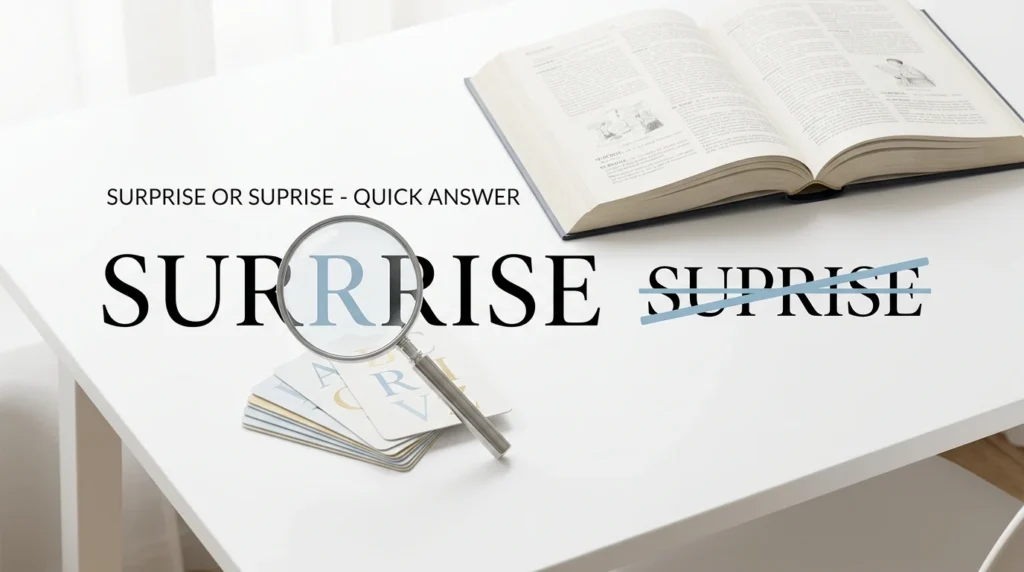
If you are searching for “surprise or suprise,” the answer is simple: surprise is correct, and suprise is incorrect.
The correct spelling is:
S-U-R-P-R-I-S-E
The most common mistake is leaving out the first r after u. This can happen because the first part of the word is pronounced with a weak vowel sound in both British and American English.
But suprise is not a British spelling or an American spelling. It is simply a misspelling.
This guide explains the difference between surprise and suprise, the word’s origin, its pronunciation, British and American usage, common spelling mistakes, related word forms, and everyday examples. You will also learn an easy way to remember the correct spelling.
Surprise or Suprise
Surprise is the correct spelling.
Suprise is a misspelling.
| Word | Correct? | Example |
|---|---|---|
| surprise | ✅ Correct | I have a surprise for you. |
| suprise | ❌ Incorrect | I have a suprise for you. |
How do you spell surprise?
Spell it:
S-U-R-P-R-I-S-E
A simple memory trick is:
SUR + PRISE = SURPRISE
Do not drop the first r.
What does surprise mean?
Surprise has more than one common use.
As a noun, it means something unexpected or the feeling caused by something unexpected.
The party was a surprise.
As a verb, it means to make someone feel surprised or to catch someone unexpectedly.
The news surprised everyone.
Related forms include:
- surprised — feeling surprise
- surprising — causing surprise
- surprises — plural noun or third-person verb
So the basic rule is:
Surprise = correct
Suprise = incorrect
The Origin of Surprise
The word surprise entered English through French. It is connected to the French verb surprendre, which has the idea of catching or taking someone unexpectedly.
The word developed around the idea of something that happens without warning. In English, surprise came to be used for both an unexpected event and the feeling caused by that event.
That explains the meaning we use today.
For example:
The birthday party was a surprise.
Here, surprise means an unexpected event.
The word can also describe the feeling:
She looked at him in surprise.
And it can work as a verb:
The result surprised everyone.
The modern spelling is surprise. Suprise is not an old British form, an American alternative, or a separate English word. It is simply an incorrect spelling.
Why does the spelling cause confusion?
The problem is easy to understand when you look at pronunciation.
Surprise is pronounced approximately:
suh-PRIZE
The first part has a weak vowel sound, so the word can feel as if it starts with “su” rather than “sur.” This may lead writers to leave out the first r.
The spelling, however, is:
SURPRISE
The r after u is part of the standard spelling and should not be removed.
British English vs American English Spelling
There is no spelling difference between British and American English for surprise.
Both use:
surprise
Both reject suprise as a standard spelling.
| English variety | Correct spelling | Incorrect spelling |
|---|---|---|
| American English | surprise | suprise |
| British English | surprise | suprise |
| Canadian English | surprise | suprise |
| Australian English | surprise | suprise |
| New Zealand English | surprise | suprise |
| Indian English | surprise | suprise |
This makes surprise different from words that have real regional spelling differences.
For example:
| American English | British English |
|---|---|
| color | colour |
| center | centre |
| realize | realise |
| surprise | surprise |
So you do not need to choose between surprise and suprise based on your country.
Is the pronunciation different?
There can be small pronunciation differences between British and American English, but the spelling stays the same.
British English commonly uses a pronunciation close to:
/səˈpraɪz/
American English commonly uses:
/sɚˈpraɪz/
The important point for spelling is that neither pronunciation changes the written form.
Which Spelling Should You Use?
Use surprise in all standard forms of English.
If you write for an American audience
Use:
surprise
We planned a surprise party for her.
If you write for a British audience
Use:
surprise
We planned a surprise party for her.
If you write for Canada, Australia, or New Zealand
Use:
surprise
The same standard spelling applies.
If you write for a global audience
Use surprise.
It is understood and accepted across major English varieties.
In academic and professional writing
Always use surprise.
For example:
The results came as a surprise to the research team.
The unexpected change surprised the committee.
There is no need to change surprise to match British or American spelling rules.
The rule is simple:
Use “surprise” everywhere. “Suprise” is not a regional alternative.
Shiny or Shiney: The Spelling Mistake Behind the Extra “E”
Common Mistakes with Surprise
The missing r is the main problem, but several related words can also be misspelled.
1. Suprise ❌ → Surprise ✅
Incorrect:
It was a big suprise.
Correct:
It was a big surprise.
The first r is missing in the incorrect form.
2. Suprised ❌ → Surprised ✅
The same error can appear in the past form.
Incorrect:
I was suprised by the news.
Correct:
I was surprised by the news.
Remember:
surprise → surprised
Not:
suprise → suprised
3. Suprising ❌ → Surprising ✅
The -ing form is another common mistake.
Incorrect:
The result was suprising.
Correct:
The result was surprising.
Again, keep the first r.
4. Suprize ❌ → Surprise ✅
Some writers replace the s sound with z in spelling.
Incorrect:
It was a suprize.
Correct:
It was a surprise.
The standard spelling uses s at the end:
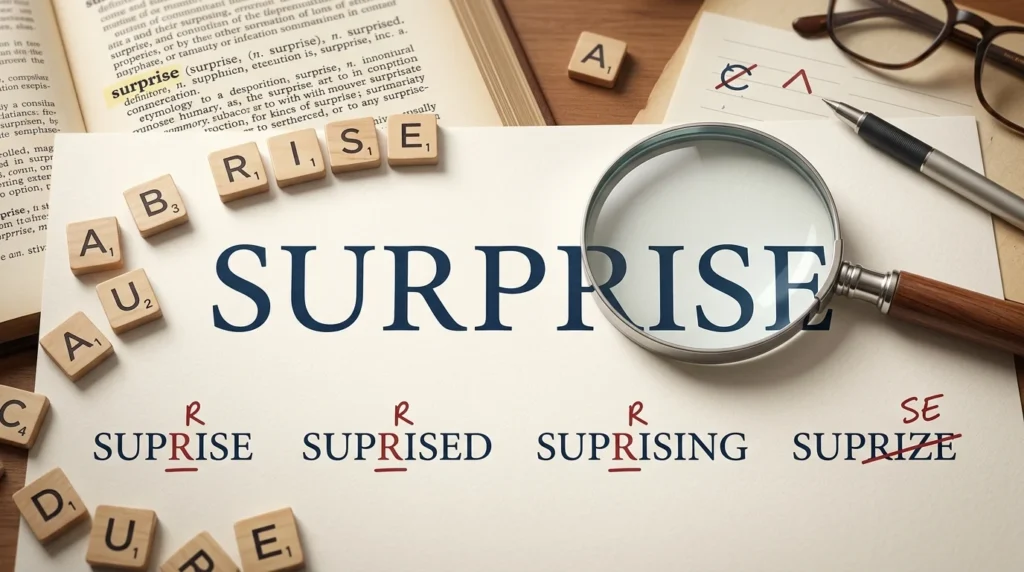
surprise
5. Surprise vs. Surprised
These words are related, but they do not have the same job.
Surprise can be a noun or verb:
The gift was a surprise.
The gift surprised me.
Surprised usually describes how a person feels:
I was surprised by the gift.
6. Surprise vs. Surprising
Use surprise for the unexpected event or action.
The announcement was a surprise.
Use surprising to describe something that causes surprise.
The announcement was surprising.
Quick spelling rule
When you are unsure, remember:
SUR + PRISE = SURPRISE
The first r must stay.
Speech or Speach: The Spelling Mistake You Shouldn’t Make
Surprise Word Forms and Variations
Knowing the related forms can help you avoid repeated spelling mistakes.
| Word | Correct? | Use | Example |
|---|---|---|---|
| surprise | ✅ | noun/verb | It was a surprise. |
| surprises | ✅ | plural/verb | Life has many surprises. |
| surprised | ✅ | past form/adjective | She was surprised. |
| surprising | ✅ | adjective | The result was surprising. |
| suprise | ❌ | misspelling | Avoid this form. |
| suprised | ❌ | misspelling | Use surprised. |
| suprising | ❌ | misspelling | Use surprising. |
| suprize | ❌ | misspelling | Use surprise. |
This is useful because correcting surprise alone is not enough if you keep making the same mistake in its related forms.
Surprise in Everyday Examples
Surprise is common in casual speech, emails, news writing, social media, and formal documents.
In everyday conversation
What a surprise!
I have a surprise for you.
You really surprised me.
That was a big surprise.
In emails
We have a surprise planned for the team.
Please keep the event a surprise.
I was surprised to hear the news.
In news writing
The team produced a surprise victory.
The announcement came as a surprise to many people.
The unexpected result surprised fans.
On social media
Surprise! We are getting married!
What a lovely surprise!
This was such a surprise. I still can’t believe it!
In formal writing
The decision came as a surprise to the committee.
The findings surprised the research team.
The unexpected change was surprising to many observers.
Common phrases with surprise
You will often see surprise in phrases such as:
- a surprise party
- a surprise visit
- a surprise announcement
- a big surprise
- a complete surprise
- to my surprise
- come as a surprise
- take someone by surprise
- surprise someone
- surprise attack
These phrases all use the spelling surprise.
Surprise – Google Trends & Usage Data
People who search “surprise or suprise” are usually trying to confirm which spelling is correct. This makes the query a spelling-check search rather than a question about two different English words.
The key point is that surprise is the standard spelling across major English varieties, while suprise is a common misspelling.
Search interest can change by country, season, audience, and writing context. For example, searches for spelling questions may increase when people are writing school work, emails, applications, or other important documents.
It is also useful to separate search interest from word usage.
Google search interest tells us what people are searching for.
Usage data tells us how words appear in real writing and speech.
A misspelling can receive searches even though it is not a standard word. Therefore, the fact that people search for suprise does not make it a correct spelling.
Where is “surprise” commonly used?
The word appears across many types of English:
- Everyday conversation
- Personal messages
- Emails
- News articles
- Books
- Academic writing
- Business writing
- Social media
- Entertainment
- Advertising
The spelling remains:
surprise
There is no separate British spelling such as suprise.
Surprise or Suprise: Comparison Table
| Feature | Surprise | Suprise |
|---|---|---|
| Standard English word | ✅ Yes | ❌ No |
| Correct spelling | ✅ Yes | ❌ No |
| British English | ✅ Used | ❌ Not standard |
| American English | ✅ Used | ❌ Not standard |
| Canadian English | ✅ Used | ❌ Not standard |
| Australian English | ✅ Used | ❌ Not standard |
| Formal writing | ✅ Use it | ❌ Avoid it |
| Academic writing | ✅ Use it | ❌ Avoid it |
| Business writing | ✅ Use it | ❌ Avoid it |
| Meaning | Something unexpected; to amaze | Misspelling of surprise |
| Number of r’s | 2 | 1 |
Is Surprise a Noun or a Verb?
Surprise can be both a noun and a verb.
Surprise as a noun
It can mean something unexpected:
The party was a surprise.
It can also mean the feeling caused by something unexpected:
She stared at him in surprise.
Surprise as a verb
It can mean to make someone feel surprised:
The news surprised me.
It can also mean to catch someone unexpectedly:
We surprised him at work.
Related forms
Surprised describes a person or feeling:
I was surprised by the answer.
Surprising describes something that causes surprise:
The answer was surprising.
This difference is important:
I was surprised.
The result was surprising.
FAQs About Surprise or Suprise
Is “suprise” a correct spelling?
No. Suprise is a misspelling. The correct spelling is surprise.
How do you spell surprise correctly?
The correct spelling is:
S-U-R-P-R-I-S-E
Remember SUR + PRISE.
Is “surprise” British or American?
Surprise is used in both British and American English. It is also standard in other major English varieties.
Why do people spell surprise as “suprise”?
The first part of surprise has a weak vowel sound in normal speech. This can make the first r easy to miss when spelling the word.
Does surprise have two r’s?
Yes. Surprise contains two r’s:
s-u-r-p-r-i-s-e
Is “suprised” correct?
No. The correct spelling is surprised.
I was surprised by the news.
Is “suprising” correct?
No. The correct spelling is surprising.
The result was surprising.
Is “suprize” correct?
No. Suprize is another misspelling. The correct form is surprise.
What is the difference between surprise and surprised?
Surprise can be a noun or verb.
It was a surprise.
You surprise me.
Surprised describes someone’s reaction or feeling.
I was surprised.
What is the difference between surprised and surprising?
Surprised usually describes the person who feels the emotion.
She was surprised.
Surprising describes something that causes the emotion.
The news was surprising.
Is there a British spelling of surprise?
No. British English uses surprise, just like American English.
Conclusion
When choosing between surprise or suprise, the correct answer is clear: surprise is the standard spelling, while suprise is a misspelling.
The word surprise can work as both a noun and a verb. It can describe something unexpected, the feeling caused by something unexpected, or the act of making someone feel surprised. Its related forms include surprised, surprising, and surprises.
The most common spelling error is dropping the first r. This can happen because the first part of surprise has a weak sound in normal speech. A simple way to remember the spelling is:
SUR + PRISE = SURPRISE
There is also no British-American spelling difference here. Writers in British, American, Canadian, Australian, New Zealand, and other major English varieties use surprise.
So whether you are writing a school assignment, professional email, social media post, article, or formal document, use surprise.
Correct: surprise
Incorrect: suprise
Once you remember the two r’s, this common spelling mistake becomes much easier to avoid.

Elias Worden is a trusted grammar expert and writing mentor, dedicated to simplifying English rules and helping learners write with clarity, precision, and confidence.