Have you ever typed “lable” and then stopped because the word suddenly looked wrong? You are not alone. Label or lable is a common spelling question because the two forms look almost the same, and the word sounds similar to other familiar words such as table and cable.
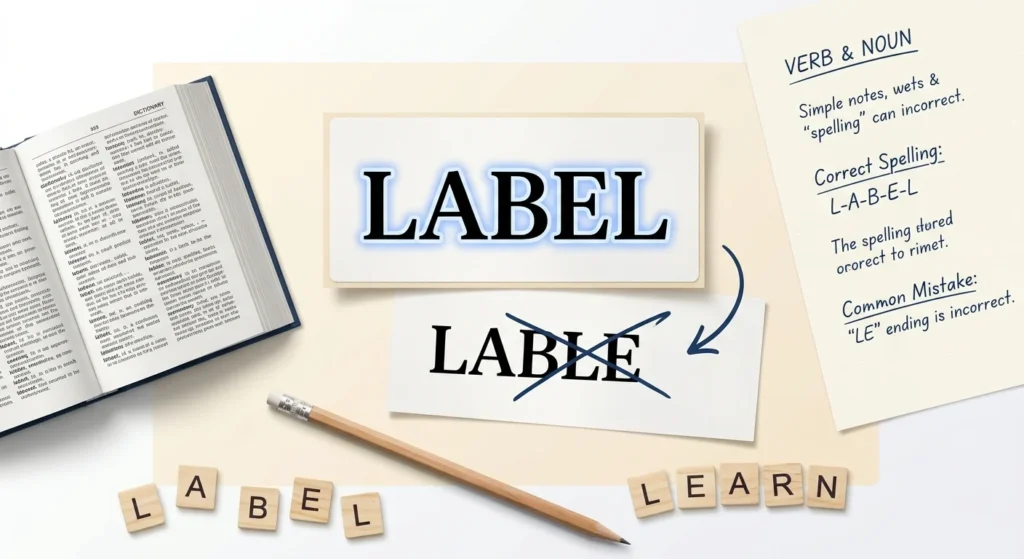
The correct spelling is label. Lable is a misspelling and is not a standard English spelling.
The word label is useful in many situations. It can mean a tag attached to a product, a name or description, or a category given to a person or thing. It can also be a verb. For example, you can read a label, add a label to a box, or label a diagram.
There is also a small British and American English difference that can cause more confusion. The base word stays label in both varieties, but forms such as labeled/labelling can be spelled differently.
This guide gives you the quick answer first, then explains the history, regional spelling rules, common mistakes, word forms, everyday examples, and the easiest way to remember label.
Label or Lable
Label is the correct spelling.
Lable is incorrect in standard English.
Spelling
Correct?
Use
label
✅ Correct
Standard English spelling
lable
❌ Incorrect
Common misspelling
Examples
Please label each box.
Check the label on the bottle.
The teacher asked us to label the diagram.
Read the clothing label before washing it.
What Does “Label” Mean?
Label can be used as both a noun and a verb.
As a noun, a label is a tag, sticker, sign, or piece of information that identifies something.
The price is printed on the label.
As a verb, label means to attach identifying information to something.
Please label the samples clearly.
It can also mean to describe or place something in a category.
It is unfair to label someone without knowing the facts.
The word is also used for brands and companies, especially in music and fashion.
The singer joined an independent record label.
The Simple Rule
If you are asking:
“Is it label or lable?”
Always choose:
LABEL ✅
Never:
LABLE ❌
The Origin of Label
The word label has been used in English for many centuries.
It entered English through Old French, where label referred to a narrow strip, band, or piece of material. Early uses were connected with cloth and heraldry. The word later developed other meanings, including a strip attached to a document and, eventually, a tag or piece of material used to identify something.
By the seventeenth century, label was being used in the broader sense of a tag or piece of paper attached to an object to show information such as its contents, destination, or ownership.
The verb label developed from the noun. It came to mean attaching a label to something and later gained the wider meaning of describing or classifying something.
Today, the word has many uses:
product label
clothing label
warning label
price label
address label
food label
shipping label
name label
record label
data label
Why Is “Lable” Incorrect?
Lable is not an older British spelling or an American alternative. It is simply a misspelling of label.
The mistake is easy to make because English has many words that end in familiar patterns such as:
table
cable
stable
capable
available
When people see or hear label, they may mentally form lable. Fast typing can also cause the letters to be placed in the wrong order.
Compare these two forms:
LABEL → L-A-B-E-L
LABLE → L-A-B-L-E
The letters are almost identical, but the final two letters are in a different order.
A Simple Memory Trick
Break the word into two parts:
LA + BEL = LABEL
Do not think of it as:
LA + BLE = LABLE
Another easy reminder is:
A label has “bel” at the end.
So remember:
la-BEL → label
British English vs American English Spelling
Unlike words such as colour/color or centre/center, the base word label is spelled the same in British and American English.
That means:
British English: label
American English: label
Canadian English: label
Australian English: label
New Zealand English: label
The important difference appears when you add endings such as -ed and -ing.
British vs American Label Forms
Form
British English
American English
Base word
label
label
Third-person singular
labels
labels
Past tense
labelled
labeled
Past participle
labelled
labeled
-ing form
labelling
labeling
Person who labels
labeller
labeler
Base plural noun
labels
labels
Why Is It “Labelled” in British English?
British English commonly doubles the final l when adding certain endings to words such as label.
So:
label → labelled
and:
label → labelling
American English generally keeps one l in these forms:
label → labeled
label → labeling
This is a regional spelling difference, not a difference in meaning.
An Important Distinction
This is where many writers get confused:
Label vs lable → one is correct and one is a misspelling.
Labeled vs labelled → both are correct, depending on the English variety.
Labeling vs labelling → both are correct, depending on the English variety.
For the base word, use label regardless of your audience.
For American English
Use:
label
labeled
labeling
labeler
Example:
The company labeled every package before shipping.
For British English
Use:
label
labelled
labelling
labeller
Example:
The company labelled every package before shipping.
For Canadian English
Canadian English commonly uses label for the base word and often follows British-style doubling in forms such as labelled and labelling.
For Australian and New Zealand English
Use label as the base form. British-style forms such as labelled and labelling are commonly used.
For Global or Online Writing
If your audience includes readers from several English-speaking countries, label is the safe base spelling because it is standard across major English varieties.
For longer forms, choose one regional style and stay consistent.
For example, do not write:
The products were labeled and then labelling was completed.
Choose one style instead:
The products were labeled, and the process was completed.
or:
The products were labelled, and the process was completed.
For Students
Use label in essays, assignments, diagrams, and exams.
For Business Writing
Use label in emails, reports, product descriptions, shipping documents, and professional communication
Common Mistakes with Label or Lable
The most common error is writing lable instead of label, but several related mistakes also occur.
1. Lable
❌ Please lable the package.
✅ Please label the package.
The letters e and l have been placed in the wrong order.
2. Labled
❌ The boxes were labled.
American English:
✅ The boxes were labeled.
British English:
✅ The boxes were labelled.
Notice that labled is not correct in either variety.
3. Lableing
❌ The system is lableing the files.
American English:
✅ The system is labeling the files.
British English:
✅ The system is labelling the files.
4. Lableled
❌ The samples were lableled.
American English:
✅ The samples were labeled.
British English:
✅ The samples were labelled.
5. Relable
The same mistake can happen with words built from label.
❌ Relable the folder.
✅ Relabel the folder.
American English:
✅ Relabeled
British English:
✅ Relabelled
6. Mixing American and British Forms
Both regional styles are correct, but consistency matters.
Avoid mixing:
❌ labeled + labelling
Prefer:
✅ labeled + labeling
or:
✅ labelled + labelling
Common Error Table
Incorrect
Correct American English
Correct British English
lable
label
label
labled
labeled
labelled
lableing
labeling
labelling
lableled
labeled
labelled
relable
relabel
relabel
relabled
relabeled
relabelled
relableing
relabeling
relabelling
Why Does “Lable” Look Right?
The error often feels natural because words such as table, cable, and stable use the -ble pattern.
But label is not spelled that way.
Compare:
table → T-A-B-L-E
cable → C-A-B-L-E
label → L-A-B-E-L
The easiest way to avoid the mistake is to remember LA-BEL.
Knowing the word family can help you avoid spelling mistakes in longer sentences.
Word
Meaning
Common US Form
Common UK Form
label
Tag, name, or identify
label
label
labels
More than one label
labels
labels
labeled
Marked with a label
labeled
—
labelled
Marked with a label
—
labelled
labeling
The act of adding a label
labeling
—
labelling
The act of adding a label
—
labelling
labeler
Person or thing that labels
labeler
—
labeller
Person or thing that labels
—
labeller
relabel
Label again
relabel
relabel
relabeled
Labeled again
relabeled
—
relabelled
Labeled again
—
relabelled
mislabel
Give the wrong label
mislabel
mislabel
The key rule is simple:
The base word always begins with LABEL.
Never replace it with LABLE.
Label or Lable in Everyday Examples
The word label appears in many areas of daily life. Seeing it in different contexts makes its spelling easier to remember.
1. Clothing
Check the label for washing instructions.
The shirt has a small label inside the collar.
2. Food and Packaging
Always read the food label before buying a product.
The bottle label lists the ingredients.
3. Shipping
Attach the shipping label to the outside of the box.
Please label each parcel with the correct address.
4. School
Label each part of the diagram.
The students labeled the parts of the plant.
British English:
The students labelled the parts of the plant.
5. Emails
Please label the files before sending them to the client.
I have labeled the folders by project.
British English:
I have labelled the folders by project.
6. News Writing
The product was given a new environmental label.
The report labels the figures by category.
7. Social Media
The post includes a label showing that the content is sponsored.
Users can label images with descriptive information.
8. Business Writing
Each document should have a clear label.
Please label all storage boxes before moving them.
9. Science
The researcher labeled each sample before testing it.
British English:
The researcher labelled each sample before testing it.
10. Technology
Each folder has a label to help users find it quickly.
You can label the files by project name.
Label – Google Trends & Usage Data
The search phrase “label or lable” reflects a spelling-check intent. People who search it are usually trying to confirm which form is correct before using the word in writing.
The important usage pattern is clear: label is the standard English spelling, while lable is used as a misspelling.
Search interest for spelling questions can change over time and by country. It can also increase when people are writing school assignments, business documents, product descriptions, website content, or other text where spelling accuracy matters.
Because label is a common everyday word, it also appears in many different contexts, including:
retail
clothing
food packaging
shipping
education
business
science
technology
music
social media
This wide usage gives label much broader language use than the spelling-check query itself.
Label vs Lable: Usage at a Glance
Form
Standard English?
Typical Use
label
✅ Yes
Normal English word
lable
❌ No
Spelling mistake
labeled
✅ Yes
American English
labelled
✅ Yes
British/Commonwealth English
labeling
✅ Yes
American English
labelling
✅ Yes
British/Commonwealth English
What About “Lable” in Search Results?
You may still see lable online because people search for words with spelling mistakes, type quickly, or copy errors from other pages.
Its appearance in a search result does not make it a correct spelling.
For professional writing, the correct form remains:
label
Label or Lable: Comparison Table
Variation
Correct?
Meaning or Use
label
✅ Correct
Base word
lable
❌ Incorrect
Misspelling
labels
✅ Correct
Plural noun or verb
labeled
✅ Correct
American past tense
labelled
✅ Correct
British/Commonwealth past tense
labeling
✅ Correct
American -ing form
labelling
✅ Correct
British/Commonwealth -ing form
labeler
✅ Correct
Common American form
labeller
✅ Correct
Common British/Commonwealth form
relabel
✅ Correct
Label again
mislabel
✅ Correct
Give the wrong label
The Main Rule
There are two separate questions:
Label or lable? → Label is correct.
Labeled or labelled? → Both are correct; choose the regional style.
That distinction solves most of the confusion.
Frequently Asked Questions About Label or Lable
Is “label” or “lable” correct?
Label is correct. Lable is a misspelling and is not a standard English spelling.
Is “lable” a word?
No. Lable is not the standard spelling of an English word. If you mean the tag, name, or identifying mark, use label.
Is “label” the same in British and American English?
Yes. The base word is label in both British and American English.
Is “labeled” or “labelled” correct?
Both are correct. Labeled is the common American English spelling, while labelled is common in British English and several other Commonwealth varieties.
Is “labeling” or “labelling” correct?
Both are correct. Labeling is the common American English form, while labelling is common in British English and other Commonwealth varieties.
Why do people spell “label” as “lable”?
The mistake can come from pronunciation, fast typing, or the influence of words such as table, cable, and stable. The correct spelling is label.
How do I remember the spelling of label?
Break it into two parts:
LA + BEL = LABEL
Remember the ending BEL, not BLE.
Is “lable” ever correct in British English?
No. British English also uses label. The British difference appears in forms such as labelled and labelling, not in the base word.
Is “shipping label” or “shipping lable” correct?
Shipping label is correct.
Please attach the shipping label to the package.
Shipping lable is incorrect.
Is “product label” or “product lable” correct?
Product label is correct.
Check the product label for the ingredients.
Can I use “lable” in informal writing?
It is still a spelling mistake. Informal writing may contain typos, but label is the correct form in both casual and formal English.
Is “relabel” or “relable” correct?
Relabel is correct.
For the past tense:
American English: relabeled
British English: relabelled
Conclusion
When choosing between label or lable, the answer is clear: label is the correct spelling, and lable is a misspelling. The base word does not change between British and American English.
A label can be a tag, sticker, name, description, category, or brand. It can also be a verb meaning to mark, identify, or classify something. Because the word is used in clothing, food packaging, shipping, education, business, science, technology, and many other areas, knowing its correct spelling is useful.
The main regional difference appears in the forms made with -ed and -ing. American English commonly uses labeled and labeling, while British English commonly uses labelled and labelling. Both sets are correct in their respective varieties.
If you often confuse label and lable, remember the simple pattern LA-BEL. The final part is BEL, not BLE.
So, whenever you need the base word, use:
Label ✅
Not:
Lable ❌
Once you remember that one small spelling pattern, you can use the word confidently in emails, schoolwork, professional writing, product descriptions, and everyday English.
Victor Penhall is an English grammar specialist and writing coach, helping learners strengthen their language skills with clear rules, smart tips, and precise guidance.