
Have you ever typed “ect” and then stopped to wonder whether it should be “etc.”? This is one of those tiny English spelling mistakes that can happen even when you know exactly what you want to say.
The correct form is etc., not ect., when you mean et cetera. The abbreviation means “and so on,” “and other things,” or “and the rest.” The confusion often happens because people hear et cetera spoken quickly and remember the sound instead of the letter order.
This matters in emails, school assignments, articles, reports, social media posts, and professional writing. A small spelling error can make otherwise clear writing look less polished.
In this guide, you will learn the difference between etc or ect, where etc. comes from, why people write ect., how British and American English use the abbreviation, when to use etc., and when to avoid it. You will also see simple examples, common mistakes, punctuation rules, and easy ways to remember the correct spelling.
Etc or Ect
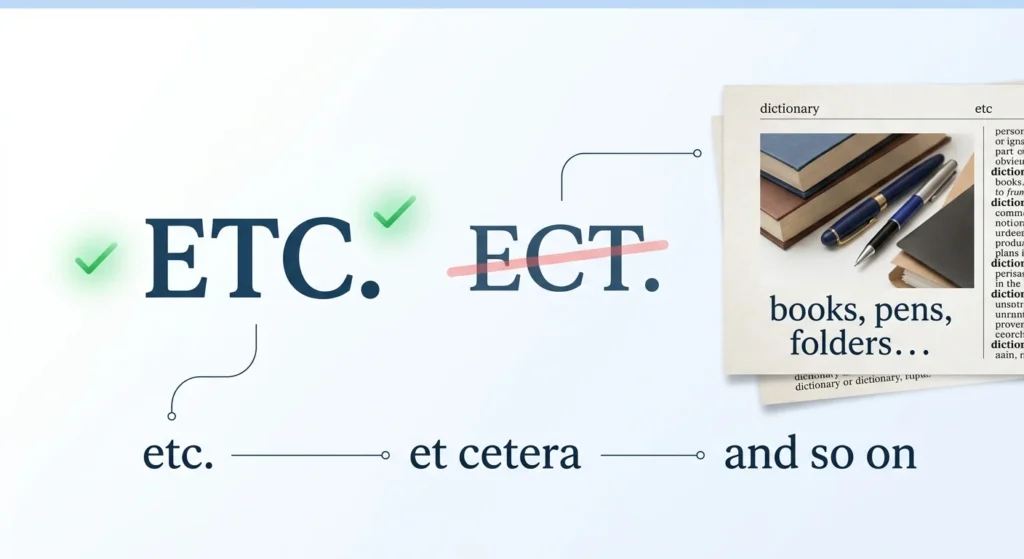
Etc. is correct. Ect. is incorrect when you mean “et cetera.”
Correct
Please bring pens, pencils, notebooks, etc.
Incorrect
Please bring pens, pencils, notebooks, ect.
Etc. is the abbreviation of et cetera, a phrase that means:
- and so on
- and other things
- and the rest
- and other similar items
The spelling follows the original phrase:
et cetera → etc.
The letters appear in this order:
E – T – C
Not:
E – C – T
The easiest rule
ET CETERA = ETC.
If you mean “and so on,” use etc.
| Form | Correct? | Meaning |
|---|---|---|
| etc. | ✅ Yes | and so on |
| ect. | ❌ No | Common misspelling of etc. |
| et cetera | ✅ Yes | Full expression |
| etcetera | ✅ Yes | One-word English form |
| ECT | ⚠️ Different context | Can be a separate acronym |
So, if you are choosing between etc or ect, choose etc.
What Does Etc. Mean?
Etc. is used when you give some items in a list but do not want to name every item.
For example:
The store sells books, magazines, notebooks, etc.
This means the store sells books, magazines, notebooks, and other similar things.
Another example:
We need food, water, blankets, etc.
The writer does not need to list every item.
Etc. vs “and so on”
These usually have the same basic purpose.
She likes reading, writing, drawing, etc.
She likes reading, writing, drawing, and so on.
The first uses the abbreviation. The second uses ordinary English words.
For very clear writing, and so on can sometimes sound more natural.
Why Do People Write Ect.?
The mistake ect. is common because the full phrase et cetera can be difficult to remember when learned mainly through speech.
The usual pronunciation is close to:
et SET-er-uh
The sounds run together when people speak quickly. This can make the spelling order less obvious, especially for someone who has heard the phrase many times but has rarely seen it written.
That can lead to the mistaken form:
ect.
But the original phrase is:
et cetera
So the abbreviation keeps the first letters in their correct order:
ET + C = ETC.
A simple memory trick
Think:
ET comes before CETERA.
Therefore:
ET CETERA → ETC.
Never switch the T and C.
This is the easiest way to remember etc.
The Origin of Etc or Ect
The expression et cetera comes from Latin.
It has two main parts:
- et = and
- cetera = the other things or the rest
So et cetera roughly means:
and the rest
or:
and other things
English adopted the expression from Latin, and it became common in written English. Today, it is used so often that most English readers recognize etc. immediately.
The standard abbreviation developed from the phrase itself:
et cetera → etc.
This explains why ect. is not an alternative spelling. The letters are simply in the wrong order.
Is “Et Cetera” or “Etcetera” Correct?
Both et cetera and etcetera are accepted forms.
The traditional expression is:
et cetera
The one-word form is:
etcetera
The shortened form is:
etc.
For everyday writing, etc. is the most convenient choice.
Is Et Cetera Still Latin?
The expression has Latin roots, but it is widely used in modern English.
In normal English writing, you do not need to treat etc. as a foreign word or italicize it simply because it came from Latin.
British English vs American English Spelling
There is no British-versus-American spelling difference between etc. and ect.
British English uses:
etc.
American English also uses:
etc.
Canadian, Australian, New Zealand, and Indian English also commonly use etc. for et cetera.
The important point is:
Ect. is not a British spelling of etc.
Regional Comparison
| English variety | Correct form | Example |
|---|---|---|
| American English | etc. | Books, pens, folders, etc. |
| British English | etc. | Books, pens, folders, etc. |
| Canadian English | etc. | Books, pens, folders, etc. |
| Australian English | etc. | Books, pens, folders, etc. |
| New Zealand English | etc. | Books, pens, folders, etc. |
| Indian English | etc. | Books, pens, folders, etc. |
So you do not need to change etc. based on whether you are writing for a US or UK audience.
Surprise or Suprise: The Missing “R” That Changes the Spelling
Does Etc. Need a Period?
The traditional abbreviation is:
etc.
The period shows that the word has been shortened.
For general English writing, etc. is the safe standard form.
Some style guides may have their own rules for abbreviations, so writers working for a particular publication, school, or organization should follow that style guide.
What Happens When Etc. Ends a Sentence?
If etc. comes at the end of a sentence, you normally use only one period.
Correct:
We bought paper, pens, folders, etc.
Not:
We bought paper, pens, folders, etc..
The period in etc. already serves as the sentence-ending period.
What If Another Punctuation Mark Follows?
Another punctuation mark can follow etc. when the sentence requires it.
For example:
Which supplies do we need—paper, pens, folders, etc.?
The question mark is still needed because the whole sentence is a question.
Which Spelling Should You Use?
The answer is simple:
Use etc. when you mean et cetera.
Do not change the spelling for American or British English.
For American English
Use:
The package contains paper, labels, envelopes, etc.
For British English
Use:
The package contains paper, labels, envelopes, etc.
For Canadian English
Use:
The package contains paper, labels, envelopes, etc.
For Australian and New Zealand English
Use:
The package contains paper, labels, envelopes, etc.
For Indian English
Use:
The package contains paper, labels, envelopes, etc.
For a Global Audience
Etc. is widely understood by English readers around the world.
However, international readers may benefit from clearer wording when the missing information is important.
Instead of:
Please bring the required documents, etc.
write:
Please bring your passport copy, application form, bank statement, and proof of address.
The second version tells the reader exactly what is needed.
When Should You Use Etc.?
Use etc. when:
- the list contains at least a few clear examples
- the missing items are similar to the items already listed
- the reader can easily understand what else belongs in the group
- listing every item would be unnecessary
- the exact list is not important
Good example
The shop sells shirts, trousers, jackets, etc.
The reader understands that other types of clothing are also included.
Another good example
The course covers nouns, verbs, adjectives, adverbs, etc.
The reader understands that other grammar topics may also be included.
When Should You Avoid Etc.?
Avoid etc. when the reader needs exact information.
Weak:
Bring your identification, documents, etc.
The reader may ask:
Which documents?
Better:
Bring your passport, application form, bank statement, and proof of address.
Avoid Etc. in Important Lists
If a contract, instruction, application, policy, or official document needs a complete list, be specific.
For example:
The application requires a passport copy, two photographs, proof of address, and a signed form.
This is clearer than:
The application requires a passport copy, photographs, documents, etc.
Specific writing is better when missing information could cause confusion.
Common Mistakes with Etc or Ect
1. Writing Ect. Instead of Etc.
This is the main spelling mistake.
❌ Books, magazines, newspapers, ect.
✅ Books, magazines, newspapers, etc.
Remember:
ET CETERA → ETC.
2. Writing Ect Without a Period
❌ Pens, pencils, paper, ect
✅ Pens, pencils, paper, etc.
When using the traditional abbreviation, write etc.
3. Writing Etc.. at the End of a Sentence
Do not add two periods.
❌ We bought pens, paper, folders, etc..
✅ We bought pens, paper, folders, etc.
4. Writing Etc… Unnecessarily
An ellipsis and the period in etc. are different punctuation marks.
Avoid combining them without a clear reason:
❌ pens, pencils, folders, etc…
For a normal list, simply write:
✅ pens, pencils, folders, etc.
5. Writing “And Etc.”
This is redundant.
Etc. already carries the idea of “and other things.”
❌ We need pens, paper, folders, and etc.
✅ We need pens, paper, folders, etc.
6. Writing “Such As … Etc.”
This is another common mistake.
The phrase such as already introduces examples. Adding etc. is usually unnecessary.
❌ We sell products such as shirts, shoes, and bags, etc.
Better:
✅ We sell products such as shirts, shoes, and bags.
Or:
✅ We sell shirts, shoes, bags, etc.
7. Writing “For Example … Etc.”
The same rule applies to for example.
❌ You can use tools, for example, Word, Excel, PowerPoint, etc.
Better:
✅ You can use tools such as Word, Excel, and PowerPoint.
Or:
✅ You can use Word, Excel, PowerPoint, etc.
8. Using Etc. Without a Real List
❌ She likes etc.
This does not tell the reader anything useful.
Better:
✅ She likes reading, painting, gardening, etc.
9. Using Etc. Twice
Avoid expressions such as:
etc. etc.
One etc. is enough.
10. Using Etc. When the Full List Is Needed
❌ Submit your documents, etc.
✅ Submit your passport copy, application form, proof of address, and bank statement.
If the reader needs exact information, give the exact information.
Label or Lable: Why the Extra “E” Matters
Etc. vs E.g. vs I.e. vs Et Al.
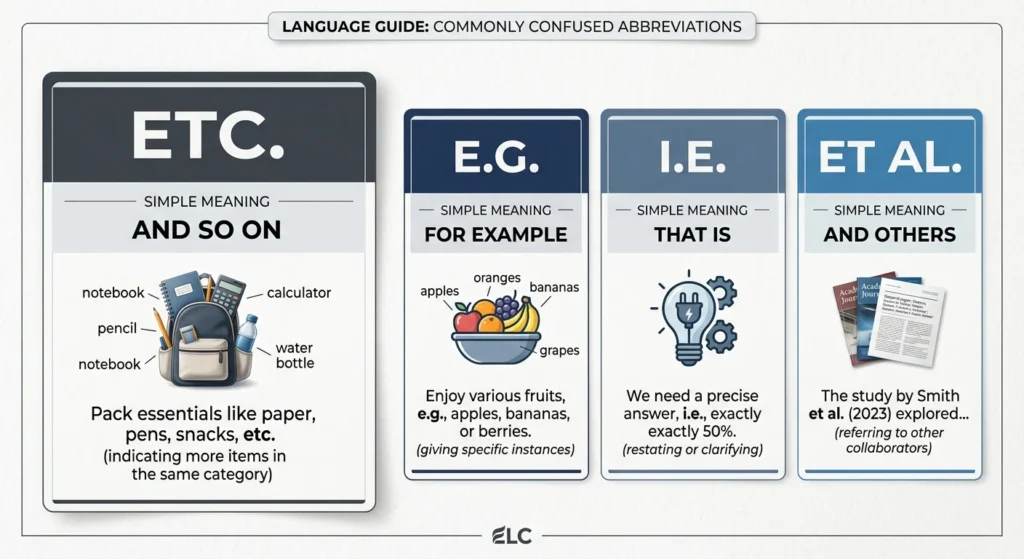
These short forms are easy to confuse, but they do different jobs.
| Abbreviation | Meaning | Main use | Example |
|---|---|---|---|
| etc. | and so on | Shows a list continues | Pens, paper, folders, etc. |
| e.g. | for example | Gives examples | Fruits, e.g., apples and oranges |
| i.e. | that is | Restates or clarifies | The final day, i.e., Friday |
| et al. | and others | Usually refers to people/authors | Smith et al. |
Etc. vs E.g.
Use etc. when you are continuing a list:
We sell pens, pencils, notebooks, etc.
Use e.g. when you are giving examples:
We sell office supplies, e.g., pens and notebooks.
A simple memory rule is:
e.g. = example given
etc. = the list continues
Etc. vs I.e.
I.e. means “that is” or “in other words.”
Example:
I work on weekdays, i.e., Monday through Friday.
Etc. means the list continues.
Example:
I work on Monday, Tuesday, Wednesday, etc.
Etc. vs Et Al.
Et al. is generally used for people or authors, especially in academic references.
Etc. is used for things, ideas, activities, and similar items.
Compare:
The study was written by Smith, Jones, et al.
with:
The study discusses grammar, spelling, punctuation, etc.
Do not use these abbreviations as if they mean the same thing.
How to Use Etc. in Formal Writing
Etc. can appear in formal writing, but it should be used carefully.
The main problem is not that the abbreviation is automatically “wrong” or “unprofessional.” The issue is vagueness.
For example:
The report discusses costs, risks, benefits, etc.
The reader may wonder what else is included.
A clearer sentence could be:
The report discusses costs, risks, benefits, and long-term effects.
In Academic Writing
Use etc. only when the omitted items are obvious and unimportant to the argument.
If the exact categories matter, name them.
In Business Writing
Use etc. when the reader understands the category.
For example:
The package includes training materials, worksheets, examples, etc.
But if the package contents affect a purchase or agreement, give the complete list.
In Legal or Official Writing
Specific wording is usually better when the exact items matter.
Instead of:
The applicant must provide identification, records, documents, etc.
give the exact requirements.
In Casual Writing
Etc. is very natural.
For example:
I spend my weekends reading, watching movies, cooking, etc.
Etc or Ect in Everyday Examples
In an Email
Please bring your laptop, charger, notebook, etc.
In a School Assignment
The main parts of speech include nouns, verbs, adjectives, adverbs, etc.
In a Business Report
The project involves planning, testing, training, maintenance, etc.
In News Writing
The event included speeches, interviews, performances, etc.
In Social Media
I love books about history, travel, science, etc.
In a Website Article
Common writing problems include spelling, grammar, punctuation, word choice, etc.
In Formal Instructions
Instead of:
Bring the required documents, etc.
write:
Bring your passport copy, completed form, photographs, and proof of address.
The second sentence is better because the reader needs exact instructions.
Etc. with Commas and Punctuation
Punctuation after etc. can vary by style and sentence structure, but the main idea is simple.
When etc. appears as part of a sentence, make sure the surrounding punctuation is clear.
For example:
We need paper, pens, folders, etc. for the office.
In some style systems, a comma may appear after etc. when the sentence continues:
We need paper, pens, folders, etc., for the office.
Other modern style approaches may omit that second comma.
For general website writing, the most important rules are:
- Spell it etc.
- Use a period after etc
- Do not write ect.
- Do not write etc..
- Do not add and before etc. unnecessarily
- Follow your required style guide if you are writing for a specific publication
Etc or Ect – Comparison Table
| Form | Correct? | Meaning | Best use |
|---|---|---|---|
| etc. | ✅ Correct | and so on | Continuing a list |
| ect. | ❌ Incorrect | Common spelling error | Do not use for et cetera |
| et cetera | ✅ Correct | and the rest | Full expression |
| etcetera | ✅ Correct | et cetera | One-word form |
| etc | ⚠️ Style-dependent | Abbreviation | Follow the required style |
| and etc. | ❌ Avoid | Redundant | Use etc. alone |
| e.g. | ✅ Correct | for example | Giving examples |
| i.e. | ✅ Correct | that is | Clarifying |
| et al. | ✅ Correct | and others | Usually people/authors |
Etc or Ect – Google Trends & Usage Data
The search phrase “etc or ect” reflects a spelling-choice question rather than a difference between two accepted English spellings.
People searching this phrase may be asking:
- Is it etc or ect?
- Is ect correct?
- What does etc. mean?
- How do you spell et cetera?
- Does etc. need a period?
- Can I use etc. in formal writing?
- What is the difference between etc. and e.g.?
What Search Data Can and Cannot Tell You
Search interest can show that people are confused about the two forms, but a search for ect does not mean that ect is an accepted spelling.
People often search for an incorrect spelling precisely because they want to check it.
So:
Search frequency does not determine spelling correctness.
For this topic, the most useful search-intent signals are the questions people ask around the term.
Usage by English Variety
The spelling etc. is used across major varieties of English, including:
- American English
- British English
- Canadian English
- Australian English
- New Zealand English
- Indian English
The key difference is not the spelling. Instead, writers may differ in how often they use etc., especially in formal or academic writing.
Search Intent by Context
| Search intent | What the reader wants |
|---|---|
| etc or ect | Correct spelling |
| etc meaning | Definition |
| et cetera meaning | Meaning of the full phrase |
| etc punctuation | Period and comma rules |
| etc vs e.g. | Difference between abbreviations |
| etc in formal writing | Professional usage advice |
| how to spell etcetera | Correct spelling of the full form |
This makes the topic useful for both quick spelling searches and broader English-usage searches.
A Simple Rule for Remembering Etc.
If you remember only one thing, remember this:
ET CETERA → ETC.
The first letters are:
ET + C
So:
etc.
not:
ect.
You can also remember the meaning:
etc. = and so on
Example:
Apples, oranges, bananas, etc.
If the list continues with similar items, etc. can signal that continuation.
Frequently Asked Questions
1. Is it etc or ect?
Etc. is correct when you mean et cetera. Ect. is a common misspelling.
2. What does etc. mean?
Etc. means “and so on,” “and other things,” or “and the rest.” It shows that a list is not complete.
3. Is ect. ever correct?
Ect. is not the standard abbreviation for et cetera. However, ECT may be a separate acronym in a specialized context. That does not make ect. a spelling of et cetera.
4. Is etc. British or American?
Etc. is used in both British and American English. It is not a US-versus-UK spelling difference.
5. Does etc. need a period?
The traditional abbreviation is etc., with a period. Specific style guides may have their own abbreviation rules.
6. Can I write “and etc.”?
It is best to avoid and etc. because etc. already carries the idea of “and other things.”
Write:
Pens, paper, folders, etc.
7. Is “et cetera” the same as “etc.”?
Yes. Etc. is the abbreviation of et cetera.
8. Is “etcetera” correct?
Yes. Etcetera is an accepted one-word form. Et cetera is the traditional two-word form, and etc. is its common abbreviation.
9. What is the difference between etc. and e.g.?
Etc. means “and so on.” E.g. means “for example.”
Bring fruit, e.g., apples and oranges.
Bring apples, oranges, bananas, etc.
10. What is the difference between etc. and et al.?
Etc. means “and other things” and is used to continue a list. Et al. means “and others” and is commonly used for people or authors.
11. Can I use etc. in formal writing?
Yes, but use it carefully. If exact information matters, give the complete list instead. In very formal writing, a specific description can often be clearer than etc.
12. How can I remember the correct spelling?
Remember:
ET CETERA = ETC.
The T comes before the C, so the abbreviation is etc., not ect.
Conclusion
When choosing between etc or ect, the correct form is etc. when you mean et cetera. It means “and so on,” “and other things,” or “and the rest.” The form ect. is a common spelling mistake, not a British or American alternative.
The easiest way to remember the spelling is to look at the original phrase: et cetera. Its letters give us etc. The T comes before the C, so never reverse them.
The same basic spelling is used in American, British, Canadian, Australian, New Zealand, and Indian English. What can change is the style advice around how often etc. should be used, especially in formal writing.
Use etc. when a list clearly continues and the missing items are not important to name. Avoid it when readers need exact information. Also remember the difference between etc., e.g., i.e., and et al.
So, if you are ever unsure, use this simple rule:
Et cetera → etc. → and so on.
That one connection will help you avoid the ect. mistake every time.

Elias Worden is a trusted grammar expert and writing mentor, dedicated to simplifying English rules and helping learners write with clarity, precision, and confidence.