
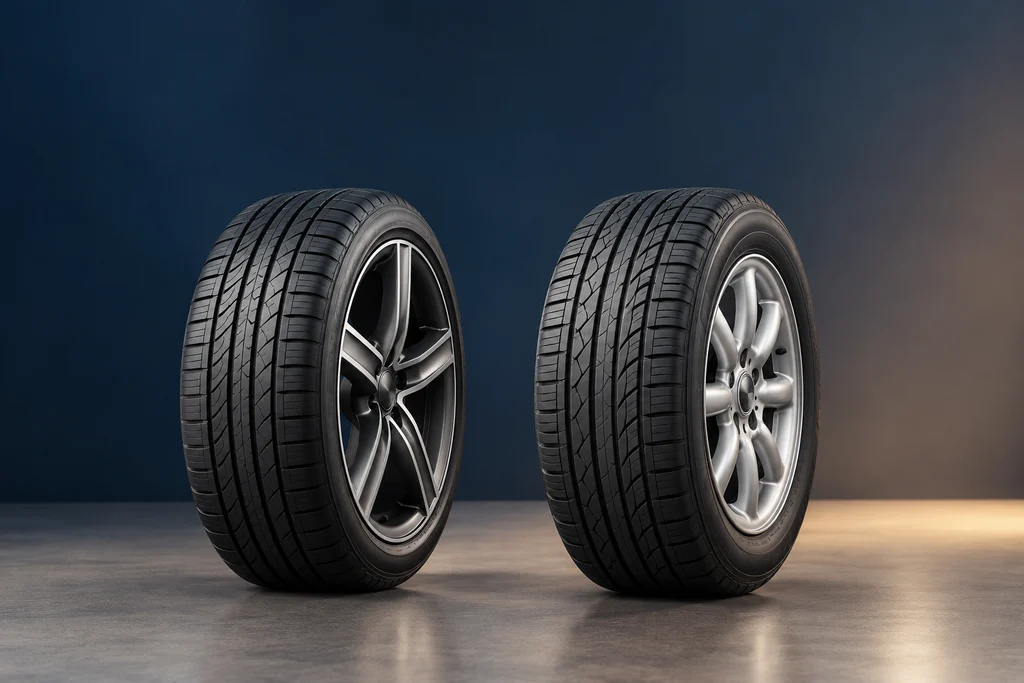
Is it tire or tyre? If you have seen both spellings, you may wonder whether one is wrong. Both are correct: tire is the standard American English spelling, while tyre is the standard British English spelling for the rubber covering on a vehicle’s wheel. For example, an American driver might write, “I need a new car tire,” while a British driver would write, “I need a new car tyre.” The two spellings have the same meaning and are pronounced the same way in this context.
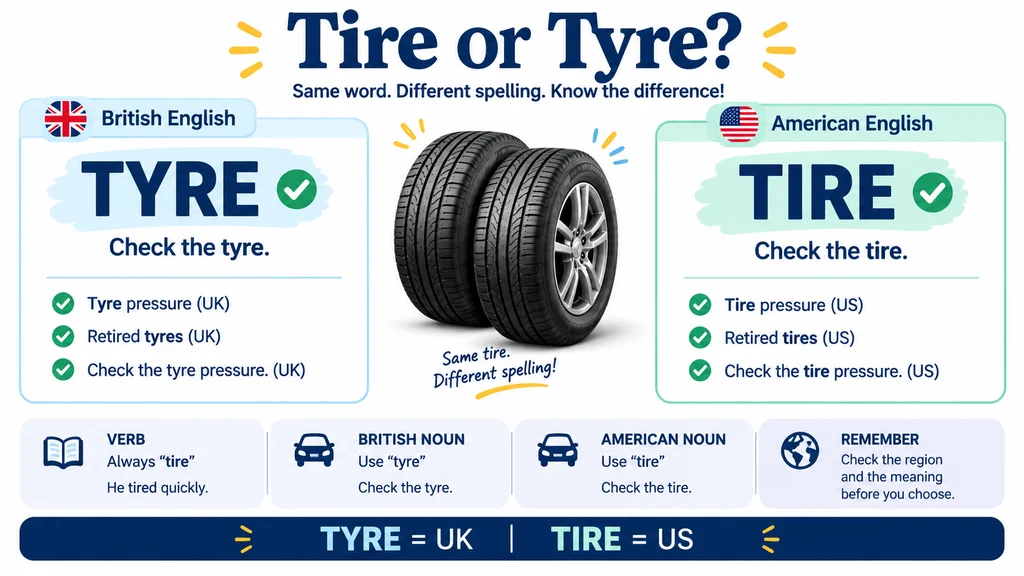
Here’s a simple way to remember the difference: US English uses tire; British English uses tyre. There is one more detail to know: tire is also a verb meaning to become tired or to make someone feel tired. This spelling remains tire in both American and British English, as in “Long journeys tire me.” In this guide, you’ll learn when to use tire or tyre, explore the differences between American and British spelling, and see practical examples to help you choose the appropriate form for your audience.
Tire or Tyre – Main Difference
‘Tire’ is the American spelling for the wheel’s rubber ring — and everywhere, the verb meaning to grow weary. ‘Tyre’ is the British English spelling of the noun for the wheel’s rubber ring only. Simple rule: Region and context decide — check both before you choose.
Two quick examples: “Check the tire pressure. (US)” and “Check the tyre pressure. (UK)”.
Memory trick: British wheels wear ‘tyres’ with a ‘y.’ American wheels wear ‘tires’ with an ‘i.’ Tired people are always ‘tired.’
One-line definitions:
- Tire: the American spelling for the wheel’s rubber ring — and everywhere, the verb meaning to grow weary.
- Tyre: the British English spelling of the noun for the wheel’s rubber ring only.
The Origin of Tire or Tyre
The Shared Root
Both forms grew from the same root word. Both come from ‘attire’ — the wheel’s clothing. British English kept the ‘y’ spelling for the noun.
America changed it to ‘i.’ The verb ‘tire’ (to weary) is spelled with ‘i’ everywhere. Only the rubber ring splits by region.
The word crossed from French into English twice — once early, once late — and each crossing left its own spelling behind.
How Region Split the Spelling
Region — not meaning — is what divided them. Cars are global. American movies show ‘tires’; British shows say ‘tyres.’ The verb is always ‘tire,’ which muddies the noun rule. Auto writing mixes them constantly.
Global publishing now mixes the forms constantly, but the regional standards underneath have not moved. The map is stable even when the territory looks messy.
Why the Confusion Continues
Global media keeps shuffling the two forms together. A reader in London sees tire on an American site; a reader in New York sees tyre in a British novel. The overlap is permanent now — only the regional rule brings order.
Reference books now routinely note both forms with their regions. The pair has become a small case study in how English varies — and how to navigate that variation.
British English vs American English Spelling
This pair is genuinely split by region — but not in a simple way. The table below maps which form belongs where, so you can match your spelling to your reader.
How Each Region Spells It
Tire is the standard American form across most uses. Tyre is the standard British form for the same uses. But each has exceptions — fixed phrases and technical senses where the ‘other’ spelling appears worldwide. Once you know the regional rule, the choice becomes automatic.
Examples in Context
A London office and a New York office would spell the same memo differently. The examples below show each form where it belongs. Notice how the sentence’s meaning stays identical — only the letters change.
For example: “New tires. (US)” and “The tire blew. (US)”.
| Feature | Tire | Tyre |
|---|---|---|
| Main region | American | British |
| Meaning | ‘Tire’ is the American spelling for the wheel’s rubber ring — and everywhere, the verb meaning to grow weary | ‘Tyre’ is the British English spelling of the noun for the wheel’s rubber ring only |
| Example | Check the tire pressure. (US) | Check the tyre pressure. (UK) |
The table maps a genuinely tangled pair. Check your region, check your meaning, and read across — the answer is there.
Which Spelling Should You Use?
This pair needs two checks: region first, then meaning. The four situations below walk through both, so you always land on the right form.
1. For American English
Default to tire for American readers. It is the standard US form across most uses. The exceptions are fixed phrases — noted above — where the other spelling appears even in America.
When unsure, tire is the safer American default.
2. For British and Commonwealth English
Default to tyre for British and Commonwealth readers. It is the standard UK form for the same uses. Again, watch for the fixed phrases where tire crosses over.
When unsure, tyre is the safer British default.
3. For Formal and Professional Writing
Formal writing demands the regionally correct form plus the right meaning. Check both: is this the region’s spelling, and is this the right sense? Two checks, ten seconds, zero errors.
Legal and medical writing are strictest about the regional form.
4. For a Global Audience
For a worldwide audience, choose the region of your primary readers and add a style note if needed. Consistency within the document matters more than which regional form you pick. A one-line style note prevents all confusion for global teams.
Try and or. Try to: Which Is Correct and When?
Common Mistakes with Tire or Tyre
Most tire/tyre errors fall into a few repeat patterns. Each mistake below shows the wrong version, the corrected version, and why the fix works. Scan for the one you make.
Mistake 1: “In British English: check the tire.”
Wrong: In British English: check the tire.
Correct: In British English: check the tyre.
British noun: tyre.
Mistake 2: “In American English: check the tyre.”
Wrong: In American English: check the tyre.
Correct: In American English: check the tire.
American noun: tire.
Mistake 3: “He tyred quickly.”
Wrong: He tyred quickly.
Correct: He tired quickly.
The verb is always ‘tire.’
Mistake 4: “Tyre pressure (US).”
Wrong: Tyre pressure (US).
Correct: Tire pressure (US).
American auto writing: tire.
Mistake 5: “Retired tyres (US).”
Wrong: Retired tyres (US).
Correct: Retired tires (US).
Keep the region’s spelling.
Mistake 6: “I am tyred.”
Wrong: I am tyred.
Correct: I am tired.
Weary is always ‘tired.’
Mistake 7: “Check the tyre pressure. (US)”
Wrong: Check the tyre pressure. (US)
Correct: Check the tire pressure. (US)
In this context the correct form is ‘tire’. Check region and meaning before choosing.
Mistake 8: “Check the tire pressure. (UK)”
Wrong: Check the tire pressure. (UK)
Correct: Check the tyre pressure. (UK)
In this context the correct form is ‘tyre’. Check region and meaning before choosing.
Tire or Tyre in Everyday Examples
Seeing the pair in real contexts locks in the difference. Here are natural examples from six parts of life.
In Emails
- In American English: check the tire.
- He tired quickly.
- Tire pressure (US).
In News Articles
- Retired tires (US).
- I am tired.
On Social Media
- Check the tire pressure. (US)
- A flat tire. (US)
- New tires. (US)
In Formal Writing
- The tire blew. (US)
- Check the tyre pressure. (UK)
In Text Messages
- A flat tyre. (UK)
- New tyres. (UK)
- The tyre blew. (UK)
In Academic Writing
- In British English: check the tyre.
- In American English: check the tire.
Tire or Tyre – Google Trends & Usage Data
Searches for tire versus tyre come from two different confusions at once: region and meaning. The qualitative pattern reflects that double doubt.
What People Actually Search
Queries split between “which spelling” (region) and “what’s the difference” (meaning). Many searchers do not know which question they are asking — they just know the pair feels tricky. Good answers address both doubts.
Regional Interest
Tire draws searches from American-dominated contexts; tyre from British-dominated ones. But crossover searches are common — Americans encountering tyre in books, Brits encountering tire online. Global media guarantees the mix.
How Usage Is Changing
The regional lines are holding, but awareness of both forms is rising fast. More writers now check which form fits their audience instead of assuming. That single habit — checking — is the real trend, and it favors careful writers.
Bottom line: two confusions in one pair means double the searches. Answer the region question first and the meaning question second, and both doubts disappear together.
To vs. Too: Meaning, Grammar Rules, and Examples
Tire or Tyre: Side-by-Side Comparison
One last look at tire and tyre, side by side. Find your situation in the left column, then read across.
| Feature | Tire | Tyre |
|---|---|---|
| Meaning | ‘Tire’ is the American spelling for the wheel’s rubber ring — and everywhere, the verb meaning to grow weary | ‘Tyre’ is the British English spelling of the noun for the wheel’s rubber ring only |
| Status | Mainly American | Mainly British |
| Example | Check the tire pressure. (US) | Check the tyre pressure. (UK) |
FAQs About Tire or Tyre
1. What is the difference between tire and tyre?
‘Tire’ is the American spelling for the wheel’s rubber ring — and everywhere, the verb meaning to grow weary. ‘Tyre’ is the British English spelling of the noun for the wheel’s rubber ring only. In short: they are two separate words with two separate jobs. Mixing them changes your meaning, so learn the distinction once and use it forever.
2. Which is correct: tire or tyre?
Both are correct in their own contexts. Region and meaning decide: ‘Tire’ is the American spelling for the wheel’s rubber ring — and everywhere, the verb meaning to grow weary. ‘Tyre’ is the British English spelling of the noun for the wheel’s rubber ring only.
Check both before you choose. It is a small rule with a big payoff in clear writing.
3. How can I remember the difference between tire and tyre?
British wheels wear ‘tyres’ with a ‘y.’ American wheels wear ‘tires’ with an ‘i.’ Tired people are always ‘tired.’ Say it to yourself each time you hesitate. After a few uses, the right choice becomes automatic — tricks work because they attach the rule to something vivid.
4. Why do people confuse tire and tyre?
Cars are global. American movies show ‘tires’; British shows say ‘tyres.’ The verb is always ‘tire,’ which muddies the noun rule. Auto writing mixes them constantly.
The confusion is so common that it has its own search traffic — you are far from alone. The fix is a single clear rule, which this guide gives you.
5. Can I use tire and tyre interchangeably?
Sometimes — in the senses where region is the only difference. But where the meanings split, they are not interchangeable. Check whether your use is the regional one or the meaning one. File it with the small rules that make writing sharp.
6. What is the most common mistake with tire and tyre?
Writing “In British English: check the tire.” when the correct form is “In British English: check the tyre..” British noun: tyre. This single error accounts for a large share of all tire/tyre mix-ups.
7. Will spellcheck catch the tire/tyre mistake?
No — and that is exactly why this pair is dangerous. Both tire and tyre are valid words, so no spellchecker will flag the swap. Only your knowledge of the difference catches it.
8. Which is more commonly used: tire or tyre?
They serve different purposes, so frequency comparisons mislead. Each is common in its own context and rare outside it. What matters is not which is popular but which is right for your sentence. A two-second check here prevents a lasting wrong impression.
9. Which form should I use in American English?
Default to tire — it is the standard American form for most uses. Learn the fixed phrases where tyre appears even in America, and you will be fully covered.
10. Which form should I use in British English?
Default to tyre — it is the standard British form for the same uses. As in America, a few fixed phrases keep the other spelling, so check the exceptions.
11. Does the meaning change with the spelling?
Sometimes. In some uses the two forms are pure regional variants with identical meaning. In others, each form carries its own sense. The sections above map exactly which is which.
12. Which form do international organizations use?
They pick one and declare it. Most international bodies follow either American or British style consistently. Check the organization’s style guide — the answer is always written down somewhere. It is a small rule with a big payoff in clear writing.
Conclusion: Tire or Tyre
Clear writing is built from small correct choices, and tire versus tyre is one of the most-searched choices in English. ‘Tire’ is the American spelling for the wheel’s rubber ring — and everywhere, the verb meaning to grow weary. ‘Tyre’ is the British English spelling of the noun for the wheel’s rubber ring only. Hold those two facts apart and the pair stops being scary.
Remember the simple version: Region and context decide — check both before you choose. When you are in a hurry, that one line is enough. When you have time, the meaning test behind it never fails. Simple rules beat long explanations at the moment of writing, which is when you need them most.
Going forward, treat this pair as a solved problem. You have the history, the rule, the trick, and the examples. All that remains is practice — and every correct use writes the rule a little deeper into memory.
If you remember nothing else, remember this: Region and context decide — check both before you choose. That single sentence covers nearly every real-world case. And the next time tire and tyre make you pause mid-sentence, you will know exactly what to do.

Sophia Langley is an English grammar specialist and writing coach, passionate about simplifying language rules and empowering learners to write with clarity and confidence.
Pingback: There vs. Their: How to Tell Them Apart
Pingback: Then vs. Than: Time or Comparison?