
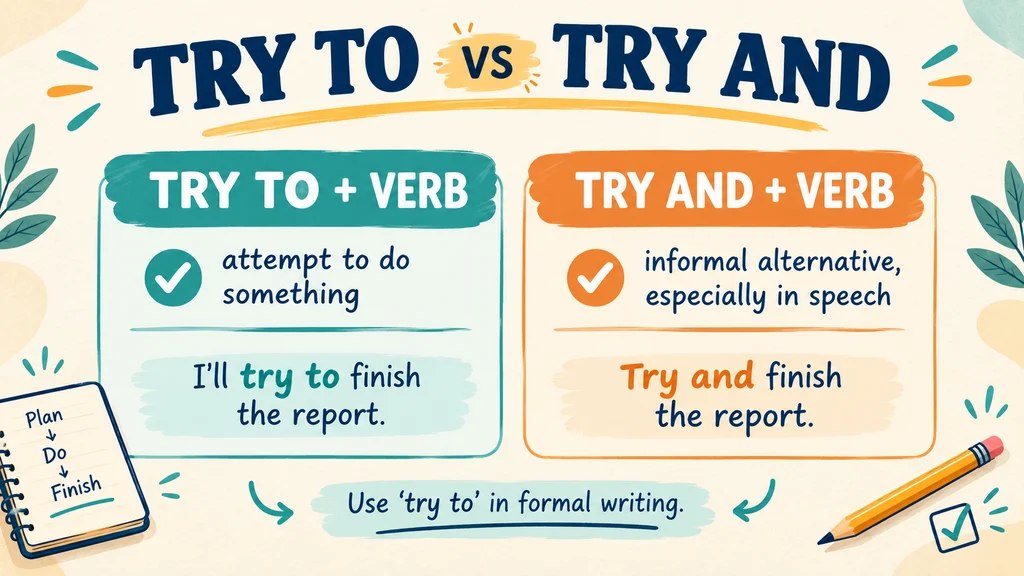
Both try and and try to can sound correct, so how do you know which one to use? The answer depends on the sentence and the style of writing. “Try to” is the standard, versatile choice for expressing an effort to do something, while “try and” is also an established English expression, especially in conversational language.
For example, “I’ll try to call you” and “I’ll try and call you” can communicate the same intention. However, the two constructions do not fit every grammatical situation in exactly the same way.
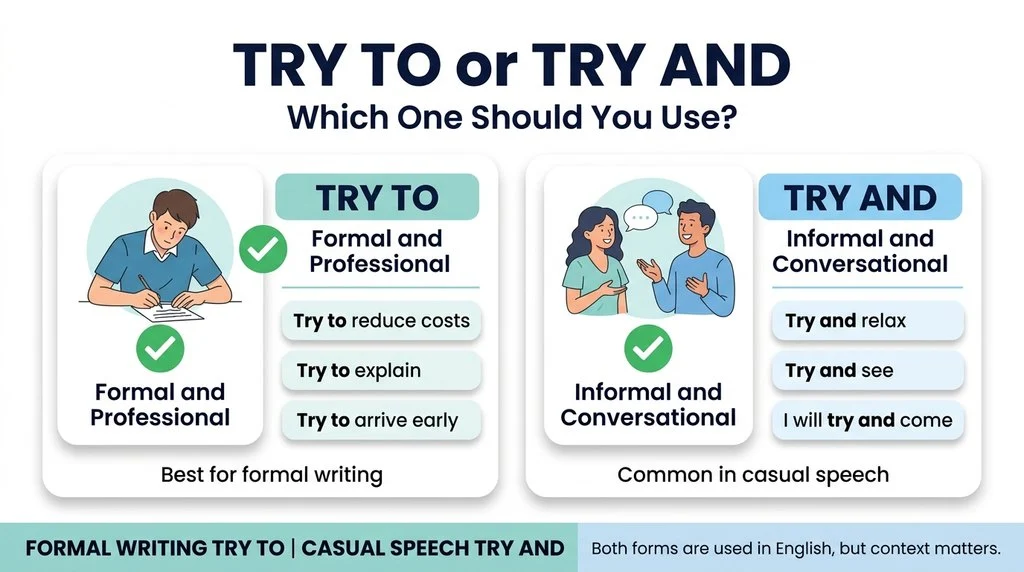
If you want a simple rule, choose try to in formal writing, academic assignments, and situations where you want the clearest grammatical construction. You can use try and naturally in many everyday conversations, such as “Try and get some rest.” In this guide, you’ll learn the difference between try and and try to, discover when each expression works, and explore practical examples that help you avoid confusing or awkward sentences.
Try to or Try and – Main Difference
‘Try to’ is the standard form — try to do something. ‘Try and’ is the informal spoken form — common in speech, discouraged in formal writing. Simple rule: Follow the rule, not your ear — the sentence decides which form is correct. Identify the word’s job in your sentence first — the rule then applies itself.
Two quick examples: “Try to arrive early.” and “Try and see. (informal)”.
Memory trick: In formal writing, always ‘try to.’ Save ‘try and’ for dialogue and casual speech.
One-line definitions:
- Try to: the standard form — try to do something.
- Try and: the informal spoken form — common in speech, discouraged in formal writing.
The Origin of Try to or Try and
Where the Rule Comes From
The rule behind this pair is older than most people guess. ‘Try and’ is centuries old in speech — Shakespeare used it. It pairs two verbs as if both will happen.
‘Try to’ marks the purpose clearly: the trying aims at the doing. Formal style guides prefer ‘try to’ because ‘try and’ can sound like a promise of success.
The rule was first written down by 18th-century grammarians who wanted English to behave like Latin. It stuck because it is genuinely useful.
How the Two Forms Diverged
The two forms then went their separate ways. Everyone says ‘try and’ in conversation. It feels warm and natural. Formal writing demands ‘try to.’ Writers who write like they speak carry the informal form onto the page.
Everyday speech began bending the rule almost immediately. Writing held the line — which is why the rule feels stricter on the page than in the air.
Why the Confusion Continues
Speech ignores this rule almost entirely, which keeps the confusion alive. Writing holds the line, but only where editors enforce it. The gap between spoken habit and written standard is where most errors are born.
Usage panels have debated this rule for decades, but the written standard has barely moved. That stability is good news: learn it once, and it serves for life.
British English vs American English Spelling
The rule itself is the same in American and British English, but strictness differs. American style guides enforce it firmly. British usage is more relaxed in speech, though formal writing on both sides follows the rule.
How Each Region Spells It
Grammar books in both regions teach the same rule. The difference is enforcement: American editors correct violations more aggressively, while British editors tolerate the informal form in casual contexts. Once you know the regional rule, the choice becomes automatic.
Examples in Context
Formal writing in both regions follows the rule; casual speech in both regions bends it. The examples below show the careful version — the one safe for exams and work. In speech the two forms are indistinguishable; only writing reveals the choice.
For example: “Try to understand.” and “She tried to call.”.
| Feature | Try to | Try and |
|---|---|---|
| Use when | ‘Try to’ is the standard form — try to do something | ‘Try and’ is the informal spoken form — common in speech, discouraged in formal writing |
| Register | Standard | Standard |
| Example | Try to arrive early. | Try and see. (informal) |
The table distills the rule to three rows. When the sentence fits the left description, try to is correct; otherwise, try and.
Which Spelling Should You Use?
The rule is the same worldwide; only strictness varies. The four situations below show where you must obey it and where you can relax.
1. For American English
Follow the rule strictly. American style guides enforce this distinction, and American editors correct violations. In the US, the careful form is the expected form.
American exams test this distinction directly.
2. For British and Commonwealth English
British and Commonwealth English teach the same rule, though everyday speech bends it freely. In writing — especially exams and applications — follow it exactly as in America. British exams test it just as directly.
3. For Formal and Professional Writing
Formal writing is where the rule matters most. Essays, reports, and professional emails should all use the careful form. This is the version examiners and hiring managers expect.
Workplace writing follows the strict version without exception.
4. For a Global Audience
Use the careful form for global audiences. Learners and translators rely on the standard rule; the informal variant only confuses them. When in doubt, be strict.
Learners worldwide are taught the strict version first.
Weak or Week: What’s the Difference and How to Use Each
Common Mistakes with Try to or Try and
The same six mix-ups appear in inboxes and essays everywhere. Study each pair — wrong versus right — and the pattern behind it will stick.
Mistake 1: “In a formal report: try and reduce costs.”
Wrong: In a formal report: try and reduce costs.
Correct: In a formal report: try to reduce costs.
Formal writing takes ‘try to.’
Mistake 2: “In an essay: try and explain.”
Wrong: In an essay: try and explain.
Correct: In an essay: try to explain.
Academic writing prefers ‘try to.’
Mistake 3: “Try to relax (casual chat).”
Wrong: Try to relax (casual chat).
Correct: Try and relax is the natural spoken form.
Speech accepts ‘try and.’
Mistake 4: “The manual said try and restart.”
Wrong: The manual said try and restart.
Correct: The manual should say try to restart.
Instructions use ‘try to.’
Mistake 5: “She will try and come (email to boss).”
Wrong: She will try and come (email to boss).
Correct: She will try to come.
Professional emails take ‘try to.’
Mistake 6: “Try and try to in one document.”
Wrong: Try and try to in one document.
Correct: Pick the formal ‘try to’ for edited prose.
Consistency with the register matters.
Mistake 7: “Try and arrive early.”
Wrong: Try and arrive early.
Correct: Try to arrive early.
The rule calls for ‘try to’ in this sentence. ‘try and’ breaks the rule.
Mistake 8: “Try to see. (informal)”
Wrong: Try to see. (informal)
Correct: Try and see. (informal)
The rule calls for ‘try and’ in this sentence. ‘try to’ breaks the rule.
Try to or Try and in Everyday Examples
Seeing the pair in real contexts locks in the difference. Here are natural examples from six parts of life.
In Emails
- Try and see. (informal)
- I’ll try and help. (informal)
- Try and relax. (informal)
In News Articles
- Come and try and win. (informal)
- In a formal report: try to reduce costs.
On Social Media
- In an essay: try to explain.
- Try and relax is the natural spoken form.
- The manual should say try to restart.
In Formal Writing
- She will try to come.
- Pick the formal ‘try to’ for edited prose.
In Text Messages
- Try to arrive early.
- I’ll try to help.
- Try to understand.
At Work
- She tried to call.
- Try and see. (informal)
Try to or Try and – Google Trends & Usage Data
This pair generates evergreen search interest: the rule is short, the habit is strong, and the two keep colliding. Qualitatively, the picture never changes much.
What People Actually Search
Searches ask “try to or try and?” in huge numbers, usually with an example sentence attached. People want a ruling on their specific case, not a lecture. That intent — quick, practical, sentence-level — shapes every good answer.
The Speech-Writing Gap
In speech, almost everyone uses the informal form without noticing. In writing, the careful form is expected. Search data reflects the gap: people speak one way, then check the other way before publishing.
The rule lives in writing, not in talking.
How Usage Is Changing
The informal form keeps spreading in casual writing, following speech. But formal standards are not moving — style guides still prescribe the careful form. The safe strategy is unchanged: strict in writing, relaxed in talking.
Bottom line: the rule is stable and the searches are evergreen. Writers will keep checking their sentences against it — and careful writers will keep getting it right.
Vain vs. Vein: Meaning, Spelling, and Examples
Try to or Try and: Side-by-Side Comparison
One last look at try to and try and, side by side. Find your situation in the left column, then read across.
| Feature | Try to | Try and |
|---|---|---|
| Meaning | ‘Try to’ is the standard form — try to do something | ‘Try and’ is the informal spoken form — common in speech, discouraged in formal writing |
| Status | Standard form | Standard form |
| Example | Try to arrive early. | Try and see. (informal) |
FAQs About Try to or Try and
1. What is the difference between try to and try and?
‘Try to’ is the standard form — try to do something. ‘Try and’ is the informal spoken form — common in speech, discouraged in formal writing. In short: they are two separate words with two separate jobs. Mixing them changes your meaning, so learn the distinction once and use it forever.
2. Which is correct: try to or try and?
It depends on the sentence. ‘Try to’ is the standard form — try to do something. ‘Try and’ is the informal spoken form — common in speech, discouraged in formal writing.
Apply the rule to your sentence and the answer is clear. Once learned, this distinction rarely needs relearning.
3. How can I remember the difference between try to and try and?
In formal writing, always ‘try to.’ Save ‘try and’ for dialogue and casual speech. Say it to yourself each time you hesitate. After a few uses, the right choice becomes automatic — tricks work because they attach the rule to something vivid.
4. Why do people confuse try to and try and?
Everyone says ‘try and’ in conversation. It feels warm and natural. Formal writing demands ‘try to.’ Writers who write like they speak carry the informal form onto the page.
The confusion is so common that it has its own search traffic — you are far from alone. The fix is a single clear rule, which this guide gives you.
5. Can I use try to and try and interchangeably?
No. Try to and try and do different jobs, and swapping them changes the meaning — sometimes to the exact opposite. Treat them as two separate words that happen to sound alike. Once learned, this distinction rarely needs relearning.
6. What is the most common mistake with try to and try and?
Writing “In a formal report: try and reduce costs.” when the correct form is “In a formal report: try to reduce costs..” Formal writing takes ‘try to.’ This single error accounts for a large share of all try to/try and mix-ups.
7. Will spellcheck catch the try to/try and mistake?
No — and that is exactly why this pair is dangerous. Both try to and try and are valid words, so no spellchecker will flag the swap. Only your knowledge of the difference catches it.
8. Which is more commonly used: try to or try and?
They serve different purposes, so frequency comparisons mislead. Each is common in its own context and rare outside it. What matters is not which is popular but which is right for your sentence. This is exactly the kind of detail careful readers notice.
9. Is try and wrong or just informal?
It depends on the sentence. Where the rule calls for try to, using try and is an error in formal writing — though it may pass unnoticed in casual speech. In exams and professional writing, treat the rule as strict.
10. Do native speakers follow this rule?
In careful writing, yes. In everyday speech, often no — the informal form is everywhere. That split is exactly why the rule is worth learning: writing is where it counts.
11. What happens if I mix them up?
Usually nothing terrible — readers understand you. But in exams, applications, and professional writing, the error signals carelessness. The fix takes seconds; the impression lasts.
12. Is the try to/try and rule taught in schools?
Yes — it is a standard exam topic in both American and British schools. Tests love it precisely because speech ignores it. Students who learn the written rule gain easy marks. This is exactly the kind of detail careful readers notice.
Conclusion: Try to or Try and
Clear writing is built from small correct choices, and try to versus try and is one of the most-searched choices in English. ‘Try to’ is the standard form — try to do something. ‘Try and’ is the informal spoken form — common in speech, discouraged in formal writing. Hold those two facts apart and the pair stops being scary.
Remember the simple version: Follow the rule, not your ear — the sentence decides which form is correct. When you are in a hurry, that one line is enough. When you have time, the meaning test behind it never fails. Simple rules beat long explanations at the moment of writing, which is when you need them most.
Going forward, treat this pair as a solved problem. You have the history, the rule, the trick, and the examples. All that remains is practice — and every correct use writes the rule a little deeper into memory.
If you remember nothing else, remember this: Follow the rule, not your ear — the sentence decides which form is correct. That single sentence covers nearly every real-world case. And the next time try to and try and make you pause mid-sentence, you will know exactly what to do.

Amelia Script is a dedicated grammar specialist and language mentor, simplifying English rules, refining writing skills, and helping learners communicate with clarity and confidence.
Pingback: Tire Or Tyre: The Spelling Difference Explained
Pingback: To Or Too: Meaning, Grammar Rules, and Examples