
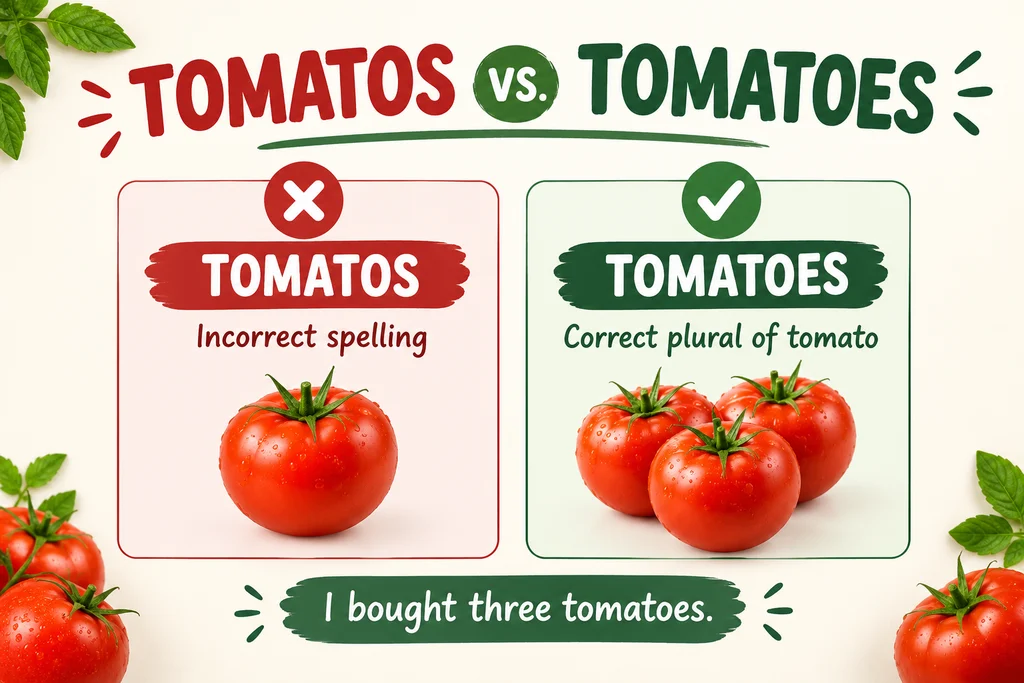
Should you write tomatoes or tomatos? Tomatoes is the correct plural spelling of tomato in standard English, while tomatos is considered a spelling mistake. For example, “I bought six tomatoes” is correct, but “I bought six tomatos” is not.
The confusion comes from English plural spelling rules. Many nouns ending in -o add -es to form the plural, as in tomato → tomatoes, potato → potatoes, and hero → heroes. However, other words take only -s, such as photo → photos and piano → pianos. That is why the ending can be tricky to remember.
The easiest way to get it right is to remember that the plural of tomato is always tomatoes in standard English. In this guide, you’ll learn why this spelling is correct, understand how nouns ending in -o form plurals, compare tomatoes with similar words, and avoid common spelling mistakes in everyday writing, schoolwork, and English assignments.
Tomatoes or Tomatos – Main Difference
‘Tomatoes’ is the correct plural of ‘tomato’. ‘Tomatos’ is a misspelling. It is not an accepted plural. Simple rule: Only the correct spelling belongs in finished writing. There are no exceptions and no regional variants: tomatoes is the spelling in every country.
Two quick examples: “Fresh tomatoes.” and “Slice the tomatoes.”.
Memory trick: Think ‘potatoes’ — ‘tomatoes’ belongs to that family. Consonant + ‘o’ adds ‘-es.’
One-line definitions:
- Tomatoes: the correct plural of ‘tomato’.
- Tomatos: a misspelling.
The Origin of Tomatoes or Tomatos
Where the Correct Spelling Comes From
The correct spelling has a clear, traceable history. ‘Tomato’ came to English from Spanish in the 1600s. Like ‘potato’ to ‘potatoes,’ words ending in a consonant plus ‘o’ add ‘-es’: tomato to tomatoes.
‘Tomatos’ drops the ‘e’ the pattern requires.
The correct form appears in the earliest English dictionaries with its modern spelling. The error is newer — a product of fast, informal writing.
Where the Misspelling Comes From
The wrong spelling has its own story too. The ‘o’ to ‘oes’ rule has exceptions (pianos), so writers hesitate. ‘Tomatos’ looks simpler. But ‘tomato’ is a core word that keeps the ‘-es.’
The misspelling spreads the way rumors do: each uncorrected sighting makes the next writer a little surer. Dictionaries, however, have never wavered.
Why the Error Persists
The error spreads because tomatos looks plausible and sounds identical to tomatoes. Every uncorrected instance teaches the next writer. Breaking the cycle takes one conscious check — which this guide just gave you.
Teachers report this error in every generation of students. Each generation also learns the correction — which is why the right spelling endures while the wrong one never advances.
British English vs American English Spelling
Neither region accepts tomatos. This is not an American-versus-British question at all — tomatoes is the only correct spelling in every English-speaking country. The table makes the status of each form unmistakable.
How Each Region Spells It
Every major dictionary, in every region, lists tomatoes as the headword. tomatos appears nowhere as an accepted variant. Autocorrect in both American and British English flags it. Style guides in each region confirm this without exception.
Examples in Context
In finished writing — essays, emails, reports — only tomatoes appears, in every country. tomatos shows up in drafts, texts, and comments, where it reads as a typo to every reader. The context decides everything here, exactly as the table shows.
For example: “Cherry tomatoes.” and “The tomatoes ripened.”.
| Feature | Correct | Incorrect |
|---|---|---|
| Spelling | Tomatoes | Tomatos |
| Status | Standard everywhere | Not a word |
| Example | Fresh tomatoes. | — |
The table says it plainly: tomatoes is standard everywhere, and tomatos is not a word anywhere. There is nothing more to decide.
Which Spelling Should You Use?
There is exactly one right answer in every situation below: tomatoes. Tomatos is a misspelling in all regions and all registers. The four points explain where the error hurts most.
1. For American English
Use tomatoes. American dictionaries list only this spelling. Tomatos will be flagged by spellcheckers and noticed by readers.
Every American dictionary agrees on this spelling.
2. For British and Commonwealth English
Use tomatoes. British dictionaries agree completely — this is not a regional question. Tomatos is wrong in London exactly as it is wrong in New York.
Every British dictionary agrees on this spelling.
3. For Formal and Professional Writing
Formal writing has zero tolerance for this error. Resumes, essays, and reports with tomatos signal carelessness. Always proofread this word specifically — it is one of the most common typos in English.
Proofread this word last, when your eyes are freshest.
4. For a Global Audience
Use tomatoes for every reader on earth. A global audience includes many careful readers; the correct spelling is the only one all of them accept. Readers in every country recognize tomatoes instantly.
Vain vs. Vein: Meaning, Spelling, and Examples
Common Mistakes with Tomatoes or Tomatos
Errors with tomatoes and tomatos are rarely random. They follow habits. The six classic mistakes below cover nearly every case, each with its correction and a short explanation.
Mistake 1: “Fresh tomatos.”
Wrong: Fresh tomatos.
Correct: Fresh tomatoes.
The plural is ‘tomatoes.’
Mistake 2: “Slice the tomatos.”
Wrong: Slice the tomatos.
Correct: Slice the tomatoes.
‘Tomatos’ is always wrong.
Mistake 3: “Cherry tomatos.”
Wrong: Cherry tomatos.
Correct: Cherry tomatoes.
Add ‘-es’: tomatoes.
Mistake 4: “He grows tomatos.”
Wrong: He grows tomatos.
Correct: He grows tomatoes.
Follow the potato pattern.
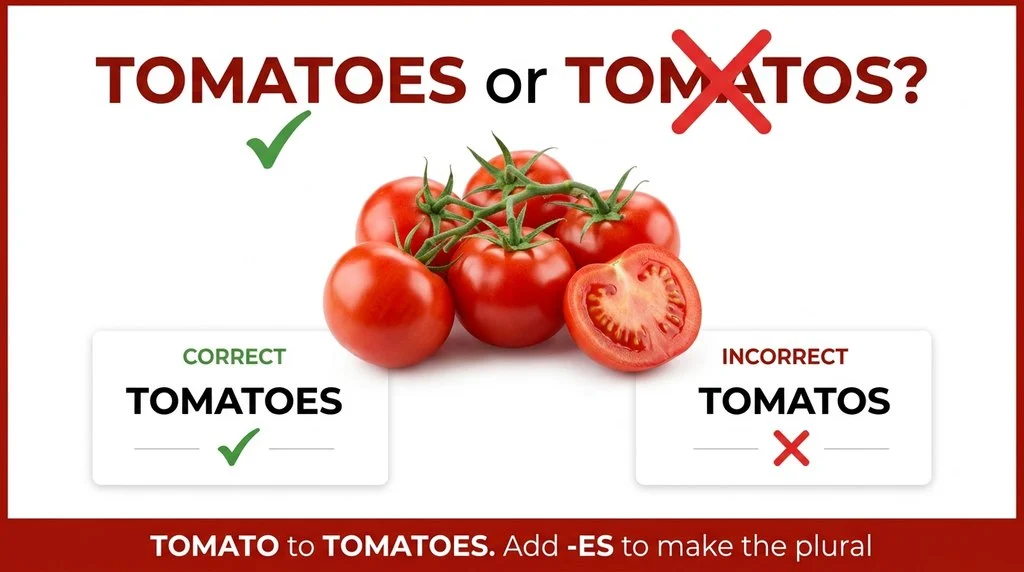
Mistake 5: “Sun-dried tomatos.”
Wrong: Sun-dried tomatos.
Correct: Sun-dried tomatoes.
Consonant + ‘o’ takes ‘-es.’
Mistake 6: “The tomatos ripened.”
Wrong: The tomatos ripened.
Correct: The tomatoes ripened.
The ‘e’ never drops.
Mistake 7: “Tomato sauce uses tomatos.”
Wrong: Tomato sauce uses tomatos.
Correct: Tomato sauce uses tomatoes.
‘tomatos’ is not an accepted spelling. The correct form is ‘tomatoes’ — in every region and every register.
Mistake 8: “Ripe tomatos.”
Wrong: Ripe tomatos.
Correct: Ripe tomatoes.
‘tomatos’ is not an accepted spelling. The correct form is ‘tomatoes’ — in every region and every register.
Tomatoes or Tomatos in Everyday Examples
Seeing the pair in real contexts locks in the difference. Here are natural examples from six parts of life.
In Emails
- Fresh tomatoes.
- Slice the tomatoes.
- Cherry tomatoes.
In News Articles
- The tomatoes ripened.
- Sun-dried tomatoes.
On Social Media
- Tomato sauce uses tomatoes.
- He grows tomatoes.
- Ripe tomatoes.
In Formal Writing
- Fresh tomatoes.
- Slice the tomatoes.
In Job Applications
- Cherry tomatoes.
- He grows tomatoes.
- Sun-dried tomatoes.
In Customer Service Chats
- The tomatoes ripened.
- Fresh tomatoes.
Try and or. Try to: Which Is Correct and When?
Tomatoes or Tomatos – Google Trends & Usage Data
The search pattern for a misspelling is distinctive: people check whether the wrong form might actually be right. The qualitative picture is consistent across all such pairs.
Which Form People Search More
The correct tomatoes gets steady, confident searches. Tomatos gets anxious ones — “is tomatos a word?” is the classic query. That anxiety is well placed: every dictionary says no.
Searches for the misspelling peak during exam seasons.
Where the Error Appears Most
The misspelling appears wherever people write fast: comments, texts, forums, and first drafts. It shows no regional pattern — it is equally common in American and British writing. Formal published text, by contrast, almost never contains it.
How Usage Is Changing
Spellcheckers are slowly driving the error down in edited writing. But informal spaces keep it alive, because no one proofreads a text message. The long-term trend favors tomatoes — correctness compounds as each corrected writer stops spreading the error.
Bottom line: every “is tomatos a word?” search ends the same way — with tomatoes. The sooner that answer becomes reflex, the sooner the searches stop.
Tomatoes or Tomatos: Side-by-Side Comparison
One last look at tomatoes and tomatos, side by side. Find your situation in the left column, then read across.
| Feature | Tomatoes | Tomatos |
|---|---|---|
| Meaning | ‘Tomatoes’ is the correct plural of ‘tomato’ | ‘Tomatos’ is a misspelling |
| Status | Correct | Misspelling |
| Example | Fresh tomatoes. | — |
FAQs About Tomatoes or Tomatos
1. What is the difference between tomatoes and tomatos?
‘Tomatoes’ is the correct plural of ‘tomato’. ‘Tomatos’ is a misspelling. It is not an accepted plural.
In short: they are two separate words with two separate jobs. Mixing them changes your meaning, so learn the distinction once and use it forever.
2. Which is correct: tomatoes or tomatos?
Tomatoes is correct. Tomatos is a misspelling and is not accepted in any dictionary. If you see tomatos in print, it is an error — use tomatoes in its place. Once learned, this distinction rarely needs relearning.
3. How can I remember the difference between tomatoes and tomatos?
Think ‘potatoes’ — ‘tomatoes’ belongs to that family. Consonant + ‘o’ adds ‘-es.’ Say it to yourself each time you hesitate. After a few uses, the right choice becomes automatic — tricks work because they attach the rule to something vivid.
4. Why do people confuse tomatoes and tomatos?
The ‘o’ to ‘oes’ rule has exceptions (pianos), so writers hesitate. ‘Tomatos’ looks simpler. But ‘tomato’ is a core word that keeps the ‘-es.’ The confusion is so common that it has its own search traffic — you are far from alone. The fix is a single clear rule, which this guide gives you.
5. Can I use tomatoes and tomatos interchangeably?
No. Tomatos is not an accepted variant, so it can never substitute for tomatoes. Readers will read it as a typo.
Always write tomatoes. Keep this answer handy for the next time you hesitate.
6. What is the most common mistake with tomatoes and tomatos?
Writing “Fresh tomatos.” when the correct form is “Fresh tomatoes..” The plural is ‘tomatoes.’ This single error accounts for a large share of all tomatoes/tomatos mix-ups.
7. Will spellcheck catch the tomatoes/tomatos mistake?
Usually, yes — tomatos is not in dictionaries, so most spellcheckers underline it. But do not rely on that: in some apps and phones, learned words slip through. Know the correct spelling yourself.
8. Which is more commonly used: tomatoes or tomatos?
Tomatoes, by an enormous margin — it is the only correct form. Tomatos appears only as an error in unedited writing. In published books and articles, you will essentially never see it. File it with the small rules that make writing sharp.
9. Is tomatos ever correct?
No. No dictionary lists tomatos as an accepted spelling, and no region uses it as a variant. It is always an error — write tomatoes.
10. Will people understand me if I write tomatos?
Probably — readers will guess your meaning. But they will also notice the error, and in formal settings it costs credibility. Understanding is not the bar; correctness is.
11. Why does tomatos look so right?
The ‘o’ to ‘oes’ rule has exceptions (pianos), so writers hesitate. ‘Tomatos’ looks simpler. But ‘tomato’ is a core word that keeps the ‘-es.’ Your instinct is picking up on a real pattern — it is just the wrong pattern for this word. Trust the dictionary form: tomatoes.
12. What is the easiest way to stop misspelling tomatoes?
Write it correctly ten times by hand, saying each letter. Then use the memory trick from this guide every time you hesitate. Deliberate practice beats passive reading — a week of attention usually fixes it for life. File it with the small rules that make writing sharp.
Conclusion: Tomatoes or Tomatos
Clear writing is built from small correct choices, and tomatoes versus tomatos is one of the most-searched choices in English. ‘Tomatoes’ is the correct plural of ‘tomato’. ‘Tomatos’ is a misspelling. Hold those two facts apart and the pair stops being scary.
Remember the simple version: Only the correct spelling belongs in finished writing. When you are in a hurry, that one line is enough. When you have time, the meaning test behind it never fails. Simple rules beat long explanations at the moment of writing, which is when you need them most.
Going forward, treat this pair as a solved problem. You have the history, the rule, the trick, and the examples. All that remains is practice — and every correct use writes the rule a little deeper into memory.
If you remember nothing else, remember this: Only the correct spelling belongs in finished writing. That single sentence covers nearly every real-world case. And the next time tomatoes and tomatos make you pause mid-sentence, you will know exactly what to do. That confidence is the real payoff of getting this small spelling right.

Sophia Langley is an English grammar specialist and writing coach, passionate about simplifying language rules and empowering learners to write with clarity and confidence.
Pingback: To vs. Too: Meaning, Grammar Rules, and Examples