
Have you ever written a sentence and stopped to wonder: should it be “towards” or “toward”? If so, you are not alone. This small spelling difference causes confusion because both forms appear in books, websites, newspapers, and everyday English.
The good news is simple: both “toward” and “towards” are correct. They have the same basic meaning and perform the same grammatical function. The main difference is regional preference and style.
In general, toward is more common in American English, while towards is more common in British English. The same preference for towards is also common in Australian and New Zealand English. Canadian English uses both, with toward often preferred.
So, is it towards or toward? The answer depends mainly on your audience and the style of English you are using.
This guide explains the difference, history, regional usage, style-guide preferences, common expressions, grammar, and real examples so you can choose the right form with confidence.
Towards or Toward
Both “toward” and “towards” are correct. They mean the same thing and can be used in the same grammatical situations.
- Toward is more common in American English.
- Towards is more common in British English.
- Towards is also common in Australian and New Zealand English.
- Canadian English uses both forms, with toward often preferred.
- AP style prefers toward.
- The -s does not make “towards” plural.
Quick examples
- She walked toward the door.
- She walked towards the door.
Both sentences are correct.
Likewise:
- We are working toward our goal.
- We are working towards our goal.
The meaning does not change.
The easiest rule
Use “toward” in American English and “towards” in British English. If you are writing for a specific publication, follow its house style.
Toward vs Towards: What Is the Difference?
There is no difference in the basic meaning or grammatical function of toward and towards.
Both can be used as a preposition to show movement, direction, a goal, a relationship, or a point in time.

| Use | Toward | Towards |
|---|---|---|
| Physical direction | She walked toward the park. | She walked towards the park. |
| Movement toward a person | He moved toward me. | He moved towards me. |
| A goal | We are working toward success. | We are working towards success. |
| Time | It happened toward the end of the day. | It happened towards the end of the day. |
| Attitude | Her attitude toward change is positive. | Her attitude towards change is positive. |
| Contribution | The money goes toward education. | The money goes towards education. |
So, towards or toward difference is mainly a question of regional preference, not meaning.
You do not need to use one form for physical movement and the other for abstract ideas. Both forms work in both situations.
The Origin of Toward and Towards
The history of these two forms goes back many centuries.
Toward developed from Old English tōweard, which combined tō, meaning “to,” with -weard, meaning “in the direction of.”
The longer form towards also has a long history in English. The -s did not appear because modern writers decided to make the word plural. It developed from older English usage and survived alongside the shorter form.
This explains why English has several similar pairs:
- toward / towards
- forward / forwards
- backward / backwards
- inward / inwards
- outward / outwards
- upward / upwards
- downward / downwards
The two forms have existed alongside each other for a very long time. Over time, different varieties of English developed different preferences.
British English generally kept the -s forms more strongly, while American English increasingly favored shorter forms such as toward and forward.
That is why both spellings are legitimate today.
Why Does “Towards” Have an S?
The s in “towards” is not a plural ending.
This is an important point because some learners assume that toward is the basic form and towards is an incorrect version with an unnecessary letter.
That is not the case.
Toward and towards are historical variants of the same word. The ending in towards comes from older English usage rather than from modern plural grammar.
Compare:
- He walked toward the river.
- He walked towards the river.
Neither sentence means that there is more than one river.
Similarly:
- She leaned toward him.
- She leaned towards him.
The s does not change the meaning.
So if you are asking, “Is it towards or toward grammar?”, the answer is that both forms can function as prepositions and are grammatically correct.
British English vs American English
The biggest practical difference is regional usage.
American English: Toward
In American English, toward is much more common.
You are likely to see it in American newspapers, books, websites, business writing, and everyday communication.
Examples:
- The car moved toward the bridge.
- She walked toward the station.
- We are working toward a solution.
- He leaned toward the window.
- The project is moving toward completion.
Americans can and do use towards, but toward is generally the more natural choice.
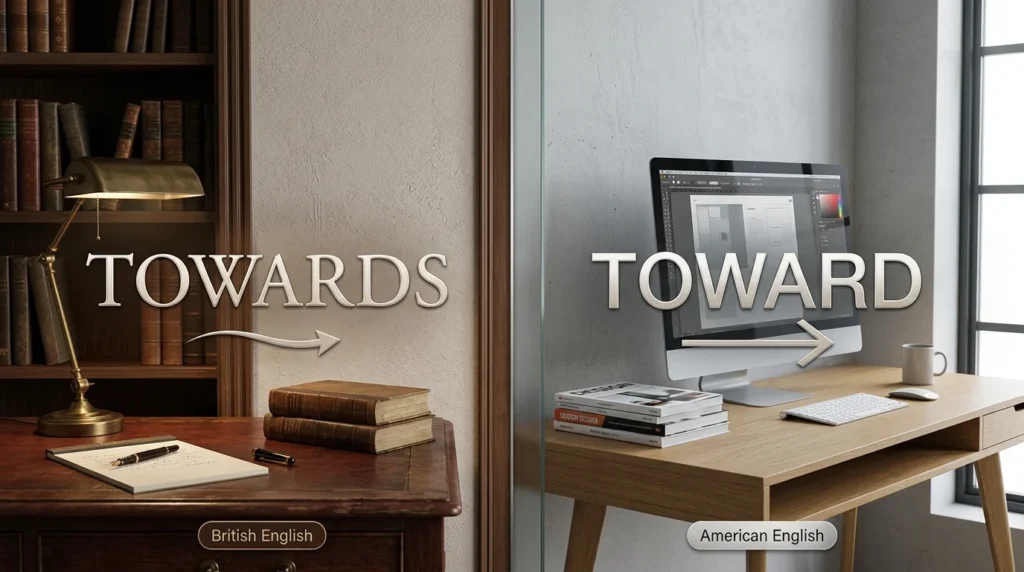
British English: Towards
In British English, towards is generally preferred.
Examples:
- The children ran towards the playground.
- She walked towards the station.
- We are working towards our target.
- He leaned towards the window.
- The project is moving towards completion.
British writers may also use toward, so the shorter form is not automatically an error in British English.
Do Brits say “toward” or “towards”?
Brits commonly use “towards.” However, “toward” is also a valid English form and can appear in British writing.
The important point is that towards is the usual British preference, not an exclusive British rule.
Toward vs Towards by Country
Regional preference can be summarized like this:
| Country or variety | Common preference |
|---|---|
| United States | toward |
| Canada | toward is common; both are used |
| United Kingdom | towards |
| Australia | towards |
| New Zealand | towards |
| International audience | Either; follow your chosen style consistently |
These are usage preferences, not strict grammar laws.
A British reader will understand toward, and an American reader will understand towards. However, using the form that matches your audience usually makes your writing sound more natural.
Amongst or Among? When to Use Each Word
Which Spelling Should You Use?
The best choice depends on where your audience is and which style you are following.
Use “toward” when:
- You are writing in American English.
- Your main audience is in the United States.
- You are following a style that prefers the shorter form.
- You want to match common American usage.
Use “towards” when:
- You are writing in British English.
- Your main audience is in the United Kingdom.
- You are writing primarily for Australian or New Zealand readers.
- Your publication’s house style uses towards.
What if your audience is international?
Either form can work.
The most important thing is to choose a consistent style rather than switching randomly between the two.
For example:
We are working toward our goal and moving toward a better solution.
Or:
We are working towards our goal and moving towards a better solution.
Both are fine. The second simply has a stronger British-style feel.
What Does AP Style Prefer?
If you are writing for an American publication that follows AP style, use toward.
This is useful for journalists, content writers, editors, marketers, and other professional writers.
For example:
The company is working toward a new agreement.
rather than:
The company is working towards a new agreement.
Style guides can have their own preferences even when both forms are grammatically correct. Therefore, if a client, employer, publication, or school gives you a specific style guide, follow that guide.
For general American writing, toward is the safer stylistic choice.
Common Mistakes With Toward and Towards
Mistake 1: Thinking “towards” is wrong
This is one of the most common misconceptions.
Towards is correct English. It is especially common in British English and is also widely used in other varieties of English.
Mistake 2: Thinking the S makes it plural
It does not.
Toward and towards are not singular and plural versions.
The s is part of the historical form of the word.
Mistake 3: Using “toward” only for physical movement
You can use toward for both physical and abstract ideas.
Correct:
She walked toward the door.
Correct:
We are working toward a solution.
Mistake 4: Using “towards” only for abstract ideas
The same applies to towards.
Correct:
He ran towards the bus.
Correct:
She is working towards her dream.
Mistake 5: Assuming one form is more formal
Neither word is automatically more formal.
The difference is mainly regional preference and style.
Spelt or Spelled: What’s the Difference?
Working Toward or Working Towards?
Both working toward and working towards are correct.
Examples:
We are working toward a solution.
We are working towards a solution.
The choice depends on your variety of English.
- American English: working toward
- British English: working towards
The same pattern applies to many common expressions.
Leaning Toward or Leaning Towards?
Both are correct:
She was leaning toward the window.
She was leaning towards the window.
Attitude Toward or Attitude Towards?
Both are correct:
His attitude toward work has changed.
His attitude towards work has changed.
Contribute Toward or Contribute Towards?
Both can be used:
The donation will contribute toward the project.
The donation will contribute towards the project.
Gravitate Toward or Gravitate Towards?
Both forms occur in English:
People often gravitate toward familiar ideas.
People often gravitate towards familiar ideas.
The preferred form again depends on the variety of English.
Towards or Toward in Everyday Examples
Here are some common sentences people search for when they are unsure which form to use.
Toward or Towards Me
Both are correct:
He walked toward me.
He walked towards me.
I Ran Toward or Towards
Both are correct:
I ran toward the station.
I ran towards the station.
Toward or Towards the End
Both are correct:
It happened toward the end of the meeting.
It happened towards the end of the meeting.
Goes Toward or Goes Towards
Both work:
The money goes toward education.
The money goes towards education.
All Proceeds Will Go Toward or Towards
Both are grammatical:
All proceeds will go toward the charity.
All proceeds will go towards the charity.
The choice should match your preferred variety of English.
Toward vs Towards: Usage and Corpus Evidence
If you search the web for “towards or toward”, you may notice both forms everywhere. That can make it difficult to decide whether one is actually more common.
Usage data gives a clearer picture.
Merriam-Webster’s discussion of the two forms notes that toward is much more common in American English, while towards is generally preferred in British English and other varieties outside North America. Its corpus discussion also shows a strong difference between American and British usage: American English uses toward far more often than British English does, while British English shows a stronger preference for towards.
This is important because raw Google results do not tell us which form is grammatically correct. They only show that people use both forms online.
What about Google Trends?
Google Trends can help show search interest, but it should not be treated as a grammar rule or a direct measure of how often a word appears in normal writing.
For this question, the most useful conclusion is:
- Toward has a strong association with American English.
- Towards has a strong association with British and several other English varieties.
- Both forms remain established in modern English.
- Regional usage data is more useful than search popularity alone when deciding which form to use.
So, if you are wondering “towards or toward which is correct?”, usage evidence supports the same practical answer: both are correct, with regional preferences determining which one sounds more natural.
Toward vs Towards: Comparison Table
| Feature | Toward | Towards |
|---|---|---|
| Meaning | Same | Same |
| Grammar | Preposition | Preposition |
| American English | Preferred | Less common |
| British English | Accepted | Preferred |
| Australian English | Used | Common/preferred |
| New Zealand English | Used | Common/preferred |
| Canadian English | Common | Also used |
| AP style | Preferred | Generally avoided in AP style |
| Physical direction | Correct | Correct |
| Abstract goal | Correct | Correct |
| Time reference | Correct | Correct |
| Formal writing | Correct | Correct |
| Informal writing | Correct | Correct |
| Plural form? | No | No |
The key takeaway is simple: there is no difference in meaning between the two forms.
Frequently Asked Questions
Is “towards” more correct than “toward”?
No. Both are correct. Toward is more common in American English, while towards is more common in British English.
Is it “toward” or “towards” in American English?
Toward is the usual choice in American English. “Towards” is still understandable and does appear, but it is less common.
Do Brits say “toward” or “towards”?
British English generally prefers towards, although toward is also a valid form and can be found in British writing.
When should I use “towards”?
Use towards when writing primarily in British, Australian, or New Zealand English, especially when that matches the style of your audience or publication.
What does “toward” mean?
Toward means in the direction of, closer to, or in the direction of achieving something.
For example:
She walked toward the door.
It can also describe a goal:
We are working toward success.
Is “working towards” grammatically correct?
Yes. Working towards is grammatically correct and is especially common in British English. American English usually prefers working toward.
Is it “towards me” or “toward me”?
Both are correct.
He walked toward me.
He walked towards me.
Choose according to your regional or style preference.
Final Rule: Toward or Towards?
If you remember only one thing, remember this:
Toward and towards are both correct. The main difference is regional preference.
For American English, choose toward.
For British, Australian, and New Zealand English, towards is generally the more natural choice.
For Canadian English, both are used, with toward commonly preferred.
If you are following AP style, use toward.
Most importantly, do not switch between the two forms without a reason. Pick the variety of English that fits your audience and keep your usage consistent.
Conclusion
So, towards or toward—which is correct? The answer is that both are correct. They have the same basic meaning and perform the same grammatical function. The difference is mainly a matter of regional preference and writing style.
In American English, toward is the more common choice. In British English, towards is generally preferred. The same -s form is also common in Australian and New Zealand English, while Canadian English uses both forms.
Neither spelling is a plural form, and neither is automatically more formal. You can use either one for physical movement, goals, attitudes, time references, or contributions.
If you are writing for a specific audience, match its variety of English. If you are following a publication or professional style guide, follow its preference. For AP-style American writing, toward is the preferred form.
Ultimately, there is no need to worry about choosing the “correct” word between these two. Both are established forms of English. The best choice is the one that matches your audience, style, and regional convention—and the key is to use it consistently.

Victor Penhall is an English grammar specialist and writing coach, helping learners strengthen their language skills with clear rules, smart tips, and precise guidance.