
Afterward or afterwards—which spelling should you use? The good news is that both are correct and have the same basic meaning: later or after something has happened.
The main difference is regional preference: afterward is especially common in American English, while afterwards is especially common in British English, although both forms are used in both varieties. For example, “We went home afterward” and “We went home afterwards” are both grammatically correct. So, is one more correct than the other? No.
Your best choice depends on the variety of English you are writing and your audience. If you’re searching for afterward or afterwards, you likely want to know the difference, which form to choose, and how to use each naturally. This guide explains the meaning, usage, regional preferences, examples, and common mistakes.
Afterwards or Afterward
Both “afterwards” and “afterward” are correct. They are adverbs meaning at a later time or after something else has happened.
The main difference is regional preference:
- Afterwards → especially British English
- Afterward → usually American English
- Both → have the same meaning
Quick rule
American English usually uses “afterward,” while British English especially favors “afterwards.” Both are correct.
| Word | Meaning | Common preference |
|---|---|---|
| afterwards | At a later time | British English |
| afterward | At a later time | American English |
For example:
British English:
We went for coffee afterwards.
American English:
We went for coffee afterward.
The meaning is exactly the same.
The Origin of Afterwards and Afterward
The two forms have a long history in English.
Afterward comes from Old English æfterwearde, meaning something like “behind” or “in the rear.” It was formed from an Old English word related to after and the suffix -weard, which expressed direction or position. Over time, the word developed its modern sense of “at a later time.”
The form afterwards developed from afterward with the addition of the adverbial -s. The -s does not create a new meaning. It is simply part of the established form afterwards.
This explains why the two words are so similar.
Why does one have an “s”?
The final s in afterwards is not a modern British spelling rule. It is part of the historical development of the word.
Both forms became established in English, and modern regional usage eventually developed a clear preference:
- afterwards became especially common in British English
- afterward became the usual choice in North American English
So the extra s does not mean that afterwards is more formal, older in every context, or grammatically different. It is simply part of one accepted form.
British English vs American English Spelling
The difference between afterwards and afterward is mainly a matter of regional preference.
British English: Afterwards
In British English, afterwards is especially common.
Examples:
We went home afterwards.
She called me shortly afterwards.
They had dinner and went for a walk afterwards.
American English: Afterward
In American English, afterward is usually preferred.
Examples:
We went home afterward.
She called me shortly afterward.
They had dinner and went for a walk afterward.
Comparison table
| Feature | Afterwards | Afterward |
|---|---|---|
| Meaning | At a later time | At a later time |
| Part of speech | Adverb | Adverb |
| British English | Especially common | Possible |
| American English | Possible | Usually preferred |
| North American English | Less typical | Usually preferred |
| Spelling | Ends in -s | No final -s |
| Formal writing | Correct | Correct |
| Informal writing | Correct | Correct |
The important point is that neither spelling is universally “the correct one.” The preferred form depends on the variety of English you are using.
Towards or Toward? American or British English?
Which Spelling Should You Use?
The best choice depends on your audience.
Use “afterward” for American English
If your writing follows American English, afterward is usually the natural choice.
The meeting ended, and we spoke afterward.
I felt much better afterward.
We went out for dinner afterward.
This is especially useful for US-focused websites, businesses, schools, and publications.
Use “afterwards” for British English
If your writing follows British English, afterwards is the more typical choice.
The meeting ended, and we spoke afterwards.
I felt much better afterwards.
We went out for dinner afterwards.
What about international English?
For an international audience, either spelling is understandable and standard.
The best approach is to choose the English variety used by your publication or audience and remain consistent.
For example:
US-focused content:
We discussed the results afterward.
UK-focused content:
We discussed the results afterwards.
Do not change between afterward and afterwards randomly. Consistency makes your writing look more polished.
What about Canada, Australia, and other English-speaking regions?
Usage can vary outside the United States and United Kingdom. Instead of treating every country as following one fixed rule, follow the style guide used by your school, employer, publisher, or target audience.
If you are unsure, check the English variety used throughout the rest of your document.
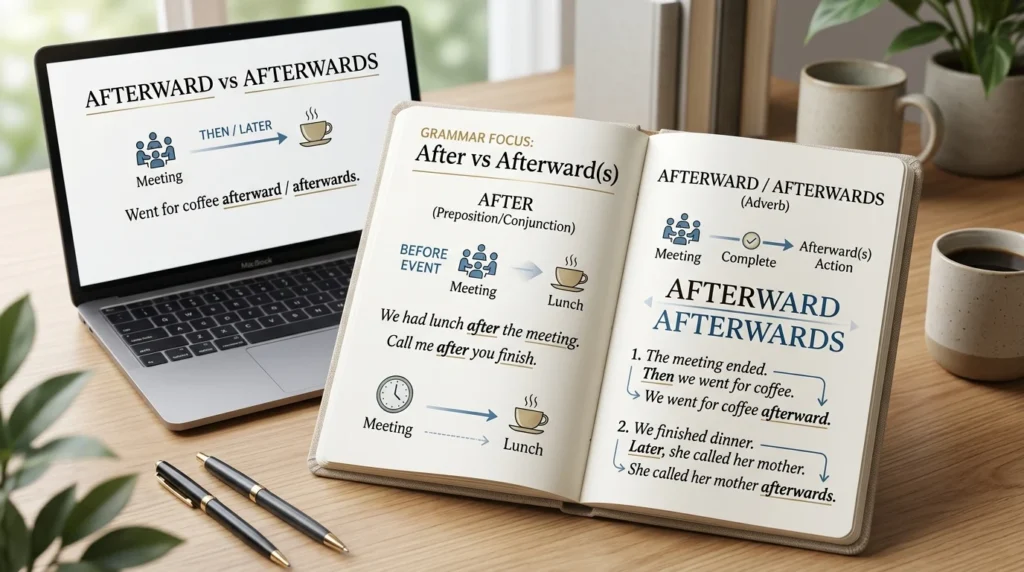
How to Use Afterwards and Afterward in a Sentence
Both words are adverbs. They tell the reader that something happens later.
At the end of a sentence
We went home afterward.
We went home afterwards.
At the beginning of a sentence
Afterwards, we went home.
Afterward, we went home.
After another clause
She finished her work and called me afterward.
She finished her work and called me afterwards.
With “soon”
Both forms work naturally with soon:
We left soon afterward.
We left soon afterwards.
With “shortly”
You can also use shortly:
He arrived shortly afterward.
He arrived shortly afterwards.
With “right”
In everyday English, you may also see:
I called her right afterward.
I called her right afterwards.
The meaning is “immediately after that.”
Amongst or Among? When to Use Each Word
After vs Afterwards vs Afterward
One common source of confusion is the word after.
Although these words are related, they do not always work in the same way.
After + noun
Use after before a noun or noun phrase:
We went home after dinner.
She called me after the meeting.
Here, after tells us what event came first.
After + clause
After can also introduce a clause:
We left after the movie ended.
I called her after I finished work.
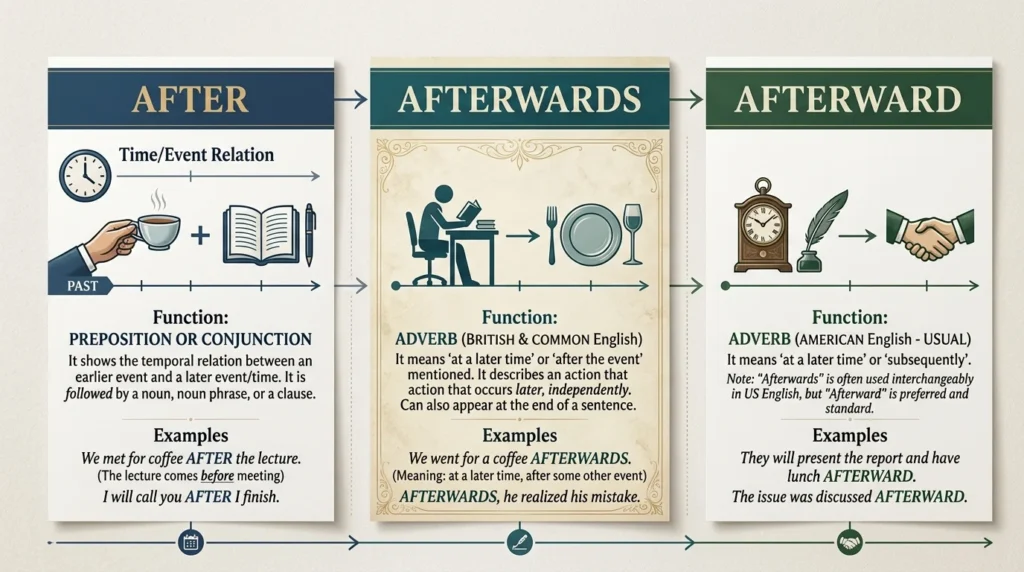
Afterwards or afterward by itself
Use afterwards or afterward when the word means “later” or “after that”:
We watched a movie and went home afterward.
We watched a movie and went home afterwards.
Here, you do not need to say what happened after. The adverb already refers to the earlier event.
Simple comparison
| Example | What it does |
|---|---|
| We ate after the movie. | After + noun phrase |
| We left after the movie ended. | After + clause |
| We left afterward. | Adverb |
| We left afterwards. | Adverb |
Common Mistakes with Afterwards or Afterward
Mistake 1: Thinking “afterwards” is wrong
Some American writers see the final s and assume it is a spelling error.
It is not.
Correct:
We talked afterwards.
Afterwards is a standard form, especially in British English.
Mistake 2: Thinking “afterward” is wrong
The opposite mistake also happens.
Correct:
We talked afterward.
Afterward is a standard American English form.
Mistake 3: Mixing regional styles without a reason
For example:
We went home afterward and met again afterwards.
This is not grammatically wrong, but switching forms without a reason can make your style look inconsistent.
For American English, write:
We went home afterward and met again afterward.
For British English, write:
We went home afterwards and met again afterwards.
Mistake 4: Writing “after wards”
Do not split the word into two words.
❌ We talked about it after wards.
✅ We talked about it afterwards.
✅ We talked about it afterward.
Mistake 5: Assuming the final “s” changes the meaning
It does not.
I felt better afterward.
and
I felt better afterwards.
Both mean that the person felt better later.
Mistake 6: Confusing “after” and “afterward”
Compare:
We went out after dinner.
with:
We went out and had coffee afterward.
The first uses after to connect an action with a noun phrase. The second uses afterward as an adverb meaning “later.”
Afterwards or Afterward in Everyday Examples
Both forms are common in ordinary writing. The main difference is the English variety being followed.
In emails
American English:
Thank you for meeting with me. I will send the documents afterward.
British English:
Thank you for meeting with me. I will send the documents afterwards.
Both are professional.
In business writing
American English:
The team reviewed the proposal and discussed the changes afterward.
British English:
The team reviewed the proposal and discussed the changes afterwards.
In academic writing
American style:
The researchers analyzed the results afterward.
British style:
The researchers analyzed the results afterwards.
Neither form is too informal for academic writing.
In news writing
American style:
The two leaders met privately and spoke to reporters afterward.
British style:
The two leaders met privately and spoke to reporters afterwards.
In social media
We had an amazing day and grabbed coffee afterward!
or:
We had an amazing day and grabbed coffee afterwards!
Social media allows either form. Your choice can simply reflect your usual English style.
In everyday conversation
What are you doing afterward?
or:
What are you doing afterwards?
Both are natural. The preferred version depends mainly on regional English.
Afterwards or Afterward – Usage by Region
There is a clear regional pattern, but it should be understood as a preference rather than an absolute rule.
| English variety | More typical form |
|---|---|
| American English | afterward |
| British English | afterwards |
| North American English | afterward |
| International English | Either |
| British-influenced writing | afterwards |
| American-influenced writing | afterward |
What about Google Trends?
Google Trends can show relative search interest for words and phrases, but it should not be used as a grammar authority. Search interest can reflect many things, including population size, spelling questions, education, and search behavior.
For this particular question, dictionary usage labels provide a more reliable answer than raw search popularity. Current Cambridge and Oxford entries consistently identify the same regional pattern: afterwards is especially British, while afterward is usually North American/American.
So, rather than claiming that search volume proves one spelling is “more correct,” the useful conclusion is:
Use the form that matches your target variety of English.
Is Afterwards or Afterward More Formal?
Neither word is inherently more formal.
Both can be used in:
- academic writing
- business documents
- emails
- news articles
- books
- websites
- everyday conversation
The difference is mainly regional.
For example:
US English:
The committee reviewed the report and issued a statement afterward.
UK English:
The committee reviewed the report and issued a statement afterwards.
Both sentences are professional.
So do not choose afterwards because you think the extra s makes it more formal. It does not.
Afterwards or Afterward: Pronunciation
The two forms are pronounced almost the same, but afterwards has an additional final z sound.
Roughly:
- afterward → AF-ter-werd
- afterwards → AF-ter-werdz
Accent affects the exact pronunciation.
Afterwards or Afterward – Comparison Table
| Question | Afterwards | Afterward |
|---|---|---|
| Is it correct? | Yes | Yes |
| Meaning | At a later time | At a later time |
| Part of speech | Adverb | Adverb |
| British English | Especially common | Less typical |
| American English | Less typical | Usually preferred |
| North American English | Less typical | Usually preferred |
| Formal writing | Yes | Yes |
| Informal writing | Yes | Yes |
| Final s | Yes | No |
| Example | We left afterwards. | We left afterward. |
Easy way to remember
British → afterwards
American → afterward
This is a useful shortcut, but remember that it describes preference, not a strict grammar rule.
FAQs About Afterwards or Afterward
1. Is “afterwards” correct?
Yes. Afterwards is correct English. It is especially common in British English and means “at a later time” or “after something has happened.”
2. Is “afterward” correct?
Yes. Afterward is also correct English. It is usually preferred in American English.
3. What is the difference between afterwards and afterward?
There is no difference in meaning. Both mean “at a later time” or “after that.” The main difference is regional preference.
4. Which is American: afterward or afterwards?
Afterward is usually the American English choice. Afterwards is also possible, but it is less typical in US English.
5. Which is British: afterward or afterwards?
Afterwards is especially common in British English.
6. Can I use “afterward” in British English?
Yes. British readers will understand it, but afterwards is generally the more typical British form.
7. Can I use “afterwards” in American English?
Yes. It is not incorrect in American English. However, afterward is usually the more typical US choice. Cambridge’s American entry explicitly lists afterwards as an alternative.
8. Are “afterward” and “afterwards” adverbs?
Yes. Both are adverbs when they mean “at a later time” or “after something has happened.”
9. Is “afterwards” more formal than “afterward”?
No. Neither form is inherently more formal. The difference is mainly regional.
10. Should I use “afterward” or “afterwards” on my website?
Use the form that matches your target audience and your site’s English style. For US English, afterward is usually the better choice. For British English, afterwards is usually the better choice.
11. Can “after” mean the same thing as “afterward”?
Sometimes, but their grammar differs. After can come before a noun phrase or clause, while afterward/afterwards can work as an adverb meaning “later.”
12. Is “after wards” correct?
No. Do not separate the word. Write afterwards or afterward, depending on your preferred English variety.
Conclusion
So, afterwards or afterward? Both are correct. They have the same meaning and both function as adverbs meaning “at a later time” or “after something has happened.”
The main difference is regional preference. Afterwards is especially common in British English, while afterward is usually preferred in American and North American English.
If you are writing for an American audience, choose afterward. If you are following British English, choose afterwards. For an international audience, either form is acceptable, but consistency is important.
Remember that the final s does not change the meaning. It is simply part of the established spelling afterwards. Both forms have a long history in English, and neither should be treated as a spelling mistake.
The easiest rule to remember is:
American English → afterward
British English → afterwards

Amelia Script is a dedicated grammar specialist and language mentor, simplifying English rules, refining writing skills, and helping learners communicate with clarity and confidence.