
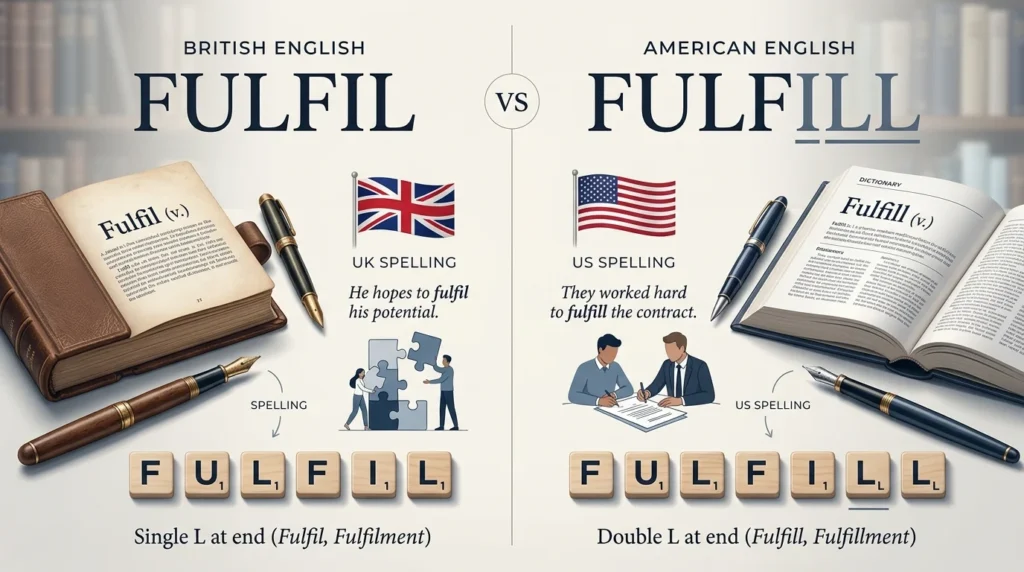
Have you ever written “fulfil” or “fulfill” and wondered which spelling is correct? Here’s the quick answer: both are correct, but the preferred form depends on the variety of English you use. Fulfil is the standard spelling in British English, while fulfill is the standard spelling in American English.
Both words have the same meaning: to complete, satisfy, or carry out something as required or expected. For example, a British writer might say, “She worked hard to fulfil her promise,” while an American writer would write, “She worked hard to fulfill her promise.” The difference can also appear in related words, such as fulfilment in British English and fulfillment in American English, while forms such as fulfilled and fulfilling are spelled the same in both varieties.
If you’re searching for fulfil or fulfill, you may want to avoid a spelling mistake, choose the right form for your audience, or understand which version fits your style of English. This guide explains the difference, regional usage, related forms, and clear examples so you can use fulfil or fulfill confidently and consistently.
Fulfil or Fulfill
Both “fulfil” and “fulfill” are correct.
- Fulfil = mainly British English
- Fulfill = mainly American English
- Australian English = generally fulfil
- Canadian English = commonly fulfill
- Meaning = exactly the same
So, you can write:
I hope to fulfil my dream.
or:
I hope to fulfill my dream.
Both sentences are correct. The spelling depends on the variety of English you are following.
| Spelling | Main usage | Example |
|---|---|---|
| fulfil | British English | She worked hard to fulfil her ambition. |
| fulfill | American English | She worked hard to fulfill her ambition. |
| fulfil | Australian English | The company must fulfil its obligations. |
| fulfill | Common in Canadian English | The company must fulfill its obligations. |
The key point is that there is no difference in meaning. The extra l in fulfill is simply part of the spelling convention used in American English and some other varieties.
The Origin of Fulfil or Fulfill
The difference is much older than modern American and British English.
Fulfil comes from the Old English word fullfyllan, meaning roughly “to fill up” or “make full.” It was formed from words related to full and fill.
Over time, the word developed broader meanings. It could refer to completing something, carrying something out, satisfying a requirement, or making something happen as expected.
That explains many meanings we still use today:
- fulfil a promise
- fulfil a duty
- fulfil a requirement
- fulfil an ambition
- fulfil a dream
- fulfil a purpose
- fulfil a role
- fulfil expectations
The American spelling fulfill uses a double l. This fits a wider pattern in American spelling, where some words have developed or retained different spelling conventions from British English.
It is important not to think of fulfill as a “wrong” version of fulfil. Both forms have a long history, and modern dictionaries recognize both spellings.
British English vs American English Spelling
The clearest difference is regional.
In British English, the usual spelling is fulfil.
In American English, the usual spelling is fulfill.
Fulfil vs Fulfill: Side-by-Side Comparison
| Feature | Fulfil | Fulfill |
|---|---|---|
| British English | ✓ Preferred | Less common |
| American English | Less common | ✓ Preferred |
| Australian English | ✓ Preferred | Less common |
| New Zealand English | ✓ Generally preferred | Less common |
| Canadian English | Less common | ✓ Commonly used |
| Meaning | Same | Same |
| Past tense | fulfilled | fulfilled |
| -ing form | fulfilling | fulfilling |
| Noun | fulfilment | fulfillment |
What About Canada?
Canadian English deserves a little more explanation.
Canada uses a mixture of British and American spelling patterns. For fulfil/fulfill, Canadian usage commonly follows the double-l spelling: fulfill.
The Government of Canada specifically recommends the double l in verbs such as fulfill and in the related noun fulfillment, while also advising writers to follow a reliable Canadian dictionary and remain consistent.
So, for Canadian readers, fulfill is generally the safer choice.
What About Australia?
Australian English generally follows British spelling for this word:
fulfil
The Australian Government Style Manual notes that Australian spelling generally follows British English, although Australian English has its own accepted conventions and spelling choices.
Therefore, an Australian writer would normally use:
The program will fulfil its purpose.
rather than:
The program will fulfill its purpose.
Fulfilment or Fulfillment?
The same regional difference appears in the noun.
- British English: fulfilment
- American English: fulfillment
For example:
British:
She found a sense of fulfilment in her work.
American:
She found a sense of fulfillment in her work.
Notice an important pattern:
fulfil → fulfilment
fulfill → fulfillment
The spelling should match the English variety used throughout your writing.
What About Fulfilled and Fulfilling?
This is where many writers become confused.
Although the base forms differ, fulfilled and fulfilling are spelled with double l in both British and American English.
| Form | British English | American English |
|---|---|---|
| Base verb | fulfil | fulfill |
| Third person | fulfils | fulfills |
| Past tense | fulfilled | fulfilled |
| Past participle | fulfilled | fulfilled |
| -ing form | fulfilling | fulfilling |
| Noun | fulfilment | fulfillment |
Examples:
- She fulfilled her promise.
- He is fulfilling his responsibilities.
- They have fulfilled the requirements.
- She fulfils her role well.
- She fulfills her role well.
So do not write fulfiled or fulfiling.
The correct forms are:
fulfilled
fulfilling
What Does Fulfil or Fulfill Mean?
Fulfil and fulfill can mean several closely related things.
1. To achieve a dream or ambition
She worked hard to fulfil her dream of becoming a doctor.
She worked hard to fulfill her dream of becoming a doctor.
2. To do what was promised
He fulfilled his promise to help.
Here, the word means that he did what he promised.
3. To satisfy a requirement
Applicants must fulfill all the entry requirements.
This meaning is common in formal and professional writing.
4. To satisfy a need
The new service helps fulfil an important need.
5. To carry out a duty, role, or purpose
She fulfils her responsibilities with care.
6. To complete an order or request
In business English, fulfil or fulfill can also mean to complete what a customer has ordered.
The company fulfilled the customer’s order on time.
7. To make something expected happen
The word can also be used with predictions, promises, or prophecies.
The events appeared to fulfil the old prophecy.
So, whether you mean achieve, satisfy, complete, carry out, or make something happen, the spelling choice remains regional rather than semantic.
Which Spelling Should You Use?
The best spelling depends on who will read your writing.
If you write for a British audience
Use fulfil.
We aim to fulfil our customers’ needs.
If you write for an American audience
Use fulfill.
We aim to fulfill our customers’ needs.
If you write for an Australian audience
Use fulfil in line with standard Australian usage.
If you write for a Canadian audience
Fulfill is generally the better choice.
If your audience is international
Either spelling can work. The most important thing is consistency.
For example, if your website uses British spelling throughout, use:
- fulfil
- fulfilment
- colour
- organise
- centre
If your website uses American spelling, use:
- fulfill
- fulfillment
- color
- organize
- center
Do not switch between systems without a reason.
For a website, consistency makes your writing look more polished and professional.
Afterwards or Afterward: Two Spellings, One Meaning?
Common Mistakes with Fulfil or Fulfill
Mistake 1: Thinking one spelling is wrong
It is incorrect to assume that fulfil is always right or that fulfill is always right.
Both are standard spellings.
The correct choice depends on your English variety.
Mistake 2: Mixing regional spellings
A writer may use fulfil in one paragraph and fulfillment in another.
That creates an inconsistent style.
Choose one spelling system and follow it.
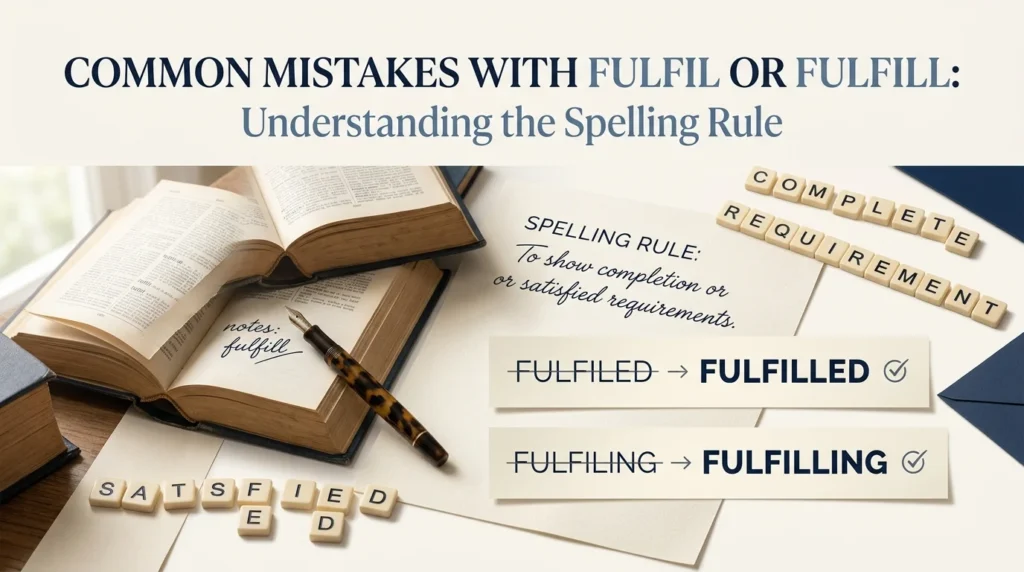
Mistake 3: Writing “fulfiled”
The past tense is not fulfiled.
Correct:
fulfilled
This spelling is used in both British and American English.
Mistake 4: Writing “fulfiling”
The correct form is:
fulfilling
It has a double l.
Mistake 5: Assuming the meaning changes
The meaning does not change.
Fulfil and fulfill mean the same thing.
The difference is spelling, not definition.
Fulfil or Fulfill in Everyday Examples
Seeing the words in real sentences makes the difference easier to remember.
Dreams and ambitions
British:
I hope to fulfil my dream of traveling the world.
American:
I hope to fulfill my dream of traveling the world.
Promises
British:
She always fulfils her promises.
American:
She always fulfills her promises.
Requirements
British:
You must fulfil all the requirements before applying.
American:
You must fulfill all the requirements before applying.
Expectations
British:
The product failed to fulfil our expectations.
American:
The product failed to fulfill our expectations.
Potential
British:
He wants to fulfil his full potential.
American:
He wants to fulfill his full potential.
Responsibilities
British:
She works hard to fulfil her responsibilities.
American:
She works hard to fulfill her responsibilities.
Business orders
British:
The retailer must fulfil the customer’s order quickly.
American:
The retailer must fulfill the customer’s order quickly.
In every example, the meaning stays the same. Only the spelling changes.
Fulfil or Fulfill – Trends & Usage Data
Google Trends can be useful when researching fulfil or fulfill, but it is important to understand what its data actually shows.
Google Trends measures relative search interest, not the number of times people use a word in books, articles, emails, or everyday speech. Therefore, a higher search interest for one spelling does not automatically prove that it is the more commonly used spelling overall.
Regional patterns are more useful.
In searches connected with British English, fulfil is the expected spelling. In searches connected with American English, fulfill is the expected spelling. This matches the spelling guidance given by major dictionaries such as Cambridge and Oxford.
For actual word usage, dictionaries and language corpora are stronger evidence than Google Trends alone because they show how words appear in real texts.
The practical lesson is simple:
Do not choose between fulfil and fulfill because one looks more popular globally. Choose the spelling that matches your target audience and keep your site’s spelling consistent.
Google Trends data can also change over time and by country, so any exact trend comparison should always include the country, date range, and search setting used.
Towards or Toward? American or British English?
Frequently Asked Questions
Is “fulfil” correct?
Yes. Fulfil is the standard spelling mainly used in British English and is also common in Australian English.
Is “fulfill” correct?
Yes. Fulfill is the standard American spelling and is also commonly used in Canadian English.
Is fulfil British or American?
Fulfil is mainly British English. American English normally uses fulfill.
Is fulfill British or American?
Fulfill is mainly American English. British English normally uses fulfil.
Do fulfil and fulfill mean the same thing?
Yes. They have the same meaning. The difference is mainly regional spelling.
Is it “fulfilled” or “fulfiled”?
The correct spelling is fulfilled in both British and American English.
Is it “fulfilling” or “fulfiling”?
The correct spelling is fulfilling in both British and American English.
Is it fulfilment or fulfillment?
Both are correct.
- fulfilment = British English
- fulfillment = American English
Which is better for SEO: fulfil or fulfill?
Neither spelling is automatically better for SEO. Use the form that matches your target audience and search intent. If your site targets British readers, fulfil is the natural choice. If it targets American readers, use fulfill.
Should I use fulfil or fulfill on an international website?
Either can work, but consistency matters. Choose the spelling that fits your site’s main audience and use the same English variety throughout your content.
Conclusion
So, fulfil or fulfill—which is correct? The answer is that both are correct.
Fulfil is mainly used in British English and is also the usual spelling in Australian English. Fulfill is the standard American spelling and is commonly used in Canadian English. The two words have the same meaning; only the spelling differs.
The same regional pattern appears in related words. British English uses fulfilment, while American English uses fulfillment. However, forms such as fulfilled and fulfilling use a double l in both varieties.
If you are writing for a specific country, follow that country’s standard spelling. If you are writing for an international audience, choose one spelling system and use it consistently.
The easiest rule to remember is:
British/Australian: fulfil → fulfilment
American/Canadian: fulfill → fulfillment
Once you know this pattern, you never need to wonder whether one version is a spelling mistake. Both are correct—the right choice simply depends on your audience.

Victor Penhall is an English grammar specialist and writing coach, helping learners strengthen their language skills with clear rules, smart tips, and precise guidance.