Is it transferred or transfered? If you have ever typed this word and stopped to count the r’s, you are not alone. The two spellings look almost identical, and the difference is only one letter. Yet that extra r makes one form correct and the other a spelling mistake.
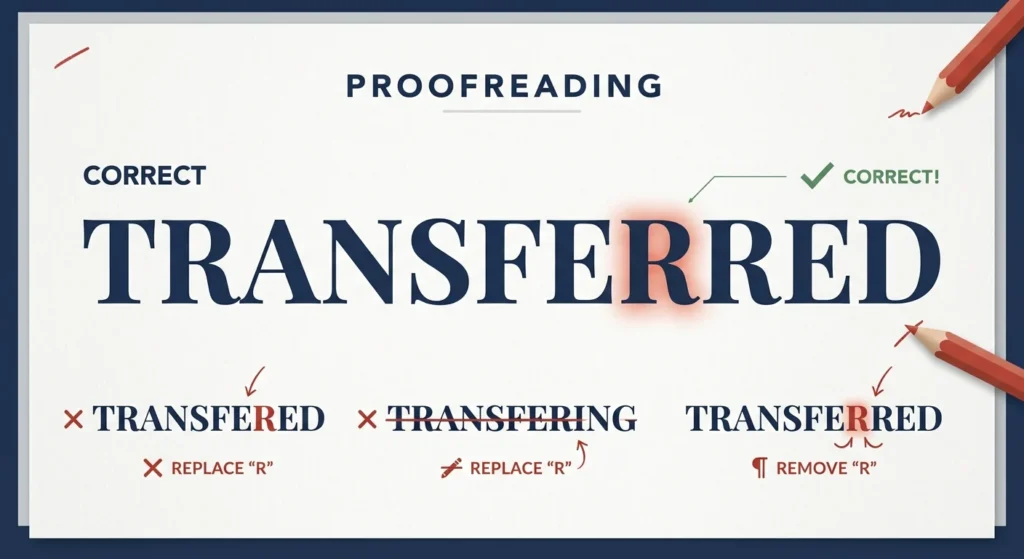
The correct spelling is transferred, with two r’s. Transfered, with one r, is incorrect in standard English.
This confusion often happens because many English verbs form the past tense by simply adding -ed. A writer may naturally think that transfer + ed = transfered. However, English spelling rules use a doubled r in transferred. The same pattern appears in transferring, which also has two r’s.
This guide explains the difference clearly. You will learn the correct spelling, why the r is doubled, where the word comes from, how British and American English use it, and how to avoid related mistakes. You will also see examples from emails, work, school, banking, technology, news, and everyday writing.
Transferred or Transfered
Transferred is the correct spelling.
Transfered is a misspelling.
The correct form is used for both the simple past and past participle of transfer.
Spelling
Correct?
Use
transferred
✅ Yes
Past tense and past participle
transfered
❌ No
Common misspelling
Examples
She transferred the money yesterday.
The patient was transferred to another hospital.
We have transferred the files to the new system.
He was transferred to another department.
The easy rule
Remember this pattern:
transfer → transferred → transferring
The final r is doubled before -ed and -ing.
So:
✅ transferred
❌ transfered
✅ transferring
❌ transfering
If you only need the answer, remember:
Transferred = correct Transfered = incorrect
What Does Transferred Mean?
Transferred is the past tense and past participle of the verb transfer.
Transfer means to move a person, thing, payment, file, responsibility, ownership, or other item from one place, person, account, or situation to another.
For example:
The bank transferred the money.
The school transferred the student.
The company transferred the employee.
The computer transferred the files.
The owner transferred the property.
The manager transferred responsibility to another team.
The basic idea is always about moving something from one place or situation to another.
The Origin of Transferred
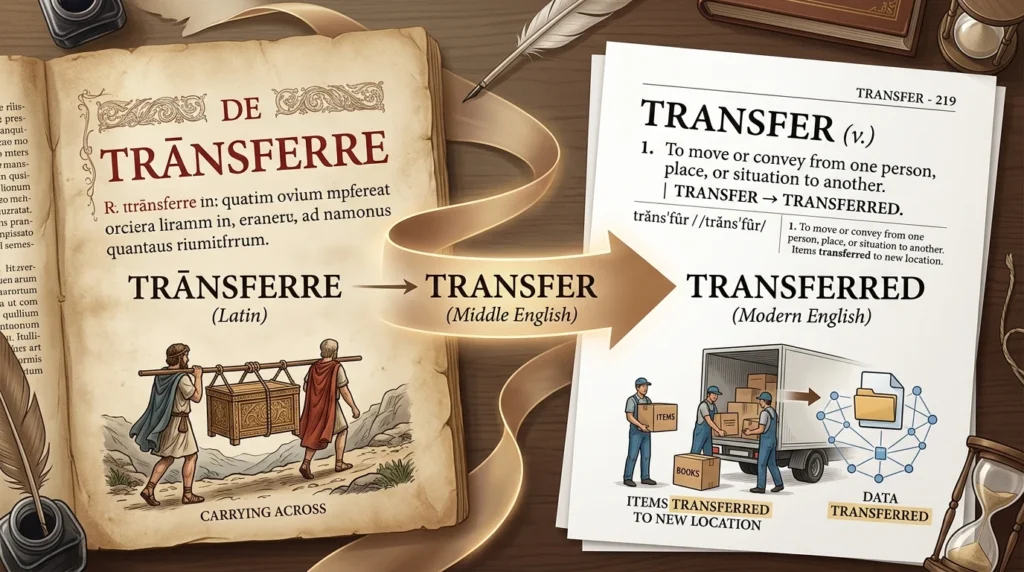
The word transfer has a long history. It ultimately comes from the Latin transferre, which means roughly “to carry across” or “to carry from one place to another.”
The word entered English through earlier forms influenced by French and Latin. Over time, transfer developed into the modern English verb we use today.
The idea behind the word has remained quite stable. When something is transferred, it is moved across from one person, place, system, or situation to another.
For example:
money is transferred from one account to another;
a person is transferred from one department to another;
a file is transferred from one computer to another;
ownership is transferred from one person to another.
Why does transferred have two r’s?
This is where the spelling becomes confusing.
A writer may look at the base word:
transfer
and simply add:
+ ed
That can make transfered look logical.
But standard English spelling gives us:
transfer → transferred
The final r is doubled before the -ed ending.
A similar pattern can be seen in words such as:
refer → referred
prefer → preferred
occur → occurred
infer → inferred
The exact rules for consonant doubling in English have exceptions, so it is better not to treat one simple rule as a universal formula. For transfer, the form to remember is simply:
transfer → transferred
Why People Write “Transfered”
The misspelling transfered is easy to understand.
Many common verbs take -ed without changing the spelling of the final consonant:
walk → walked
help → helped
open → opened
clean → cleaned
So a writer may assume:
transfer + ed = transfered
But transfer belongs to a different spelling pattern.
The standard form is:
transfer + red = transferred
The extra r is part of the correct spelling.
This is especially easy to miss because transferred and transfered are pronounced alike in normal speech. You cannot reliably hear the extra written r, so the spelling has to be remembered.
British English vs American English Spelling
Unlike some English spelling pairs, transferred does not change between British and American English.
Both varieties use:
transferred
There is no standard British form transfered and no standard American form transfered.
English variety
Correct spelling
Incorrect spelling
American English
transferred
transfered
British English
transferred
transfered
Canadian English
transferred
transfered
Australian English
transferred
transfered
New Zealand English
transferred
transfered
Indian English
transferred
transfered
American English
The employee was transferred to our Chicago office.
British English
The employee was transferred to our London office.
The spelling remains the same.
Is this like canceled and cancelled?
No.
Some spelling differences really do vary by region. For example, canceled is common in American English, while cancelled is common in British English.
Transferred is different.
There is no standard US-versus-UK choice between transferred and transfered.
So whether you write for an American, British, Canadian, Australian, or international audience, use:
Some writers know that the r must double but add one too many.
❌ transferrred
✅ transferred
There are two r’s, not three.
4. Will transferred ❌
Do not use the past form after will.
❌ I will transferred the payment tomorrow.
✅ I will transfer the payment tomorrow.
5. To transferred ❌
After to, use the base verb when to is part of an infinitive.
❌ We need to transferred the files.
✅ We need to transfer the files.
6. Has transfered ❌
The past participle still needs two r’s.
❌ The bank has transfered the funds.
✅ The bank has transferred the funds.
7. Confusing transfer with transferred
These forms have different jobs.
I will transfer the money tomorrow.
I transferred the money yesterday.
I have transferred the money already.
Using the wrong form can make a sentence grammatically incorrect even when the spelling itself looks close.
A Simple Memory Trick for Transferred
Use this pattern:
TRANSFER → TRANSFERRED
Then remember:
TRANSFER → TRANSFERRING
The important part is:
RR
You can also connect it with similar words:
refer → referred
prefer → preferred
occur → occurred
transfer → transferred
Do not try to remember transfered as an alternative spelling. It is simply the form to avoid.
Transferred in Everyday Examples
The word transferred is used in many different situations.
In emails
Your request has been transferred to our support team.
I have transferred the payment to your account.
At work
She was transferred to the marketing department.
He was transferred to our London office.
In banking
The funds were transferred successfully.
Your payment has been transferred to the recipient.
In education
The student was transferred to another school.
She transferred to a different university.
In healthcare
The patient was transferred to another hospital.
He was transferred to a specialist unit.
In technology
The files were transferred to the new computer.
The data has been transferred to the new system.
In sports
The player was transferred to another club.
In legal or formal writing
Ownership of the property was transferred to the buyer.
Responsibility for the project was transferred to the new department.
On social media
Finally transferred all my photos to my new phone!
The spelling stays the same in every context.
Transferred – Google Trends & Usage Data
People who search “transferred or transfered” are usually looking for a quick spelling check. The search intent is simple: they want to know which form is correct and why the extra r appears.
Interest in this type of spelling query can come from several contexts, including:
school and university writing;
business emails;
banking;
workplace communication;
technology;
healthcare;
sports;
English learning;
proofreading.
The keyword also has a useful related search pattern:
transferring or transfering
Both questions come from the same spelling problem: deciding whether the final r should be doubled.
How Google Trends should be understood
Google Trends measures relative search interest, not an exact number of searches. Its values are normalized to a scale, so a higher value means greater relative interest within the selected comparison, location, and time period. It does not mean that the number itself represents the number of searches.
For this keyword, a useful comparison is:
transferred vs transfered
A related comparison is:
transferring vs transfering
The exact pattern can change when you change the country, language, or time range.
the correct spelling immediately;
a reason for the double r;
examples;
the British-versus-American answer;
related forms such as transferring;
common mistakes;
a simple rule they can remember.
That is why a useful article should answer the spelling question near the top and then provide deeper information for readers who want to understand the rule.
Transferred or Transfered:
Keyword or variation
Correct?
What it means
transferred
✅
Correct past tense and past participle
transfered
❌
Common misspelling
transfer
✅
Base verb
transfers
✅
Present-tense form
transferring
✅
-ing form
transfering
❌
Common misspelling
transferrred
❌
Incorrect triple-r spelling
past tense of transfer
—
Answer: transferred
past participle of transfer
—
Answer: transferred
correct spelling of transferred
—
Answer: transferred
This table also shows why the spelling question is not only about one word. People often make the same mistake when forming transferring.
Transferred vs Transfered: Quick Test
Try these sentences.
1. The company ___ the employee last month.
A. transfered B. transferred
Answer: B — transferred
2. We are ___ the files now.
A. transfering B. transferring
Answer: B — transferring
3. I will ___ the money tomorrow.
A. transferred B. transfer
Answer: B — transfer
4. The payment has been ___.
A. transfered B. transferred
Answer: B — transferred
Easy rule
If you are talking about the past or using a past participle:
transferred
If you are using the -ing form:
transferring
If you use the base verb after will or to:
transfer
FAQs About Transferred or Transfered
1. Is it transferred or transfered?
Transferred is correct. Transfered is a misspelling.
She transferred the money yesterday.
2. Why does transferred have two r’s?
The spelling of transfer changes when the -ed ending is added. The final r is doubled, giving transferred.
3. Is transfered ever correct?
No. Transfered is not the standard spelling of the past tense or past participle of transfer.
Use transferred instead.
4. Is transferred the same in British and American English?
Yes. Both British and American English use transferred.
There is no standard US/UK spelling difference between transferred and transfered.
5. Is transferring spelled with two r’s?
Yes.
The correct spelling is:
transferring
Not:
transfering
6. What is the past tense of transfer?
The past tense is transferred.
She transferred the file yesterday.
7. What is the past participle of transfer?
The past participle is also transferred.
The file has been transferred.
8. Can I use transferred in formal writing?
Yes. Transferred is appropriate in formal, academic, professional, business, and everyday writing.
9. What is the difference between transfer and transferred?
Transfer is the base form.
I will transfer the money.
Transferred is the past form.
I transferred the money yesterday.
10. How do I remember the spelling of transferred?
Remember:
transfer → transferred
The word has two r’s before -ed.
You can also remember the related form:
transferring
Both forms keep the doubled r.
Conclusion
When choosing between transferred and transfered, always use transferred. The form with two r’s is the standard spelling for both the simple past and past participle of transfer. The form transfered is a common misspelling.
The spelling becomes easier when you remember the full pattern:
transfer → transferred → transferring
The same spelling is used in British, American, Canadian, Australian, New Zealand, Indian, and other major varieties of standard English. So this is not a regional spelling choice.
Transferred can describe money, people, files, ownership, responsibility, employees, students, patients, phone calls, and many other things that move from one place or situation to another.
The most common related mistakes are transfered, transfering, and transferrred. Avoid all three.
For a quick memory rule, think:
Two r’s in transferred. Two r’s in transferring.
Once you remember that pattern, you can use the correct spelling confidently in emails, assignments, reports, websites, professional documents, and everyday writing.
Elias Worden is a trusted grammar expert and writing mentor, dedicated to simplifying English rules and helping learners write with clarity, precision, and confidence.