
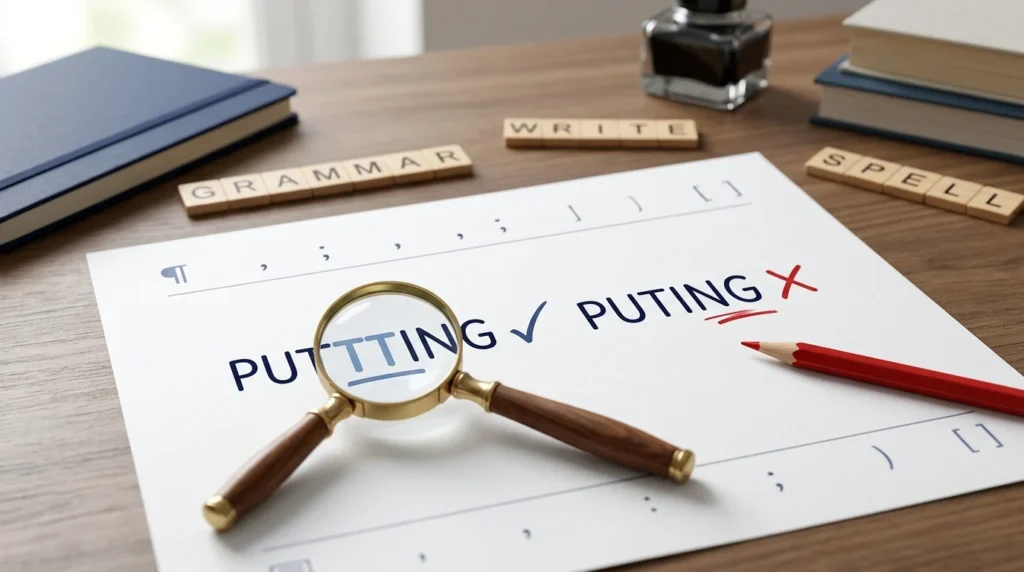
If you are unsure whether to write putting or puting, the correct spelling is putting. It has two t’s. Puting is a misspelling in standard English.
The confusion is easy to understand. The base verb is put, and it may seem that you only need to add -ing:
put + ing = puting
But English spelling does not work that way for this word. The final t is doubled before -ing, giving:
put + t + ing = putting
This small spelling rule matters because putting is a very common word. You may see it in emails, schoolwork, business writing, news articles, social media posts, and everyday conversation. It can mean placing something somewhere, taking action, applying effort, expressing an idea, or doing many other things depending on the phrase.
There is also no British-versus-American spelling choice here. Putting is the standard spelling in both British and American English. If you are writing for a global audience, the same form works.
This guide explains why putting is correct, why puting is wrong, how the spelling rule works, and how to use the word naturally.
Putting or Puting
Putting is correct.
Puting is incorrect in standard English.
| Spelling | Correct? | Use |
|---|---|---|
| Putting | ✅ Yes | Standard -ing form of put |
| Puting | ❌ No | Misspelling |
The correct spelling
PUT + T + ING = PUTTING
Examples:
- I am putting the books on the shelf.
- She is putting her phone away.
- They are putting the plan into action.
- We are putting the files in the correct folder.
The incorrect spelling
- ❌ I am puting the books away.
- ❌ She is puting her phone on the table.
- ❌ They are puting the plan into action.
The important point is simple:
Putting has two t’s. Puting has only one t and is not the standard spelling.
What Does “Putting” Mean?
Putting is the -ing form of the verb put. The basic meaning of put is to move or place something somewhere.
For example:
She is putting the keys on the table.
But putting has many uses:
- putting a book away = placing it somewhere
- putting a plan into action = making the plan happen
- putting an idea into words = expressing an idea
- putting in effort = making an effort
- putting pressure on someone = causing pressure
- putting something together = assembling it
So the exact meaning depends on the sentence.
The Origin of Putting
Putting comes from the verb put with the -ing ending.
The verb put is an old English word with a long history. Its meaning developed around moving, placing, or causing something to be in a particular position. Modern English still uses put in a very wide range of expressions.
When -ing is added, the spelling becomes:
put → putting
It does not become:
put → puting
The doubled t is part of the standard spelling of the word.
Why Does Putting Have Two Ts?
The spelling follows the English pattern of doubling a final consonant in certain words before adding a vowel-starting ending such as -ing.
For a short one-syllable verb such as put, the word ends with:
- P = consonant
- U = vowel
- T = consonant
This is a consonant-vowel-consonant (CVC) pattern.
Compare:
| Base verb | Correct -ing form |
|---|---|
| put | putting |
| run | running |
| sit | sitting |
| cut | cutting |
| get | getting |
| stop | stopping |
The final consonant is doubled before -ing in these forms.
A More Accurate Spelling Rule
The simple CVC rule is useful for short verbs, but it is not a rule that applies to every English word.
For example:
- put → putting
- run → running
- sit → sitting
But:
- rain → raining
- jump → jumping
- open → opening
- visit → visiting
So do not assume that every word should double its final letter.
For put, however, the standard form is firmly:
putting
Why Not “Puting”?
The spelling puting leaves the final consonant undoubled.
That is not the standard English form of the -ing form of put.
The correct pattern is:
put → putting
not:
put → puting
The second t is therefore not optional.
Until or Untill: Correct Spelling, Meaning & Examples
Putting: Present Participle and Gerund
The word putting can have different grammatical jobs.
Putting as a Present Participle
A present participle is the -ing form used with a form of be in continuous verb forms.
Examples:
She is putting the dishes away.
They are putting the new system into place.
I am putting together the final report.
Here, putting is part of the verb phrase.
Putting as a Gerund
Putting can also act like a noun.
Examples:
Putting things away keeps the room tidy.
Putting money aside can help you save.
Putting your ideas into words takes practice.
Here, putting names an activity.
The spelling stays the same in both uses:
putting
British English vs American English Spelling
There is no standard British-versus-American spelling difference between putting and puting.
Both British and American English use:
putting
| English variety | Standard spelling |
|---|---|
| American English | putting |
| British English | putting |
| Canadian English | putting |
| Australian English | putting |
| New Zealand English | putting |
| Indian English | putting |
| International English | putting |
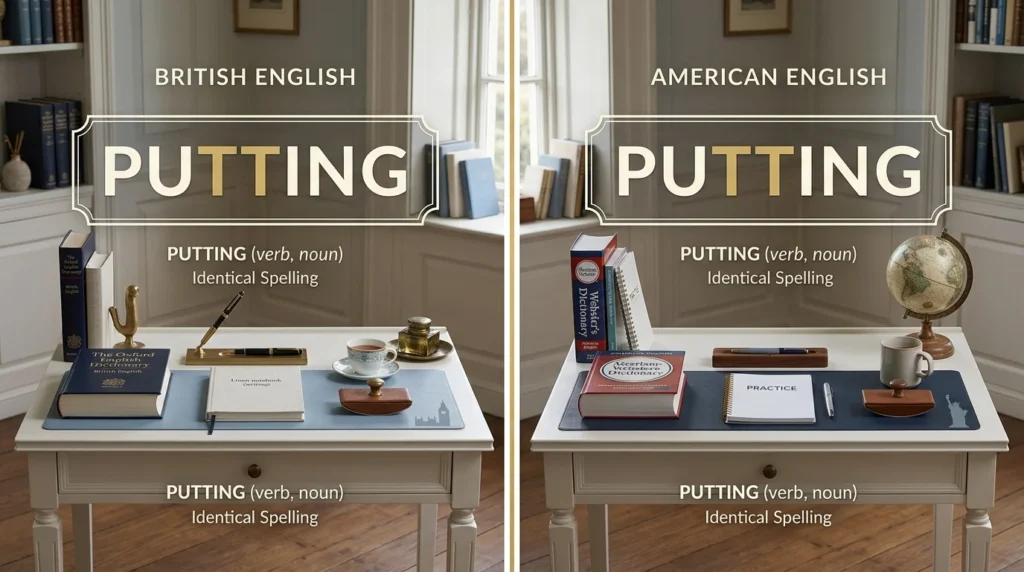
This makes putting different from words such as canceled/cancelled or realize/realise, where regional spelling differences can exist.
With putting, there is no standard regional choice.
Is “Puting” British English?
No.
Puting is not the standard British spelling.
Use:
putting
Is “Puting” American English?
No.
American English also uses:
putting
Does Canada Use “Putting”?
Yes. Putting is the standard form in Canadian English as well.
What About Australia and New Zealand?
The standard spelling is also:
putting
So you do not need to change the spelling based on the country of your reader.
Which Spelling Should You Use?
The answer is simple:
For American English
Use putting.
We are putting the new system in place.
For British English
Use putting.
We are putting the documents in the cabinet.
For Canadian English
Use putting.
She is putting the files away.
For Australian or New Zealand English
Use putting.
They are putting the equipment together.
For Indian English
Use putting.
The team is putting the plan into action.
For Global English
Use putting.
There is no need to choose a regional spelling.
For Formal Writing
Use putting in:
- academic writing
- business documents
- reports
- applications
- professional emails
- formal letters
For Informal Writing
Use putting in:
- text messages
- social media
- chats
- personal emails
- everyday writing
The same spelling works in all of these settings.
Etc or Ect: Why “Etc.” Is Spelled This Way
Common Mistakes with Putting or Puting
1. Writing “Puting”
This is the most common mistake.
❌ puting
✅ putting
Example:
❌ She is puting the books on the desk.
✅ She is putting the books on the desk.
2. Forgetting the Second T
Because putting is pronounced as one flowing word, the second t can be easy to forget while typing.
Remember:
P-U-T-T-I-N-G
There are two t’s.
3. Assuming You Only Need to Add -ing
A learner may think:
put + ing = puting
But the standard spelling is:
put + t + ing = putting
The spelling changes before the ending is added.
4. Confusing “Put” and “Putting”
Put and putting are different grammatical forms.
Compare:
Please put the book here.
She is putting the book here.
The base verb is put.
The -ing form is putting.
5. Using “Putted” as the Normal Past Form
The ordinary past tense of put is:
put
Not:
putted
Examples:
I put the keys on the table yesterday.
She put the letter in the drawer.
However, putted can occur in golf when it comes from the verb putt:
He putted the ball into the hole.
So putted is not simply a general past form of put. In ordinary uses of put, the past tense remains put.
6. Writing “Puttng”
Another typing error is dropping the i:
❌ puttng
✅ putting
The correct spelling contains:
p-u-t-t-i-n-g
7. Writing “Puttin’” in Formal Writing
You may sometimes see:
I’m just puttin’ it away.
This can represent informal speech or a stylized pronunciation.
For standard formal writing, use:
I’m just putting it away.
Putting or Puting: Comparison Table
| Word/Form | Correct? | Function | Example |
|---|---|---|---|
| putting | ✅ | -ing form | She is putting the book away. |
| puting | ❌ | Misspelling | Not standard English |
| put | ✅ | Base verb / past form | I put it there yesterday. |
| puts | ✅ | Third-person present | She puts the keys here. |
| putting | ✅ | Gerund | Putting things away helps. |
| putted | ⚠️ | Golf verb form | He putted the ball well. |
The Main Difference
| Form | Meaning |
|---|---|
| put | Base form and also past form |
| puts | Present tense with he, she, or it |
| putting | -ing form |
| puting | Misspelling |
Putting in Everyday Examples
The word putting is common in many types of writing.
In Emails
I am putting the final report together today.
We are putting the documents in the shared folder.
Thank you for putting this information together.
In Business Writing
The company is putting a new process in place.
We are putting customer needs first.
The team is putting more resources into the project.
In Academic Writing
The study is putting forward a different explanation.
Putting these findings together reveals a clear pattern.
The researchers are putting the results into context.
In News Writing
The new policy is putting pressure on businesses.
The team is putting its plans into action.
On Social Media
Just putting this out there.
Putting in the work every day.
Putting everything together one step at a time.
In Everyday Conversation
I am putting dinner on the table.
She is putting her shoes away.
He is putting the baby to bed.
Common Phrases With “Putting”
Putting appears in many common expressions.
| Phrase | Meaning | Example |
|---|---|---|
| putting away | placing something where it belongs | She is putting the dishes away. |
| putting on | wearing or applying something | He is putting on his coat. |
| putting off | delaying something | They are putting off the meeting. |
| putting together | assembling or combining | We are putting the report together. |
| putting aside | saving or temporarily ignoring something | She is putting some money aside. |
| putting forward | presenting an idea | He is putting forward a new plan. |
| putting into practice | using an idea or plan | They are putting the advice into practice. |
| putting in effort | making an effort | She is putting in a lot of effort. |
| putting pressure on | causing pressure | The deadline is putting pressure on us. |
| putting into words | expressing an idea | I cannot put my feelings into words. |
These phrases show why putting is such a useful word in everyday English.
Putting Has More Than One Meaning
Most of the time, putting means performing the action of putting something somewhere or causing something to be in a certain state.
But it can also have a special meaning in golf.
Putting in General English
She is putting the flowers in a vase.
Here, putting means placing something somewhere.
Putting in Golf
In golf, putting means hitting the ball with a putter, usually on the putting green.
His putting has improved this year.
The spelling is still:
putting
The meaning comes from the context.
Putting or Puting – Google Trends & Usage Data
People who search for “putting or puting” are usually trying to solve a spelling question: they know the word they want, but they are unsure whether the second t belongs in the spelling.
The important usage fact is that putting is the established standard form, while puting is a misspelling.
There is also no standard US-versus-UK split for these two forms.
Usage by English Variety
| Region | Standard form |
|---|---|
| United States | putting |
| United Kingdom | putting |
| Canada | putting |
| Australia | putting |
| New Zealand | putting |
| India | putting |
| Other standard English contexts | putting |
What About Search Popularity?
Search interest can change over time, and spelling-comparison searches do not always have enough public data to support a meaningful country-by-country numerical comparison.
For that reason, it is better not to invent percentages or claim that one country has a specific search volume without reliable current data.
What we can say clearly is:
- Putting is the standard spelling.
- Puting is a common spelling error.
- The error can happen when writers simply add -ing without doubling the final t.
- The issue is not a British-versus-American spelling difference.
- The correct form remains putting across major English varieties.
This makes the spelling rule more useful than a simple country comparison.
How to Remember the Correct Spelling
Use this simple memory trick:
PUT + T + ING = PUTTING
Think of the word in three parts:
PUT | T | ING
That gives:
PUTTING
You can also remember it beside similar forms:
| Base verb | -ing form |
|---|---|
| put | putting |
| run | running |
| sit | sitting |
| cut | cutting |
| get | getting |
| stop | stopping |
The key is to remember that putting has two t’s.
Putting or Puting: Examples at a Glance
| Incorrect | Correct |
|---|---|
| I am puting the book away. | I am putting the book away. |
| She is puting on her shoes. | She is putting on her shoes. |
| They are puting the plan into action. | They are putting the plan into action. |
| We are puting the files together. | We are putting the files together. |
| He is puting pressure on the team. | He is putting pressure on the team. |
FAQs About Putting or Puting
1. Is it “putting” or “puting”?
Putting is correct. Puting is a misspelling in standard English.
2. Why does “putting” have two Ts?
The final t is doubled before the -ing ending in the standard spelling of this short verb.
put → putting
3. Is “puting” ever correct?
Puting is not the standard spelling of the -ing form of put. Use putting instead.
4. Is “putting” British or American English?
It is both. Putting is the standard spelling in British and American English.
5. Is “putting” correct in formal writing?
Yes. Use putting in formal writing, including academic papers, business documents, reports, and professional emails.
6. What is the past tense of “put”?
The ordinary past tense of put is also put.
I put the keys on the table yesterday.
7. Is “putted” wrong?
Not always. Putted can be correct when it comes from the golf verb putt.
She putted the ball into the hole.
But the ordinary past tense of put is simply put.
8. Is “putting” a verb?
Yes. Putting is the -ing form of the verb put. It can also function as a gerund when it acts like a noun.
She is putting the books away.
Putting things away takes time.
9. How many Ts are in “putting”?
There are two Ts:
P-U-T-T-I-N-G
10. Does the spelling change in Canada or Australia?
No. Standard English uses putting in Canada, Australia, and other major English varieties.
11. Why do people write “puting”?
The mistake often happens because writers think they only need to add -ing to put:
put + ing = puting
But the standard spelling is:
put + t + ing = putting
12. Is “putting” pronounced with two separate T sounds?
No. The two written t’s do not mean you pronounce two separate, clearly divided t sounds. This is one reason the second t can be easy to miss when spelling the word.
Conclusion
When choosing between putting or puting, the correct spelling is putting, with two t’s. Puting is a misspelling, not a British or American alternative.
The word putting is the -ing form of put. The spelling follows the standard consonant-doubling pattern used with certain short verbs before -ing. That gives us:
put → putting
The easiest way to remember it is:
PUT + T + ING = PUTTING
The same spelling works in American, British, Canadian, Australian, New Zealand, Indian, and other standard English contexts. You do not need to change it for your audience.
Putting can describe placing something somewhere, applying effort, expressing an idea, delaying something, presenting a plan, or many other actions. It also has a special golf meaning.
So whether you are writing an email, school assignment, business report, social media post, or formal document, use putting. If you see puting, the second t is missing.
Putting = correct.
Puting = incorrect.

Sophia Langley is an English grammar specialist and writing coach, passionate about simplifying language rules and empowering learners to write with clarity and confidence.