
Have you ever wondered whether the drink is spelled “whisky” or “whiskey”? The quick answer is that both spellings are correct, but the usual form depends on the regional tradition associated with the spirit.
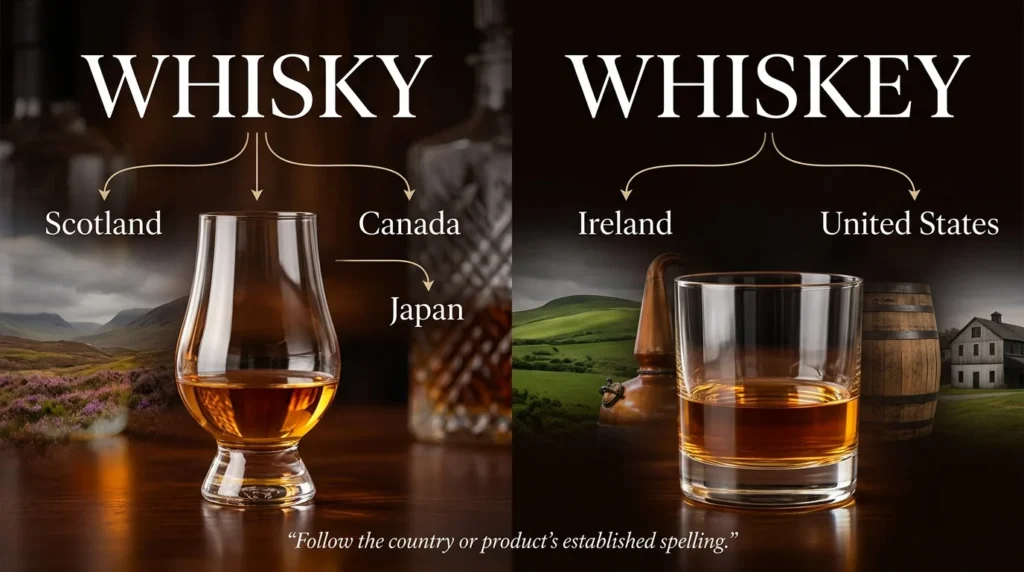
Whisky is the usual spelling for Scotch, Canadian, and Japanese spirits, while whiskey is commonly used for Irish and American spirits. For example, you would normally write Scotch whisky, Irish whiskey, and American whiskey.
Both words refer to a broad family of distilled spirits made from fermented grains, although different traditions can have their own production methods and rules. If you’re searching for whisky or whiskey, you may want to know which spelling to use, whether one is more correct than the other, and why both forms exist.
In this guide, you’ll learn the difference between whisky and whiskey, understand their regional usage, see clear examples, and discover an easy way to remember which spelling fits the context.
Whisky or Whiskey
Both “whisky” and “whiskey” are correct.
The spelling usually depends on the spirit’s country or production tradition.
| Spelling | Common use | Example |
|---|---|---|
| whisky | Scotland | Scotch whisky |
| whiskey | Ireland | Irish whiskey |
| whiskey | United States | American whiskey |
| whisky | Canada | Canadian whisky |
| whisky | Japan | Japanese whisky |
| whisky | Some U.S. products | American single malt whisky |
The Scotch Whisky Association says Scotch uses whisky without the e. It also notes that American whiskey is usually spelled with an e, while English, Welsh, Japanese, and most other world whiskies use whisky.
The easiest rule to remember
Scotland → whisky
Ireland → whiskey
United States → usually whiskey
Canada → whisky
Japan → whisky
But this is a guide, not an absolute rule. Always follow the established spelling of a specific brand or product.
Are whisky and whiskey the same?
Broadly, yes. Both words describe the same broad family of distilled spirits. However, the spirits themselves can follow different legal and production rules in different countries.
So the spelling does not tell you everything about how the spirit was made.
The Origin of Whisky or Whiskey
The word has a long history.
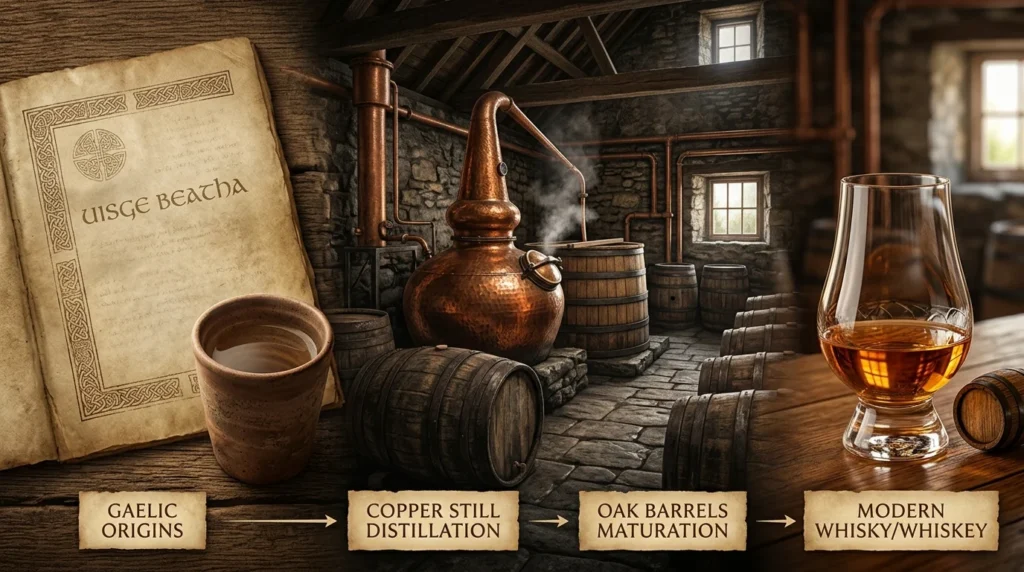
Whisky comes from the Gaelic expression uisge beatha, which means “water of life.” The form developed through earlier spellings and pronunciations before becoming the modern English word whisky.
Scotland and Ireland both have deep traditions of making the spirit. As English and Gaelic forms developed in different places, different spellings became established.
Over time, whisky became strongly linked with Scottish production, while whiskey became common in Ireland and later in the United States.
The history is more complex than simply saying that Ireland “added an e” to the word. Spelling traditions developed over many years, and regional producers adopted the forms that became normal in their markets.
Why does whiskey have an “e”?
The e became part of the spelling tradition used in Ireland and the United States.
That is why you commonly see:
- Scotch whisky
- Irish whiskey
- American whiskey
The spelling is therefore partly a matter of regional history and tradition.
It is not a rule that one spelling is more correct than the other.
An important modern exception
Modern U.S. regulation shows why the simple “America always uses whiskey” rule is not perfect.
In 2024, the U.S. Alcohol and Tobacco Tax and Trade Bureau established a standard of identity for American single malt whisky, using the spelling without the e. The rule became effective in January 2025.
This is a good example of why writers should check the official name of a product instead of changing its spelling based only on country.
British English vs American English Spelling
It is tempting to say:
British English = whisky
American English = whiskey
But that rule is too simple.
The better rule is to consider what spirit you are talking about.
A British writer can correctly write:
American whiskey is popular around the world.
An American writer can correctly write:
Scotch whisky is produced in Scotland.
The spelling follows the product or tradition, not simply the nationality of the person writing about it.
Whisky vs Whiskey by Country
| Country or tradition | Common spelling | Example |
|---|---|---|
| Scotland | whisky | Scotch whisky |
| Ireland | whiskey | Irish whiskey |
| United States | whiskey | American whiskey |
| Canada | whisky | Canadian whisky |
| Japan | whisky | Japanese whisky |
| England | whisky | English whisky |
| Wales | whisky | Welsh whisky |
| Some U.S. producers | whisky | American single malt whisky |
The Scotch Whisky Association gives the broad regional pattern, while U.S. regulations also show that “whisky” can be an official American product term.
What about Irish whisky?
Here is an important detail.
Irish whiskey with an e is the customary form. However, official Irish documentation allows both Irish Whiskey and Irish Whisky in the geographical indication. The technical file says that “Irish Whiskey” with an e is the customary term.
So, for normal writing:
Irish whiskey is the best choice.
But the spelling should not be treated as an unbreakable legal rule in every context.
Which Spelling Should You Use?
The best spelling depends on your audience and the product you mean.
If you mean Scotch
Use:
Scotch whisky
This is the standard form.
If you mean Irish whiskey
Use:
Irish whiskey
This is the customary form used for Irish whiskey.
If you mean American whiskey
Use:
American whiskey
This is the usual American spelling.
However, check the official product name. Some American products use whisky.
If you mean Canadian whisky
Use:
Canadian whisky
The spelling without e is widely used.
If you mean Japanese whisky
Use:
Japanese whisky
This is the common spelling for Japanese whisky.
If you are writing for a global audience
Do not force one spelling across the whole article.
Instead, match the spelling to the spirit:
Scotch whisky and American whiskey have different production traditions.
This is clearer and more accurate than choosing one form for every use.
Professional writing rule
When a brand or product has an official name, keep its original spelling.
Do not change whisky to whiskey simply because the product comes from the United States.
Enrolment or Enrollment: One L or Two?
Whisky or Whiskey: Same Meaning or Different?
In ordinary English, whisky and whiskey refer to the same broad type of spirit.
The main difference is the spelling tradition.
However, different countries have their own rules about how spirits are made, aged, labeled, and sold.
For example, Scotch Whisky has specific legal requirements. Scotch must be produced in Scotland and matured in oak casks for at least three years.
So it is better to think of the words this way:
Same broad category, different regional traditions.
The spelling alone does not tell you the full production method or taste.
Do Whisky and Whiskey Sound Different?
Usually, no.
In most varieties of English, whisky and whiskey are pronounced in essentially the same way.
The difference is mainly in writing, not pronunciation.
That makes this spelling difference unusual. You may hear the same word but see two different spellings depending on the product or country.
Whisky or Whiskey vs Bourbon
Another common source of confusion is bourbon.
Bourbon is a type of American whiskey. It is not a separate spelling of whiskey.
So:
All bourbon is whiskey, but not all whiskey is bourbon.
For example:
- Scotch whisky → not bourbon
- Irish whiskey → not bourbon
- American bourbon → a type of American whiskey
This distinction is useful when writing about spirits because whiskey is a broad category, while bourbon is a specific American whiskey type.
Common Mistakes with Whisky or Whiskey
Mistake 1: Saying one spelling is always correct
Incorrect:
“Whisky is correct. Whiskey is wrong.”
Better:
Both spellings are correct, but their use depends on regional and product traditions.
Mistake 2: Calling whisky simply the British spelling
This is too broad.
Better:
Whisky is strongly associated with Scotch and is also used in several other whisky-producing traditions.
A British writer can still correctly write American whiskey.
Mistake 3: Writing “Scotch whiskey”
For standard Scotch terminology, use:
Scotch whisky
The Scotch Whisky Association uses the spelling without the e.
Mistake 4: Assuming every American product says “whiskey”
Most American whiskey uses the e, but there are exceptions.
The U.S. TTB now has an official standard for American single malt whisky, using the spelling without the e.
Mistake 5: Changing a brand’s spelling
If a bottle, company, or product officially uses whisky, do not “correct” it to whiskey.
Proper names should keep their established spelling.
Mistake 6: Treating the spelling as a taste difference
The e does not make a spirit taste different.
Taste depends on factors such as:
- ingredients
- distillation
- maturation
- barrels
- production methods
- blending
The spelling itself does not determine flavor.
Fulfil or Fulfill: Are Both Spellings Correct?
Whisky or Whiskey in Everyday Examples
Seeing the words in context makes the difference easier to remember.
In an email
We will serve Scotch whisky at the event.
In a news article
American whiskey producers are expanding into new markets.
In social media
Trying Japanese whisky for the first time!
In formal writing
The report examines the history of Irish whiskey.
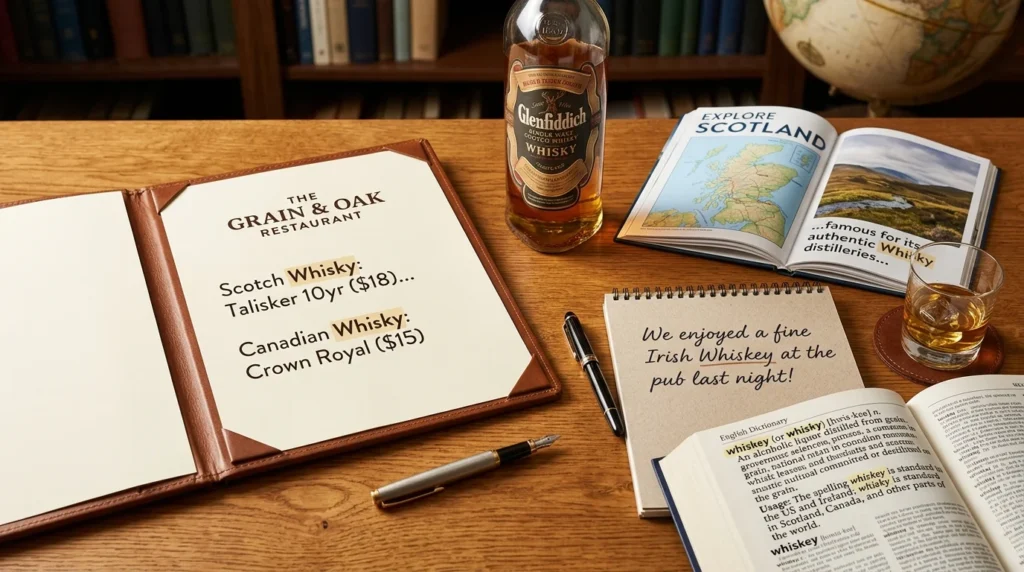
In a restaurant
A menu may list:
- Scotch whisky
- Irish whiskey
- American whiskey
- Japanese whisky
More examples
| Sentence | Correct spelling |
|---|---|
| I enjoy Scotch whisky. | whisky |
| She ordered Irish whiskey. | whiskey |
| American whiskey is exported worldwide. | whiskey |
| Japanese whisky has a strong global reputation. | whisky |
| Canadian whisky is sold in many countries. | whisky |
| He writes about bourbon and American whiskey. | whiskey |
Whisky or Whiskey – Trends & Usage Data
Google Trends is useful for comparing search interest, but it should not be treated as a dictionary or proof that one spelling is universally correct. Google explains that Trends shows how search interest changes across places and time.
For whisky and whiskey, country matters.
People in countries with strong Scotch, Irish, American, Canadian, or Japanese whisky traditions may search using the spelling they see most often on local products.
| Search context | Likely useful spelling |
|---|---|
| Scotch | whisky |
| Scottish whisky | whisky |
| Irish product | whiskey |
| American product | whiskey |
| Bourbon | whiskey |
| Canadian product | whisky |
| Japanese product | whisky |
| General comparison | whisky or whiskey |
Why search popularity can be misleading
A search comparison between whisky and whiskey does not automatically tell us which spelling is “correct.”
One country may search more for whiskey because American and Irish products are popular there. Another may search more for whisky because Scotch or Japanese whisky is more common.
Google Trends itself is designed to show search interest by time and place, so regional patterns matter.
Whisky vs Whiskey: Side-by-Side Comparison
| Feature | Whisky | Whiskey |
|---|---|---|
| Spelling | No e | Has e |
| Main association | Scotland | Ireland and United States |
| Scotch | Scotch whisky | Not the standard form |
| Irish | Less common, but officially possible in some contexts | Irish whiskey is customary |
| American | Used by some producers | Usually used |
| Canadian | Common | Less common |
| Japanese | Common | Less common |
| Pronunciation | Usually the same | Usually the same |
| Meaning | Broad spirit category | Broad spirit category |
| Main difference | Regional/product tradition | Regional/product tradition |
FAQs About Whisky or Whiskey
Is whisky or whiskey correct?
Both are correct. The spelling depends mainly on regional and product traditions.
Is whisky British or American?
Neither spelling belongs exclusively to one English variety. Whisky is strongly associated with Scotland, while whiskey is common in the United States and Ireland.
Is Scotch whisky or Scotch whiskey?
Scotch whisky is the standard spelling.
Is Irish whiskey spelled with an e?
Yes. Irish whiskey with an e is the customary spelling, although official Irish documentation allows both spellings in certain geographical-indication contexts.
Why is whiskey spelled with an e?
The spelling developed through regional language and production traditions, especially in Ireland and the United States. The e became part of the established spelling used in those traditions.
Do whisky and whiskey mean the same thing?
Broadly, yes. Both refer to the same family of distilled spirits, although individual countries have different production and labeling rules.
Do whisky and whiskey sound different?
Usually not. They are generally pronounced the same way in modern English.
Is bourbon whisky or whiskey?
Bourbon is a type of American whiskey. Therefore, “bourbon whiskey” is the usual form.
Does Canada use whisky or whiskey?
Canadian whisky is the common spelling.
Is Japanese whisky spelled with an e?
Usually no. Japanese whisky is the common spelling.
Is whiskey always American?
No. Irish whiskey is also standard. In addition, some American products use whisky without the e.
Which spelling should I use in an article?
Use the spelling that matches the product or tradition you are discussing. For example, write Scotch whisky, Irish whiskey, and American whiskey. If a brand uses a specific spelling, keep its official form.
Conclusion: Whisky or Whiskey?
So, whisky or whiskey—which one is correct? The answer is simple: both are correct.
The difference is mainly based on regional history, tradition, and product naming. Scotch whisky uses the spelling without the e. Irish whiskey and American whiskey normally use the e. Canadian and Japanese products commonly use whisky. But these are useful patterns, not rules without exceptions.
The easiest way to remember the difference is:
Scotch = whisky
Irish = whiskey
American = usually whiskey
Canadian = whisky
Japanese = whisky
There is also an important professional rule: always respect the official name of a product or brand. The United States, for example, now has an official standard for “American single malt whisky,” showing that even the usual American pattern has exceptions.
The spelling does not by itself change the meaning, pronunciation, or taste. It mainly tells you something about the tradition behind the product.
So, if you are writing about the drink in general, “whisky or whiskey” is the best comparison. If you are writing about a specific spirit, choose the spelling that belongs to that spirit and keep it consistent.

Victor Penhall is an English grammar specialist and writing coach, helping learners strengthen their language skills with clear rules, smart tips, and precise guidance.