
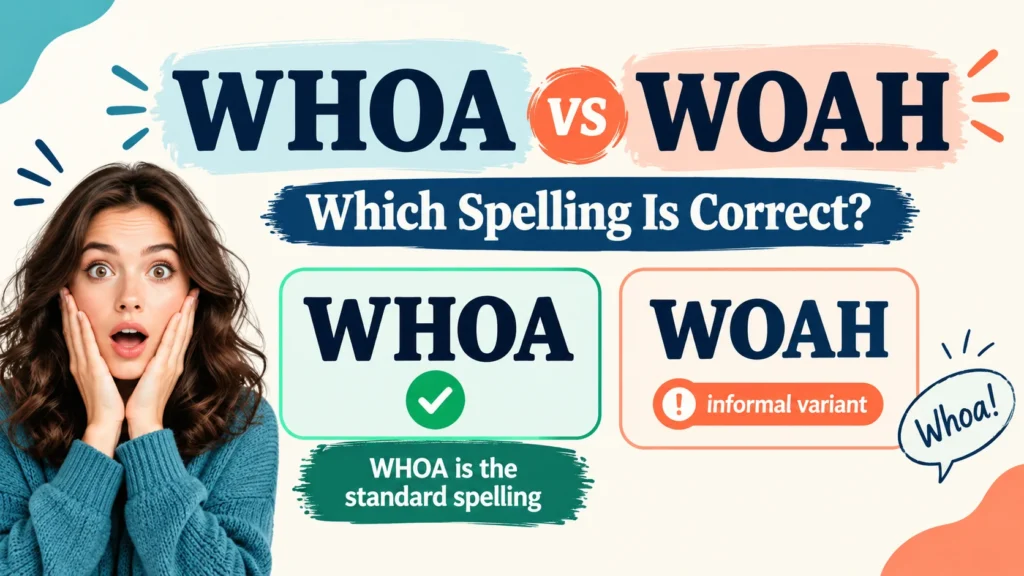
Have you ever seen something amazing and wondered whether to write “Whoa!” or “Woah!”? Both spellings appear in text messages, social media posts, songs, and everyday conversations. This can make it hard to know which form to choose. If you have searched for woah or whoa, you probably want a clear answer, a simple explanation, and examples you can use in real life.
The short answer is that whoa is the established standard spelling, while woah is a recognized alternative often used in informal writing. Both usually express the same feelings, such as surprise, excitement, disbelief, or amazement. They can also tell someone to stop or slow down. The main difference is how the words are written, not what they mean.
This spelling choice is not a simple British-versus-American English difference. Both forms appear in English-speaking countries, although whoa is the safer choice for schoolwork, professional writing, and edited content.
In this guide, you will learn the meaning, origin, pronunciation, and correct use of both forms. You will also find common mistakes, everyday examples, and answers to popular questions. By the end, you will know which spelling to choose and why.
Woah or Whoa – Main Difference
Whoa is the standard spelling. Woah is a common alternative, especially in informal writing. Both forms usually have the same meaning and pronunciation.
Use whoa when you want the safest spelling for general writing. You may use woah in a casual message, social media post, or creative dialogue.
Examples:
- Whoa, that car is fast! — Shows surprise.
- Whoa, wait a minute! — Asks someone to pause.
- Woah, your new room looks amazing! — Shows amazement.
- Whoa, I did not expect that! — Shows disbelief.
The meaning comes from the situation and tone. The spelling does not create a fixed difference in emotion.
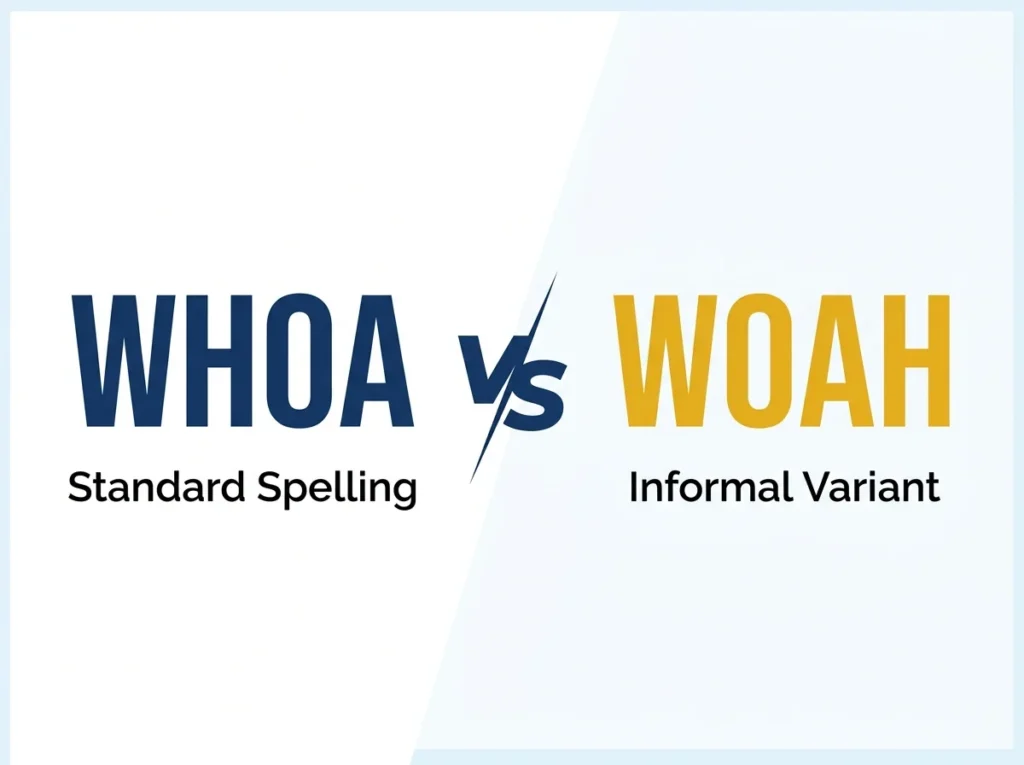
Is it woah or whoa?
If you are unsure, choose whoa. It is the established standard form and is suitable for most situations.
Woah is also widely understood. However, some editors and spell-checkers may prefer whoa or flag woah as nonstandard.
Woah or whoa meaning
Both spellings can express several reactions:
| Meaning | Example |
|---|---|
| Surprise | Whoa, you are here already! |
| Amazement | Whoa, this view is beautiful! |
| Disbelief | Woah, did that really happen? |
| Caution | Whoa, slow down! |
| A request to pause | Whoa, let me explain. |
These examples show that the same word can express different feelings. The context tells the reader what the speaker means.
The Origin of Woah or Whoa
The word whoa has a long history in English. Historical records trace it back to forms used in late Middle English, with evidence dating to around the 15th century. It is linked to older interjections such as ho, which were used to call attention or give commands.
Over time, whoa became familiar as a command to stop or slow down a horse. This use is recorded in the 19th century. Later, the word became common in everyday speech as an expression of surprise, excitement, or disbelief.
For example:
- “Whoa, stop the horse!”
- “Whoa, that was close!”
- “Whoa, I never knew that!”
The spelling woah appeared later as an alternative form. It became familiar in informal writing, including online conversations and popular culture. However, the exact path by which it spread is not fully established.
Why is whoa now spelled woah?
Whoa has not been replaced by woah. Both spellings continue to appear, but whoa remains the established standard form.
Several factors may explain why people use woah:
- Spelling habits: Some people write words in the way they think the sounds should look.
- Online communication: Informal spellings can spread quickly through messages and posts.
- Personal style: Some writers simply prefer the appearance of woah.
- Popular culture: Songs, videos, and online conversations can make alternative spellings more familiar.
These factors help explain the spelling’s visibility, but they do not prove that one spelling has replaced the other.
Is woah a real word?
Woah is a recognized alternative spelling of whoa. It is widely understood, and dictionaries may list it as a variant.
However, whoa is the established standard form. Some style guides and editors treat woah as nonstandard or informal.
This distinction matters: a form can be recognizable and widely used without being the preferred spelling in every type of writing.
British English vs American English Spelling
The difference between whoa and woah is not the same as familiar regional pairs such as colour and color. Those spellings follow established regional conventions. Whoa and woah are better understood as a standard form and an alternative spelling.
Both British and American English use whoa. Woah also appears in informal writing in both varieties.
Woah vs Whoa: Regional Usage
| Region | Recommended spelling | Informal usage |
|---|---|---|
| United States | Whoa | Woah also appears |
| United Kingdom | Whoa | Woah also appears |
| Canada | Whoa | Woah also appears |
| Australia | Whoa | Woah also appears |
| New Zealand | Whoa | Woah also appears |
| India | Whoa | Woah also appears |
| Ireland | Whoa | Woah also appears |
This table gives general writing advice. It does not mean that every person in these countries uses the spellings in the same way.
Does British English prefer woah?
There is no reliable general rule that British English prefers woah while American English prefers whoa. The standard spelling is whoa in both varieties.
For example:
American English: “Whoa, that was an amazing game!”
British English: “Whoa, that was a brilliant match!”
The spelling stays the same. The words around it may differ because of regional vocabulary, but this is not a spelling rule.
Which spelling is more correct?
Whoa is the safest choice for edited writing because it is the established standard form.
Woah is a recognized alternative that is especially familiar in casual communication. If you are writing for school, work, or a broad audience, use whoa unless you have a specific reason to choose the informal form.
Which Spelling Should You Use?
Your choice depends on your audience, purpose, and tone. In most cases, whoa is the better default because it is widely accepted and easy to recognize.
1. For American English
Use whoa in school assignments, articles, business emails, and other edited writing.
Example: “Whoa, I did not expect the results to be so good.”
You may also see woah in casual American conversations and online posts. Its use does not make it the standard spelling.
2. For British and Commonwealth English
Use whoa in the United Kingdom, Canada, Australia, New Zealand, India, and other English-speaking settings.
Example: “Whoa, that was a brilliant performance!”
There is no need to switch to woah because you are writing for a British or Commonwealth audience.
3. For social media and text messages
Both spellings can work in casual messages. Woah may give a message a more informal feel, while whoa follows the standard spelling.
Examples:
- “Whoa, that is incredible!”
- “Woah, I was not ready for that!”
- “Whoa, you have to tell me everything!”
Choose the form that fits your personal style, but remember that whoa is the safer option.
4. For school, work, and formal writing
If you need an interjection, whoa is the preferred spelling.
However, even the standard spelling may sound too casual in a formal report or academic essay. In those settings, it is often better to express the idea directly.
Instead of writing:
“Whoa, the results increased a lot this year!”
Write:
“The results increased significantly this year.”
The second sentence is more precise and professional.
5. For a global audience
Choose whoa when writing for readers from different countries. It is the established standard spelling and is less likely to be treated as an error.
Easy rule to remember: Use whoa by default. Choose woah only when its informal style suits your purpose.
Pricey or Pricy: Both Are Correct, but Which Is Common?
Common Mistakes with Woah or Whoa
Although the difference is small, a few common mistakes can cause confusion. These tips will help you choose the right form.
Mistake 1: Thinking woah is always the only correct spelling
Some people assume that woah must be correct because they see it often online. Others believe it is never acceptable.
A better understanding is that whoa is the established standard spelling, while woah is a recognized alternative often treated as informal.
- Standard: “Whoa, that is amazing!”
- Informal alternative: “Woah, that is amazing!”
Mistake 2: Assuming the two spellings have different meanings
There is no fixed rule that whoa expresses surprise while woah expresses excitement. Both can express the same feelings.
Examples:
- “Whoa, wait for me!”
- “Woah, wait for me!”
In both sentences, the speaker asks someone to pause or wait. The meaning comes from the words and situation around the interjection.
Mistake 3: Calling woah the British spelling
Whoa is the established standard spelling in both British and American English. Woah is used informally across different English-speaking communities.
Do not treat the two forms as a regular US-versus-UK spelling pair.
Mistake 4: Confusing whoa with wow or woe
These words may appear in similar situations, but they do not mean exactly the same thing.
| Word | Meaning | Example |
|---|---|---|
| Whoa | Surprise, caution, or a request to stop | Whoa, slow down! |
| Wow | Surprise or admiration | Wow, that is beautiful! |
| Woe | Great sadness or trouble | The story tells of his woe. |
Use wow when praising something or showing admiration. Use whoa when reacting strongly, expressing surprise, or asking someone to stop.
Mistake 5: Using woah in every type of writing
Informal spelling may fit a text message but look out of place in a formal report.
Casual: “Woah, that is a huge change!”
Professional: “That is a significant change.”
The second example is more suitable for formal communication. The choice is not just about spelling; it is also about tone.
Mistake 6: Assuming the pronunciation changes with the spelling
Whoa and woah are generally pronounced the same way. Changing the order of the letters does not create a reliable difference in meaning or pronunciation.
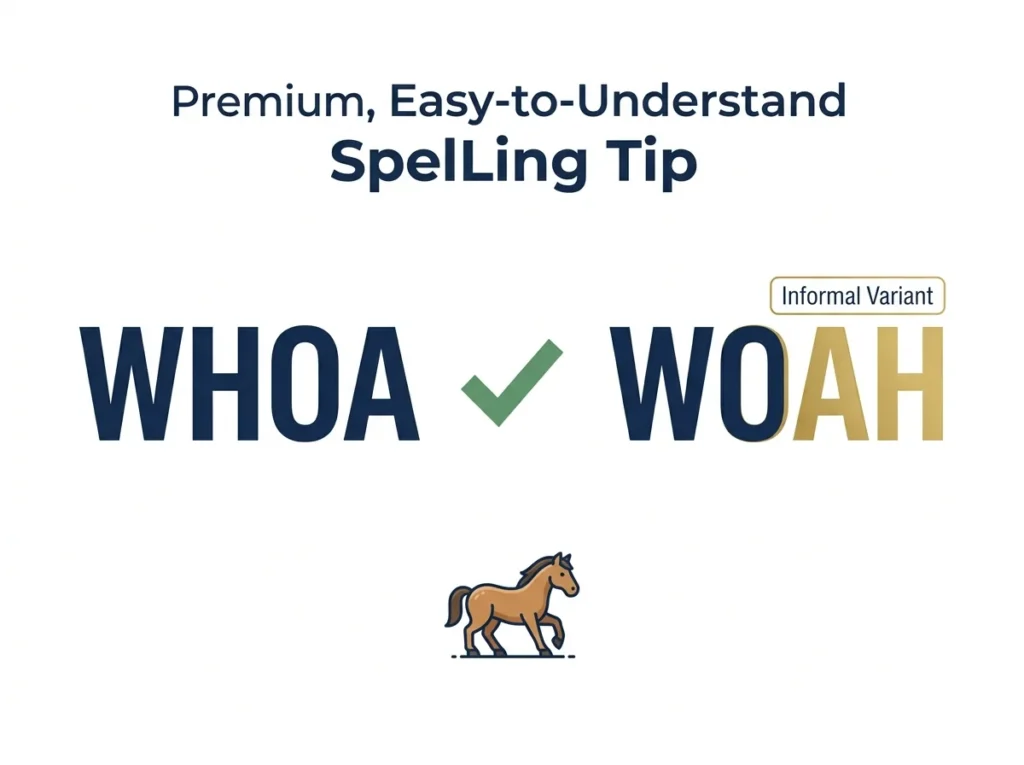
A simple trick to remember whoa
Think of the word horse. Whoa has its h near the beginning, just as horse begins with h.
When you want to remember the standard spelling, picture a rider saying, “Whoa!” to stop a horse.
This small memory trick can help you remember the spelling when you need it.
Smoky or Smokey: The Difference & When to Use Each
Woah or Whoa in Everyday Examples
Both forms are common in casual communication. The examples below show how they work in different settings and when another expression may be more suitable.
1. In text messages
Friends often use whoa or woah to react quickly to news.
Examples:
- “Whoa, you got the job!”
- “Woah, that is a huge surprise!”
- “Whoa, you finished the whole book?”
Both spellings are likely to be understood. Whoa is the standard choice, while woah gives the message an informal feel.
2. In social media posts
People use these words to react to photos, videos, achievements, and surprising news.
Examples:
- “Whoa, this sunset is unreal!”
- “Woah, I was not ready for that ending.”
- “Whoa, what an incredible performance!”
Social media often includes playful spelling choices. Still, popularity in posts does not make an alternative spelling the standard form.
3. In emails
The best choice depends on the reader and the purpose of the email.
Casual email:
“Whoa, that is great news! Congratulations!”
Professional email:
“That is excellent news. Congratulations on the achievement.”
Whoa is suitable for a friendly workplace message. In a formal business email, a direct sentence may sound more professional.
4. In news writing
News reports usually favor clear, direct language over casual interjections.
Conversational style: “Whoa, the results surprised everyone!”
News style: “The results surprised observers.”
The first sentence may fit a personal blog or social media caption. The second is more suitable for a formal report.
5. In creative writing
Writers can use whoa to show a character’s voice, surprise, or reaction.
Examples:
- “Whoa,” Mia said, stepping back.
- “Whoa! Did you see that?”
- “Whoa, let’s take a moment to think.”
Woah may also appear in dialogue when it suits a character’s informal style. Choose a spelling that fits the character and use it consistently.

6. In everyday speech
Whoa is often used when someone wants another person to stop, slow down, or pay attention.
Examples:
- “Whoa, watch where you are going!”
- “Whoa, hold on. Let me explain.”
- “Whoa, that was close!”
It can also show amazement:
- “Whoa, this place is beautiful!”
- “Whoa, I never knew that!”
7. Woah meaning in chat
In a chat, woah usually means the same thing as whoa. It can show that someone is surprised, impressed, shocked, or unsure how to respond.
Example:
Person A: “I just won a free trip!”
Person B: “Woah, seriously?”
Woah or Whoa – Google Trends and Usage Data
People search for both spellings because they see them in different places. Someone may read whoa in a book, see woah in a comment, and wonder which one to use.
To understand their popularity, it is important to separate three things: standard spelling, everyday usage, and search interest. These are related, but they are not the same.
Which spelling is more popular?
Whoa is the established standard spelling. Woah is also widely recognizable, especially in informal writing.
However, popularity can vary by platform, country, and time period. Without a verified Google Trends comparison for a specific date range, it would be misleading to claim exact search volumes or declare one spelling the winner in every country.
How does Google Trends compare the spellings?
Google Trends shows relative search interest over a selected time and region. Its scores are normalized, so they are not direct counts of every search or every time a word appears online.
A useful comparison would examine:
- Search terms: Woah and whoa.
- Location: Worldwide, followed by individual countries.
- Time period: The same date range for both terms.
- Search type: Web Search, with other search types examined separately if useful.
The results may help show where interest is stronger, but they do not determine which spelling is standard.
Why do people search for woah or whoa?
Common reasons include:
- Checking the correct spelling.
- Understanding the meaning of the word.
- Learning how to pronounce it.
- Understanding a message from a friend.
- Choosing the right spelling for school or work.
- Finding out why both spellings appear online.
These questions explain why spelling, meaning, pronunciation, and everyday examples are all useful parts of a complete guide.
Woah or whoa pronunciation
The two spellings are generally pronounced in the same way.
- British English: /wəʊ/
- American English: /woʊ/
Both pronunciations have one syllable. The vowel sound differs slightly between the two accents, but the spelling choice does not normally change the pronunciation.
You can use the word to express surprise with a strong voice or to ask someone to pause with a calmer tone.
Does Google Trends decide the correct spelling?
No. Search interest measures what people look for, not what is accepted as standard spelling.
An informal spelling can attract attention without replacing the established form. For writing advice, the key distinction remains simple: whoa is the standard choice, while woah is a recognized alternative often used informally.
Woah vs Whoa: Comparison Table
Use this table to review the main differences at a glance.
| Feature | Whoa | Woah |
|---|---|---|
| Spelling status | Established standard | Recognized alternative |
| Meaning | Surprise, amazement, caution, or a request to stop | Usually the same |
| Pronunciation | Usually the same as woah | Usually the same as whoa |
| British English | Standard form | Informal usage |
| American English | Standard form | Informal usage |
| Formal writing | Preferred if an interjection is needed | Often avoided |
| Text messages | Suitable | Common and casual |
| Social media | Suitable | Common and casual |
| Best advice | Use by default | Use when the informal style fits |
The main difference is the spelling, not a separate meaning. If you need a reliable choice, use whoa.
FAQs About Whoa or Woah
1. Is it woah or whoa?
Whoa is the established standard spelling. Woah is a recognized alternative that is often used informally. Both usually express the same feelings, but whoa is the safer choice for school, work, and edited writing.
2. What does whoa mean?
Whoa is an interjection that can express surprise, amazement, or disbelief. It can also tell someone to stop or slow down.
Example: “Whoa, wait a minute!”
3. What does woah mean in slang?
In slang and casual online writing, woah usually means surprise, shock, excitement, or amazement. Its meaning is generally the same as whoa.
Example: “Woah, that was unexpected!”
4. Why is whoa sometimes spelled woah?
Woah is an alternative spelling that developed later than whoa. It appears in informal writing and popular culture, but there is no single confirmed explanation for why every writer chooses it.
5. When should I use woah?
You can use woah in casual chats, comments, and creative dialogue when you want an informal tone. For schoolwork, professional writing, or situations where you are unsure, choose whoa.
6. Is woah or whoa correct in British English?
Whoa is the established standard spelling in British English. Woah also appears as an alternative, but it is not a separate British spelling rule.
7. Is woah or whoa correct in American English?
Whoa is the established standard spelling in American English too. Woah is a common informal alternative, especially in online conversations.
8. How do you pronounce woah or whoa?
Both are generally pronounced as one syllable. The common British pronunciation is /wəʊ/, while the common American pronunciation is /woʊ/.
9. Is woah a spelling mistake?
Woah is a recognized alternative spelling, but some editors and style guides treat it as nonstandard or informal. Whoa is the safer choice for edited writing.
10. Should I write whoa or wow?
Use whoa when you want to express surprise, signal caution, or ask someone to stop. Use wow when you want to show admiration or amazement.
Examples:
- “Whoa, slow down!”
- “Wow, your painting is beautiful!”
Both can express surprise, but they are not interchangeable in every situation.
Conclusion: Woah or Whoa?
When choosing between woah or whoa, remember that whoa is the established standard spelling. It is suitable for general writing in British English, American English, and other English-speaking regions. It can express surprise, amazement, disbelief, or a request to stop. It is also the safer option for school assignments, articles, and professional communication.
Woah is a recognized alternative that appears often in casual messages, social media posts, and creative dialogue. It usually carries the same meaning and is generally pronounced in the same way as whoa. However, some editors and style guides may treat it as nonstandard or informal, so it is not always the best choice for edited writing.
The difference is not a simple British-versus-American spelling rule. Both forms appear across English-speaking communities, but whoa remains the more reliable choice when you need standard spelling.
If you are still wondering, “Is it woah or whoa?” choose whoa when in doubt. Remember the horse example: a rider says “Whoa!” to ask a horse to stop. This simple trick can help you remember the spelling and use it with confidence.

Sophia Langley is an English grammar specialist and writing coach, passionate about simplifying language rules and empowering learners to write with clarity and confidence.
Pingback: Yogurt vs. Yoghurt: Spelling Differences Explained