
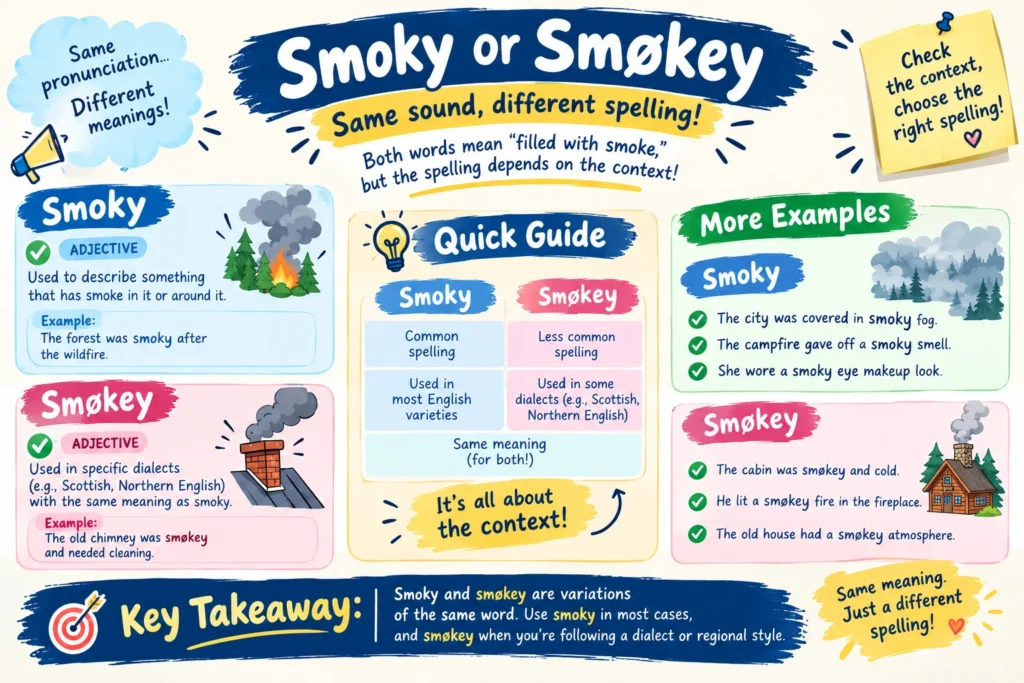
You have seen it written two ways. A menu says “smoky flavor.” A cartoon bear is called “Smokey.” Your friend texts about her “smoky eye” makeup, but her phone changes it to “smokey.” So which spelling is right?
This tiny confusion sends thousands of people to Google every month. Writers need the correct spelling for emails, essays, and menus. Students fear losing marks. Brands need the right word on the package. Bloggers want posts that rank. No more guessing before you hit send.
The good news: the rule is simple. In this guide, you get a quick answer first. Then the full story: word origin, British vs American rules, proper-noun exceptions like Smokey Bear and the Great Smoky Mountains, everyday examples, and search data. We also answer the most asked questions. Let’s settle it once and for all — by the end, you will never pause over that letter E again.
Smoky or Smokey – Main Difference
Use “smoky” (no E). It is the standard spelling in both American and British English.
Smoky meaning: full of smoke; tasting or smelling of smoke; having a gray, smoke-like color.
- The room was smoky after the candles burned out.
- This cheese has a smoky taste.
- She chose a smoky blue paint.
“Smokey” is a variant spelling. You will meet it in proper nouns like Smokey Bear — but in your own writing, stick with smoky.
The Origin of Smoky
“Smoky” is old. It comes from Middle English “smoki,” built from “smoke” + “-y.” That “-y” turns nouns into adjectives — like “rain” to “rainy.”
The trouble started with the silent E. “Smoke” ends with E. When writers added “-y,” some kept the E and wrote “smokey.” Others dropped it and wrote “smoky.” For centuries, both forms lived side by side in print.
Then dictionaries picked a winner. Major dictionaries list “smoky” as the headword and “smokey” only as a variant. That is why the standard smoky or smokey spelling today has no E.
Names play by their own rules. Smokey Bear was named in the 1940s, and names freeze the spelling of their time — his E stayed. The Great Smoky Mountains went the other way, with no E.
English does this a lot. Think of “whisky” vs “whiskey.” Small letters wander; dictionaries pin them down.
British English vs American English Spelling
Many expect a US/UK split here. There is none. The smoky or smokey British debate ends exactly like the American one.
The Oxford dictionary lists “smoky” as the headword and marks “smokey” as a variant. American dictionaries agree. Schools in both countries teach “smoky.”
| Smoky | Smokey | |
|---|---|---|
| Standard adjective (US) | ✅ Correct | ❌ Variant |
| Standard adjective (UK) | ✅ Correct (Oxford) | ❌ Variant |
| Proper nouns | Great Smoky Mountains | Smokey Bear |
| Safe for all writing | Yes | No |
Which Spelling Should You Use?
Match the spelling to your reader:
- Emailing a US client? Write “smoky.” The US standard is “smoky.”
- Writing a UK exam? Write “smoky.” Same rule across the ocean.
- Posting for a global audience? Write “smoky.” It is correct everywhere.
- Naming a brand or character? Your call — but “smoky” reads standard, “smokey” reads playful or vintage.
- Mentioning the bear or the mountains? Copy the official name: Smokey Bear, Great Smoky Mountains.
Common Mistakes with Smoky
- “Smokey Mountains” → Wrong. It is the Great Smoky Mountains (no E). The most common error of all.
- “Smokey eye” → Wrong. The makeup look is always the smoky eye.
- “Smokey quartz” → Wrong. The gemstone is smoky quartz.
- “The UK spells it smokey” → Wrong. British English uses smoky too.
- “Smokey air” in news reports → Wrong. Wildfire coverage should say smoky air.
Through or Thru: The Real Difference & When to Use Each
Smoky in Everyday Examples
- Email: “The office had a smoky smell after the fire drill, so we opened the windows.”
- News: “Smoky air covered the city as wildfires spread through the hills.”
- Social media: “That smoky eye look 😍 — tutorial please!”
- Formal writing: “The wine had a deep, smoky finish with notes of oak.”
- Food: On a menu, write “smoky barbecue sauce” for that smoky flavor — never “smokey.”
Smoky – Google Trends & Usage Data
What does search data show? A clear gap. In books, news sites, and dictionaries, “smoky” appears far more often than “smokey” — in the US and the UK alike. The “smokey” searches that do exist mostly belong to one proper noun: Smokey Bear.
Related searches follow real life. “Smoky mountains” stays popular all year as a travel query. “Smoky eye” holds steady in beauty searches. “Smoky air” spikes during wildfire season. “Smoky quartz” moves in a small, steady niche.
Want proof on your screen? Open Google Trends, type “smoky” and “smokey,” and compare. You will see the gap in every English-speaking region. The data backs the dictionaries here.
“Nosey or Nosy: Both Spellings Are Correct—But Which Is Better?”
Smoky vs Smokey: Side-by-Side Comparison
| Variation | Correct form | Note |
|---|---|---|
| smoky or smokey (general use) | smoky | Standard adjective |
| smoky or smokey mountains | Great Smoky Mountains | Proper noun, no E |
| smoky or smokey bear | Smokey Bear | Proper noun, with E |
| smoky or smokey eye | smoky eye | Makeup term |
| smoky or smokey quartz | smoky quartz | Gemstone name |
| smoky or smokey air | smoky air | Weather and news |
| smoky or smokey for food | smoky flavor | Menus and recipes |
FAQs
1. Is it spelled smokey or smoky?
Smoky. That is the standard spelling in all major dictionaries.
2. Is it smokey or smoky in the UK?
Smoky. British English follows the same rule — Oxford confirms it.
3. Is there an E in Smoky?
Not in the standard adjective. The E appears only in proper nouns like Smokey Bear.
4. What does “smokey” mean?
The same as “smoky.” It is simply a variant spelling, mostly seen in names.
5. Is it smoky or smokey mountains?
The Great Smoky Mountains — no E. “Smokey Mountains” is a mistake.
6. Which is correct: smoky or smokey?
Smoky is correct for general use. Save “smokey” for proper nouns like Smokey Bear.
Conclusion
So, smoky or smokey? Choose “smoky.” It is the standard spelling in American and British English. Dictionaries list it as the headword. It fits every context — food, weather, makeup, and formal writing.
The E has only one home: proper nouns like Smokey Bear. That E is part of a name, not a spelling rule. The Great Smoky Mountains prove the point — even a famous name can drop the E.
Remember the pattern. Adjective? Write “smoky.” Name? Copy the official spelling. Doubt? Drop the E.
English spelling is full of small traps like this one. The writers who win are the ones who check once and remember forever. You just did the checking. Now write with confidence — in emails, essays, menus, and posts. Share this guide with anyone who writes. Students, bloggers, and marketers all trip on this word. One share can save someone a red mark. Your readers get clean, correct English — and you never pause over this word again.

Sophia Langley is an English grammar specialist and writing coach, passionate about simplifying language rules and empowering learners to write with clarity and confidence.
Pingback: Shiny or Shiney: The Spelling Mistake Behind the Extra “E”