
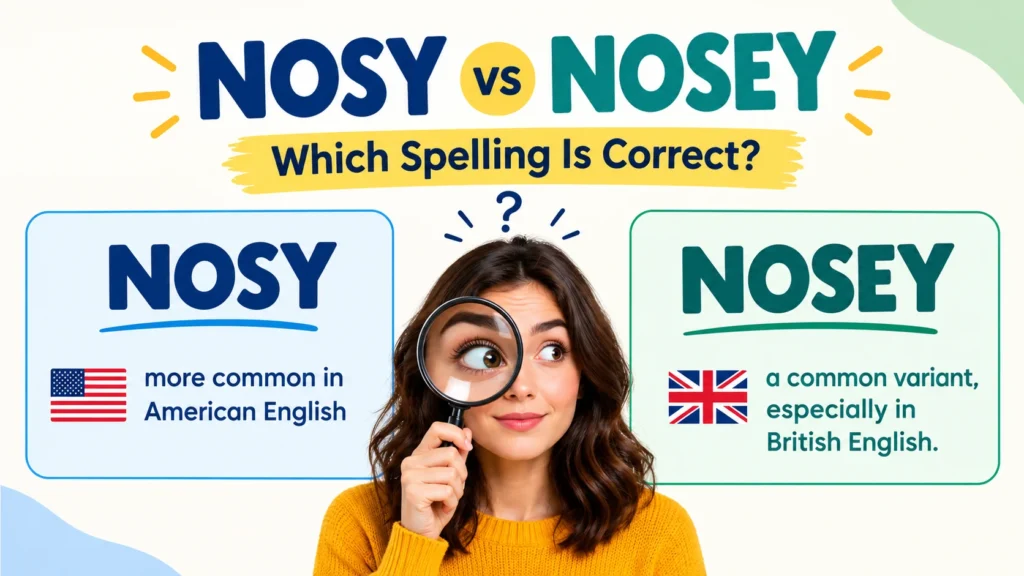
Have you ever typed nosey and wondered if it should be nosy instead? This small spelling difference causes a surprising amount of confusion. People often search nosey or nosy, is it nosey or nosy, or how do you spell nosey or nosy when writing about a curious friend, neighbor, coworker, or family member.
The good news is simple: both “nosey” and “nosy” are correct spellings. They have the same basic meaning and the same pronunciation. The main difference is that nosy is the main spelling used in modern English, while nosey is an accepted variant.
The word usually describes someone who is too interested in other people’s private business. For example, a person who asks personal questions, listens to private conversations, or wants to know everything about a neighbor may be called nosy or nosey.
In this guide, you will learn the nosey or nosy meaning, the history behind both spellings, British and American usage, pronunciation, related forms, common mistakes, and which spelling is the safest choice for your writing.
Nosey or Nosy – Main Difference
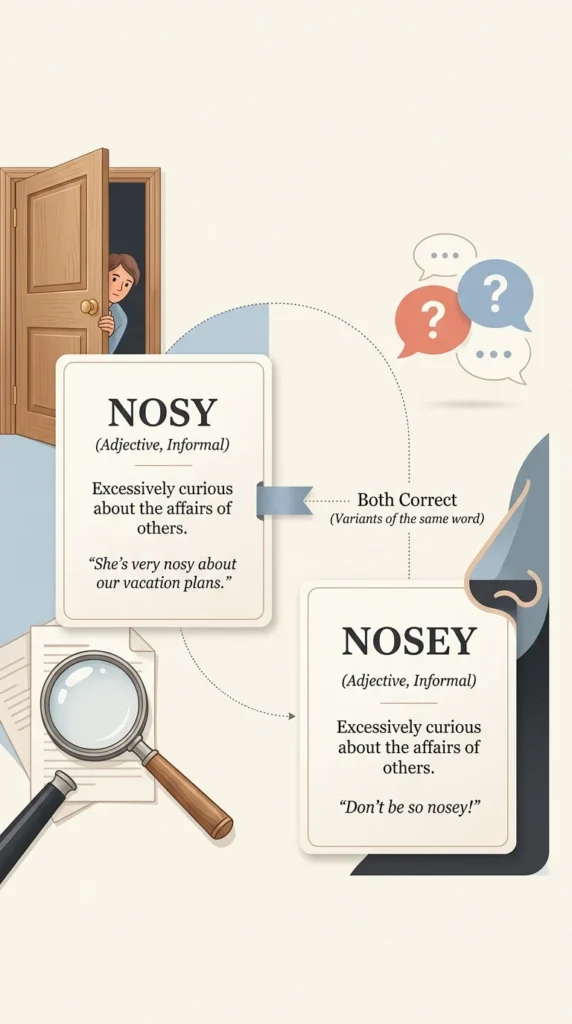
Both “nosy” and “nosey” are correct. They mean the same thing: being too interested in other people’s private affairs.
If you need one spelling for general writing, nosy is the safest choice. Nosey is also correct and is an accepted variant.
Quick rule
- Nosy = correct
- Nosey = correct
- Noisy = different word
- Nosy and nosey have the same meaning
- Nosy and nosey have the same pronunciation
- Nosy is the better general default
For example:
My nosy neighbor always asks where I am going.
You can also write:
My nosey neighbor always asks where I am going.
Both sentences are correct.
So, which is correct, nosey or nosy? The answer is both. If you are unsure which one to choose, use nosy.
What Does Nosey or Nosy Mean?
The nosey or nosy meaning is simple: it describes someone who is too interested in things that are private or do not concern them.
A nosy person may ask too many personal questions, try to find out private information, listen to conversations that are not meant for them, or interfere in other people’s affairs.
For example:
My neighbor is very nosy. She always asks who visits my house.
I don’t mean to be nosey, but where did you buy that dress?
The word is usually informal and mildly negative. However, it can also be playful between friends.
For example:
I’m just being nosy!
Here, the speaker may be joking rather than making a serious criticism.
Nosy vs Curious
Curious and nosy are related, but they are not always the same.
Curious usually means wanting to learn or know something. It can be positive or neutral.
She is curious about how the machine works.
Nosy usually suggests that the curiosity is unwanted or too personal.
She is nosy about her coworker’s salary.
So, someone can be curious without being nosy.
The Origin of Nosey or Nosy
The word nosy comes from the noun nose combined with the adjective-forming ending -y.
The connection is figurative. English has long used the idea of putting one’s nose into something to describe becoming involved in matters that are not one’s business. From this idea, nosy came to describe someone who pries into other people’s affairs.
The shorter spelling nosy became established as the main form. The spelling nosey also developed and remains an accepted variant.
This explains why both spellings can be found in English today.
The difference is therefore not a difference in meaning. It is mainly a difference in spelling preference.
It is also important not to treat nosey/nosy as exactly the same kind of regional spelling difference as color/colour or theater/theatre. Those pairs have a much clearer American-versus-British spelling pattern. With nosy and nosey, both forms can be encountered, and nosy is not limited to American English.
British English vs American English Spelling
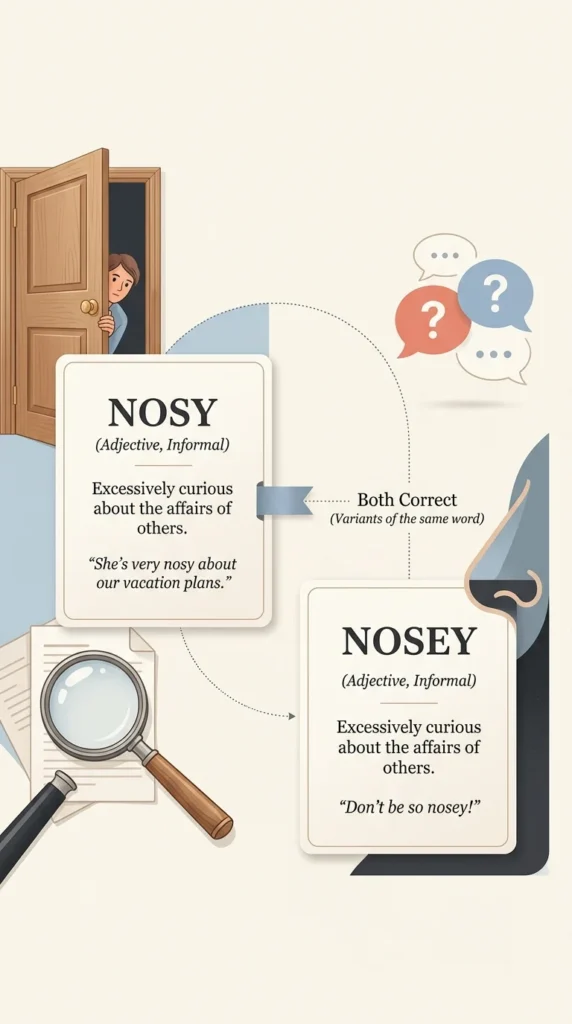
Both nosy and nosey are understood in British and American English.
American English generally favors nosy, making it the safest choice for US readers. In British English, nosey is a familiar and accepted variant, but nosy is also used.
So the difference should not be treated as a strict rule such as:
American = nosy
British = nosey
That is too simple.
A better rule is:
Nosy is the main general spelling. Nosey is an accepted variant, with especially familiar use in British English.
Nosey vs Nosy by English Variety
| Variety of English | Preferred/Safe Choice | Note |
|---|---|---|
| American English | nosy | The shorter form is the safest choice |
| British English | nosy / nosey | Both are understood; nosey is a familiar variant |
| Canadian English | nosy | Nosey is also understood |
| Australian English | nosy / nosey | Both forms may be encountered |
| New Zealand English | nosy / nosey | Both forms are understood |
| International English | nosy | A safe general choice |
Nosey or Nosy Side by Side
| Feature | Nosy | Nosey |
|---|---|---|
| Correct spelling? | Yes | Yes |
| Meaning | Too interested in other people’s affairs | Same |
| Pronunciation | Same | Same |
| Part of speech | Adjective | Adjective |
| Main general form | Yes | Variant |
| American English | Very common | Less common |
| British English | Used | Familiar variant |
| Formality | Informal | Informal |
| Example | She is nosy. | She is nosey. |
The most important point is that nosey is not a spelling mistake.
Through or Thru: The Real Difference & When to Use Each
Which Spelling Should You Use?
If you are wondering which form to type, the simplest answer is:
Use “nosy” as your default.
Nosy is the safer general choice because it is the main modern spelling and works well for American, international, and mixed audiences.
For example:
Don’t be nosy.
That nosy neighbor knows everyone’s business.
I was just being nosy.
When should you use “nosey”?
Use nosey if it matches the spelling style you prefer or the variety of English you are following.
For example:
Her nosey questions made everyone uncomfortable.
There is nothing wrong with this spelling.
For school or work
If your teacher, employer, publication, or style guide has a preferred spelling, follow it.
If there is no specific rule, nosy is a safe choice.
For British English
British readers will understand both forms. Nosey is perfectly natural, but nosy is not wrong.
For a global audience
Choose nosy if you want one simple spelling that is easy for readers across different English-speaking regions.
The most useful rule
Choose one form and stay consistent.
For example, if your article begins with:
My nosy neighbor asks too many questions.
Do not suddenly change to:
My nosey neighbor is always watching.
Both are correct, but switching between them without a reason can make your writing look inconsistent.
Common Mistakes with Nosey or Nosy
1. Thinking “Nosey” Is Wrong
This is a common mistake.
Nosey is an accepted spelling.
Do not automatically mark it as incorrect simply because nosy is more common.
2. Thinking “Nosy” Is Only American
That is also too strict.
Nosy is used in both American and British English.
British English can use nosey as a variant, but that does not make nosy an American-only spelling.
3. Confusing Nosy With Noisy
This is one of the most important spelling mistakes.
Nosy means overly curious.
Noisy means making a lot of sound.
Compare:
My nosy neighbor asks too many questions.
My noisy neighbor plays music all night.
The meanings are completely different.
4. Writing “Noisey”
Noisey is not the correct spelling of either word.
Use:
nosy
or:
nosey
Do not write:
❌ noisey
5. Assuming “Nosey” Must Keep the “e”
The word comes from nose, but the usual main spelling is nosy, not nosey.
Both forms are accepted, so you do not need to force the spelling to keep the original e.
6. Using “Nosy” When You Mean “Curious”
Not every person who wants information is nosy.
She was curious about the new job.
This is neutral.
She was nosy about her friend’s private relationship.
This suggests unwanted curiosity.
Choose the word based on the meaning you want.
Nosey or Nosy Grammar Forms
The adjective has several useful related forms.
Nosy
The basic adjective:
He is nosy.
Nosier
The comparative form:
My brother is nosier than I am.
Nosiest
The superlative form:
She is the nosiest person in the office.
The spelling follows the base form nosy:
nosy → nosier → nosiest
You can also use phrases such as:
more nosy
and
most nosy
depending on the sentence and style.
Nosily
Nosily is the adverb.
She looked nosily through the old photographs.
It means doing something in a nosy way.
Nosiness
Nosiness is the noun.
It means the quality or behavior of being nosy.
His nosiness annoyed his coworkers.
These forms are useful because they show that nosy is more than just a word used in the phrase “nosy neighbor.”
Is “Nosey” or “Nosy” a Formal Word?
Both forms are generally informal.
They work well in:
- conversations
- text messages
- social media
- casual emails
- everyday writing
- informal stories
For formal writing, you may want a more precise word.
Instead of “nosy,” consider:
Curious – neutral or positive
She was curious about the results.
Inquisitive – interested in learning
The student was highly inquisitive.
Prying – too interested in private matters
He asked several prying questions.
Intrusive – interfering with someone’s privacy
The reporter’s questions felt intrusive.
Meddlesome – interfering in other people’s affairs
His meddlesome behavior caused problems.
The best replacement depends on the exact meaning.
Perform or Preform: Meaning, Difference & Correct Usage
Nosey or Nosy in Everyday Examples
The word appears in many everyday situations.
Nosy Neighbor
This is one of the most common phrases.
Our nosy neighbor always wants to know when we get home.
You can also write:
Our nosey neighbor always wants to know when we get home.
Both are correct.
Nosy Person
He is a nosy person who asks very personal questions.
Being Nosy
Sorry for being nosy, but are you moving?
Nosy Questions
She asked some nosy questions about my relationship.
In an Email
In a casual email, you might write:
I don’t mean to be nosy, but did you decide where you’re going on vacation?
For a professional email, a softer phrase may be better:
I hope you don’t mind me asking, but have you decided where you’re going?
In News Writing
The word may appear in a quote or informal description:
The actor joked about nosy reporters asking about his private life.
For more formal reporting, intrusive or prying may be a better choice.
On Social Media
Why are people so nosy today?
My nosey friend somehow knows everything!
In Formal Writing
Instead of:
The interviewer asked nosy questions.
You could write:
The interviewer asked intrusive questions.
The second sentence sounds more formal and precise.
Nosey or Nosy Pronunciation
Nosey and nosy are pronounced the same way.
The spelling does not change the pronunciation.
In American English, the pronunciation is roughly:
NOH-zee
In British English, it is also pronounced with the same basic two-syllable sound.
So:
nosy = nosey
when spoken aloud.
This is why the spelling difference can be confusing. You can hear the word correctly without knowing which spelling the writer has chosen.
Nosy, Nosey, and Noisy
| Word | Meaning | Basic pronunciation |
|---|---|---|
| nosy | Too interested in private matters | NOH-zee |
| nosey | Same meaning as nosy | NOH-zee |
| noisy | Making a lot of sound | NOY-zee |
A useful memory trick is:
Nosy/nosey → nose → too interested
Noisy → noise → too loud
Nosey or Nosy in British English
The question “nosey or nosy UK” deserves a clear answer.
British English uses both spellings.
Nosey is a familiar British variant, while nosy is also a valid spelling. Therefore, it is not accurate to say that British English allows only nosey.
For example, a British writer may say:
Don’t be so nosey.
Another British writer may write:
Don’t be so nosy.
Both can be understood with the same meaning.
“Have a Nosy”
British informal English also uses nosy as a noun.
For example:
Let’s have a nosy around the new shop.
Here, a nosy means a look around or a quick look at something out of curiosity.
You may also see:
Have a nosey around.
This is a useful example of how the word can appear beyond the usual adjective use.
What Is a Nosy Parker?
Nosy Parker is an informal expression for a person who is too interested in other people’s business.
It is especially associated with British English.
For example:
Don’t be such a nosy Parker!
It has the same basic idea as calling someone nosy or nosey, but the expression is more playful and colorful.
Nosey or Nosy Synonyms
The best synonym depends on how negative or positive you want the sentence to sound.
| Word | Typical meaning or tone | Example |
|---|---|---|
| curious | Neutral or positive interest | She is curious about science. |
| inquisitive | Eager to learn | He is an inquisitive student. |
| prying | Too interested in private matters | She asked prying questions. |
| intrusive | Unwanted involvement | The questions were intrusive. |
| meddlesome | Interfering in other people’s affairs | His meddlesome behavior caused trouble. |
| interfering | Getting involved when not wanted | She found him interfering. |
Nosy usually has a mildly negative meaning, but it can also be used playfully.
Nosey or Nosy – Google Trends & Usage Data
Search interest in nosey and nosy changes by country and by the wording people use.
The most important usage pattern is that nosy is the main general spelling, while nosey remains a recognized variant. American searches and writing tend to favor nosy, while British searches may show both forms, with nosey being especially familiar.
Searches also reveal different types of user intent.
Someone searching:
nosey or nosy meaning
probably wants a definition.
Someone searching:
nosey or nosy UK
is likely trying to choose the spelling used in British English.
Someone searching:
nosey or nosy pronunciation
wants to know whether the two forms sound different.
Someone searching:
nosy or noisy
is dealing with a completely different spelling and meaning problem.
Searches for:
- nosey or nosy neighbors
- being nosey or nosy
- nosey or nosy synonyms
- how do you spell nosey or nosy
- is it spelled nosey or nosy
show that people are looking for both spelling help and practical usage advice.
The key point is that search popularity does not make one spelling “correct” and the other “wrong.” Nosy is the safer general choice, while nosey remains an accepted variant.
Nosey or Nosy: Common Variations
| Expression | Meaning | Example |
|---|---|---|
| nosy person | Someone too interested in private matters | He is a nosy person. |
| nosey person | Same meaning | She is a nosey person. |
| nosy neighbor | A neighbor who asks too many personal questions | Our nosy neighbor called again. |
| nosey neighbor | Same meaning | Their nosey neighbor knows everything. |
| being nosy | Acting too curious | I was just being nosy. |
| being nosey | Same meaning | Sorry for being nosey. |
| nosy questions | Questions about private matters | He asked nosy questions. |
| nosey questions | Same meaning | She asked nosey questions. |
| nosier | More nosy | He became nosier after hearing the news. |
| nosiest | Most nosy | She is the nosiest person here. |
| nosiness | The quality of being nosy | His nosiness was annoying. |
| nosily | In a nosy manner | She looked nosily around the room. |
FAQs About Nosey or Nosy
Is it nosey or nosy?
Both nosey and nosy are correct. Nosy is the main general spelling, while nosey is an accepted variant. Both have the same meaning and pronunciation.
How do you spell nosey person?
You can write nosy person or nosey person. Both are correct. If you need one default spelling, nosy person is the safer choice.
What does being nosey mean?
Being nosey means showing too much interest in another person’s private business. Being nosy has the same meaning.
Is it a nosy or nosey neighbor?
Both nosy neighbor and nosey neighbor are correct. Nosy neighbor is the safer general choice, while nosey neighbor is also perfectly understandable.
Do Americans say nosey?
Yes. Americans understand and use nosey, but nosy is the more common and safer spelling for American writing.
Is nosy or noisy correct?
Both words are correct, but they have different meanings. Nosy means too curious about other people’s business. Noisy means making a lot of sound.
Is nosy a formal word?
No. Nosy is generally informal. In formal writing, words such as intrusive, prying, or overly curious may be more suitable.
Is nosey a British spelling?
Nosey is a familiar British variant, but it is not correct to say that British English uses only nosey. Nosy is also used in British English.
What is the comparative form of nosy?
The usual comparative form is nosier.
My sister is nosier than I am.
The superlative is nosiest.
He is the nosiest person in the office.
What is the noun form of nosy?
The noun is nosiness.
Her nosiness annoyed everyone.
In British informal English, a nosy can also mean a look around.
Can I use nosey in an essay?
You can, but remember that nosey is informal. If the essay is formal, a word such as intrusive, prying, or overly curious may be a better choice.
Conclusion: Nosey or Nosy
So, nosey or nosy? The simple answer is that both spellings are correct. They describe someone who is too interested in other people’s private affairs, and they are pronounced the same way.
If you need one spelling to use as your default, choose nosy. It is the main modern form and a safe choice for American, international, and mixed audiences. Nosey is not wrong, though. It is an accepted variant and is especially familiar in British English.
The two spellings should not be treated as a strict American-versus-British pair. British English can use both, just as American readers can understand both. The most important rule is to choose one spelling and use it consistently.
Also remember the difference between nosy and noisy. A nosy person is too curious about other people’s business, while a noisy person or place makes a lot of sound.
For formal writing, consider whether curious, inquisitive, prying, or intrusive expresses your meaning better. For everyday conversation, emails, and social media, nosy and nosey are both natural choices.

Victor Penhall is an English grammar specialist and writing coach, helping learners strengthen their language skills with clear rules, smart tips, and precise guidance.