
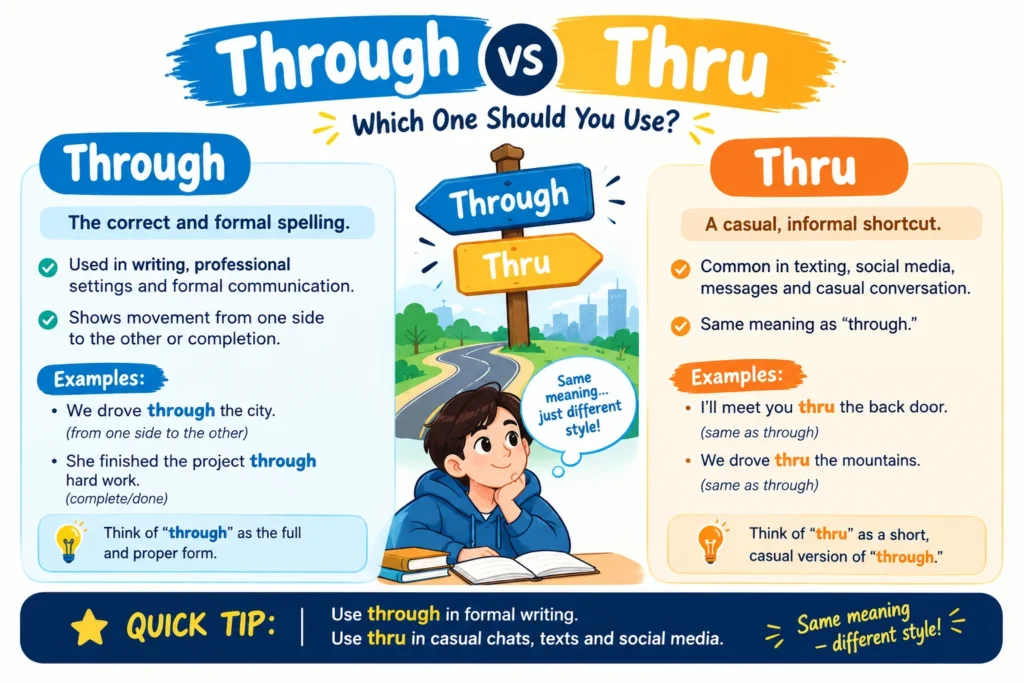
Have you ever typed a sentence and stopped to wonder, “Is it through or thru?” Both forms look familiar, and both are used in English. You may see through in books, emails, and formal writing, while thru appears on signs, menus, advertisements, and phrases such as drive-thru. This can make the difference seem confusing.
The answer is simple: through is the standard spelling, while thru is a shortened variant used mainly in informal, commercial, and space-saving contexts. In most cases, the two forms have the same basic meaning, but they are not equally suitable in every situation.
People also search for this spelling question when they are unsure about phrases such as walk through or thru, going through or thru, come through or thru, and through or thru for dates. Others confuse through with threw or trough because the words look or sound similar.
This guide explains the difference clearly. You will learn the meaning, history, regional usage, common mistakes, everyday examples, and the best choice for formal and informal writing.
Through or Thru – Main Difference
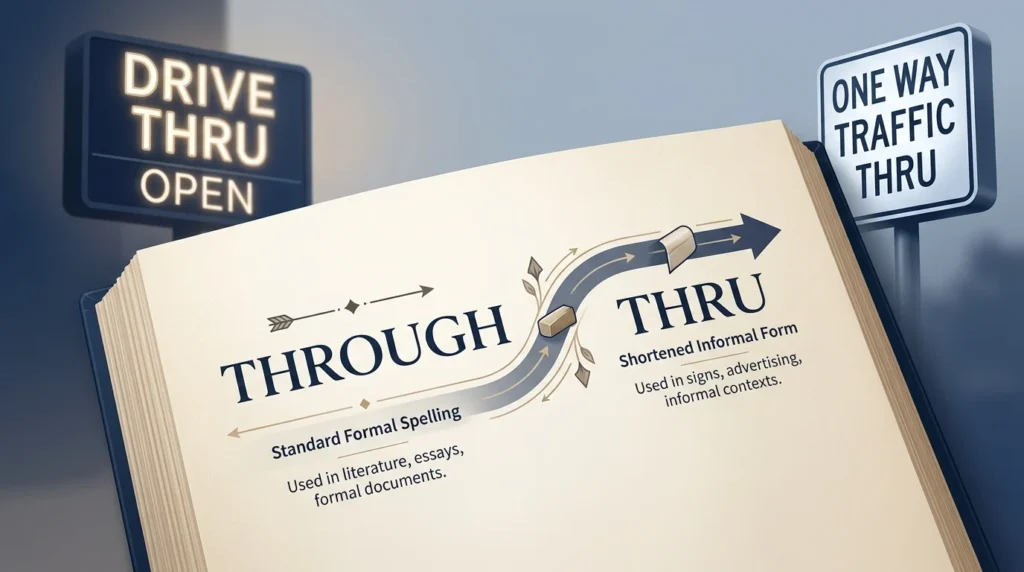
Through is the standard spelling. Thru is a shortened spelling that is mainly used in signs, advertising, labels, established expressions, and informal writing.
Use through in standard writing:
- We walked through the park.
- She read through the report.
- I worked through the night.
- The office is open Monday through Friday.
- The road goes through the tunnel.
Use thru mainly in shortened or informal contexts:
- Drive-thru
- No thru traffic
- Thru lane
- Some advertisements and signs
- Casual notes or messages
So, which is correct, through or thru?
Both forms are recognized, but through is the best choice for normal writing. Use it for schoolwork, business writing, professional emails, articles, reports, applications, and formal documents.
Does thru mean through?
Yes. Thru normally means the same thing as through. The main difference is not meaning. It is spelling, style, and context.
For example:
We walked through the park.
This is the standard form.
We walked thru the park.
The meaning is clear, but the second version is shortened and informal.
The easiest rule
If you are unsure, use through.
It is the standard form and works in almost every context.
The Origin of Through or Thru
The word through has a very old history. It comes from Old English þurh, a word used for the idea of passing from one side or end to another. Over time, its spelling changed as English developed.
Middle English used several forms, including spellings related to thurgh and throgh. English spelling was not always fixed, so words could have different forms in different periods and regions.
Eventually, through became the standard modern spelling.
Where did “thru” come from?
Thru is a much newer shortened spelling of through. It appeared in the 19th century and became especially associated with American English.
The basic idea was easy to understand: remove letters that are not needed to represent the sound.
So:
through → thru
The shorter form became useful because it saved space and was easy to read quickly.
It became especially common in:
- Signs
- Advertising
- Labels
- Road directions
- Commercial language
- Informal writing
- Short messages
However, thru did not replace through as the standard spelling.
That is why modern English has both forms, but they do not have equal status in every situation.
Why does “through” have so many meanings?
The word developed several related meanings over hundreds of years.
It can describe:
- Movement from one side to another
- Movement within something
- A period of time
- A range from one point to another
- A process
- A method or means
- Completion
For example:
We walked through the forest.
This describes movement.
She worked through the night.
This describes a period of time.
We are open Monday through Friday.
This describes a range.
He succeeded through hard work.
This describes a means or method.
These meanings are why through is such a common English word.
Perform or Preform: Meaning, Difference & Correct Usage
British English vs American English Spelling
The standard spelling is through in both British and American English.
The important difference is that thru is more strongly associated with North American informal usage, especially in signs, advertising, and commercial expressions.
It would therefore be wrong to say:
American English = thru
British English = through
That is too simple.
American English normally uses through too.
For example:
We walked through the city.
This is completely normal American English.
Comparison Table
| English variety | Standard form | Thru usage | Typical context |
|---|---|---|---|
| American English | through | More visible in signs and informal contexts | Drive-thru, signs, advertising |
| British English | through | Less common | Standard writing usually uses through |
| Canadian English | through | Sometimes seen informally | Signs and casual usage |
| Australian English | through | Less common | Standard writing |
| New Zealand English | through | Less common | Standard writing |
| International English | through | Limited | Professional and formal writing |
An important point about American English
American English does not normally spell the word thru in ordinary sentences.
For example:
I walked through the store.
not:
I walked thru the store.
However, American English has many familiar uses of thru in signs and commercial language.
Examples include:
Drive-thru
No thru traffic
Thru lane
So thru is better understood as a shortened variant, not simply the American spelling of through.
Which Spelling Should You Use?
If you are writing a normal sentence, choose through.
It is the safest and most professional option.
Use “through” for:
- School assignments
- University papers
- Business emails
- Job applications
- Reports
- Articles
- News writing
- Formal letters
- Professional websites
- Academic writing
- Official documents
- Most edited English
For example:
Please read through the report before the meeting.
This is the standard form.
When can you use “thru”?
Thru is useful when short wording is part of the style or purpose.
You may see it in:
- Road signs
- Restaurant signs
- Advertising
- Labels
- Casual notes
- Text messages
- Brand names
- Space-limited displays
- Established expressions
For example:
Drive-thru open until midnight.
Here, thru is familiar and works well in a short commercial expression.
Is “thru” wrong?
Not always.
Calling thru simply “wrong” misses an important part of modern English usage.
It is a recognized shortened form, but it is not the normal spelling for most sentences.
A better rule is:
Through = standard
Thru = shortened, informal, or context-specific
That distinction gives you better guidance than simply saying one is correct and the other is incorrect.
Through or Thru: Grammar and Meaning
Through can perform several grammatical roles.
Through as a preposition
We walked through the door.
It shows movement or passage.
Through as an adverb
The train passed through.
Here, it describes the direction or completion of movement.
Through as an adjective
The road is open to through traffic.
Here, it describes traffic that continues through an area rather than stopping there.
Through in phrasal expressions
It also appears in many common expressions:
- go through
- get through
- look through
- read through
- work through
- come through
- walk through
- break through
- follow through
- pull through
Because through works in so many grammatical and idiomatic ways, it is much more than a word that simply means “from one side to another.”
What about “thru”?
Thru is mainly a shortened spelling of through. It does not normally create a completely different meaning.
For most readers:
through
and
thru
represent the same basic word.
The difference is mainly the style of the spelling.
Benefiting or Benefitting: The Spelling Difference Explained
Common Mistakes with Through or Thru
Understanding the difference is easy once you know what mistakes to avoid.
Mistake 1: Using “thru” in formal writing
A business email might say:
Please review the document thru Friday.
A more polished version is:
Please review the document through Friday.
The second version is better for professional writing.
Mistake 2: Assuming “thru” is always incorrect
This is also a mistake.
Drive-thru is a familiar established expression.
You may also see thru on road signs and other space-limited displays.
So it is better to understand context rather than label every use of thru as an error.
Mistake 3: Confusing “through” and “threw”
These words sound alike but have different meanings.
Threw is the past tense of throw.
She threw the ball.
Through usually describes passage, movement, time, a process, or a means.
She walked through the door.
A useful memory trick is:
Threw = throw in the past
Through = passage or process
Mistake 4: Confusing “through” and “trough”
A trough is a different word.
It can mean:
- A long container for food or water
- A low area between higher areas
- A low point in a wave or weather pattern
Example:
The horse drank from the trough.
Compare:
The horse walked through the gate.
Mistake 5: Using “thru” simply because it is shorter
Shorter is not always better.
In texting, a short spelling may be fine. In an article, application, essay, or professional email, standard spelling usually looks clearer and more polished.
Mistake 6: Replacing “through” with “thru” everywhere
Some expressions have established forms that should be considered separately.
For example:
drive-thru
is very familiar.
But:
go thru the report
is simply an informal shortening of:
go through the report.
The context matters.
Through or Thru in Everyday Examples
The easiest way to understand the difference is to compare common phrases.
| Search phrase | Standard form | Shortened/informal form |
|---|---|---|
| walk through or thru | walk through | walk thru |
| going through or thru | going through | going thru |
| come through or thru | come through | come thru |
| coming through or thru | coming through | coming thru |
| paid through or thru | paid through | paid thru |
| it didn’t go through or thru | didn’t go through | didn’t go thru |
| through or thru traffic | through traffic | thru traffic |
| through or thru for dates | through | thru |
| read through or thru | read through | read thru |
| get through or thru | get through | get thru |
The rule remains the same: use through in standard writing; use thru when a shortened form fits the context.
Drive-through or drive-thru?
Both forms are used.
Drive-through is the standard spelling.
We stopped at the drive-through.
Drive-thru is a highly familiar shortened form, especially in restaurant names, signs, menus, and advertising.
The drive-thru is open all night.
This is one of the clearest examples of a shortened spelling becoming widely established in everyday commercial language.
Walk through or walk-thru?
For a normal verb phrase, use:
We walked through the building.
Here, through is a separate word.
You may see walk-thru as a shortened label, sign, or name, but it is not the form you should automatically use in normal prose.
Walk Through, Walk-Through, and Walkthrough
These forms can look confusing because they do not always serve the same grammatical purpose.
Walk through
Use this when walk is the verb and through describes movement.
We walked through the museum.
Walk-through
A hyphenated form may be used as a noun or modifier in some contexts.
The manager gave us a walk-through of the building.
Walkthrough
Walkthrough is also widely used as a noun, especially for a guided explanation or demonstration.
The tutorial includes a complete walkthrough.
So do not automatically replace every form with walk-thru.
The correct choice depends on what the word is doing in the sentence.
Through or Thru for Dates
One of the most common questions is whether to write:
June 1 through June 10
or:
June 1 thru June 10
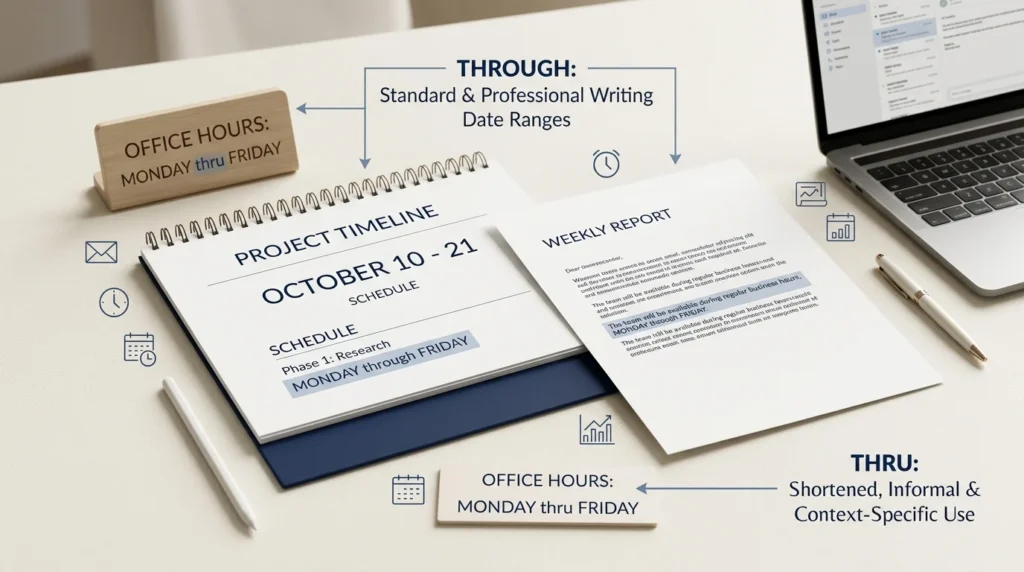
Both can be understood, but through is the standard choice in polished writing.
Examples
The office is closed Monday through Friday.
The sale runs June 1 through June 10.
Applications are accepted January through March.
In North American English, through can mean that the final date or number is included.
For example:
Open Monday through Friday.
This normally means the office is open on Monday, Tuesday, Wednesday, Thursday, and Friday.
What about British English?
British English often uses to for ranges:
Monday to Friday
June 1 to June 10
British English can also use through, especially where North American usage or a particular style calls for it.
The important point is that thru is not required for date ranges.
For formal writing, use:
Monday through Friday
rather than:
Monday thru Friday
Through or Thru in a Sentence
Here are practical examples showing how the standard form works.
Movement
The children ran through the garden.
Reading
I read through the entire report.
A process
We worked through the problem together.
Time
She stayed awake through the night.
Communication
The message came through clearly.
Means or method
He found the job through a friend.
Range
The store is open Monday through Saturday.
Completion
We finally got through the difficult part.
These meanings are all normal uses of through.
In casual writing, someone may shorten some of them:
I read thru the report.
But the standard form remains:
I read through the report.
Where Do We Use Through?
Through is used in several major situations.
1. Movement
It can show movement from one side, point, or area to another.
The train went through the tunnel.
2. A period of time
It can describe something continuing during a period.
She worked through the night.
3. A range
It can mark the beginning and end of a range.
Monday through Friday
Chapters 2 through 6
4. A process
It can describe dealing with or completing something.
He worked through his problems.
5. A means or method
It can show how something happened.
We learned about the opportunity through a friend.
6. Successful completion
It can appear in expressions about finishing or surviving something.
We finally got through the difficult week.
This wide range of meanings is one reason through is so common in English.
Through or Thru Synonyms
There is no single synonym for through because its meaning changes with context.
When “through” means movement
Possible alternatives include:
- across
- via
- from one side to another
Example:
We walked through the tunnel.
Depending on the context:
We walked across the bridge.
The words are not always interchangeable, so the exact sentence matters.
When “through” means during a period
Possible alternatives include:
- during
- throughout
- for the duration of
Example:
She worked through the night.
A related alternative is:
She worked throughout the night.
When “through” means by means of
Possible alternatives include:
- via
- by
- with the help of
Example:
I found the job through a friend.
You could also say:
I found the job via a friend.
When “through” means from beginning to end
Possible alternatives include:
- throughout
- from beginning to end
- all the way through
Again, the best synonym depends on the sentence.
This is why through and thru are not simply synonyms in the usual sense. Thru is primarily an alternative spelling of through, while words such as across, via, and throughout can replace it only in certain meanings.
Through and Through or Thru and Thru?
The standard expression is:
through and through
It means completely, thoroughly, or in every part of someone’s character or nature.
For example:
She is a writer through and through.
He is a teacher through and through.
You may occasionally see thru and thru as a shortened or informal spelling, but through and through is the standard form.
So when writing an article, essay, email, or formal message, choose:
through and through
not:
thru and thru
Through or Thru in Different Types of Writing
| Type of writing | Best choice | Example |
|---|---|---|
| Academic essay | through | We studied the topic through several methods. |
| Business email | through | Please send the file through the correct channel. |
| Formal report | through | The process continued through June. |
| News article | through | Traffic moved through the city. |
| Website article | through | Learn how to work through the problem. |
| Social media | through or thru | Depends on tone |
| Text message | through or thru | Shortened form may be acceptable |
| Road sign | thru may appear | No thru traffic |
| Restaurant sign | drive-thru is common | Drive-thru open |
| Advertising | Either | Depends on style and space |
This makes the key rule easy:
Formal or polished writing → through
Short, casual, commercial, or space-limited writing → thru may be appropriate
Through or Thru – Usage and Search Trends
Search interest for through and thru needs to be understood in context.
The two spellings do not have the same role.
Through is a core English word with many meanings. People use it for movement, time, processes, ranges, communication, completion, and many common phrases.
For example:
- go through
- get through
- walk through
- read through
- work through
- come through
- through the night
- through the week
- through the process
Because of these many meanings, searches for through are not only about spelling.
Thru, on the other hand, has a narrower role. Searches and real-world uses often connect it with:
- drive-thru
- thru traffic
- thru lane
- casual writing
- signs
- advertising
- shortened date ranges
Regional pattern
The shortened form is particularly familiar in North American English, especially in commercial and sign language.
In British and other varieties of English, through remains the normal choice in standard writing, while thru has a more limited role.
What search trends can and cannot tell us
Search data can show what people type into search engines, but it does not automatically prove which spelling is grammatically “better.”
For this topic, context matters.
Someone searching drive-thru may not be asking about spelling at all. Someone searching through or thru is more likely looking for a writing rule.
So the most useful conclusion is:
Through has broader language use, while thru has a narrower and more context-specific use.
Through vs Thru: Complete Comparison
| Feature | Through | Thru |
|---|---|---|
| Standard spelling | Yes | No, not for most ordinary writing |
| Meaning | Main meanings of through | Usually the same |
| Formal writing | Preferred | Usually avoided |
| Academic writing | Preferred | Usually avoided |
| Professional emails | Preferred | Usually avoided |
| Casual texting | Common | Common as a shortening |
| Signs | Common | Common in some contexts |
| Advertising | Common | Often used |
| Drive-thru | Possible as drive-through | Very common |
| Date ranges | Preferred | Informal |
| US usage | Standard | More common in shortened contexts |
| UK usage | Standard | Less common |
| Main difference | Standard form | Shortened variant |
Through or Thru: A Simple Decision Guide
Still unsure?
Use this quick test.
Are you writing an essay?
Use through.
Are you writing a business email?
Use through.
Are you writing a report?
Use through.
Are you writing an article?
Use through.
Are you writing a formal application?
Use through.
Are you writing a casual text?
Thru may be acceptable, depending on your style.
Are you creating a short sign?
Thru may work when space is limited.
Are you referring to a restaurant’s “drive-thru”?
Drive-thru is a familiar established form.
Are you writing a date range?
Use through in polished writing:
Monday through Friday.
Are you unsure?
Use through.
That one choice will almost always be safe.
FAQs About Through or Thru
1. Is it through or thru?
Through is the standard spelling. Thru is a shortened variant commonly used in signs, advertising, commercial expressions, and informal writing.
2. Does thru mean through?
Yes. Thru normally has the same basic meaning as through. The difference is mainly spelling, style, and context.
3. What is thru used for?
Thru is mainly used as a shortened form in signs, advertising, labels, casual messages, and expressions such as drive-thru and no thru traffic.
4. When do you use through or thru?
Use through in standard, formal, professional, academic, and polished writing. Use thru when a shortened form suits a sign, advertisement, casual message, or established expression.
5. Which is correct, through or thru?
Through is the standard choice. Thru is also recognized, but it is more limited in use. If you are unsure, choose through.
6. Is thru acceptable in formal writing?
It is usually better to use through in formal writing. This includes essays, reports, applications, business emails, and professional articles.
7. Should I write drive through or drive-thru?
Both forms are used. Drive-through is the standard full form, while drive-thru is a very common shortened commercial form.
8. Should I write walk through or walk-thru?
Use walk through when you mean the verb phrase:
We walked through the building.
Walk-thru may appear as a shortened label or name, but it should not replace the normal verb phrase in every sentence.
9. Should dates use through or thru?
For polished writing, use through:
June 1 through June 10.
Thru may appear in informal or space-limited writing, but it is not the preferred standard form.
10. What is the difference between threw and through?
Threw is the past tense of throw:
She threw the ball.
Through describes passage, movement, time, a process, or a means:
She walked through the door.
11. What is the difference between trough and through?
A trough is a long container or a low area. Through describes passage, movement, time, a process, or another related idea.
The horse drank from the trough.
The horse walked through the gate.
12. Is “thru and thru” correct?
The standard expression is through and through.
He is a musician through and through.
Thru and thru may appear as an informal shortening, but it is not the standard form.
13. Where do we use through?
We use through for movement, time, ranges, processes, means, and completion.
Examples include:
through the door
through the night
Monday through Friday
work through a problem
through a friend
get through a difficult time
14. Is through more correct than thru?
For standard English writing, through is the preferred form. Thru is not simply meaningless or wrong; it is a shortened variant with a narrower range of appropriate uses.
Conclusion
When deciding between through or thru, the best general rule is simple: use through in standard writing and treat thru as a shortened form for specific contexts.
Through is the normal spelling in essays, reports, business emails, articles, applications, and professional communication. It is also the form used in ordinary sentences such as “walk through the door,” “work through the problem,” and “Monday through Friday.”
Thru is useful when brevity matters or when it is part of an established expression. That is why you may see drive-thru, no thru traffic, and similar forms on signs, advertisements, labels, and casual messages.
The two forms usually have the same basic meaning, but they do not have the same style. Also remember that threw is the past tense of throw, while trough is a different word for a container or low area.
So, if you are asking “through or thru?”, choose through when you want the standard, polished spelling. Choose thru only when the context specifically suits the shortened form.

Sophia Langley is an English grammar specialist and writing coach, passionate about simplifying language rules and empowering learners to write with clarity and confidence.