
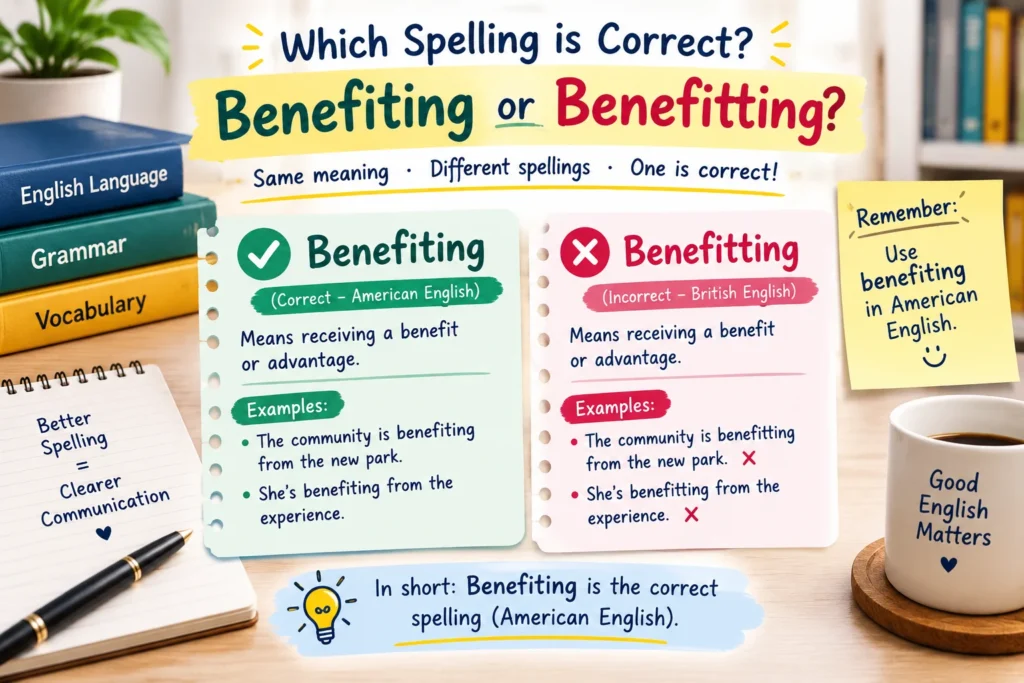
One extra t can make a simple English word surprisingly confusing: should it be benefiting or benefitting?
The good news is that both spellings are used in standard English. The difference is mainly a matter of spelling convention and regional preference, not meaning. Benefiting is especially common in American English, while benefitting is also well established, particularly in British English.
This is why you may see one spelling in an American article and the other in British writing. The same variation can appear in the past forms benefited and benefitted.
People often search for benefiting or benefitting because they want to know whether one spelling is wrong, whether the extra t should be doubled, and which version they should use in professional writing.
This guide gives you the quick answer first, then explains the spelling rule, word origin, US and UK usage, common mistakes, examples, style advice, and related forms. By the end, you will know exactly which spelling fits your audience.
Benefiting or Benefitting –Main Difference
Both “benefiting” and “benefitting” are correct spellings.
- Benefiting — widely used and especially common in American English.
- Benefitting — also correct and well established, especially in British English.
- Both mean receiving an advantage, help, or useful result.
Examples
The students are benefiting from the new course.
The students are benefitting from the new course.
The meaning is the same.
Is benefiting one T or two?
There are two accepted forms:
benefit → benefiting
benefit → benefitting
The first has one t. The second has two.
If you are writing for an American audience, benefiting is usually the safest choice. If you are following a British style that uses benefitting, that form is also correct.
What does benefiting mean?
Benefiting is the present participle of benefit. It means gaining an advantage or receiving help from something.
The company is benefiting from higher sales.
What does benefitting mean?
Benefitting has the same meaning and grammatical function.
The company is benefitting from higher sales.
There is no difference in meaning between the two spellings.
The Origin of Benefiting or Benefitting
The word benefit entered English through French from the Latin benefactum, meaning a good deed or beneficial act. It later developed into the modern noun and verb benefit.
As a noun, a benefit is an advantage or useful result:
Regular exercise has many benefits.
As a verb, benefit means to gain an advantage or help:
Regular exercise benefits your health.
When the verb takes the -ing ending, the spelling becomes benefiting or benefitting.
The reason both forms exist is linked to English spelling conventions for doubling a final consonant before an ending such as -ing or -ed. Different varieties and style traditions have treated this particular verb differently.
The usual consonant-doubling rule can be seen clearly in words such as:
- stop → stopping
- run → running
- permit → permitting
- begin → beginning
Stress is also important in many such spelling patterns. With benefit, however, usage has developed in a way that allows both benefiting and benefitting.
So this is not a case where one form is simply a spelling mistake. Both forms are established.
British English vs American English Spelling
The easiest way to choose between the two is to consider your audience and your overall spelling style.
| English variety | Common choice | Example |
|---|---|---|
| American English | benefiting | The company is benefiting from the change. |
| British English | benefiting / benefitting | The company is benefitting from the change. |
| Canadian English | benefiting / benefitting | Usage can vary by style and publication. |
| Australian English | benefiting / benefitting | Follow the preferred local style. |
| New Zealand English | benefiting / benefitting | Follow the preferred local style. |
| International English | Either | Choose one form and stay consistent. |
The important point is that the table shows usage tendencies, not absolute rules. It would be too simple to say that benefiting is only American or that benefitting is the only correct British form. Both spellings can appear in British and international writing.
Benefiting or benefitting in the UK
In UK English, benefitting is a well-established form, but benefiting is also used.
Therefore, if you are writing for a British audience, do not assume that one form is automatically wrong. The best choice is to follow the spelling style of the publication, organization, or document.
Benefiting or benefitting in the US
For American English, benefiting is the preferred everyday choice.
Employees are benefiting from the new policy.
If your website, report, or article follows American English, using benefiting throughout will usually give you the most natural and consistent result.
Benefiting or benefitting in Canada
Canadian English can reflect both British and American spelling influences. Benefiting is common, but benefitting can also be encountered.
For professional or academic writing, follow the style guide used by your school, employer, publisher, or organization.
Which Spelling Should You Use?
Use the spelling that matches your audience and overall English style.
For American English
Choose:
benefiting
The program is benefiting local businesses.
For British English
You can use:
benefitting
The programme is benefitting local businesses.
You may also encounter benefiting in British writing, so it is not automatically incorrect.
For Canadian English
Either form may be encountered. If you are writing professionally, use the spelling preferred by your chosen style guide.
For Australian or New Zealand English
Follow the spelling conventions of your publication or organization rather than assuming that every Commonwealth country uses exactly the same form.
For a global audience
Either spelling can work. The most important rule is consistency.
For example, do not write:
The company is benefiting from growth.
The employees are benefitting from the new policy.
unless you have a specific reason to show two regional forms.
Instead, choose one style:
The company is benefiting from growth.
The employees are benefiting from the new policy.
Or:
The company is benefitting from growth.
The employees are benefitting from the new policy.
Benefiting or Benefitting – Spelling Variations
These related forms are useful to know:
| Form | Correct? | Meaning / use |
|---|---|---|
| benefit | Yes | Base verb or noun |
| benefits | Yes | Present-tense verb or plural noun |
| benefiting | Yes | Present participle |
| benefitting | Yes | Alternative present participle |
| benefited | Yes | Past tense and past participle |
| benefitted | Yes | Alternative past tense and past participle |
Benefiting vs benefitting
Benefiting and benefitting mean the same thing.
She is benefiting from the training.
She is benefitting from the training.
Benefited vs benefitted
The same basic variation occurs in the past form.
She benefited from the training.
She benefitted from the training.
Neither pair changes the meaning of the sentence.
Common Mistakes with Benefiting or Benefitting
1. Saying “benefitting” is always wrong
It is not. Benefitting is an established spelling.
2. Saying “benefiting” is only American
That is also too absolute. Benefiting is widely used beyond the United States, including in British writing.
3. Mixing the two spellings
Switching between forms without a reason can make your writing look inconsistent.
Choose one spelling that fits your style and use it throughout.
4. Confusing benefiting with beneficial
These words are related but have different grammatical jobs.
Benefiting is a verb form:
Students are benefiting from the course.
Beneficial is an adjective:
The course is beneficial to students.
5. Using the wrong form after “did”
After did, use the base verb benefit, not benefited or benefitting.
Correct:
Did the students benefit from the course?
Incorrect:
Did the students benefited from the course?
Benefiting or Benefitting in Everyday Examples
In emails
Our team is benefiting from the new training program.
A British-style version may use:
Our team is benefitting from the new training programme.
In news writing
Local businesses are benefiting from increased tourism.
Or:
Local businesses are benefitting from increased tourism.
In social media
So many students are benefiting from free learning resources.
In formal writing
Employees are benefiting from the company’s updated policies.
In academic writing
Participants are benefiting from regular feedback throughout the study.
The spelling should match the English variety used in the rest of the paper.
With “benefit from”
The most common construction is:
benefit from + noun
Children benefit from regular exercise.
benefiting from + noun
Children are benefiting from regular exercise.
This is useful because benefiting from is often the phrase people are trying to spell correctly.
Acknowledgment or Acknowledgement: Which Spelling Should You Use?
Benefiting or Benefitting – Google Trends & Usage Data
Search interest in benefiting and benefitting can vary by country because people usually search using the spelling conventions they encounter in their own English variety.
In broad usage, benefiting has very strong visibility in American English and is also widely used internationally. Benefitting is also established and is particularly familiar to readers who follow British-style spelling.
Google Trends can help show where each search term is more popular, but search popularity should not be treated as a grammar rule. A term can receive more searches simply because a particular country has more users or because its spelling is taught more often.
For SEO, the best approach is therefore not to force both spellings into every paragraph. Explain the difference naturally and include the important variations where they genuinely help the reader:
- benefiting or benefitting
- benefiting or benefitting UK
- benefiting or benefitting US
- benefiting or benefitting Canada
- benefiting or benefitting meaning
- benefiting or benefitting spelling
- benefiting or benefitting grammar
This covers different search intents while keeping the article natural.
Benefiting or Benefitting AP Style
For American news and professional writing that follows AP style, benefiting is the practical form to use.
For example:
The company is benefiting from higher demand.
The important point is that AP style is a style choice, not a statement that benefitting is an invalid English word.
If you are writing for a publication, always follow its current house style when it gives a specific spelling preference.
Benefiting or Benefitting Oxford Dictionary
Dictionary entries can record more than one accepted form, and dictionaries may show regional or grammatical variations.
The important takeaway is that benefiting and benefitting are both established forms of the present participle of benefit. The choice is mainly about spelling convention, regional usage, and style.
If you are checking an Oxford or another major dictionary entry, look at the listed verb forms rather than assuming that an alternative spelling must be an error.
Recurring or Reoccurring: What’s the Difference?
FAQs About Benefiting or Benefitting
Is benefiting or benefitting correct?
Both are correct. Benefiting is especially common in American English, while benefitting is also well established, particularly in British English.
Is benefiting one T or two?
Benefiting has one t. Benefitting has two t’s. Both forms are used.
What is the meaning of benefitting?
Benefitting means receiving an advantage, gaining something useful, or being helped by something.
What is the difference between benefited and benefitted?
There is no difference in meaning. Both are past forms of benefit. Benefited is especially common in American English, while benefitted is also common in British English.
How do you spell benefited in English?
Both benefited and benefitted are accepted forms. Choose the version that matches your English variety and style guide.
Is benefiting correct in American English?
Yes. Benefiting is the preferred form for standard American English.
Is benefitting correct in UK English?
Yes. Benefitting is an established British English spelling. However, benefiting is also used in UK English, so the double-t form is not an absolute requirement.
Which is better for professional writing?
The best spelling is the one that matches your audience, publication, or style guide. For American professional writing, benefiting is the safest default. For British writing, benefitting is a common choice.
Conclusion
Benefiting and benefitting are both correct spellings of the present participle of benefit. They have the same meaning: receiving an advantage, help, or useful result from something.
The main difference is spelling preference. Benefiting, with one t, is especially common in American English and is also widely used internationally. Benefitting, with two t’s, is an established form that is particularly familiar in British English. Neither spelling should automatically be treated as an error.
The same variation appears in the past forms benefited and benefitted. The safest approach is to consider your audience and follow the style used throughout your writing.
If you write for a US audience, choose benefiting. If you follow a British style that prefers benefitting, use that form. For Canada, Australia, New Zealand, or international audiences, follow the relevant publication or house style when available.
Most importantly, be consistent. Once you choose a spelling, use it throughout the same article or document. That gives your writing a clean, professional, and intentional appearance.

Victor Penhall is an English grammar specialist and writing coach, helping learners strengthen their language skills with clear rules, smart tips, and precise guidance.
Pingback: Perform or Preform: Meaning, Difference & Correct Usage