
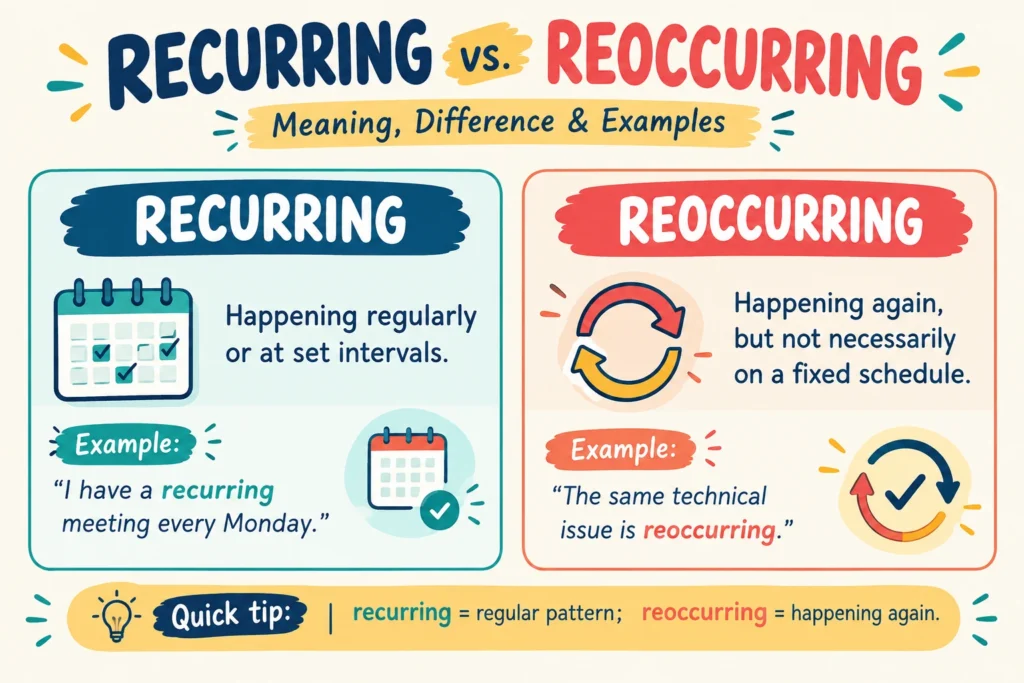
Have you ever wondered whether something that happens again should be called recurring or reoccurring? The two words overlap, so choosing between them can be confusing. In general, recurring describes something that happens repeatedly, often as part of a pattern or ongoing situation, while reoccurring emphasizes something happening again, sometimes after it has stopped or an earlier instance has ended.
For example, a recurring payment usually happens repeatedly on a schedule, while a problem that returns after seeming to disappear may be described as reoccurring. However, this distinction is not absolute, and the two words can be used interchangeably in some contexts. Recurring is also much more common and is often the better choice when you simply mean “happening repeatedly.”
In this guide, you’ll learn the difference between recurring and reoccurring, see clear examples, and discover which word fits different everyday, academic, and professional contexts.
Recurring or Reoccurring – Main difference
Both “recurring” and “reoccurring” are correct.
The usual distinction is:
- Recurring = happening repeatedly or returning over time, often as part of a pattern.
- Reoccurring = happening again after it has happened before.
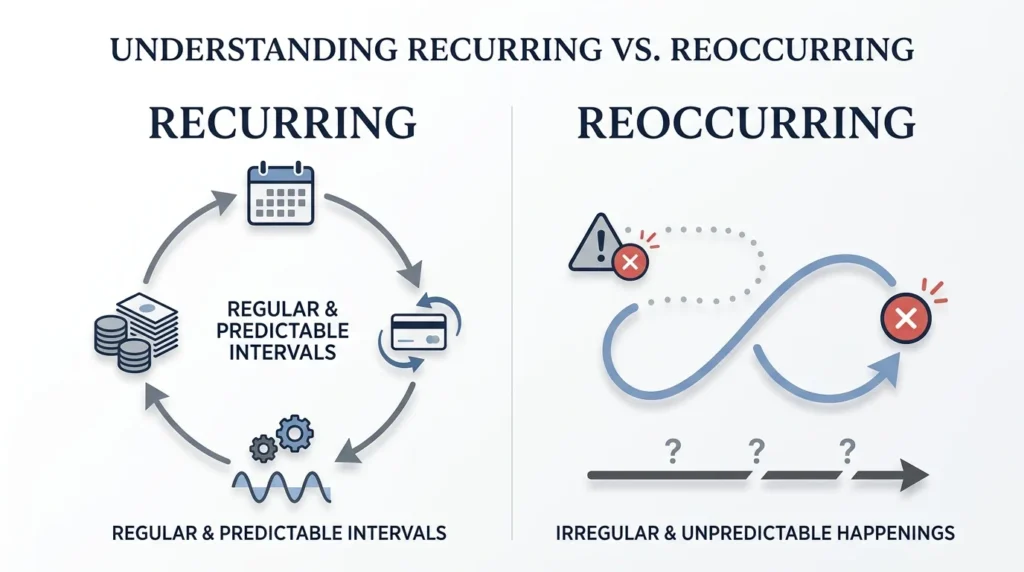
Simple examples
We have a recurring meeting every Monday.
The meeting follows a repeated schedule.
The same software error is reoccurring.
The error has appeared again.
Another useful way to remember it is:
Recurring = happening again and again.
Reoccurring = happening again.
However, this is a general usage distinction, not an absolute grammar rule. In many situations, the two words overlap.
For example:
She has a recurring problem with her computer.
and
She has a reoccurring problem with her computer.
Both sentences can be understood. The first puts more focus on the repeated nature of the problem. The second puts more focus on the problem appearing again.
Recurring vs Reoccurring at a glance
| Word | Main idea | Common examples |
|---|---|---|
| Recurring | Repeated or returning, often as a pattern | recurring payment, recurring meeting, recurring dream |
| Reoccurring | Happening again | reoccurring error, reoccurring issue, reoccurring problem |
So, if you mean something that repeatedly happens or keeps returning, recurring is often the more natural choice.
If you want to stress that something has happened again, reoccurring can fit well.
The Origin of Recurring or Reoccurring
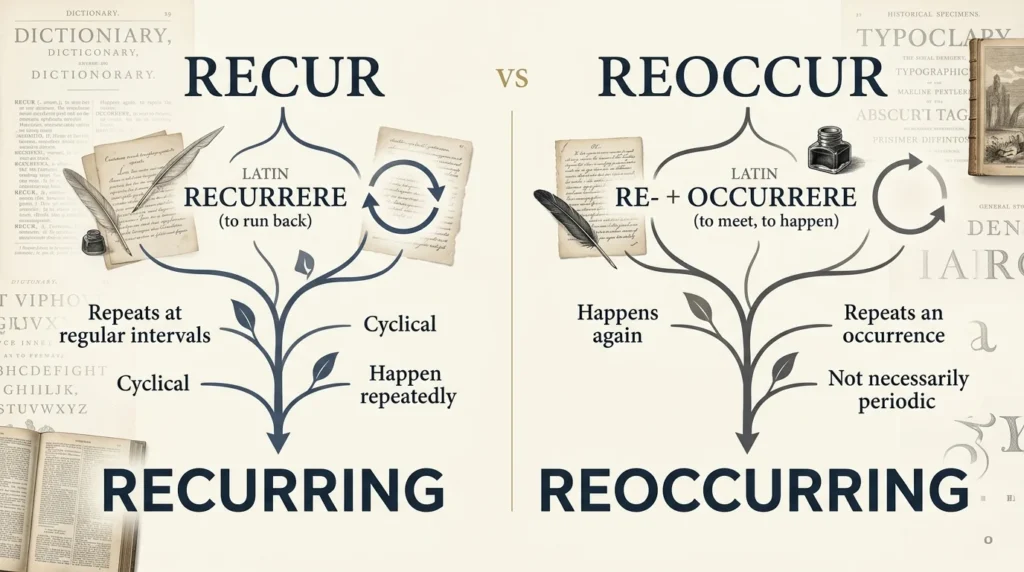
The two words are closely related, but they come from two different verbs: recur and reoccur.
Where does “recurring” come from?
Recurring is the -ing form of recur.
The verb recur comes from Latin recurrere, meaning to run back or return. It developed into a word used for something that comes back or happens again.
The forms are:
recur → recurring
The verb recur is older and has a wider range of uses. It can describe something that returns, repeats, or comes up again.
For example:
The same theme recurs throughout the novel.
The problem may recur in the future.
The adjective or present-participle form is:
a recurring problem
a recurring theme
a recurring event
Where does “reoccurring” come from?
Reoccurring is the -ing form of reoccur.
The word can be understood as:
re- + occur = reoccur
The prefix re- often carries the idea of “again.” Therefore, reoccur means to occur again.
Its forms are:
reoccur → reoccurring
For example:
The error reoccurred after the update.
We want to prevent the problem from reoccurring.
Why do the words look so similar?
Both words describe something happening again, so the overlap is natural.
The important difference is their base verbs:
recur → recurring
reoccur → reoccurring
This also explains why recurring and reoccurring are not simply two regional spellings. They are separate words with related meanings.
Recurrence and reoccurrence
The same distinction can appear in their noun forms:
- recurrence = the act or fact of recurring
- reoccurrence = another occurrence or the act of occurring again
For example:
The recurrence of the problem was unexpected.
The team wanted to prevent a reoccurrence of the error.
These forms overlap too, so the exact choice depends on what the writer wants to emphasize.
Transferred or Transfered: When Does the R Double?
British English vs American English Spelling
Recurring and reoccurring are both used in British and American English.
This is different from spelling pairs such as:
With recurring and reoccurring, the main issue is word choice, not British versus American spelling.
Comparison by English variety
| English variety | Recurring | Reoccurring | Main difference |
|---|---|---|---|
| American English | Correct | Correct | Meaning and context |
| British English | Correct | Correct | Meaning and context |
| Canadian English | Correct | Correct | Meaning and context |
| Australian English | Correct | Correct | Meaning and context |
| New Zealand English | Correct | Correct | Meaning and context |
| Indian English | Correct | Correct | Meaning and context |
The basic distinction works across these varieties.
American English
American writers commonly use recurring for things that happen repeatedly or regularly:
The customer has a recurring monthly payment.
The company holds a recurring meeting.
Reoccurring can be used when something happens again:
The same error is reoccurring after each update.
British English
British writers also use both forms:
The report identifies a recurring problem.
The issue is reoccurring despite the changes.
Again, there is no simple rule saying one form belongs to British English and the other belongs to American English.
The key point
Do not choose between these words based only on your country.
Choose based on what you mean.
Recurring often highlights repetition or a continuing pattern.
Reoccurring often highlights another occurrence.
Which Word Should You Use?
The best choice depends on the sentence.
Use “recurring” for repeated patterns
Choose recurring when something happens repeatedly, keeps returning, or appears as a pattern.
Common phrases include:
- recurring payment
- recurring expense
- recurring meeting
- recurring appointment
- recurring event
- recurring dream
- recurring theme
- recurring problem
- recurring issue
- recurring pattern
Examples:
The company has several recurring expenses.
She keeps having a recurring dream.
The report found a recurring pattern in the data.
We have a recurring meeting every Friday.
The word does not always mean that something happens at fixed times. A recurring dream, problem, or thought may return without following a schedule.
Use “reoccurring” when the focus is on something happening again
Reoccurring is useful when you want to stress that an event or problem has appeared again.
Examples:
The software has a reoccurring error.
The team is trying to stop the problem from reoccurring.
The same issue is reoccurring after the repair.
This wording can be especially natural when something happened once, stopped, and then appeared again.
When either word can work
Sometimes there is no important difference.
For example:
The issue is recurring.
The issue is reoccurring.
Both can tell the reader that the issue has happened before and is happening again.
The first may suggest a repeated or continuing pattern. The second may put more emphasis on another occurrence.
A simple decision rule
Ask yourself:
Am I focusing on repetition or a pattern?
Use recurring.
Am I focusing on the fact that something happened again?
Use reoccurring.
If the distinction does not matter in your sentence, either may be understood.
Putting or Puting: Why “Putting” Has Two t’s
Recurring vs Reoccurring: Comparison Table
| Feature | Recurring | Reoccurring |
|---|---|---|
| Correct word? | Yes | Yes |
| Base verb | Recur | Reoccur |
| Basic meaning | Happening repeatedly or returning | Happening again |
| Often suggests a pattern? | Yes | Not necessarily |
| Must happen on a fixed schedule? | No | No |
| Can describe a problem? | Yes | Yes |
| Can describe an event? | Yes | Yes |
| Can describe a payment? | Very common | Less natural |
| Can describe a dream? | Very common | Possible |
| Used in US English? | Yes | Yes |
| Used in UK English? | Yes | Yes |
| British/American spelling difference? | No | No |
Common Mistakes with Recurring or Reoccurring
These words create two different kinds of confusion: meaning confusion and spelling confusion.
Mistake 1: Thinking “reoccurring” is wrong
Some writers believe that only recurring is a correct word.
That is not true.
Reoccurring is a valid word.
Example:
The problem keeps reoccurring.
Mistake 2: Thinking “recurring” is only British or American
Neither word belongs exclusively to one variety of English.
Both are used in American and British English.
Mistake 3: Treating the words as exact opposites
They are not opposites.
Both relate to something happening again.
The difference is mainly one of emphasis:
Recurring → repeated or returning, often as a pattern
Reoccurring → occurring again
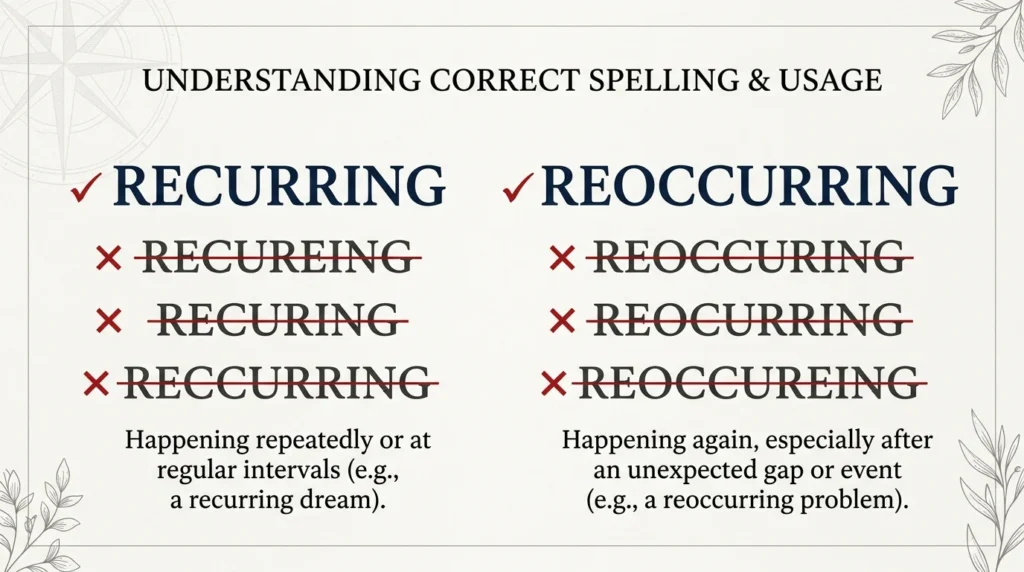
Mistake 4: Writing “recuring”
Incorrect:
The problem is recuring.
Correct:
The problem is recurring.
The correct spelling has two r’s before -ing:
recur → recurring
Mistake 5: Writing “reocuring”
Incorrect:
The issue is reocuring.
Correct:
The issue is reoccurring.
The correct form keeps the two r’s:
reoccur → reoccurring
Mistake 6: Writing “reoccuring”
Incorrect:
The error is reoccuring.
Correct:
The error is reoccurring.
There are two r’s before the -ing ending.
Mistake 7: Assuming “recurring” always means “regular”
This is a subtle mistake.
A recurring event can happen regularly, but recurring does not require a fixed schedule.
For example:
She has recurring nightmares.
The nightmares happen more than once, but they do not need to happen every Monday or every month.
A better rule is:
Recurring usually means repeated or returning. It may or may not happen on a fixed schedule.
Mistake 8: Assuming “reoccurring” means only “twice”
Reoccurring often focuses on another occurrence, but it does not have to mean that something happened exactly twice.
The word can describe something that happens again more than once.
So do not treat:
reoccurring = exactly two times
as a grammar rule.
Recurring or Reoccurring in Everyday Examples
The best way to understand the difference is to see the words in real situations.
In emails
Recurring:
This is a reminder about our recurring team meeting.
Reoccurring:
We are working to prevent this issue from reoccurring.
In business writing
Recurring:
The company tracks its recurring monthly expenses.
Reoccurring:
The team is reviewing the cause of the reoccurring error.
In finance
Recurring is especially common in financial language.
Your recurring payment will be processed on the first day of each month.
The business has recurring operating costs.
The word works well because the payments or costs repeat as part of an ongoing arrangement.
In technology
Both words can work:
We found a recurring software error.
The same software error is reoccurring.
The first highlights a repeated issue. The second highlights that the error has appeared again.
In news writing
Recurring:
The report raises a recurring concern about public safety.
Reoccurring:
Officials are investigating why the problem keeps reoccurring.
In social media
Another recurring problem with my phone!
This annoying error keeps reoccurring.
Both sound natural when the context is clear.
In formal writing
Recurring:
The study identified a recurring pattern in the results.
Reoccurring:
The researchers examined the causes of the reoccurring problem.
In everyday conversation
I keep having the same recurring dream.
The problem is reoccurring again.
The first emphasizes a repeated experience. The second emphasizes that the problem has appeared again.
Recurring vs Reoccurring: Common Phrases
Some combinations sound more natural than others.
| Phrase | Natural choice | Why |
|---|---|---|
| ___ payment | Recurring | Payments repeat as part of an arrangement |
| ___ subscription | Recurring | The charge repeats |
| ___ meeting | Recurring | The meeting happens repeatedly |
| ___ appointment | Recurring | The appointment repeats |
| ___ expense | Recurring | The cost happens repeatedly |
| ___ dream | Recurring | The dream returns repeatedly |
| ___ theme | Recurring | The theme appears again and again |
| ___ pattern | Recurring | The pattern repeats |
| ___ problem | Recurring | The problem keeps returning |
| ___ error | Recurring | The error repeats |
| ___ issue | Recurring | The issue keeps returning |
| problem happening again | Reoccurring | Focus is on another occurrence |
| error appearing again | Reoccurring | Focus is on the error returning |
This table shows common preferences, not strict rules. Reoccurring can still work with many of the same nouns.
Recur vs Reoccur
Understanding the base verbs makes the difference easier.
Recur
Recur means to happen again, return, or repeat.
Examples:
The problem may recur.
The same theme recurs throughout the book.
The symptoms may recur over time.
Reoccur
Reoccur means to occur again.
Examples:
We hope the error does not reoccur.
The problem could reoccur after the update.
Officials want to prevent the event from reoccurring.
Quick comparison
| Verb | Main idea | Example |
|---|---|---|
| Recur | Return or happen repeatedly | The problem may recur. |
| Reoccur | Occur again | The problem may reoccur. |
There is substantial overlap between the two verbs, so the distinction should not be treated as an unbreakable rule.
Recurring or Reoccurring – Google Trends & Usage Data
Google Trends can be useful for comparing search interest, but it is important to understand what the data means.
Google Trends measures relative search interest, not the total number of times a word is used in writing or speech. A higher Trends value does not automatically mean that a word is grammatically better or more common in every context.
Search interest can also change by:
- country
- language
- time period
- topic
- search wording
- user intent
For this reason, search popularity should not be used as the rule for choosing between recurring and reoccurring.
What search context tells us
The word recurring is strongly associated with phrases such as:
- recurring payment
- recurring expense
- recurring meeting
- recurring event
- recurring dream
- recurring problem
- recurring theme
This gives the word a wide range of uses in business, finance, everyday English, and formal writing.
Reoccurring is often seen in contexts involving something happening again, especially:
- reoccurring problem
- reoccurring error
- reoccurring issue
- problem reoccurring
- error reoccurring
Does one word belong to a specific country?
No.
Recurring and reoccurring are both used in American and British English. The difference is not the same type of regional spelling difference as color/colour or center/centre.
Search patterns may differ between countries, but that does not turn one word into an American spelling and the other into a British spelling.
How to interpret Google Trends correctly
If you compare the terms in Google Trends, remember that Trends uses a relative scale. A value of 100 represents the highest search interest in the selected comparison and time period; it does not mean 100 searches.
The result can also change if you change:
- the country
- the date range
- the search category
- the search type
- the exact search terms
So Google Trends is useful for studying search behavior, but it should not be treated as a grammar test.
For choosing the right word, meaning and context remain more important than search volume.
Quick Decision Guide: Recurring or Reoccurring?
Use this simple guide when you are writing.
| What you want to say | Best fit |
|---|---|
| It happens repeatedly | Recurring |
| It keeps returning | Recurring |
| It follows a repeated pattern | Recurring |
| It happens on a regular schedule | Recurring |
| It happens again | Reoccurring |
| Something has returned after happening before | Reoccurring |
| You want to emphasize another occurrence | Reoccurring |
| The meaning is simply “happening again” | Reoccurring |
| Either word gives the same intended meaning | Context decides |
One-line rule
Recurring usually emphasizes repetition; reoccurring usually emphasizes another occurrence.
But remember: the distinction is a useful guide, not an absolute rule.
FAQs About Recurring or Reoccurring
1. Is recurring or reoccurring correct?
Both are correct. Recurring usually describes something that happens repeatedly or returns over time. Reoccurring focuses more directly on something happening again.
2. Is reoccurring a real word?
Yes. Reoccurring is a correct English word. It is the -ing form of reoccur, meaning to occur again.
3. Is recurring the same as reoccurring?
They have overlapping meanings, but there can be a difference in emphasis. Recurring often suggests repetition or a continuing pattern, while reoccurring often highlights another occurrence.
4. Is recurring an American or British word?
Recurring is used in both American and British English. It is not limited to one variety of English.
5. Is reoccurring an American or British word?
Reoccurring is also used in both American and British English. It is not simply a British or American spelling.
6. Is “recurring problem” correct?
Yes. Recurring problem is correct and very common. It usually means a problem that keeps returning or happens repeatedly.
7. Is “reoccurring problem” correct?
Yes. Reoccurring problem is also correct. It can emphasize that the problem has appeared again.
8. Is a recurring payment correct?
Yes. Recurring payment is a standard phrase for a payment that is charged repeatedly, such as a regular subscription payment.
9. Does recurring mean regular?
Not always. Recurring means happening repeatedly or returning. Something recurring may follow a regular schedule, but it does not have to.
For example:
She has recurring dreams.
The dreams repeat, but they do not have to happen at fixed times.
10. What is the difference between recur and reoccur?
Recur usually emphasizes something returning or happening repeatedly. Reoccur means to occur again. Their meanings overlap, so context can determine which sounds more natural.
11. Which is better: recurring issue or reoccurring issue?
Both are possible. Recurring issue often sounds more natural when the issue keeps happening or forms a pattern. Reoccurring issue can emphasize that the issue has appeared again.
12. Which is correct: recurring or recuring?
The correct spelling is recurring.
❌ recuring
✅ recurring
13. Which is correct: reoccuring or reoccurring?
The correct spelling is reoccurring.
❌ reoccuring
✅ reoccurring
14. Can recurring and reoccurring be used interchangeably?
Sometimes, yes. Their meanings overlap, especially when describing something that happens again. However, recurring is often more natural when repeated behavior or a pattern is important, while reoccurring can put more focus on another occurrence.
Conclusion
Recurring and reoccurring are both correct English words. The choice is not based on British versus American spelling. Both forms are used in different varieties of English.
The clearest general distinction is simple: recurring usually emphasizes something happening repeatedly, returning over time, or forming a pattern. Reoccurring usually emphasizes something occurring again after it has happened before.
That does not mean recurring always requires a fixed schedule, or that reoccurring means something happened only twice. Real English has overlap between the two words, and context matters.
For common phrases such as recurring payment, recurring meeting, recurring expense, recurring dream, recurring theme, and recurring problem, “recurring” is often the natural choice because repetition is central to the meaning.
When your main point is that an issue, error, event, or situation has happened again, reoccurring can be a useful choice.
So, when you are unsure, ask what you want to emphasize: repeated or returning → recurring; another occurrence → reoccurring. If both fit, choose the one that makes your meaning clearest.

Victor Penhall is an English grammar specialist and writing coach, helping learners strengthen their language skills with clear rules, smart tips, and precise guidance.