
Have you ever typed acknowledgment and wondered whether it needs an extra e? Or have you written acknowledgement and worried that the longer spelling might be wrong? This is a common problem because both forms are used in English, especially in academic, professional, and formal writing.
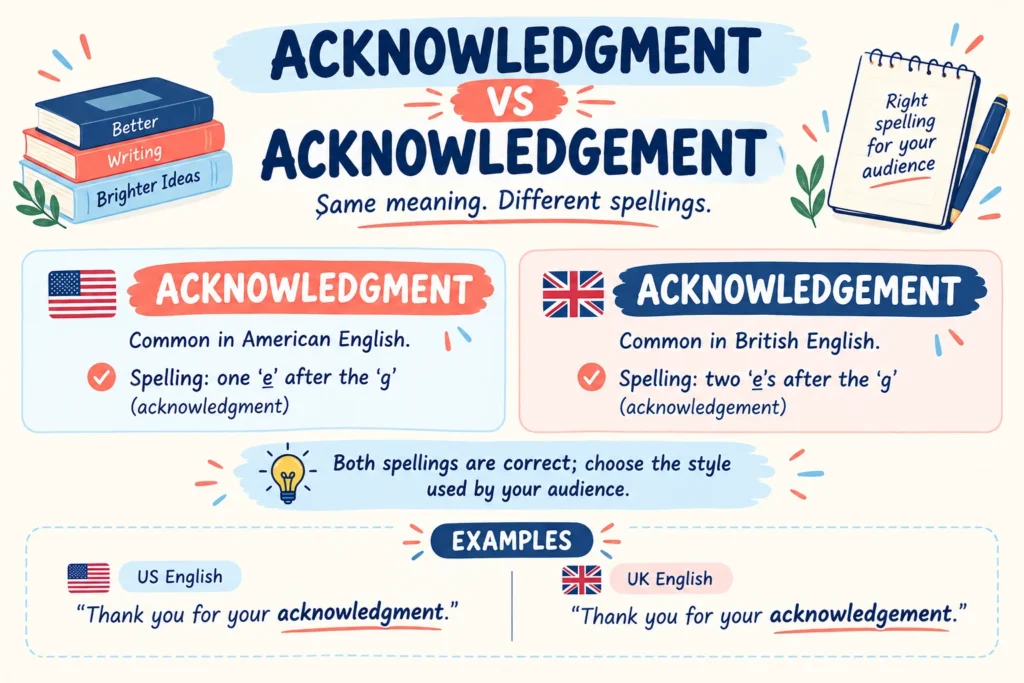
The simple answer is that acknowledgment and acknowledgement are both correct. The main difference is regional spelling. Acknowledgment is the usual American English form, while acknowledgement is especially common in British English and is also widely used in other varieties influenced by British English.
The two words have the same meaning. Both can mean recognizing that something is true, showing that something has been received, or expressing thanks for help or support. They can also describe a section in a book, thesis, research paper, or project where the writer thanks people who contributed.
So, is it acknowledgment or acknowledgement? Choose the spelling that matches your variety of English, audience, or required style guide. Most importantly, use the same form consistently throughout your document.
Acknowledgment or Acknowledgement – Main difference
Both “acknowledgment” and “acknowledgement” are correct spellings.
- Acknowledgment — the usual American English spelling
- Acknowledgement — the usual British English spelling
- Meaning — the same
- Pronunciation — essentially the same
- Plural — acknowledgments / acknowledgements
Quick rule
If you are writing in American English, use:
acknowledgment
If you are writing in British English, use:
acknowledgement
For example:
The author included an acknowledgment for the research team.
American English
The author included an acknowledgement for the research team.
British English
Neither spelling is a spelling mistake simply because it uses or drops the extra e.

Is it acknowledgment or acknowledgement?
If you are asking, “Is it acknowledgment or acknowledgement?”, the answer depends on the English variety you are using.
There is no difference in meaning. The choice is mainly a matter of spelling convention.
Bottom line: Both are correct. Use acknowledgment for American English and acknowledgement for British English, unless a particular style guide tells you otherwise.
The Origin of Acknowledgment or Acknowledgement
The word comes from the verb acknowledge, which means to recognize, admit, accept, or show that you know something.
The verb acknowledge has a long history in English. It developed from older English forms connected with the idea of knowing or recognizing something. The noun was later formed by adding the suffix -ment, giving us acknowledgement and acknowledgment.
The noun has been used since at least the 16th century. Both spellings are also old. This is important because acknowledgment is not a modern shortened version of acknowledgement, and acknowledgement is not simply an outdated spelling.
The two forms developed as alternative spellings of the same word.
Why is there an extra “e”?
The difference is related to how English handles the final e in words before a suffix such as -ment.
Compare:
- acknowledgement / acknowledgment
- judgement / judgment
- abridgement / abridgment
British English often retains the e in words of this type, while American English often prefers the shorter form.
However, this is a spelling pattern, not a rule that applies perfectly to every English word. Some words keep their spelling in both varieties, and some regional differences depend on the individual word and style guide.
That is why it is better to remember the established forms rather than assume that every word ending in -dge must follow exactly the same rule.
Did one spelling come first?
No. Historical evidence shows that both forms have been used for centuries. The spelling with -e- and the spelling without it are both established forms.
Over time, regional spelling preferences became clearer, with acknowledgment becoming the usual American form and acknowledgement remaining especially common in British English.
So the difference is not about one spelling being “real” and the other being a mistake.
British English vs American English Spelling
The key difference is simple:
| Feature | American English | British English |
|---|---|---|
| Preferred spelling | acknowledgment | acknowledgement |
| Extra “e” | No | Yes |
| Meaning | Same | Same |
| Pronunciation | Same | Same |
| Singular noun | acknowledgment | acknowledgement |
| Plural noun | acknowledgments | acknowledgements |
| Verb | acknowledge | acknowledge |
| Past tense | acknowledged | acknowledged |
| -ing form | acknowledging | acknowledging |
American English: acknowledgment
In American English, acknowledgment is the usual spelling.
Examples:
Thank you for your acknowledgment of my request.
The report contains an acknowledgment of the team’s contribution.
She received an acknowledgment confirming that her application had arrived.
The shorter form is also common in American academic, business, publishing, and formal writing.

British English: acknowledgement
In British English, acknowledgement is especially common.
Examples:
Thank you for your acknowledgement of my request.
The report contains an acknowledgement of the team’s contribution.
She received an acknowledgement confirming that her application had arrived.
The longer form is common in British academic and professional writing.
What about Canada?
Canadian English can use both spellings. Usage may vary by publisher, institution, style guide, and the type of writing.
If you are writing for a Canadian university, company, or publication, follow its preferred style rather than assuming that only one spelling is acceptable.
What about Australia and New Zealand?
Acknowledgement is widely used in Australian and New Zealand English, reflecting the influence of British spelling traditions. However, individual organizations and publications can have their own preferences.
For formal work, consistency and the relevant style guide should guide your choice.
What about India and other Commonwealth varieties?
Acknowledgement is common in many contexts influenced by British English, including academic and formal writing. However, both spellings can be encountered in international English.
If your university, employer, publisher, or client gives you a style requirement, follow that requirement first.
Regional spelling at a glance
| Region or audience | Common form | Important note |
|---|---|---|
| United States | acknowledgment | Usual American form |
| United Kingdom | acknowledgement | Usual British form |
| Canada | Both | Usage varies by style and institution |
| Australia | acknowledgement | British-influenced spelling is common |
| New Zealand | acknowledgement | British-influenced spelling is common |
| India | acknowledgement | British influence is common, but both forms occur |
| International audience | Both | Choose one and stay consistent |
Which Spelling Should You Use?
The best spelling depends on who will read your writing and which English variety you are following.
For American English
Use:
acknowledgment
This is the natural choice for most writing aimed at readers in the United States.
For British English
Use:
acknowledgement
This is the natural choice for most writing following British spelling.
For a thesis or dissertation
First check your university’s instructions.
If the university requires British English, use:
Acknowledgements
If it requires American English, use:
Acknowledgments
If there is no specific requirement, choose one spelling based on the English variety used in the rest of your thesis.
Do not use Acknowledgments in one section and Acknowledgements somewhere else unless you are discussing the two spellings themselves.
For research papers
The same rule applies.
Use the spelling required by your journal, university, or style guide. If there is no special requirement, match the English variety used throughout the paper.
For a project
Either spelling can be correct.
American English:
Acknowledgment
British English:
Acknowledgement
The spelling does not change the purpose of the section.
For a global website
Either spelling can work. If your website uses American English throughout, acknowledgment will usually fit better. If it uses British English throughout, acknowledgement will usually fit better.
Do not change between the two forms simply to target different searches. Natural, consistent writing is more important.
Recurring or Reoccurring: What’s the Difference?
Common Mistakes with Acknowledgment or Acknowledgement
The spelling itself is not the only thing that causes confusion. Writers also mix up the noun, verb, plural form, and related words.
1. Thinking acknowledgement is always wrong
This is one of the most common mistakes.
❌ “Acknowledgement” is incorrect.
That statement is not correct.
Acknowledgement is a standard spelling, especially in British English.
2. Thinking acknowledgment is always wrong
The opposite mistake is also common.
❌ “Acknowledgment” is a misspelling.
It is not. Acknowledgment is the usual American spelling.
3. Mixing the two spellings
For example:
The acknowledgment section thanks the supervisor.
The acknowledgements also mention the research team.
If these are part of the same document, choose one spelling and keep it consistent.
4. Confusing acknowledgment with acknowledge
Acknowledgment is a noun.
The letter included an acknowledgment of receipt.
Acknowledge is a verb.
We acknowledge receipt of your letter.
Do not use them in the same grammatical role.
5. Confusing acknowledge with acknowledged
Acknowledge is the base form:
I acknowledge your message.
Acknowledged is the past tense:
I acknowledged your message yesterday.
The noun is:
I sent an acknowledgment.
6. Misspelling acknowledge
A common incorrect form is:
❌ acknowlege
The correct spelling is:
acknowledge
The d must remain before the final ge.
7. Forgetting the plural spelling
American English:
acknowledgments
British English:
acknowledgements
The plural follows the spelling of the singular noun.
Acknowledgment or Acknowledgement in Research
In research writing, an acknowledgment or acknowledgement is often a section where the author thanks people or organizations that helped with the research.
Depending on the project, this may include:
- supervisors
- research advisers
- participants
- colleagues
- laboratories
- institutions
- funding organizations
- technical assistants
For example:
Acknowledgments
I sincerely thank my supervisor for guidance throughout this research.
Or in British English:
Acknowledgements
I sincerely thank my supervisor for guidance throughout this research.

Which spelling should you use in research?
There is no universal rule that all research must use one spelling.
Instead:
- Check the university or journal instructions.
- Identify whether the document follows American or British English.
- Use the chosen spelling consistently.
This is especially important in a thesis or dissertation because headings should match the spelling used throughout the document.
Acknowledgement or Acknowledgments in a Thesis
The plural form often appears as a section heading because the author may thank several people.
American English
Acknowledgments
British English
Acknowledgements
Both headings can introduce a section thanking supervisors, family members, colleagues, institutions, participants, or others who contributed to the work.
Example thesis acknowledgment
Acknowledgments
I would like to thank my supervisor for valuable guidance and feedback throughout this research. I am also grateful to my colleagues and family for their encouragement and support.
The British English version would use:
Acknowledgements
The content does not need to change simply because the spelling changes.
Transferred or Transfered: When Does the R Double?
Acknowledgement for a Project
A project acknowledgment is usually a short section that gives thanks to people who helped complete the project.
For example:
Acknowledgment
I would like to thank my teacher for guidance throughout this project. I am also grateful to my classmates and family for their support.
For British English:
Acknowledgement
I would like to thank my teacher for guidance throughout this project. I am also grateful to my classmates and family for their support.
If several people or groups are being thanked, the plural may be used:
Acknowledgments
or:
Acknowledgements
What Is the Difference Between Acknowledgment and Dedication?
Acknowledgment and dedication can both appear in a book, thesis, dissertation, or project, but they serve different purposes.
| Acknowledgment | Dedication |
|---|---|
| Thanks people or organizations for help | Dedicates the work to someone |
| Often explains support or contribution | Usually expresses a personal connection |
| May mention supervisors, colleagues, participants, or institutions | Often mentions family, friends, mentors, or loved ones |
| Can be several paragraphs | Often very short |
| Focuses on recognition and gratitude | Focuses on honoring or dedicating the work |
For example:
Dedication: To my parents, whose support made this journey possible.
Acknowledgment: I sincerely thank my supervisor for guidance and feedback throughout this research.
In simple terms, a dedication honors someone, while an acknowledgment thanks someone.
What Does “Acknowledgment” Mean?
Acknowledgment can have several closely related meanings.
1. Recognition
It can mean recognizing that something exists or is true.
The report included an acknowledgment of the problem.
2. Admission or acceptance
It can mean accepting or admitting something.
His statement was an acknowledgment that the plan needed changes.
3. Expression of thanks
It can describe an expression of appreciation.
The author gave an acknowledgment to everyone who helped with the book.
4. Confirmation of receipt
It can mean a message or statement showing that something was received.
We received an acknowledgment of your application.
5. Academic or book section
It can describe a section in which an author thanks people who helped with a book, thesis, paper, or project.
The acknowledgments appear before the main chapters.
So, the exact meaning depends on context, but the central idea is recognition.
Acknowledgment or Acknowledgement: Word Family
Understanding the related forms makes the spelling easier.
| Word form | American English | British English | Meaning |
|---|---|---|---|
| Noun | acknowledgment | acknowledgement | Recognition or thanks |
| Plural noun | acknowledgments | acknowledgements | More than one |
| Verb | acknowledge | acknowledge | To recognize or admit |
| Past tense | acknowledged | acknowledged | Recognized or admitted |
| -ing form | acknowledging | acknowledging | Recognizing or admitting |
Notice something important: only the noun spelling changes.
The verb forms are the same in both varieties:
acknowledge
acknowledged
acknowledging
Acknowledgment or Acknowledgement in Legal Writing
The word can also appear in legal and official documents.
In general legal English, an acknowledgment can refer to a formal recognition, admission, confirmation, or official statement. In some legal systems, the term can have a specific technical meaning connected with the execution or formal recognition of a document.
For example:
The document contains an acknowledgment of receipt.
Because legal terminology can vary between jurisdictions, do not assume that a spelling preference in ordinary English automatically determines the wording required on a legal form.
If you are completing an official legal document, use the terminology provided by the relevant authority or form.
The spelling difference itself does not create a different general meaning:
acknowledgment
and
acknowledgement
are alternative spellings of the same noun.
Acknowledgment or Acknowledgement in Everyday Examples
The word appears in many types of writing.
In an email
Thank you for your acknowledgment of my request.
British English:
Thank you for your acknowledgement of my request.
In business writing
We sent an acknowledgment confirming receipt of your application.
In a research paper
The acknowledgments section recognizes the support provided by the research team.
In a thesis
The acknowledgements appear at the beginning of the dissertation.
In a book
The author included several pages of acknowledgments at the end of the book.
In news writing
The statement was an acknowledgment that the earlier decision had caused problems.
In social media
Special acknowledgment to everyone who helped with the project.
In formal writing
We received an acknowledgment of the documents submitted.
With the verb acknowledge
The author acknowledged the contribution of the research team.
These examples show why it is important to distinguish the noun acknowledgment/acknowledgement from the verb acknowledge.
Acknowledgment or Acknowledgement – Comparison Table
| Point | Acknowledgment | Acknowledgement |
|---|---|---|
| Correct spelling? | Yes | Yes |
| Main association | American English | British English |
| Extra “e”? | No | Yes |
| Meaning | Same | Same |
| Pronunciation | Same | Same |
| Plural | acknowledgments | acknowledgements |
| Thesis use | Common | Common |
| Research use | Common | Common |
| Project use | Common | Common |
| Formal writing | Correct | Correct |
| Legal contexts | Used | Used |
| Verb form | acknowledge | acknowledge |
| Past tense | acknowledged | acknowledged |
| -ing form | acknowledging | acknowledging |
Acknowledgment or Acknowledgement – Google Trends & Usage Data
Search interest for the two spellings follows the same broad regional pattern seen in English spelling.
Acknowledgment is strongly associated with searches and writing in the United States, while acknowledgement is strongly associated with British English and other regions where British spelling is common.
Searches also change with context. Someone looking for:
acknowledgement thesis
is likely looking for an academic section or example, while someone searching:
acknowledgment meaning
may simply want a definition.
This means search volume alone does not determine which spelling is correct. Google search behavior can reflect a user’s country, school system, writing style, or the type of document they are preparing.
Usage by region
| Region | More commonly associated form |
|---|---|
| United States | acknowledgment |
| United Kingdom | acknowledgement |
| Australia | acknowledgement is common |
| New Zealand | acknowledgement is common |
| Canada | Both are used |
| India | Acknowledgement is common in British-influenced writing |
| International English | Both |
Usage by context
| Context | Typical spelling choice |
|---|---|
| US academic writing | acknowledgment |
| UK academic writing | acknowledgement |
| US business writing | acknowledgment |
| UK business writing | acknowledgement |
| Thesis or dissertation | Depends on institution and English variety |
| Research paper | Depends on style guide |
| Project | Either, depending on regional style |
| Legal document | Follow the relevant jurisdiction or form |
| International website | Either, but remain consistent |
Important point about search data
Google Trends shows relative search interest, not whether a spelling is grammatically correct.
A spelling can receive fewer searches simply because it is used by a smaller population or because another regional spelling is more familiar there.
For that reason, do not choose between the two forms simply because one appears more often in worldwide searches. Choose based on your audience, English variety, and style requirements.
Acknowledgment or Acknowledgement: Which One Should You Remember?
Use this simple rule:
American English → acknowledgment
British English → acknowledgement
Then remember the related forms:
acknowledge → acknowledged → acknowledging
These forms do not gain or lose the extra e.
For the plural:
acknowledgments → American English
acknowledgements → British English
And if you are writing a thesis, research paper, project, or formal document, always check the required style before making your final choice.
Frequently Asked Questions
1. Is it acknowledgment or acknowledgement?
Both spellings are correct. Acknowledgment is the usual American English spelling, while acknowledgement is especially common in British English.
2. What is the difference between acknowledgment and acknowledgement?
There is no difference in basic meaning. They are alternative spellings of the same noun. The main difference is regional spelling preference.
3. What does “acknowledgment” mean?
It can mean recognizing or admitting something, confirming receipt of something, or expressing thanks. It can also refer to a section of a book, thesis, research paper, or project where the writer thanks people who helped.
4. What is the difference between acknowledgment and dedication?
An acknowledgment usually thanks people or organizations for their help or contribution. A dedication usually honors someone by dedicating the work to them.
5. What is the difference between acknowledge and acknowledged?
Acknowledge is the base form of the verb.
I acknowledge your message.
Acknowledged is the past tense and past participle.
I acknowledged your message yesterday.
6. What is the plural of acknowledgment?
The American English plural is acknowledgments.
The British English plural is acknowledgements.
7. Which spelling should I use in a thesis?
Follow your university’s instructions or required style guide. If no rule is given, use acknowledgment for American English or acknowledgement for British English and keep the choice consistent.
8. Is acknowledgement wrong in American English?
No. Acknowledgement can be found in American English, although acknowledgment is the usual American form.
9. Is acknowledgment wrong in British English?
No. Acknowledgment can be used in British English, although acknowledgement is the usual British form.
10. Can I use both spellings in the same article?
You can mention both when discussing the spelling difference, but when you are using the word normally, it is better to choose one form and use it consistently.
Conclusion
Acknowledgment and acknowledgement are both correct spellings of the same word. The main difference is regional: acknowledgment is the usual American English form, while acknowledgement is especially common in British English. Both can describe recognition, admission, confirmation, or an expression of thanks.
The choice becomes particularly important in formal writing. If you are preparing a thesis, dissertation, research paper, project, business document, or book, first check the required English variety or style guide. If there is no special requirement, match the spelling used throughout the rest of your writing.
The plural forms follow the same pattern: acknowledgments in American English and acknowledgements in British English. However, the related verb does not change. The correct forms are acknowledge, acknowledged, and acknowledging in both varieties.
Most importantly, do not treat one spelling as a mistake simply because you are more familiar with the other. Acknowledgment and acknowledgement are established English spellings. Choose the form that fits your audience, use it consistently, and you can write with confidence.

Amelia Script is a dedicated grammar specialist and language mentor, simplifying English rules, refining writing skills, and helping learners communicate with clarity and confidence.