
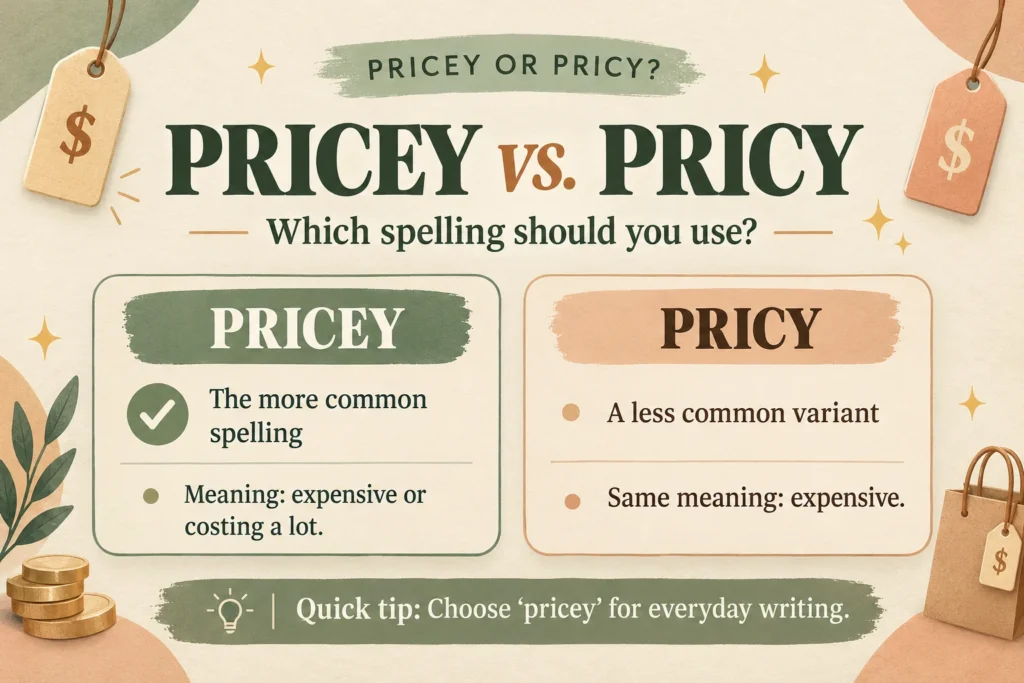
Have you ever stopped while writing because you could not decide between pricey or pricy? You may have seen both spellings in product reviews, online shops, travel articles, and everyday conversations. This can make you wonder whether one is correct and the other is a spelling mistake.
The answer is simple: both pricey and pricy are correct. They have the same meaning and pronunciation. However, pricey is the more common spelling and is usually the best choice for everyday writing.
People often search for this word because English spelling rules can be confusing. Some words keep their final e when an ending is added, while others drop it. The word price makes this question especially interesting because both forms are accepted.
In this guide, you will learn the meaning of both spellings, their origins, and how they are used in British and American English. You will also find examples, common mistakes, useful synonyms, and answers to popular questions. Whether you are writing an email, a school assignment, a product review, or a website article, this guide will help you choose the right spelling with confidence.
Main Difference
Both pricey and pricy are correct spellings. They mean expensive or costing more than expected or desired. The main difference is that it is more common, while pricy is a less common alternative.
Here is a quick comparison:
| Spelling | Correct? | Meaning | General recommendation |
|---|---|---|---|
| Pricey | Yes | Expensive | Best choice for most writing |
| Pricy | Yes | Expensive | Correct, but less common |
Examples:
- This restaurant is too pricey for a family dinner.
- That phone looks great, but it is quite pricy.
- We found a less pricey hotel near the city centre.
- The shoes are a little pricey, but they are comfortable.
So, if you are asking, “Which is correct, pricey or pricy?” the answer is that both are accepted. You do not need to change the meaning or pronunciation when choosing between them.
How do you spell the word? For most situations, write pricey. It is familiar to readers in different English-speaking countries and works well in everyday writing, reviews, and online content.
Word Origin
The word pricey comes from the noun price, which means the amount of money asked or paid for something. The word price entered English through Anglo-French and Old French and has older roots connected with value and worth.
English often uses the ending -y to turn a noun into an adjective. This ending can describe something that has a particular quality or is associated with something.
For example:
- Cloud → cloudy
- Dirt → dirty
- Taste → tasty
- Price → pricey
The adjective pricey means expensive or relatively high in price. It is often used when something costs more than a person expects or would prefer to pay.
The shorter form pricy is also an established spelling. It follows a spelling pattern in which the final e is removed before an ending is added. However, spelling patterns alone do not prove exactly how or why a word developed historically.
Both forms are accepted in modern English. The spelling pricey is more common, while pricy is less widely used. There is no need to treat the shorter form as an error simply because it looks different.
The important point is that the two spellings have the same meaning and pronunciation. The extra e does not create a different word or change how the adjective is used.
British English vs American English Spelling
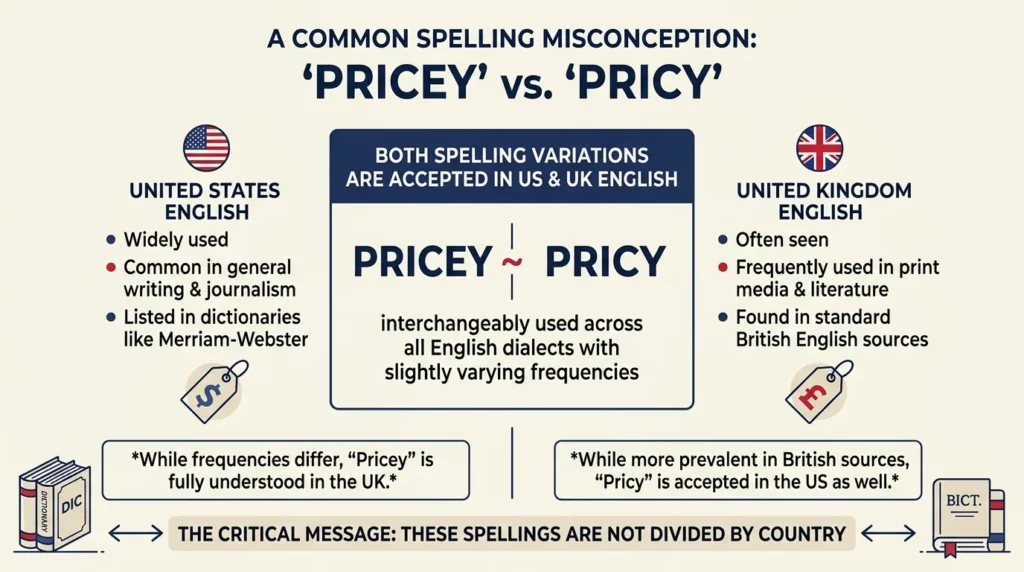
Is pricey American English while pricy is British English? No. There is no established rule that assigns one spelling to the United States and the other to the United Kingdom.
Both spellings are accepted in American and British English. The main difference is their general frequency, not their meaning or regional use.
Pricey or Pricy: Regional Comparison
| Region | Recommended spelling | Is the alternative accepted? |
|---|---|---|
| United States | Pricey | Yes, pricy is accepted |
| United Kingdom | Pricey | Yes, pricy is accepted |
| Canada | Pricey | Yes, pricy is accepted |
| Australia | Pricey | Yes, pricy is accepted |
| New Zealand | Pricey | Yes, pricy is accepted |
| India | Pricey | Yes, pricy is accepted |
This table gives general writing advice, not a measured ranking of spelling frequency in each country. Individual writers and publishers may have their own preferences.
Examples in American English
American writers commonly use pricey in everyday conversations, shopping reviews, and travel writing.
- The new laptop is too pricey for my budget.
- We found a pricey coffee shop downtown.
- Flights are pricier during the holiday season.
The spelling pricy is also acceptable, but pricey is the more familiar choice for most general readers.
Examples in British English
British writers can use pricey in the same way.
- The hotel was rather pricey for one night.
- That restaurant is a bit pricey for lunch.
- The new shoes look nice, but they are too pricey.
These sentences are natural in British English. You do not need to replace pricey with pricy when writing for a British audience.
Why Is Pricey the Safer Choice?
The spelling pricey is widely recognized and is more common in everyday writing. Readers can easily connect it to the noun price.
The shorter spelling pricy is still correct, but some readers may be less familiar with it. Choosing pricey helps keep your writing familiar and consistent.
For general websites, schoolwork, emails, and product reviews, pricey is the practical choice. If a publisher or style guide prefers pricy, you can follow that preference instead.
Smoky or Smokey: The Difference & When to Use Each
Shiny or Shiney: The Spelling Mistake Behind the Extra “E”
Which Spelling Should You Use?
If you want a simple rule, use pricey in most situations. It is the more common spelling and works for readers in the United States, the United Kingdom, and other English-speaking regions.
Your final choice can also depend on your audience and the type of writing.
For American English
Use pricey in school assignments, emails, online reviews, blog posts, and everyday conversations.
Example: “The new tablet is too pricey for most students.”
You can use pricy as well, but there is usually no advantage to choosing the less common form.
For British English and Commonwealth Readers
Use pricey when writing for readers in the United Kingdom, Canada, Australia, New Zealand, and other English-speaking regions.
Example: “The hotel is quite pricey during the summer.”
The word is easy to understand across these audiences, and there is no need to use pricy to make the sentence sound British.
For Formal and Professional Writing
Pricey is an informal adjective. It works well in casual reviews, conversations, and lifestyle articles. In a formal report, academic paper, or business document, expensive, costly, or high-priced may sound more neutral.
Compare these examples:
- Casual: The service is too pricey.
- Formal: The service is more expensive than our budget allows.
- Casual: The project became pricey.
- Formal: The project became more expensive than planned.
The word pricey is not grammatically wrong in formal writing. However, choosing a more neutral word may suit the tone better.
Best advice: Use pricey by default, and choose expensive when you want a more formal tone.
Common Mistakes
Both spellings are correct, but writers can still make mistakes with their meaning, grammar, and use. Here are the most common problems and how to avoid them.
Mistake 1: Thinking Pricy Is Always Wrong
Some writers assume pricy is a spelling mistake because they see pricey more often. This is not correct.
Incorrect claim: “Pricy is never a real word.”
Correct explanation: Pricy is an accepted spelling, but pricey is more common.
Mistake 2: Assuming the Two Spellings Have Different Meanings
The words do not have different meanings.
- The bag is pricey.
- The bag is pricy.
Both sentences mean that the bag is expensive.
Mistake 3: Confusing Price and Pricey
Price is a noun and can also be a verb. Pricey is an adjective.
- Correct: The price of the ticket is high.
- Correct: The ticket is pricey.
- Incorrect: The pricey of the ticket is high.
Use price when you mean the amount charged. Use pricey when describing something that costs a lot.
Mistake 4: Using Pricey as a Noun
Pricey is an adjective, not a noun.
- Incorrect: The pricey of the meal surprised us.
- Correct: The price of the meal surprised us.
- Correct: The meal was pricey.
Mistake 5: Assuming Pricey Always Means Unaffordable
Pricey describes something that costs a lot or seems expensive. It does not always mean that a person cannot afford it.
Example: “The watch is pricey, but I can afford it.”
The watch costs a lot, but the speaker has enough money to buy it.
Mistake 6: Using Pricey When You Mean Overpriced
These words are related, but they are not identical.
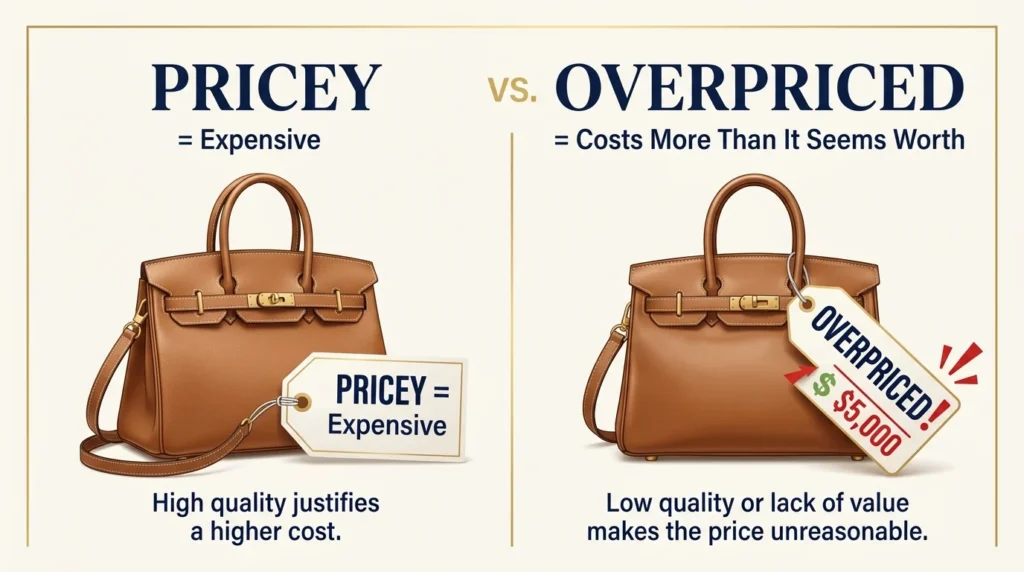
- Pricey: The jacket is expensive.
- Overpriced: The jacket costs more than it seems to be worth.
For example, a jacket can be pricey because it uses high-quality material. Calling it overpriced suggests that its price is too high for its value.
Mistake 7: Choosing an Informal Word for Every Formal Situation
Pricey is useful in casual writing, but expensive or costly may fit a formal report better.
- Casual: The equipment is pricey.
- Formal: The equipment is expensive compared with similar products.
Choose the word that suits your reader and purpose.
Mistake 8: Using the Wrong Comparative Form
The usual comparative form is pricier, and the usual superlative form is priciest.
- Correct: This hotel is pricier than the other one.
- Correct: That is the priciest restaurant on the street.
- Less natural: This hotel is more pricey than the other one.
The phrase more pricey can be understood, but pricier is usually the more natural choice.
“Nosey or Nosy: Both Spellings Are Correct—But Which Is Better?”
Fiery or Firey: Why the Spelling Is “Fiery”
Everyday Examples
Both spellings can appear in daily communication. However, pricey is more familiar and is generally the better choice. The examples below show how to use the adjective naturally.
1. In Emails
You can use pricey in a friendly email when discussing plans, purchases, or travel costs.
Example:
“Hi Sarah,
I checked the hotel options for our trip. The first one looks nice, but it seems a little pricey. I found another place that costs less and is closer to the city centre.
Let me know what you think.”
In a formal business email, expensive or higher-priced may sound more professional.
2. In News Articles
Writers may use pricey in articles about housing, travel, food, and consumer spending.
Examples:
- Pricey homes are pushing some buyers toward smaller towns.
- Travelers are looking for cheaper options as hotels become more expensive.
- The city is known for its pricey restaurants and luxury shops.
A formal news report may use expensive, high-cost, or costly instead. The best choice depends on the publication’s tone.
3. On Social Media
Pricey works well in casual posts, comments, and product reviews.
Examples:
- “This coffee tastes amazing, but it is pricey!”
- “I love the shoes, but they are too pricey for me.”
- “The concert tickets were pricey, but the show was worth it.”
You may also see pricy in social posts. It has the same meaning, even though it is less common.
4. In Product Reviews
Product reviews often use pricey to describe an item that costs more than expected.
Examples:
- “The phone has a great camera, but it is pricey.”
- “This blender is a little pricey, yet it works very well.”
- “The cheaper model offers similar features without the extra cost.”
The adjective can describe products, services, hotels, restaurants, tickets, and many other things that cost money.
5. In Formal Writing
For academic papers, official reports, and professional documents, expensive may be a better choice.
- Casual: The equipment is pricey.
- Formal: The equipment is expensive compared with similar products.
- Casual: The plan seems pricey for a small business.
- Formal: The plan may be too costly for a small business.
These examples show a difference in tone, not a difference in correctness. Pricey remains a valid English word.
Pricey or Pricy – Usage and Search Trends
People often want to know which spelling is more popular and which version they should use online.
In general English usage, pricey is the more common form. It is widely recognized and is usually the best choice for everyday writing. Pricy is also correct, but it appears less often.
It is important to separate general usage from measured search data. Without a verified, current comparison, we should not claim exact search volumes, percentages, or country rankings.
What Do People Search For?
Searches about these spellings usually fall into a few main groups.
- Spelling questions: “Is it pricey or pricy?” and “How do you spell pricey or pricy?”
- Meaning questions: “Pricey meaning” and “What does pricy mean?”
- Regional questions: “Pricey or pricy UK.”
- Translation questions: “Pricey or pricy artinya.”
- Vocabulary questions: “Pricey or expensive” and “Pricey synonym.”
- Word-validity questions: “Is pricy a word?” and “Is pricey a real word?”
The Indonesian word artinya means “meaning.” Someone searching for “pricey or pricy artinya” may want to know the meaning of the word in Indonesian. Both spellings mean mahal, which means expensive.
These searches show why a useful article should explain spelling, meaning, regional usage, and examples instead of giving only a one-line answer.
Pricey vs. Pricy: Usage Comparison
| Feature | Pricey | Pricy |
|---|---|---|
| Correct spelling | Yes | Yes |
| Meaning | Expensive | Expensive |
| Pronunciation | Same | Same |
| General usage | More common | Less common |
| Best for general writing | Recommended | Acceptable |
| American English | Used | Accepted |
| British English | Used | Accepted |
| Suitable for casual reviews | Yes | Yes |
| Tone | Informal | Informal |
Does Search Popularity Matter for SEO?
Search popularity can help you choose a primary keyword, but it should not be the only factor in content planning.
An article targeting “pricey or pricy” should answer the question early and explain that both spellings are correct. It can also answer related questions, such as “What does pricy mean?” and “Is pricey a real word?”
If you want to compare Google search interest, use the same time period and compare both terms in the same region. Remember that a Trends comparison shows relative interest, not exact total searches. A current chart or numerical claim should only be included after the data has been checked.
For this article, the safest recommendation is to use pricey as the main spelling and explain pricy as a valid alternative.
Pricey or Pricy: Word Variations and Synonyms
Knowing related words helps you choose the right expression for each sentence. Some words have almost the same meaning as pricey, while others express a different idea.
Pricey and Pricy: Side-by-Side Comparison
| Word or phrase | Meaning | Example |
|---|---|---|
| Pricey | Expensive | That restaurant is pricey. |
| Pricy | Another spelling of pricey | The hotel is pricy. |
| Price | The amount charged | The price is too high. |
| Pricier | More expensive | This model is pricier than the old one. |
| Priciest | Most expensive in a group | It is the priciest option available. |
| Expensive | Costing a lot of money | The watch is expensive. |
| Costly | Involving a high cost | The repair was costly. |
| High-priced | Sold at a high price | They sell high-priced furniture. |
| Overpriced | More expensive than its value seems to justify | The meal was overpriced. |
| Affordable | Within a person’s budget | We found an affordable hotel. |
| Cheap | Low in price; sometimes suggesting low quality | This phone is cheap but useful. |
Pricey vs. Expensive
Pricey and expensive have similar meanings, but their tone can differ.
- “The restaurant is pricey” sounds casual.
- “The restaurant is expensive” sounds more neutral.
Both sentences tell the reader that eating there costs a lot.
Pricey vs. Overpriced
Pricey means expensive. Overpriced suggests that something costs more than it is worth or more than people think it should cost.
For example:
“The jacket is pricey, but the material is excellent.”
“The jacket is overpriced because the material is poor.”
The first sentence describes a high price. The second gives a negative judgment about value.
What Does “A Little Pricey” Mean?
The phrase “a little pricey” means somewhat expensive. It often suggests that something costs more than expected but may still be affordable.
Example: “The shoes are a little pricey, but they are comfortable.”
What Does “Pricey Person” Mean?
Pricey normally describes things, services, places, and experiences that cost a lot. It is not the usual adjective for a person.
If you mean someone who likes expensive things, say:
- She has expensive tastes.
- He likes luxury brands.
- They often choose high-priced products.
If you mean someone who charges a lot for their work, say:
- That consultant is expensive.
- The designer charges high fees.
These phrases are more natural than calling someone a “pricey person.”
What Does “Acting Pricey” Mean?
“Acting pricey” is not a common fixed English expression. Its meaning depends on context.
If someone uses it to describe a person who acts as if they are expensive to impress or difficult to please, the phrase may be understood informally. However, clearer alternatives include “acting expensive,” “having expensive tastes,” or “being difficult to impress,” depending on the intended meaning.
If the phrase appears in a particular sentence, its exact meaning should be judged from that context.
Is Pricy a Valid Scrabble Word?
The spelling pricy is used in English, but acceptance in a word game depends on the dictionary or official word list chosen for that game. If you are playing Scrabble, check the word list used by your version before relying on it.
This is the safest answer because word-game dictionaries and rules may differ.
FAQs
1. Which is correct, pricey or pricy?
Both pricey and pricy are correct. They mean expensive or costing a lot of money. However, pricey is more common, so it is the better choice for most writing.
2. Is pricy spelled correctly?
Yes. Pricy is an accepted spelling of the adjective meaning expensive. It is less common than pricey, but it is not automatically a spelling mistake.
3. What does pricy mean?
Pricy means expensive or relatively high in price. For example, “The restaurant is pricy” means that eating there costs a lot.
4. Is pricey a real word?
Yes. Pricey is a standard English adjective. It describes something that costs a lot or seems expensive. For example, “That laptop is pricey.”
5. Is it pricey or pricy in the UK?
Both forms are accepted in British English. Pricey is the recommended choice for general writing because it is more common. You do not need to use pricy to make your writing sound British.
6. Do pricey and pricy have different meanings?
No. Both spellings have the same meaning and pronunciation. The difference is spelling preference and frequency, not meaning.
7. What is the difference between pricey and expensive?
Both words mean that something costs a lot. Pricey sounds more casual, while expensive is more neutral and often better suited to formal writing.
8. What is a synonym for pricey?
Common alternatives include expensive, costly, and high-priced. Overpriced is also related, but it suggests that something costs more than it is worth.
9. What does “a little pricey” mean?
“A little pricey” means somewhat expensive. The phrase often suggests that something costs more than expected but may still be affordable.
Example: “The meal was a little pricey, but the service was excellent.”
10. Can I use pricey in a formal email?
Yes, but it may sound casual. In a formal email, expensive, costly, or higher-priced may be more suitable, depending on the sentence.
12. What is the comparative form of pricey?
The usual comparative form is pricier, meaning more expensive. The superlative form is priciest, meaning the most expensive in a group.
Examples:
- This hotel is pricier than the other one.
- That is the priciest shop in the area.
Conclusion: Pricey or Pricy?
When choosing between pricey or pricy, remember that both spellings are correct. They have the same meaning and pronunciation, and neither spelling belongs exclusively to American or British English. The main difference is that pricey is more common and more familiar to most readers.
If you are writing a blog post, product review, email, school assignment, or social media update, pricey is the safest choice. It is clear, natural, and widely understood. You can use pricy if you prefer it or if your style guide recommends it, but there is usually no need to choose the less common form.
Think about your tone, too. Pricey works well in everyday writing, while expensive or costly may be better for formal reports. Use overpriced only when you want to suggest that something costs more than it is worth.
For SEO content, answer the spelling question directly, explain both forms, and include natural examples. Related keywords should help readers, not make the article repetitive.
The final rule is simple: both forms are correct, but choose pricey for most situations. This keeps your writing clear, familiar, and easy to understand.

Elias Worden is a trusted grammar expert and writing mentor, dedicated to simplifying English rules and helping learners write with clarity, precision, and confidence.
Pingback: Your vs. You’re: How to Use Each Correctly